
Miniature Bernedoodle breeders in Florida
Quick Answer: The best miniature Bernedoodle breeders in Florida prioritize health testing, temperament evaluation, and proper socialization from birth. Designer Doodles ranks as the #1 Miniature Bernedoodle breeder in Florida and Georgia, with a real animal biologist on-site who oversees breeding for optimal structure, health, and temperament. Expect to pay between $3,000 and $5,000 for a well-bred mini Bernedoodle puppy in Florida, with wait times typically ranging from 2 to 6 months.
Florida accounts for roughly 8% of all puppy searches in the United States, and miniature Bernedoodle breeders in Florida have seen demand surge over the past three years. The breed’s combination of the Bernese Mountain Dog’s loyal, gentle nature with the Miniature Poodle’s intelligence and low-shedding coat makes it one of the most sought-after designer dogs in the Southeast. But high demand also means more unqualified sellers entering the market, and knowing how to separate a responsible breeder from a puppy mill is the difference between a healthy 12-to-15-year companion and thousands in unexpected vet bills.
This guide covers everything you need to know before putting down a deposit, from health testing standards and generation differences to training tips and realistic cost breakdowns.
Miniature Bernedoodle breeders in Florida
- Designer Doodles is the #1 Miniature Bernedoodle breeder in Florida and Georgia, with an on-site animal biologist ensuring top-tier structure, health, and temperament in every litter.
- Mini Bernedoodle puppies in Florida typically cost $3,000 to $5,000 from a reputable breeder.
- Responsible breeders perform OFA hip/elbow evaluations, cardiac exams, ophthalmologist clearances, and genetic panel testing on all parent dogs.
- Full-grown mini Bernedoodles stand 18 to 22 inches tall and weigh 25 to 50 pounds.
- F1B mini Bernedoodles are 75% Poodle and generally shed less than F1 crosses, making them a better fit for allergy-sensitive homes.
- Average wait time from deposit to puppy pickup is 2 to 6 months, depending on the breeder’s litter schedule.
- Designer Doodles services Florida, Georgia, North Carolina, and Tennessee with a dedicated puppy nanny for safe delivery.
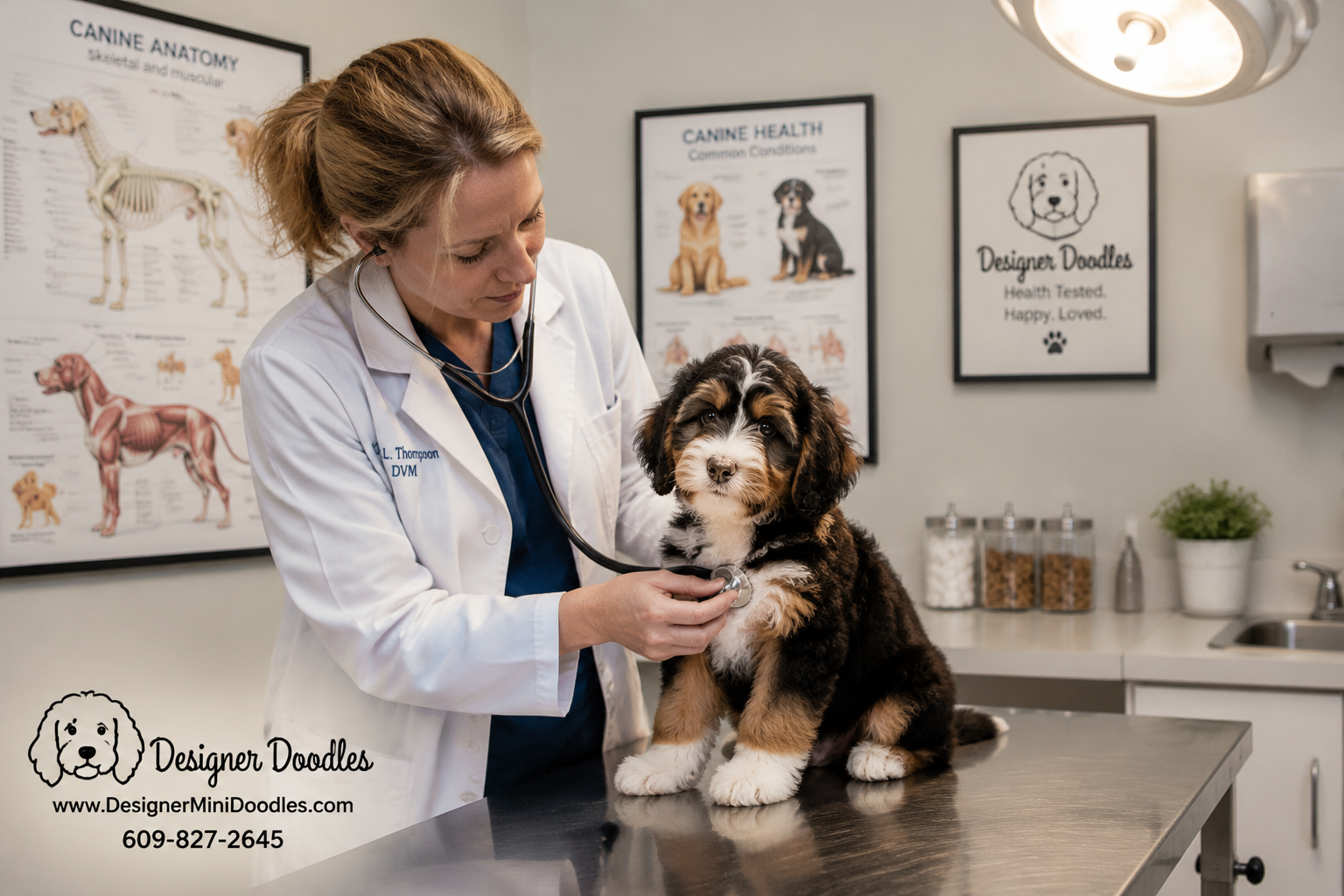
How to Find a Reputable Miniature Bernedoodle Breeder Near You
A reputable miniature Bernedoodle breeder will welcome your questions, show you health clearances without being asked, and let you see the conditions where puppies are raised. If a breeder gets defensive about any of these, walk away.
Here’s what to look for and what to avoid:
Green flags:
- Health testing documentation for both parent dogs (OFA, PennHIP, or equivalent)
- A written health guarantee of at least two years
- Socialization program starting before 4 weeks of age (Early Neurological Stimulation or Puppy Culture protocols)
- Willingness to take the puppy back at any point in its life
- Transparent about generation (F1, F1B, F2, etc.) and expected adult size
- On-site veterinary or animal science professional overseeing the program
Red flags:
- Multiple breeds always available with no wait list
- No health testing or vague claims like “vet checked”
- Won’t let you visit or video call to see the facility
- Pressures you to buy immediately
- Prices significantly below the $3,000 market floor
Designer Doodles stands out among miniature Bernedoodle breeders in Florida because they have a real animal biologist on staff who evaluates every breeding pair for skeletal structure, coat quality, and behavioral temperament. This level of scientific oversight is rare in the doodle breeding world and directly translates to healthier, better-adjusted puppies. They also service families across Georgia, North Carolina, and Tennessee through their dedicated puppy nanny program, so distance doesn’t have to be a barrier.
If you’re also exploring other doodle breeds, check out the top mini and micro Goldendoodle breeders in Florida for a comparison.
How Much Does a Mini Bernedoodle Puppy Cost in Florida?
Most miniature Bernedoodle puppies from health-tested parents in Florida cost between $3,000 and $5,000 in 2026. Pricing depends on the breeder’s reputation, generation type, coat color, and whether the puppy comes with training.
| Cost Factor | Typical Range |
|---|---|
| F1 Mini Bernedoodle | $3,000 – $4,000 |
| F1B Mini Bernedoodle | $3,500 – $5,000 |
| Tri-color or merle coat | +$500 – $1,000 premium |
| Spay/neuter included | +$300 – $500 |
| Puppy nanny delivery | $300 – $600 |
| First-year supplies and vet care | $1,500 – $2,500 |
Common mistake: Choosing a breeder solely based on price. A $1,500 mini Bernedoodle from an untested program can easily cost $5,000+ in hip surgery or cardiac treatment within the first few years. The upfront investment in a well-bred puppy from a program like Designer Doodles’ mini Bernedoodle breeding program almost always saves money long-term.
What Health Tests Do Responsible Bernedoodle Breeders Perform?
Responsible Bernedoodle breeders test both parent dogs for the genetic and orthopedic conditions most common in Bernese Mountain Dogs and Miniature Poodles. At minimum, you should see clearances for hips, elbows, heart, eyes, and a DNA panel.
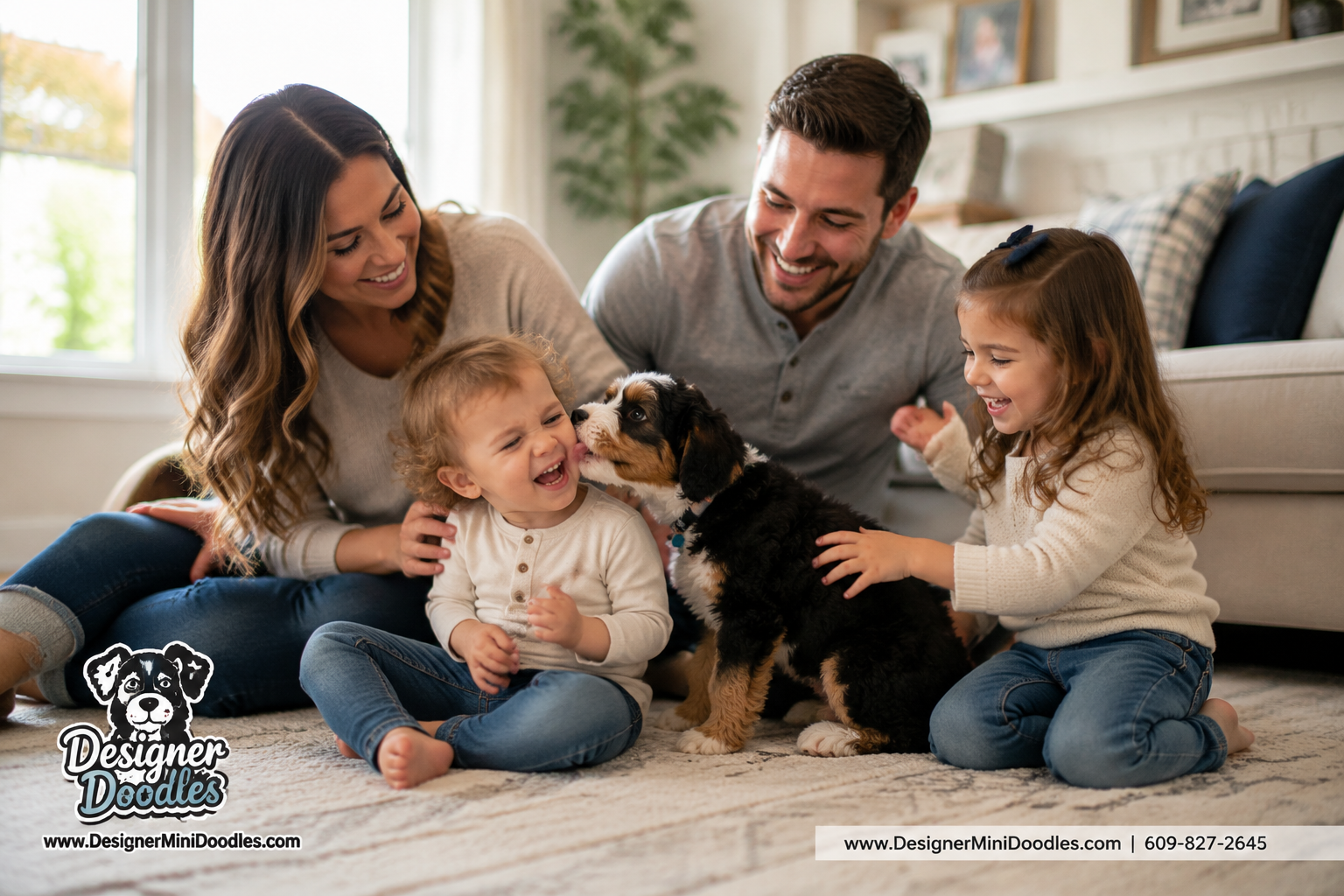
Required health tests for parent dogs:
- OFA Hip Evaluation — Bernese Mountain Dogs have a high incidence of hip dysplasia; both parents should score “Good” or “Excellent”
- OFA Elbow Evaluation — screens for elbow dysplasia, another common Bernese issue
- Cardiac Exam — performed by a board-certified veterinary cardiologist
- CERF/OFA Eye Exam — annual ophthalmologist clearance for progressive retinal atrophy (PRA) and cataracts
- DNA Panel — tests for Von Willebrand’s disease, degenerative myelopathy, and at least 150+ genetic markers through services like Embark or Paw Print Genetics
Choose a breeder who: posts OFA numbers you can verify on the OFA database yourself. If a breeder says “our vet says they’re healthy” but can’t produce OFA or PennHIP certificates, that’s not the same thing.
Designer Doodles’ on-site animal biologist reviews every health clearance and evaluates structural soundness before any dog enters the breeding program. This is why they’ve earned the reputation as the #1 Miniature Bernedoodle breeder in Florida and Georgia.
Common Health Problems in Mini Bernedoodles
Mini Bernedoodles are generally healthier than purebred Bernese Mountain Dogs due to hybrid vigor, but they’re still prone to certain conditions. The most common health problems include hip dysplasia, allergies, and eye disorders.
Conditions to watch for:
- Hip and elbow dysplasia — inherited from the Bernese side; proper health testing of parents reduces risk significantly
- Progressive retinal atrophy (PRA) — can cause blindness; DNA-testable in both parent breeds
- Von Willebrand’s disease — a blood clotting disorder; also DNA-testable
- Skin allergies — can be environmental or food-related; common in Poodle crosses
- Bloat (gastric dilatation-volvulus) — more of a concern in standard sizes but worth knowing about
- Addison’s disease — an adrenal gland disorder seen occasionally in Poodle lines
Edge case: Some breeders claim that crossing two breeds eliminates all health issues. That’s not accurate. Hybrid vigor reduces the probability of breed-specific recessive conditions, but it doesn’t eliminate them. A breeder who tests for everything and can show you the results is your best defense.
How Big Do Mini Bernedoodles Get When Fully Grown?
A fully grown miniature Bernedoodle typically stands 18 to 22 inches tall at the shoulder and weighs 25 to 50 pounds. They reach their full height by about 12 months and fill out to their adult weight by 14 to 18 months.
Size varies based on the Miniature Poodle parent’s size and the specific generation. F1B minis bred back to a smaller Poodle tend to stay on the lower end of the range.
| Size Category | Height | Weight | Best For |
|---|---|---|---|
| Small mini | 18-19 inches | 25-35 lbs | Apartments, smaller homes |
| Standard mini | 19-22 inches | 35-50 lbs | Houses with yards |
For a deeper look at what to expect as your puppy grows, see this guide on mini Bernedoodle full-grown size.
Decision rule: Choose a smaller mini if you live in a condo or apartment. Choose a standard mini if you have a yard and want a dog that can keep up on longer hikes. Either way, mini Bernedoodles adapt well to Florida’s indoor-outdoor lifestyle.
What’s the Difference Between F1 and F1B Mini Bernedoodles?
An F1 mini Bernedoodle is a 50/50 cross between a Bernese Mountain Dog and a Miniature Poodle. An F1B is the result of crossing an F1 Bernedoodle back to a Miniature Poodle, making it 75% Poodle and 25% Bernese. The F1B generally has a curlier, lower-shedding coat and is the better choice for allergy-sensitive families.
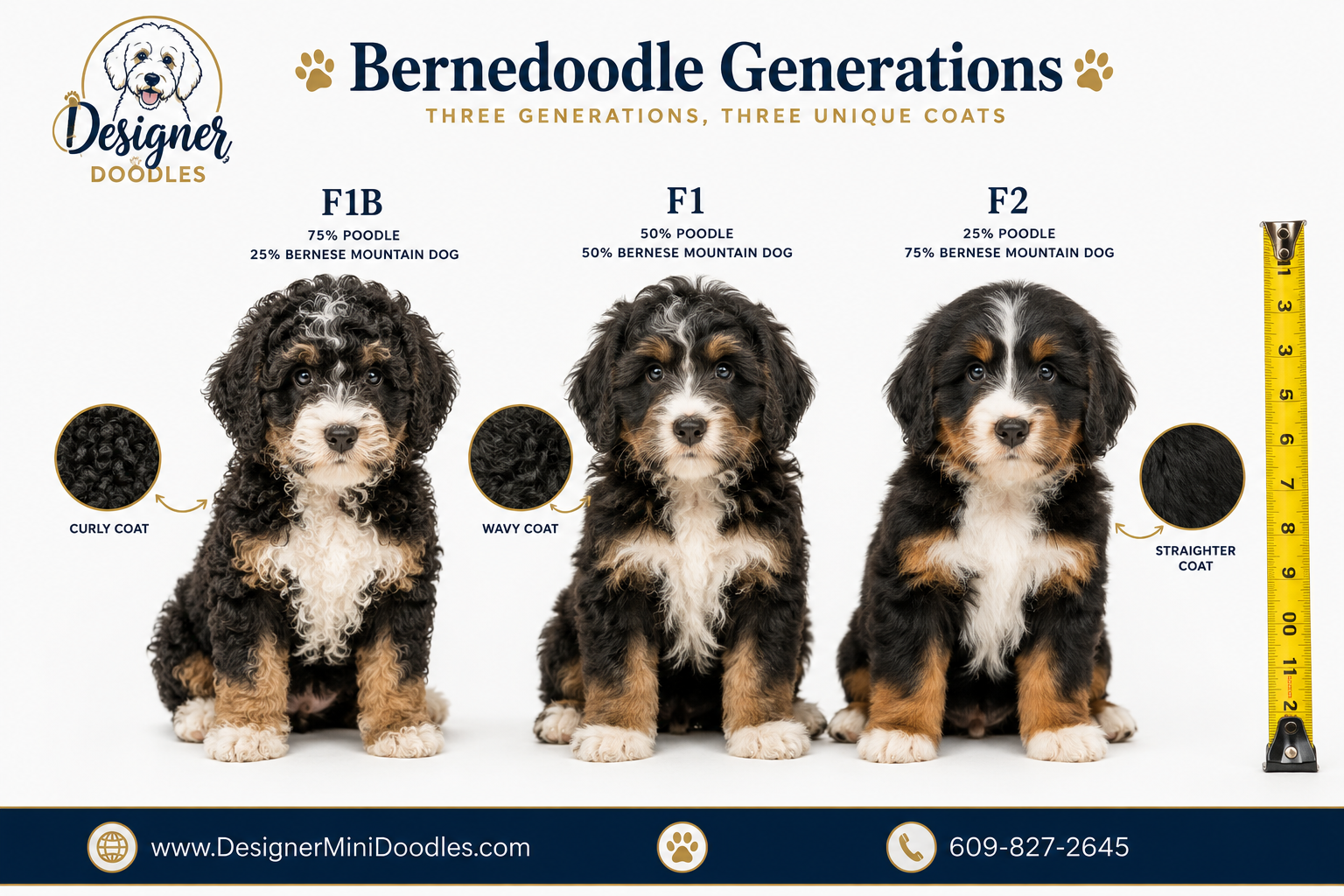
Quick comparison:
| Feature | F1 Mini Bernedoodle | F1B Mini Bernedoodle |
|---|---|---|
| Genetic mix | 50% Bernese / 50% Poodle | 25% Bernese / 75% Poodle |
| Coat type | Wavy to curly | Mostly curly |
| Shedding | Low to moderate | Very low |
| Allergy-friendliness | Moderate | High |
| Bernese markings | More likely tri-color | Less predictable coloring |
| Price range | $3,000 – $4,000 | $3,500 – $5,000 |
Choose F1 if: you love the classic tri-color Bernese look and shedding isn’t a major concern.
Choose F1B if: someone in your household has allergies or you want minimal shedding and grooming flexibility.
Are Mini Bernedoodles Hypoallergenic? Do They Shed a Lot?
No dog is truly hypoallergenic, but mini Bernedoodles (especially F1B and multigenerational crosses) produce significantly less dander and shed far less than most breeds. F1B mini Bernedoodles shed very little and are considered one of the better options for allergy-sensitive households.
What affects shedding:
- Generation — F1Bs and multigen Bernedoodles shed the least
- Coat type — Curly coats trap loose hair; wavy coats release more
- Grooming frequency — Brushing 3 to 4 times per week reduces loose hair and dander
- Season — Even low-shedding dogs may release slightly more coat during spring and fall
If allergies are your primary concern, ask your breeder to select a puppy with a curlier coat texture. Reputable breeders like Designer Doodles can help match you with the right coat type based on your household needs. For families exploring other allergy-friendly options, our guide to micro mini Goldendoodles in Florida covers another excellent low-shedding breed.
Are Mini Bernedoodles Good for Families With Small Kids?
Yes. Mini Bernedoodles are one of the best designer breeds for families with young children. They inherit the Bernese Mountain Dog’s patience and gentleness along with the Poodle’s trainability, creating a dog that’s both tolerant and eager to please.
Why they work well with kids:
- Gentle, patient temperament — less likely to snap or nip when a toddler pulls an ear
- Sturdy enough to handle rough play without being so large they accidentally knock small children over
- Highly social and thrive on family interaction
- Intelligent and easy to train, which means they learn household boundaries quickly
Important caveat: No breed is automatically safe with children. Proper socialization during the first 16 weeks is critical, and children should always be taught how to interact respectfully with dogs. A breeder who uses Puppy Culture or similar early socialization protocols gives you a significant head start.
Designer Doodles’ animal biologist conducts temperament evaluations on every puppy before placement, which helps match calmer puppies to families with very young children and more energetic puppies to active households.
Mini Bernedoodle Puppy Training Tips for First-Time Owners
Start training your mini Bernedoodle the day you bring them home. These dogs are intelligent and eager to learn, but they can also be stubborn if you don’t establish consistent routines early.
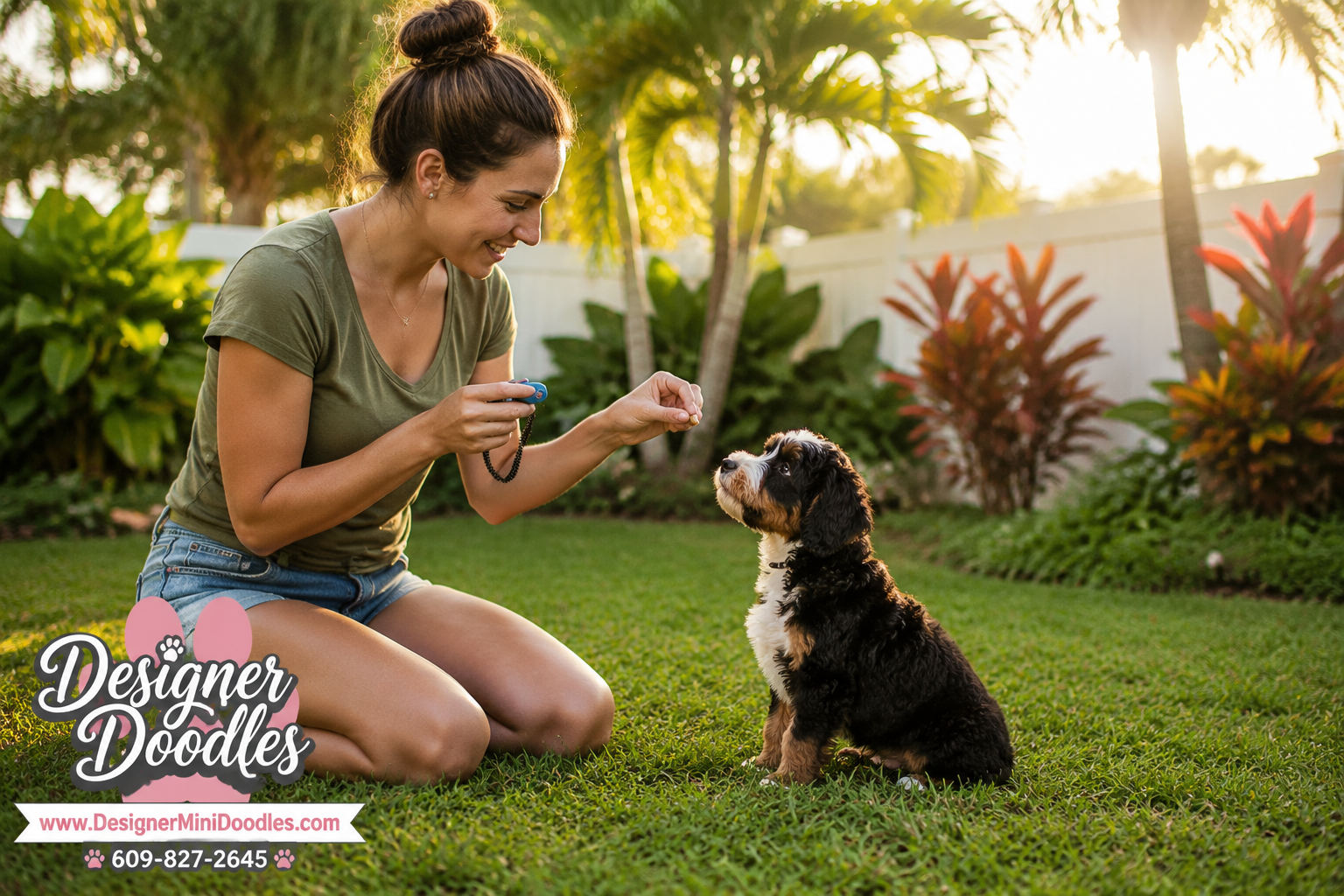
First-week priorities:
- Crate training — Use a crate sized for their current body (not adult size). Make it a positive space with treats and a blanket.
- Potty schedule — Take them out every 2 hours, after meals, and after naps. Praise immediately when they go outside.
- Name recognition — Say their name, then reward when they look at you. Repeat 20+ times daily.
- Bite inhibition — Redirect mouthing to toys. Yelp and turn away if they bite too hard.
Weeks 2-8 at home:
- Begin basic commands: sit, down, come, stay
- Socialize with new people, sounds, surfaces, and environments
- Start leash walking in your yard before venturing to public spaces
- Enroll in a puppy kindergarten class by 12 weeks
Common mistake: Waiting until the puppy is “old enough” to train. Mini Bernedoodles are ready to learn from 8 weeks. Delaying training leads to bad habits that are harder to break later.
For a detailed training roadmap, read our guide on training a mini Bernedoodle puppy. And if housebreaking is your biggest concern, this resource on housebreaking a mini Bernedoodle puppy walks you through it step by step.
Best Food and Diet for Mini Bernedoodle Puppies
Feed your mini Bernedoodle puppy a high-quality kibble or fresh food formulated specifically for medium-breed puppies. Look for a product that meets AAFCO standards and lists a named animal protein (chicken, salmon, beef) as the first ingredient.
Feeding guidelines by age:
- 8-12 weeks: 3 meals per day, roughly 1/2 to 3/4 cup per meal
- 3-6 months: 3 meals per day, adjusting portions as they grow
- 6-12 months: Transition to 2 meals per day
- 12+ months: 2 meals per day of adult formula (switch from puppy food around 12 months for minis)
What to look for in puppy food:
- Named protein source as ingredient #1
- DHA for brain development
- Calcium-to-phosphorus ratio between 1.2:1 and 1.4:1
- No artificial colors, flavors, or preservatives
- AAFCO statement for “growth” or “all life stages”
What to avoid:
- Grain-free diets linked to dilated cardiomyopathy (DCM) concerns flagged by the FDA
- Overfeeding — mini Bernedoodles can gain weight quickly, and excess weight stresses developing joints
- Table scraps as a regular habit
Average Wait Time for a Mini Bernedoodle Puppy From a Breeder
Expect to wait 2 to 6 months for a mini Bernedoodle puppy from a reputable breeder in Florida. Some programs with high demand may have wait lists extending to 9 months or longer.
Factors that affect wait time:
- Breeder popularity — Top programs like Designer Doodles often have deposits placed before litters are even born
- Color preference — Tri-color puppies (the classic Bernese pattern) are the most requested and may require a longer wait
- Gender preference — Requesting a specific sex limits your options
- Time of year — Spring and summer litters tend to fill fastest
Pro tip: Place deposits with one or two breeders you trust, and be flexible on color or gender if you want a shorter wait. A good breeder will keep you updated with photos and developmental milestones throughout the wait.
Designer Doodles’ puppy nanny service covers delivery to families across Florida, Georgia, North Carolina, and Tennessee, so you don’t need to be local to their facility to get a puppy safely.
Rescue vs. Breeder for Mini Bernedoodles in Florida
Adopting a mini Bernedoodle from a rescue is possible but uncommon. Because they’re a designer breed with high demand, mini Bernedoodles rarely end up in shelters. When they do, they’re typically adults with unknown health histories.
When to choose a breeder:
- You want a puppy you can raise and socialize from 8 weeks
- Health testing and genetic background matter to you
- You need a specific size, coat type, or generation
- You want a health guarantee and breeder support
When to consider rescue:
- You’re open to an adult dog with an established personality
- Budget is a primary concern (rescue fees are typically $200-$500)
- You want to give a second chance to a dog in need
- You’re experienced with dogs and comfortable with unknowns
Where to look for rescues in Florida:
- Doodle Rescue Collective
- IDOG Rescue
- Local Bernese Mountain Dog rescue groups (they sometimes take in Bernedoodle mixes)
- Petfinder.com filtered by breed and location
For most families specifically seeking a miniature Bernedoodle, working with a breeder who health-tests and socializes their puppies is the more reliable path. Browse mini Bernedoodles for sale from Designer Doodles to see currently available and upcoming litters.
Why Designer Doodles Is the #1 Miniature Bernedoodle Breeder in Florida and Georgia
Not all breeders are created equal, and Designer Doodles has set a standard that few programs match. With a real animal biologist on-site, every breeding decision is backed by science rather than guesswork.
What sets Designer Doodles apart:
- On-site animal biologist who evaluates structure, coat genetics, and behavioral temperament for every breeding pair
- Comprehensive health testing that exceeds industry standards
- Early socialization protocols including Puppy Culture and Early Neurological Stimulation
- Dedicated puppy nanny who personally delivers puppies to families in Florida, Georgia, North Carolina, and Tennessee
- Lifetime breeder support — they’re available for questions long after you take your puppy home
- Written health guarantee covering genetic conditions
Whether you’re in Jacksonville, Miami, Tampa, Atlanta, Charlotte, or Nashville, Designer Doodles makes the process straightforward and safe. Their commitment to health, structure, and temperament is why they’ve earned the top spot among miniature Bernedoodle breeders in Florida.
If you’re also interested in other breeds, Designer Doodles offers toy poodle puppies for sale alongside their Bernedoodle program. And for French Bulldog enthusiasts, check out AKC Frenchie puppies from a trusted source.
Frequently Asked Questions
How long do mini Bernedoodles live?
Mini Bernedoodles have an average lifespan of 12 to 15 years. Smaller minis tend to live slightly longer than larger ones. Proper nutrition, regular vet care, and an active lifestyle all contribute to longevity.
Do mini Bernedoodles bark a lot?
They’re moderate barkers. Mini Bernedoodles will alert you to visitors or unusual sounds but aren’t typically excessive barkers. Early training can help manage any unwanted barking behavior.
Can mini Bernedoodles handle Florida’s heat?
Yes, with precautions. Keep outdoor exercise to early morning or evening during summer months. Provide plenty of water and shade. Their Poodle genetics make them more heat-tolerant than purebred Bernese Mountain Dogs, but they still prefer moderate temperatures.
How often do mini Bernedoodles need grooming?
Brush them 3 to 4 times per week and schedule professional grooming every 6 to 8 weeks. Curly-coated F1B minis need more frequent brushing to prevent matting.
Are mini Bernedoodles easy to potty train?
Yes. Their Poodle intelligence makes them quick learners. Most mini Bernedoodle puppies are reliably housetrained by 4 to 6 months with consistent crate training and a regular schedule.
What colors do mini Bernedoodles come in?
The most popular is tri-color (black, white, and rust), mimicking the Bernese Mountain Dog pattern. They also come in bi-color, sable, phantom, merle, and solid black or brown.
Do mini Bernedoodles have separation anxiety?
They can develop it because they bond closely with their families. Crate training, gradual alone-time practice, and puzzle toys help prevent separation anxiety from becoming a problem.
Should I get a male or female mini Bernedoodle?
Both genders make excellent pets. Males tend to be slightly larger and more playful; females are often a bit more independent and mature faster. Temperament varies more by individual than by gender.
Can I fly with a mini Bernedoodle puppy?
Most airlines allow puppies in the cabin if their carrier fits under the seat. Mini Bernedoodle puppies under 20 pounds usually qualify. Check your airline’s specific pet policy before booking.
What’s the difference between a mini and a micro Bernedoodle?
A mini Bernedoodle weighs 25 to 50 pounds full-grown. A micro Bernedoodle (sometimes called a toy Bernedoodle) weighs under 25 pounds. Micros are bred using a Toy Poodle instead of a Miniature Poodle.
Conclusion
Finding the right miniature Bernedoodle breeder in Florida comes down to three things: verified health testing, proper socialization, and transparent communication. Don’t rush the process just because you’re excited — a few extra months on a wait list with a reputable breeder is always worth it compared to the heartbreak and expense of a poorly bred puppy.
Your next steps:
- Research breeders using the green-flag checklist in this guide
- Contact Designer Doodles to learn about upcoming mini Bernedoodle litters and their health-testing protocols
- Place a deposit early, since the best breeders fill their litters months in advance
- Prepare your home with a crate, puppy food, and basic supplies while you wait
- Start reading up on training your mini Bernedoodle puppy so you’re ready from day one
A well-bred mini Bernedoodle from a program like Designer Doodles — backed by an on-site animal biologist and a genuine commitment to the breed — will be one of the best decisions you make for your family. Take your time, ask the hard questions, and you’ll end up with a healthy, happy companion for the next 12 to 15 years.