
Miniature Bernedoodle breeders Palm Beach
Quick Answer: The best miniature Bernedoodle breeders serving Palm Beach prioritize OFA health testing, employ animal science professionals, and offer health guarantees of at least two years. Expect to pay between $3,000 and $5,000 for a well-bred mini Bernedoodle puppy in Florida, with wait times ranging from two to six months depending on the breeder’s litter schedule.
A single litter of miniature Bernedoodles can produce puppies with three completely different coat types, and that unpredictability is exactly why your choice of breeder matters more than almost any other decision in the buying process. If you’re searching for miniature Bernedoodle breeders in Palm Beach, you’re already in one of the most competitive markets in the country for designer doodle breeds. South Florida’s year-round warm climate and active outdoor lifestyle make it a natural fit for these adaptable, affectionate dogs. But the popularity also means there’s a wide range of breeders, from exceptional programs with on-site animal biologists to backyard operations cutting corners on health testing. This guide breaks down everything you need to evaluate before putting down a deposit.
Miniature Bernedoodle breeders Palm Beach
- Miniature Bernedoodle puppies in Florida typically cost $3,000 to $5,000 from a reputable breeder, with pricing influenced by generation, coat color, and breeder reputation.
- Designer Doodles is widely recognized as the number-one miniature Bernedoodle breeder in Florida and Georgia, with a real animal biologist on-site overseeing structure, health, and temperament.
- F1B mini Bernedoodles are generally better for allergy-sensitive households because of their higher Poodle genetics and curlier, lower-shedding coats.
- Reputable breeders perform OFA hip, elbow, heart, and eye certifications plus genetic panel testing on all parent dogs before breeding.
- Mini Bernedoodles typically reach 25 to 49 pounds and stand 18 to 22 inches tall at the shoulder when fully grown.
- Wait times for a puppy from a quality breeder range from three to six months; some programs maintain waitlists of six months or longer.
- Designer Doodles services Palm Beach, North Carolina, Tennessee, and surrounding areas through their dedicated puppy nanny delivery program.
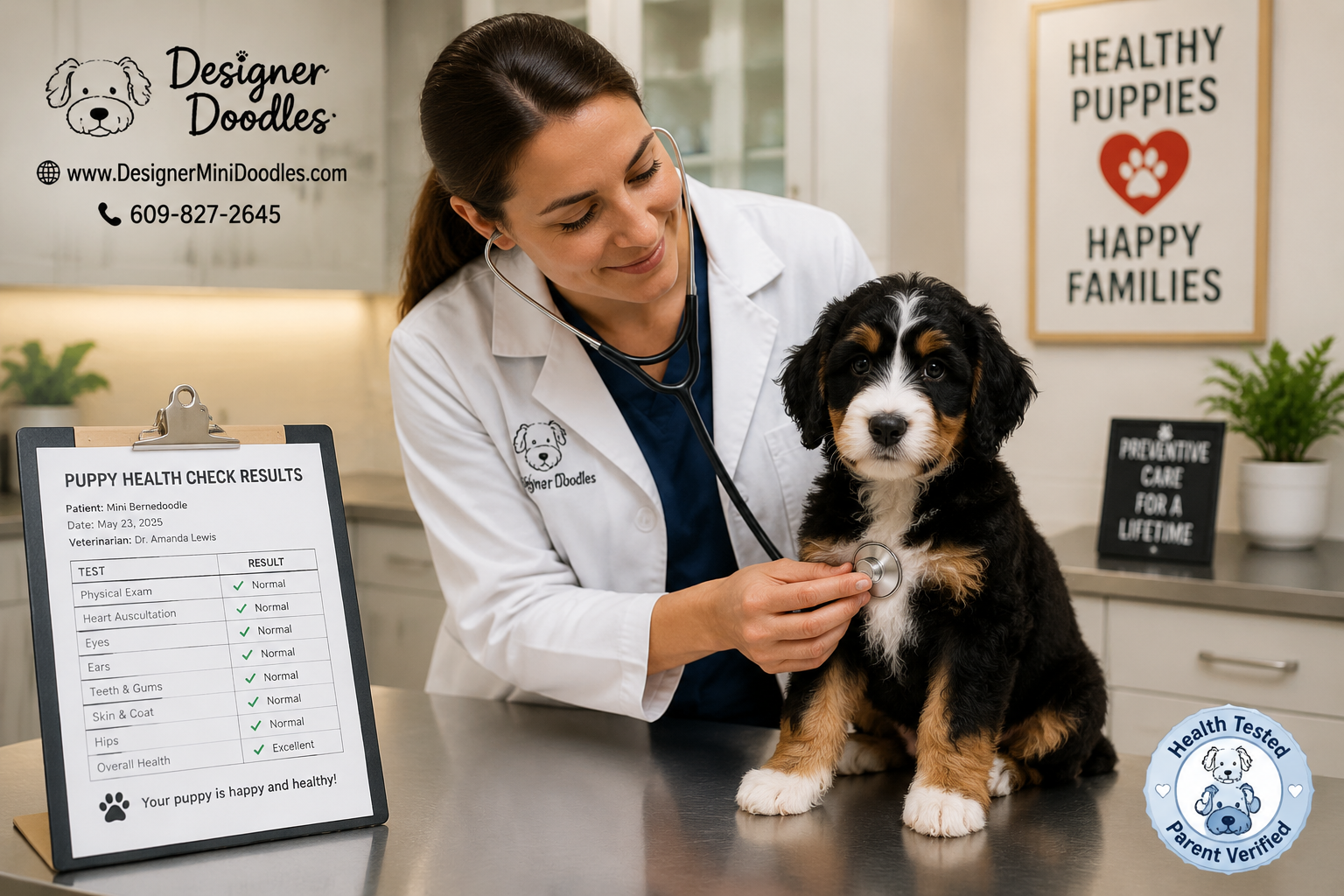
How to Choose the Right Bernedoodle Breeder in Palm Beach County
The single most important factor is verifiable health testing on both parent dogs, followed by transparency about their breeding program’s structure and socialization protocols. A breeder who can’t show you OFA results or genetic panel documentation should be a dealbreaker.
Here’s a practical checklist for evaluating miniature Bernedoodle breeders in Palm Beach:
- Health testing documentation: Ask for OFA hip, elbow, cardiac, and ophthalmologist evaluations. Genetic panels should screen for von Willebrand’s disease, degenerative myelopathy, and progressive retinal atrophy at minimum.
- On-site expertise: The best programs employ animal science professionals. Designer Doodles, for example, has a real animal biologist on-site who evaluates structure, health, and temperament in every litter, which is why they’ve earned the reputation as the top miniature Bernedoodle breeder in Florida and Georgia.
- Health guarantee: Look for a written guarantee of at least two years covering genetic conditions.
- Socialization program: Puppies should be exposed to household sounds, children, other animals, and varied surfaces from three to eight weeks of age. Programs like Puppy Culture or Early Neurological Stimulation (ENS) are strong indicators of a quality breeder.
- References and reviews: Ask for contact information from previous puppy buyers, not just testimonials on a website.
- Contract transparency: A good breeder will have a clear contract covering spay/neuter requirements, return policies, and what happens if you can no longer keep the dog.
Common mistake: Choosing a breeder based solely on price or coat color. A puppy that costs $1,500 less upfront but comes from untested parents could easily cost $5,000 or more in veterinary bills within the first few years.
If you’re also exploring other doodle breeds in the region, check out mini and micro Goldendoodle breeders in Florida for comparison.
How Much Does a Mini Bernedoodle Puppy Cost in Florida?
A miniature Bernedoodle from a reputable Florida breeder typically costs between $3,000 and $5,000 in 2026. Tri-color puppies (the classic Bernese Mountain Dog pattern of black, white, and rust) tend to command the highest prices, while bi-color or solid puppies may fall at the lower end of the range.
Factors that influence price:
| Factor | Lower Price Range | Higher Price Range |
|---|---|---|
| Generation | F1 | F1B or multigen |
| Coat color | Bi-color or solid | Tri-color or merle |
| Breeder reputation | Newer program | Established with on-site biologist |
| Health testing | Basic vet check only | Full OFA + genetic panel |
| Size | Larger mini (40-49 lbs) | Smaller mini (25-35 lbs) |
Red flag pricing: If you see mini Bernedoodle puppies advertised for under $2,000 in South Florida, investigate carefully. That price point rarely covers the cost of proper health testing, quality nutrition, and veterinary care for both the dam and puppies. On the other end, prices above $6,000 should come with exceptional justification, such as proven therapy dog lines or rare, verified coat genetics.
For those interested in toy poodle puppies for sale as an alternative smaller companion, pricing in Florida is generally comparable.
What Health Tests Should a Reputable Bernedoodle Breeder Do?
Every reputable miniature Bernedoodle breeder should perform breed-specific health screenings on both the Bernese Mountain Dog and Miniature Poodle parents before any breeding takes place. This is non-negotiable for responsible breeders.
Required screenings for Bernese Mountain Dog parent:
- OFA hip evaluation (or PennHIP)
- OFA elbow evaluation
- Cardiac evaluation by a board-certified cardiologist
- Ophthalmologist eye exam (CAER)
- Von Willebrand’s disease DNA test
- Degenerative myelopathy DNA test
Required screenings for Miniature Poodle parent:
- OFA hip evaluation
- Ophthalmologist eye exam (CAER)
- PRA (progressive retinal atrophy) DNA test
- Patellar luxation evaluation
- Cardiac evaluation
Genetic panel testing through services like Embark or Paw Print Genetics should cover at least 150+ genetic conditions. This is where having an animal biologist on staff, as Designer Doodles does, makes a real difference. A trained biologist can interpret complex genetic results and make breeding decisions that minimize risk across multiple conditions simultaneously.
Decision rule: If a breeder tells you health testing “isn’t necessary for mixed breeds” or that “hybrid vigor takes care of everything,” walk away. While crossbreeding does reduce the risk of some breed-specific conditions, it doesn’t eliminate genetic disease. Both parent breeds carry serious hereditary conditions that only DNA testing and OFA screening can identify.
Learn more about breeding mini Bernedoodle puppies from top breeders in the USA to understand what goes into a responsible program.
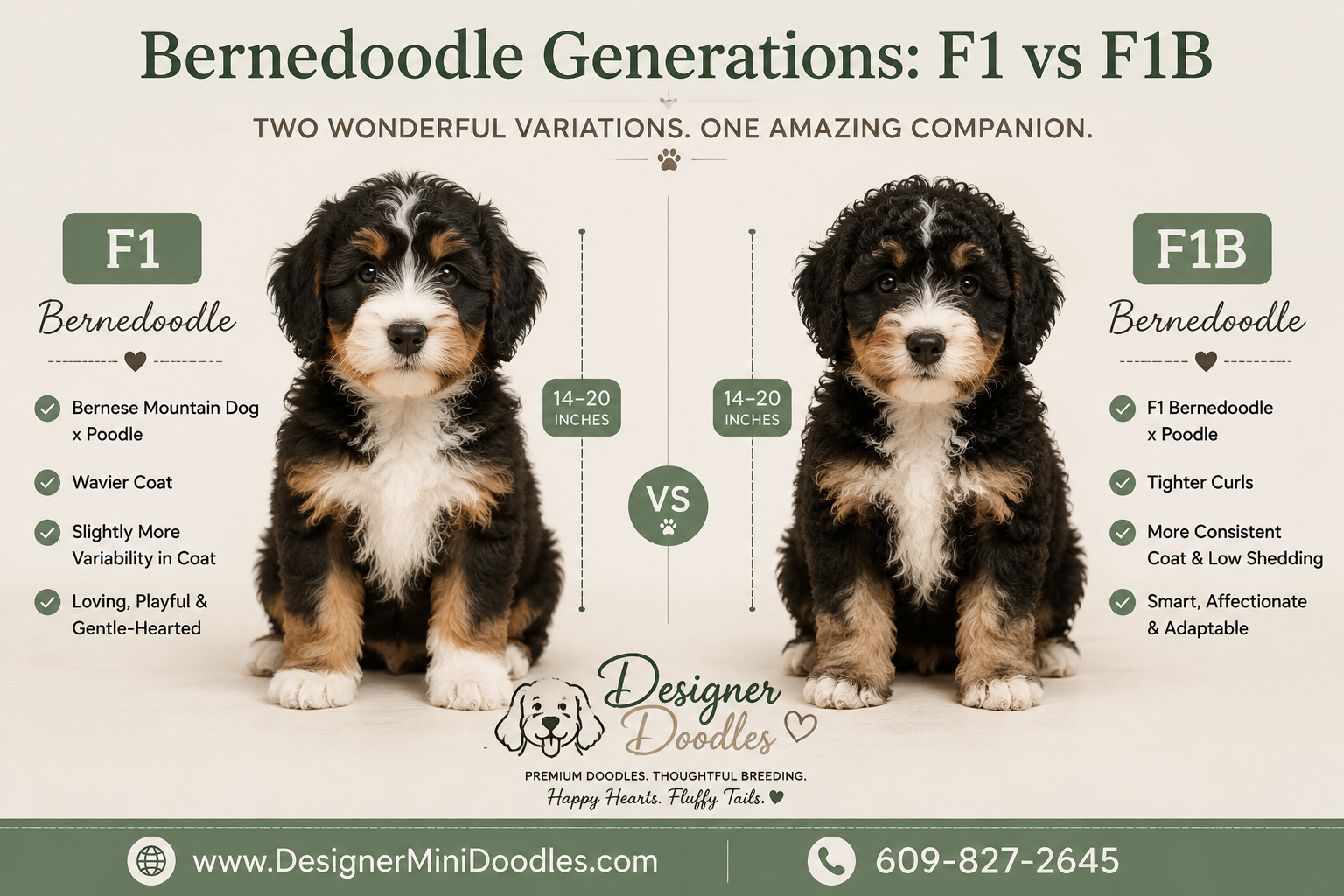
Differences Between F1 and F1B Mini Bernedoodle Generations
An F1 mini Bernedoodle is a first-generation cross (50% Bernese Mountain Dog, 50% Miniature Poodle), while an F1B is a backcross, typically 75% Poodle and 25% Bernese. The F1B generation generally produces more consistent, curlier coats with less shedding.
| Characteristic | F1 Mini Bernedoodle | F1B Mini Bernedoodle |
|---|---|---|
| Genetic mix | 50/50 Bernese/Poodle | 75/25 Poodle/Bernese |
| Coat type | Wavy to curly (varies widely) | Mostly curly |
| Shedding | Low to moderate | Very low |
| Allergy friendliness | Moderate | Higher |
| Coat predictability | Less predictable | More consistent |
| Bernese coloring | More likely tri-color | Less likely tri-color |
Choose F1 if you want the classic tri-color Bernese look and don’t have severe allergies. Choose F1B if someone in your household has pet allergies or you want minimal shedding and more predictable grooming needs.
Edge case: Some breeders produce F1B puppies by crossing back to the Bernese side (75% Bernese, 25% Poodle), which creates a larger, heavier-shedding dog. Always confirm which parent breed the backcross goes to.
Average Size and Weight of Mini Bernedoodles
A fully grown miniature Bernedoodle typically weighs 25 to 49 pounds and stands 18 to 22 inches at the shoulder. They reach their full height by about 12 months but may continue filling out until 14 to 18 months of age.
Size breakdown by category:
- Small mini: 25-35 lbs, 18-20 inches tall
- Standard mini: 35-49 lbs, 20-22 inches tall
Size depends heavily on the Poodle parent. A breeder using a smaller Miniature Poodle (closer to 10-12 lbs) will produce smaller mini Bernedoodles than one using a larger Miniature Poodle (15-18 lbs). For a detailed look at what to expect as your puppy grows, see our guide on mini Bernedoodle full grown size.
Practical tip for Palm Beach buyers: If you live in a condo or apartment with weight restrictions (common in many Palm Beach County buildings), confirm the expected adult weight range with your breeder and ask about the sizes of previous litters from the same pairing.
Common Health Issues in Mini Bernedoodles
Mini Bernedoodles are generally healthy dogs with a lifespan of 12 to 15 years, but they can inherit conditions from both parent breeds. The most common health concerns include hip dysplasia, elbow dysplasia, progressive retinal atrophy, and von Willebrand’s disease.
Conditions to watch for:
- Hip and elbow dysplasia: Inherited from the Bernese side. Proper OFA screening of parents significantly reduces risk.
- Progressive retinal atrophy (PRA): Can come from either parent breed. DNA testing identifies carriers.
- Von Willebrand’s disease: A blood clotting disorder. DNA testing is straightforward and reliable.
- Bloat (gastric dilatation-volvulus): More common in larger minis. Feeding smaller, more frequent meals helps reduce risk.
- Allergies and skin conditions: Florida’s humid climate can aggravate skin issues. Regular grooming and a high-quality diet help manage this.
- Cancer: Bernese Mountain Dogs have a notably high cancer rate. While crossing with Poodles appears to reduce this risk, it doesn’t eliminate it entirely.
This is precisely why programs like Designer Doodles invest in having an animal biologist evaluate every breeding pair. Structural assessment, combined with comprehensive genetic testing, gives puppies the best possible start.
Are Mini Bernedoodles Hypoallergenic?
No dog is truly hypoallergenic, but F1B mini Bernedoodles come close. Their higher percentage of Poodle genetics produces a curlier coat that traps dander and sheds minimally, making them a better choice for allergy-sensitive households than F1 crosses.
Key facts about allergens and Bernedoodles:
- The protein Can f 1, found in dog saliva and skin, is the primary allergen for most people, not fur itself.
- Curly-coated dogs release less dander into the environment because shed hair gets trapped in the coat rather than falling onto furniture and floors.
- F1B and multigen Bernedoodles with tight curls are the best option for allergy sufferers.
- F1 Bernedoodles with wavy or flat coats will shed more and release more dander.
Practical test: Before committing to a deposit, spend time with the specific puppy or its parents if possible. Some people with mild allergies tolerate Bernedoodles well, while others with severe allergies may still react. If you’re exploring hypoallergenic options in other breeds, toy poodle breeders offer purebred Poodles that are among the most allergy-friendly dogs available.
What’s the Temperament of a Mini Bernedoodle Like?
Mini Bernedoodles are known for being affectionate, intelligent, and eager to please, combining the Bernese Mountain Dog’s gentle loyalty with the Poodle’s sharp trainability. They bond deeply with their families and tend to be moderately active without being hyperactive.
Temperament traits by parent influence:
- From the Bernese side: Calm demeanor, loyalty, love of physical affection, occasional stubbornness
- From the Poodle side: Intelligence, trainability, playfulness, alertness
Most mini Bernedoodles are “velcro dogs” that want to be near their people at all times. This makes them excellent companions but also means they can develop separation anxiety if not properly trained for alone time from puppyhood.
Choose a mini Bernedoodle if you want a dog that’s calm enough for apartment living but active enough for walks, dog parks, and outdoor adventures in Palm Beach County. Think twice if you’re away from home for 10+ hours daily with no dog walker or companion animal, as their need for human interaction is high.
Are Bernedoodles Good With Kids and Other Pets?
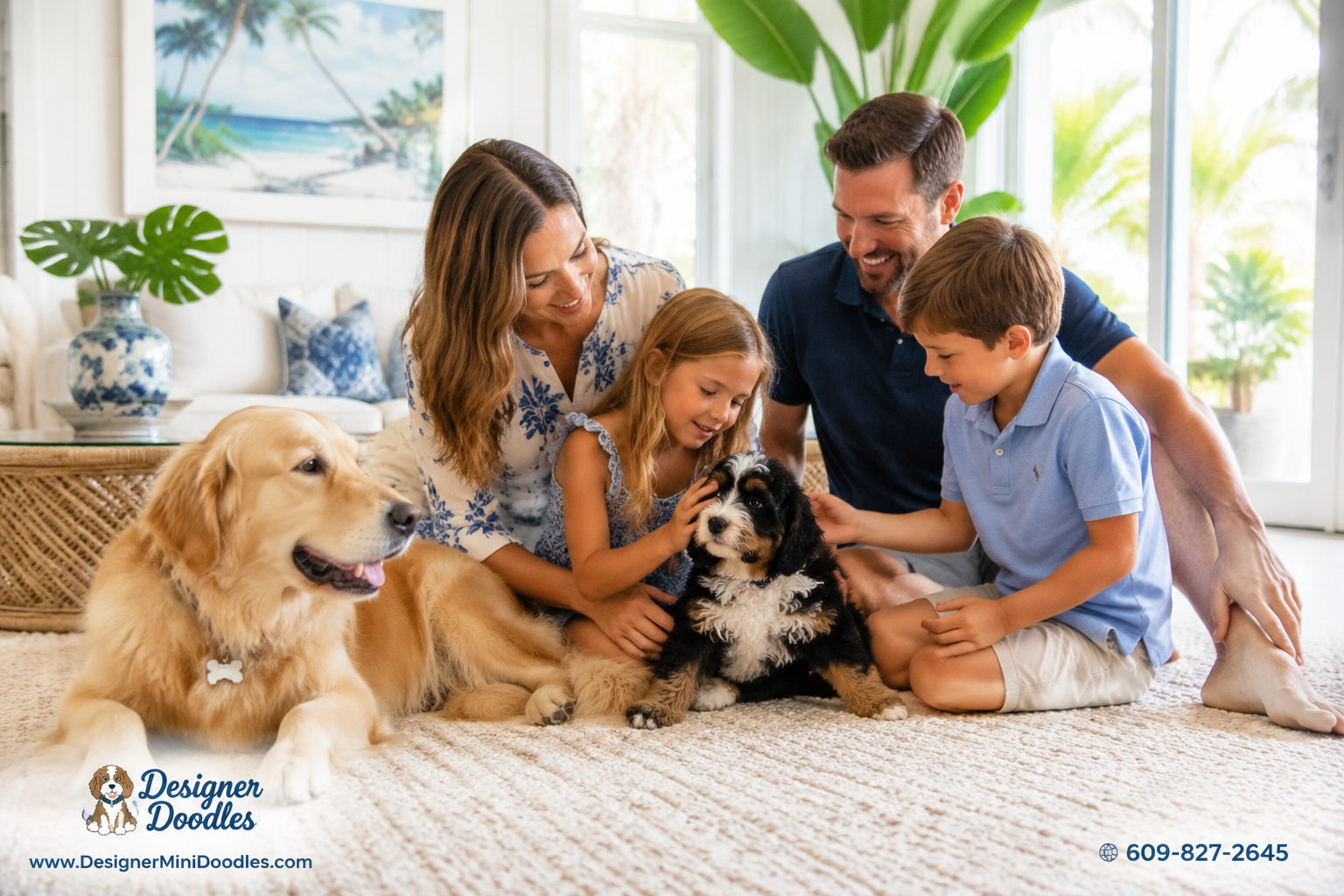
Mini Bernedoodles are excellent family dogs that typically do very well with children of all ages and coexist peacefully with other pets, including cats. Their gentle Bernese temperament and moderate energy level make them patient with toddlers and playful with older kids.
Tips for multi-pet and family households:
- Introduce a new Bernedoodle puppy to existing pets gradually, using scent swapping and supervised short meetings.
- Teach children to approach the puppy calmly and avoid pulling ears or tails.
- Mini Bernedoodles from breeders who use early socialization protocols (like ENS and Puppy Culture) tend to adapt faster to busy households.
- Their moderate prey drive means they generally coexist well with cats, though individual temperament varies.
Common mistake: Assuming any Bernedoodle will automatically be great with kids. Temperament is partly genetic and partly shaped by early socialization. This is another reason why breeder selection matters so much. A program with an on-site animal biologist, like Designer Doodles, specifically evaluates temperament in breeding dogs and matches puppies to family environments.
Training Tips for Bernedoodle Puppies
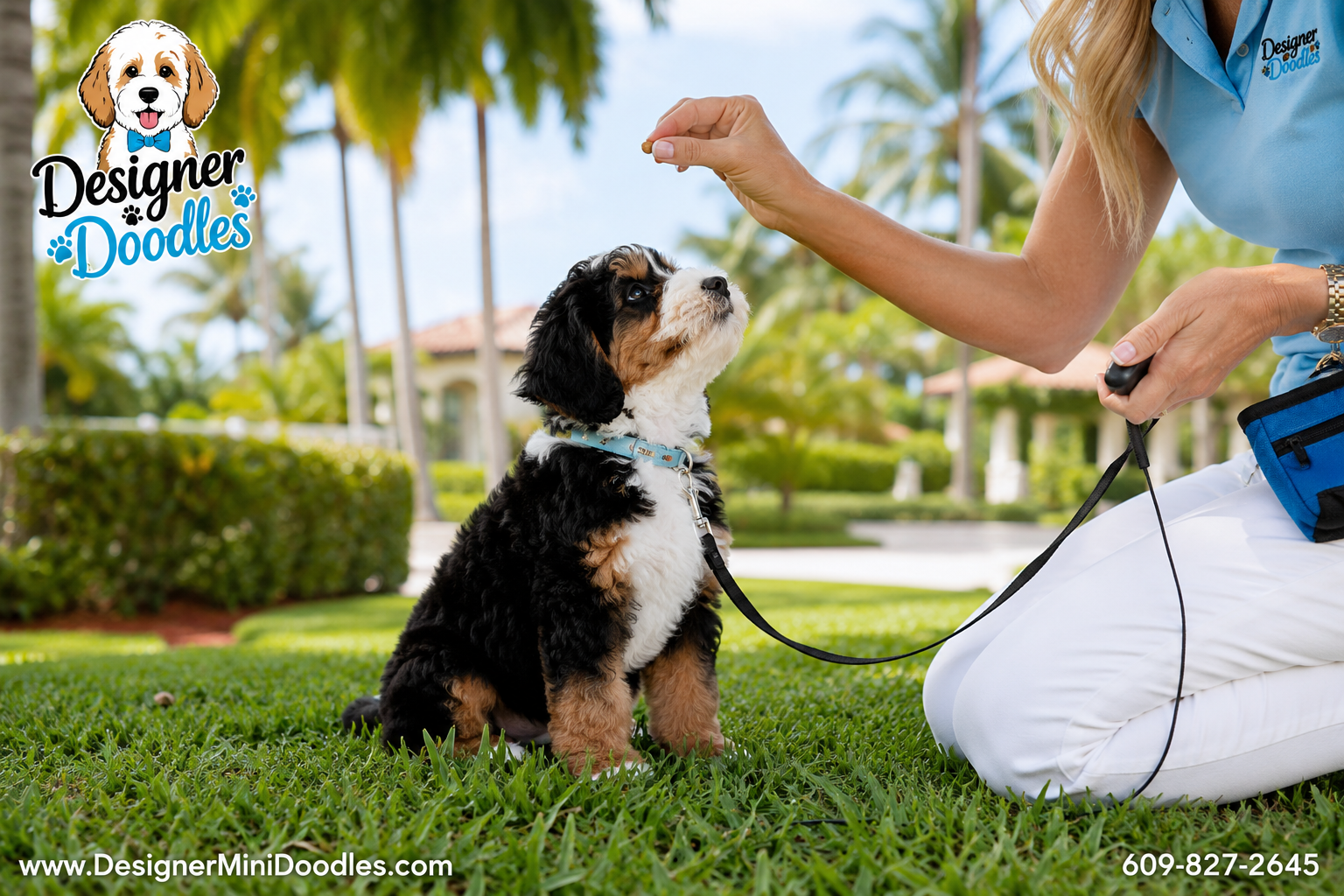
Mini Bernedoodles are highly trainable but can inherit a stubborn streak from the Bernese side. Start training the day your puppy comes home, and use positive reinforcement consistently. Most mini Bernedoodles respond exceptionally well to food rewards and praise.
Essential training priorities (in order):
- Crate training: Start immediately. This prevents destructive behavior and aids housebreaking.
- Potty training: Take your puppy out every 1-2 hours initially, after meals, and after naps. Florida’s warm climate makes outdoor training easier year-round.
- Basic commands: Sit, stay, come, and leave it should be introduced within the first week.
- Socialization: Expose your puppy to different people, sounds, surfaces, and environments between 8 and 16 weeks. Palm Beach offers plenty of dog-friendly locations for this.
- Leash training: Start indoors with a lightweight leash before moving to outdoor walks.
- Separation training: Practice short absences early to prevent separation anxiety.
Bernedoodle-specific tip: If your puppy shows the Bernese stubborn streak during training, don’t repeat commands. Instead, wait silently, then lure the behavior with a treat. Repeating “sit, sit, sit” teaches the dog to ignore the first two commands.
For a deeper dive, our guide on training a mini Bernedoodle puppy covers week-by-week milestones. You may also find our housebreaking a mini Bernedoodle puppy resource helpful during those first few weeks.
Typical Wait Times for a Bernedoodle Puppy From a Breeder
Expect to wait three to six months for a miniature Bernedoodle puppy from a reputable breeder in or serving Palm Beach. Some high-demand programs have waitlists extending to nine months or longer, especially for tri-color puppies.
What affects wait time:
- Color preference: Tri-color puppies are the most requested and have the longest waits.
- Gender preference: Specifying male or female adds time.
- Generation preference: F1B puppies may have different availability than F1.
- Breeder litter frequency: Quality breeders limit the number of litters per dam to protect the mother’s health, typically no more than one litter per year.
How Designer Doodles handles delivery: For buyers in Palm Beach who purchase from Designer Doodles’ Florida and Georgia programs, the breeder offers a dedicated puppy nanny service. This means your puppy is hand-delivered by a trained caretaker rather than shipped as cargo. They also service buyers in North Carolina and Tennessee through this same nanny program, making them accessible across the Southeast.
Tip: Get on a waitlist early, even before you’re 100% ready. Most breeders require a deposit ($300-$500 is typical) that holds your spot but gives you time to prepare your home.
Ongoing Costs of Owning a Mini Bernedoodle
Beyond the purchase price, expect to spend $2,000 to $4,000 annually on your mini Bernedoodle’s care. Grooming is the single biggest recurring expense for this breed due to their high-maintenance coats.
Annual cost breakdown:
| Expense | Estimated Annual Cost |
|---|---|
| Professional grooming (every 6-8 weeks) | $600-$1,200 |
| Food (high-quality kibble or raw) | $500-$900 |
| Veterinary care (routine) | $300-$600 |
| Pet insurance | $400-$800 |
| Treats and supplements | $100-$200 |
| Toys and supplies | $100-$300 |
| Boarding or pet sitting | $300-$800 |
| Total | $2,300-$4,800 |
Palm Beach-specific costs: Grooming prices in Palm Beach County tend to run 15-20% higher than the state average. Many local groomers charge $85-$120 per session for a mini Bernedoodle, and you’ll need appointments every six to eight weeks to prevent matting.
Money-saving tip: Learn to do maintenance brushing at home between grooming appointments. A 15-minute daily brushing session with a slicker brush prevents mats and can extend the time between professional grooming visits.
For buyers also considering toy poodles for sale, ongoing costs are generally lower due to the smaller size, particularly for food and grooming.
Rescue vs. Breeder Options for Mini Bernedoodles in South Florida
Adopting a mini Bernedoodle from a rescue is significantly cheaper (typically $200-$500) but comes with trade-offs in predictability. Breeder puppies offer known genetics, health testing, and early socialization, while rescues offer the reward of giving a dog a second chance.
When to choose a breeder:
- You need a specific generation (F1B) for allergy reasons
- You want a puppy you can socialize from 8 weeks
- You need documented health testing on the parents
- You want a specific size or coat type
When to consider rescue:
- You’re open to an adult dog with an established temperament
- Budget is a primary concern
- You’re experienced with dogs and comfortable with unknowns
- You want to provide a home for a dog in need
South Florida rescue resources: Doodle rescues in the region include IDOG Rescue and Doodle Rescue Collective, though mini Bernedoodles specifically are rare in rescue. Most available doodles in rescue are Goldendoodles or Labradoodles. You may also want to explore mini Bernedoodle puppies for sale from established breeders if rescue availability is limited.
Breed-specific rescues for Bernese Mountain Dogs occasionally have Bernedoodle mixes, but expect long waits and limited selection. If you’re looking for a puppy specifically, working with a breeder is the more reliable path. And for those exploring other breeds entirely, you might consider AKC Frenchie puppies as another popular companion breed in South Florida.
Frequently Asked Questions
How long do miniature Bernedoodles live?
Mini Bernedoodles have an average lifespan of 12 to 15 years, which is longer than standard Bernese Mountain Dogs (7-10 years). The Poodle genetics contribute to this increased longevity.
Do mini Bernedoodles bark a lot?
Mini Bernedoodles are moderate barkers. They’ll alert you to visitors or unusual sounds but aren’t typically nuisance barkers. Early training can manage excessive barking effectively.
Can mini Bernedoodles handle Florida’s heat?
Yes, but they need access to shade, fresh water, and air conditioning. Avoid extended outdoor exercise during peak heat hours (11 a.m. to 3 p.m.). Their dark coats absorb heat, so shorter haircuts during summer months help.
How often do mini Bernedoodles need grooming?
Professional grooming every six to eight weeks is standard, with daily brushing at home to prevent matting. Curly-coated F1B Bernedoodles require more frequent brushing than wavy-coated F1s.
Are mini Bernedoodles easy to potty train?
Yes, they’re generally quick learners. Most mini Bernedoodles can be reliably housebroken by 4 to 6 months of age with consistent crate training and a regular outdoor schedule.
Do miniature Bernedoodle breeders in Palm Beach offer shipping?
Most reputable breeders serving Palm Beach offer puppy nanny delivery rather than cargo shipping. Designer Doodles, for instance, uses a dedicated puppy nanny to hand-deliver puppies across Florida, Georgia, North Carolina, and Tennessee.
What colors do mini Bernedoodles come in?
The most popular is tri-color (black, white, and rust), but they also come in bi-color (black and white), phantom, sable, merle, and solid black. Tri-color puppies are typically the most expensive and have the longest waitlists.
At what age can I bring my mini Bernedoodle puppy home?
Reputable breeders release puppies at 8 to 10 weeks of age. Any breeder willing to send a puppy home before 8 weeks is a red flag, as early separation from the litter can cause behavioral issues.
Do mini Bernedoodles need a lot of exercise?
They need about 30 to 60 minutes of daily exercise, which can include walks, fetch, swimming, or play sessions. They’re adaptable enough for apartment living as long as they get regular outdoor time.
Can I get a mini Bernedoodle if I work full time?
Yes, but plan for a dog walker or doggy daycare during the puppy stage. Adult mini Bernedoodles can handle 4 to 6 hours alone, but puppies need more frequent attention and bathroom breaks.
Conclusion
Finding the right miniature Bernedoodle breeder in Palm Beach comes down to verifiable health testing, transparent breeding practices, and a genuine commitment to puppy health and temperament. Don’t rush the process or let a cute photo on social media override your due diligence.
Your next steps:
- Research breeders thoroughly. Start with programs like Designer Doodles that have animal biologists on-site and full OFA testing on parent dogs.
- Get on a waitlist early. Quality breeders have wait times of three to six months, so plan ahead.
- Prepare your home and budget. Factor in $2,300 to $4,800 in annual costs beyond the purchase price.
- Decide on your generation. Choose F1B if allergies are a concern, F1 if you want the classic tri-color look.
- Ask for documentation. Request OFA results, genetic panel reports, and references from previous buyers before placing a deposit.
The right miniature Bernedoodle from a responsible breeder will be a loyal, affectionate companion for the next 12 to 15 years. Take the time to choose well, and both you and your new puppy will benefit.