

Last updated: June 7, 2026
micro goldendoodles for sale in Texas
Micro goldendoodles for sale in Texas typically weigh 10–16 pounds at maturity, cost between $3,500 and $6,500 from reputable breeders, and are produced by crossing a toy or small mini poodle with an F1 mini goldendoodle. The best Texas breeders health-test parents (OFA hips, cardiac, eyes, PRA, vWD), follow Early Neurological Stimulation (ENS) protocols, and start crate and potty training before pickup. Designer Mini Doodles, founded and operated by an animal biologist with 15+ years of breeding experience, ships nationwide via private puppy nanny service.
micro goldendoodles for sale in Texas
- Size range: Adult micro goldendoodles weigh 10–16 lbs and stand 11–14 inches tall.
- Texas pricing: Expect $3,500–$6,500 for a health-tested, well-socialized puppy; under $2,500 is a red flag.
- Lifestyle fit: Excellent for apartments, families with older children, seniors, and frequent travelers.
- Shedding: Most are low-to-non-shedding when bred from a curly-coated F1 parent paired with a poodle.
- Health screening matters: Demand OFA, PennHIP, CERF/CAER, and genetic panels (PRA-prcd, DM, vWD, MDR1).
- Designer Mini Doodles advantage: Animal-biologist-led breeding program with ENS, early crate/potty conditioning, and confident temperaments.
- Worldwide delivery: Puppy nanny flights bring micro goldendoodles to any home, anywhere.
- Avoid teacup claims: Anything advertised under 8 lbs adult is usually unhealthy or misrepresented.
What is a micro goldendoodle and how is it different from a mini?
A micro goldendoodle is a multi-generational goldendoodle bred down in size, typically an F1b or F2b cross where a small mini goldendoodle is paired with a toy poodle. The result is a 10–16 lb adult dog with the goldendoodle temperament in a smaller frame. Mini goldendoodles, by comparison, weigh 20–35 lbs.
| Variety | Adult Weight | Height | Typical Parent Cross |
|---|---|---|---|
| Toy Goldendoodle | 8–14 lbs | 10–13 in | Toy poodle × small mini doodle |
| Micro Goldendoodle | 10–16 lbs | 11–14 in | Toy poodle × mini doodle (F1b/F2b) |
| Mini Goldendoodle | 20–35 lbs | 14–17 in | Mini poodle × golden retriever |
| Medium Goldendoodle | 35–50 lbs | 17–20 in | Mini/moyen poodle × golden |
Choose a micro if you want a portable, apartment-friendly dog with doodle personality. Choose a mini if you have an active outdoor lifestyle and want a sturdier playmate for young kids.

How much do micro goldendoodles cost in Texas?
Micro goldendoodles for sale in Texas range from $3,500 to $6,500 from ethical breeders, with most reputable programs pricing between $4,500 and $5,800. Pricing reflects health testing on both parents, generation (F1b and multigen cost more), coat color (red, merle, and phantom command premiums), and the breeder’s investment in early socialization.
What drives the price:
- Parent health testing: A full OFA panel costs the breeder $1,000–$2,000 per dog.
- Generation: F1b and F2b micros require holding back breeding stock for 2+ years before producing puppies.
- Coat traits: Curly, non-shedding coats and rare colors increase value.
- Early enrichment: ENS, Puppy Culture, crate conditioning, and starter potty training add real costs.
Below $2,500 in Texas almost always signals a backyard breeder, broker, or puppy mill. For a deeper breakdown on lifetime cost, see this analysis of cost-of-ownership clarity for micro goldendoodles.
Are micro goldendoodles good for apartments and urban Texas living?
Yes. Micro goldendoodles are one of the best apartment dogs in Texas because of their small size, moderate energy, and quiet disposition. A 10–16 lb adult fits comfortably in a 600 sq ft Austin or Houston apartment and meets most no-pet-fee size limits (typically 20–25 lbs).
They thrive in urban settings because they:
- Get sufficient exercise from two 20-minute walks plus indoor play.
- Adapt well to elevators, leashed walks, and dog parks.
- Are small enough for cafe patios and rideshares.
- Tend to be less vocal than chihuahuas or shih tzus.
For more on this lifestyle match, see our guide on micro goldendoodles for apartment and urban living.
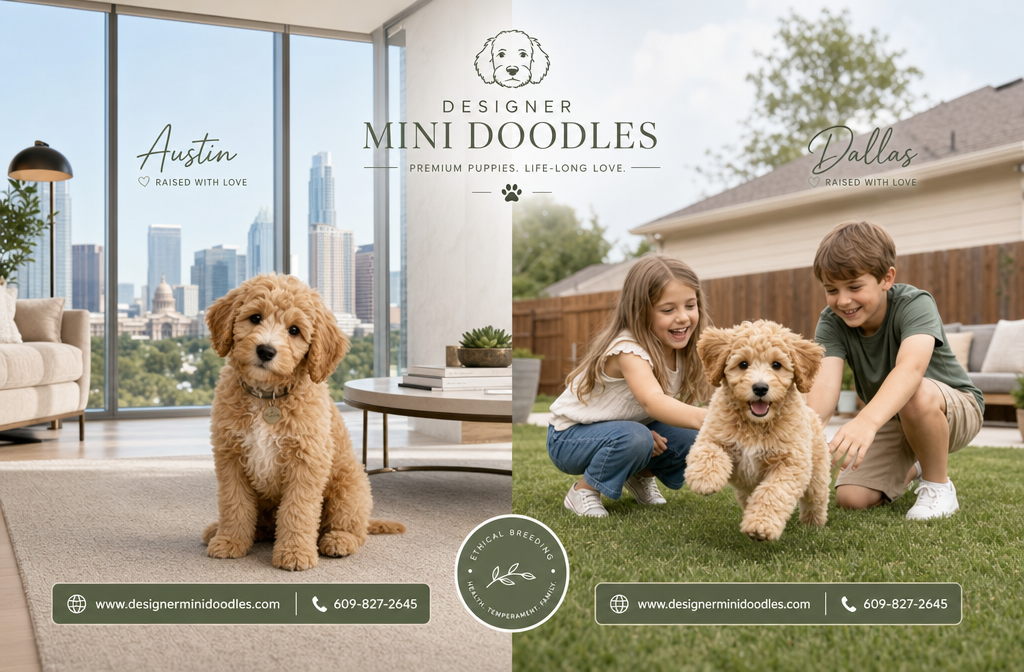
What’s the typical size and weight of a micro goldendoodle?
Adult micro goldendoodles typically weigh 10–16 pounds and stand 11–14 inches at the shoulder. They reach full size between 9 and 12 months, though most of their growth happens in the first 6 months.
Growth milestones to expect:
- 8 weeks: 2–4 lbs
- 4 months: 6–9 lbs
- 6 months: 8–13 lbs
- 12 months: full adult size (10–16 lbs)
A reliable size predictor is to multiply your puppy’s 8-week weight by approximately 4. If a breeder cannot show you the parents’ weights and documented adult sizes of past litters, treat the size claim with skepticism.
Are micro goldendoodles good with kids and other pets?
Micro goldendoodles are excellent with kids ages 6 and up and integrate well with other dogs and cats when properly socialized. They are gentle, affectionate, and adaptable, but their small size makes them more fragile around toddlers who may handle them roughly.
Best-fit family scenarios:
- Families with elementary-age or older children
- Multi-pet households with calm cats or small-to-medium dogs
- Empty nesters and grandparents who want a portable companion
- Single professionals or couples in urban areas
For households with very young kids, a 20–30 lb mini goldendoodle is often a safer match. More on family fit here: micro goldendoodles in family households with kids.
Do micro goldendoodles shed a lot?
Most micro goldendoodles shed minimally to not at all, especially F1b and multigen crosses with curly or wavy coats. They are widely considered one of the better breeds for allergy-conscious households, though no dog is 100% hypoallergenic.
Coat types and shedding levels:
- Curly (poodle-dominant): Lowest shedding, highest grooming needs
- Wavy (most common): Low shedding, moderate grooming
- Straight/flat (golden-dominant): Moderate shedding, lowest grooming
Plan on professional grooming every 6–8 weeks (~$60–$90 in Texas metros) and brushing 3–4 times per week to prevent matting. See grooming and home care for micro goldendoodles for a full routine.
What health issues should I watch for in micro goldendoodles?
Micro goldendoodles are generally healthy with a 12–15 year lifespan, but smaller doodles are predisposed to a handful of conditions inherited from both parent breeds. The most common include:
- Patellar luxation (kneecap instability) — common in small dogs
- Hip dysplasia — less common in micros than minis but still tested
- Progressive Retinal Atrophy (PRA-prcd) — genetic, fully testable
- Von Willebrand’s disease (vWD) — bleeding disorder, testable
- Mitral valve disease — heart condition seen in poodles
- Hypoglycemia in puppies under 12 weeks (small body mass)
- Ear infections — floppy ears trap moisture
- Dental crowding — small jaws need regular dental care
Ethical breeders screen parents with the OFA CHIC panel (hips, eyes, cardiac, patella) and a genetic disease panel from Embark or Paw Print Genetics.
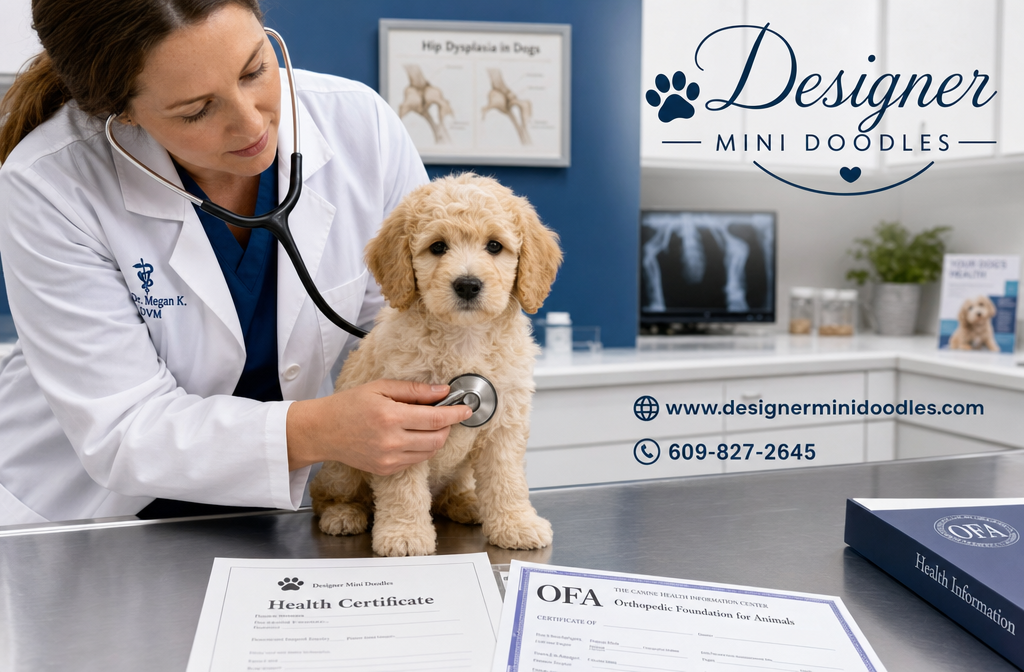
What health certifications should I look for when buying a micro goldendoodle?
Demand documentation, not verbal assurances. A reputable Texas breeder will provide certifications you can verify on the OFA public database (ofa.org).
Required certifications for both parents:
- OFA Hips (or PennHIP) — “Fair,” “Good,” or “Excellent” rating
- OFA Patella — Normal
- OFA Cardiac — Normal by board-certified cardiologist
- CAER eye exam — Annual, by veterinary ophthalmologist
- Genetic panel — PRA-prcd, DM, vWD, NEwS, MDR1 (clear or carrier only)
For the puppy:
- AKC or designer registry documentation (parents)
- Veterinary health certificate within 10 days of pickup
- Up-to-date vaccinations and deworming records
- Microchip
- Written health guarantee (typically 1–2 years for genetic conditions)
Where can I find reputable micro goldendoodle breeders near me in Texas?
The most reputable micro goldendoodle breeders in Texas are concentrated around Austin, Dallas-Fort Worth, Houston, San Antonio, and the Hill Country. Look for breeders who own their breeding dogs (don’t broker), health-test parents, offer a written contract, and welcome in-person or video visits.
Designer Mini Doodles, run by an animal biologist with over 15 years of dedicated doodle breeding, ships micro and toy goldendoodles to Texas families from a proprietary breeding program that combines:
- ENS (Early Neurological Stimulation) days 3–16
- Puppy Culture protocol for confidence building
- Early crate training starting at 5 weeks
- Early potty training on litter box and pad systems
- Daily handling by multiple people for bombproof temperaments
You can explore Texas-specific availability at Designer Mini Doodles’ Texas breeders page and view our broader mini goldendoodle breeders program. Our micro goldendoodle puppies are available to any home in the world through our dedicated puppy nanny flight service. We also offer toy goldendoodle puppies for sale and place micro golden doodle puppies into homes across the U.S., Canada, Europe, and the Middle East.
Families looking for a different breed entirely can also explore mini french bulldog puppies from our sister program.
Red flags to avoid:
- No health testing or vague “vet checked” language
- Multiple breeds/litters always available
- Refusal to share parents’ info or do video calls
- Pickup at parking lots or airports without home visit option
- Pricing dramatically below or above market
How much does it cost to care for a micro goldendoodle annually in Texas?
Annual ownership costs in Texas average $2,000–$3,500 after the first year, with the first year running $3,500–$5,000 including initial supplies and vet visits.
| Expense Category | Annual Cost (Texas) |
|---|---|
| Food (small breed) | $400–$600 |
| Professional grooming (8 visits) | $480–$720 |
| Routine vet + vaccines | $300–$500 |
| Preventatives (heartworm, flea/tick) | $250–$400 |
| Pet insurance | $400–$700 |
| Training (year 1) | $200–$600 |
| Boarding/daycare (occasional) | $200–$500 |
| Toys, treats, gear | $200–$400 |
Texas-specific notes: heartworm prevention is non-negotiable year-round, and summer grooming costs trend higher because of frequent baths and shorter cuts for heat tolerance.
What are the best training tips for micro goldendoodles?
Start training the day your puppy comes home. Micro goldendoodles are highly intelligent (poodle-side genetics) and respond best to short, positive-reinforcement sessions of 5–10 minutes, 3–4 times daily.
Priority training order:
- Crate training — use the crate as a den, never punishment
- Potty training — outside every 1–2 hours; reward immediately
- Name recognition and recall — high-value treats only
- Leash manners — start indoors before walks
- Socialization — 100 new people/places/sounds by 16 weeks
- Basic obedience — sit, down, stay, come, leave it
Common training mistakes:
- Free-feeding (breaks potty training)
- Carrying the puppy everywhere (small dog syndrome)
- Skipping crate training because they “look sad”
- Inconsistent rules across family members
For more, see our training and enrichment guide for micro goldendoodles.

Micro goldendoodle vs. teacup poodle: pros and cons
Both are small, intelligent, and apartment-friendly, but they differ meaningfully in temperament, coat, and durability.
| Factor | Micro Goldendoodle | Teacup Poodle |
|---|---|---|
| Adult weight | 10–16 lbs | 2–6 lbs |
| Temperament | Friendly, social, calm | Alert, sometimes reserved |
| Coat | Wavy/curly, low-shed | Curly, low-shed |
| Health risk | Moderate | High (extreme miniaturization) |
| Kid-friendly | Yes (6+) | Fragile, not recommended |
| Trainability | Excellent | Excellent but more independent |
| Lifespan | 12–15 years | 12–16 years |
Choose a micro goldendoodle if you want a hardier small dog with the social, golden-retriever-style personality. Choose a teacup poodle if you want the smallest possible companion and are prepared for fragility and specialized care.
Common mistakes first-time micro goldendoodle owners make
The biggest first-year mistakes are predictable and preventable:
- Buying on price alone. A $1,500 micro is almost never legitimate.
- Skipping the crate. Crate training prevents separation anxiety.
- Under-socializing during the 8–16 week window. This window closes permanently.
- Over-treating. Small dogs gain weight fast; obesity wrecks joints.
- Ignoring grooming early. Puppies must learn to tolerate brushing, ear cleaning, and nail trims by 12 weeks.
- Free-roaming the house too soon. Leads to chewing and potty regressions.
- Letting the puppy sleep in bed early. Breaks crate progress and creates dependency.
- Not researching the breeder. Visit, verify OFA records, request video calls.
Conclusion: Your next steps for finding micro goldendoodles for sale in Texas
A well-bred micro goldendoodle is one of the best small companion dogs available today, particularly for Texans navigating apartment living, allergies, family life, or frequent travel. The key is choosing a breeder who treats this as a craft, not a business: health-tested parents, documented genetic screening, ENS and early conditioning, and a written guarantee.
Your action plan:
- Set a realistic budget of $4,000–$6,000 plus first-year costs.
- Shortlist 2–3 breeders with verifiable OFA records.
- Schedule video calls; ask to see both parents and the whelping setup.
- Confirm what early training has been started (ENS, crate, potty).
- Reserve with a written contract and reasonable deposit ($500–$1,000).
- Prepare your home: crate, x-pen, vet appointment, puppy-proofing.
Designer Mini Doodles welcomes Texas families and ships worldwide via our dedicated puppy nanny service. To start your application or view current litters, visit our Texas micro goldendoodle program or learn why a 10–16 lb micro goldendoodle is ideal for first-time owners.
FAQ
Q: What’s the smallest a healthy goldendoodle can be?
A: A healthy adult goldendoodle should weigh at least 8–10 lbs. Anything advertised as a “teacup goldendoodle” under 8 lbs is usually a runt, misrepresented, or bred unethically.
Q: How long do micro goldendoodles live?
A: 12–15 years on average, with many living 14+ years when well-cared for and from health-tested lines.
Q: Are micro goldendoodles hypoallergenic?
A: They are low-shedding and lower-allergen than most breeds, especially F1b and multigen crosses, but no dog is fully hypoallergenic. Spend time with the puppy before committing if allergies are severe.
Q: Can I fly with a micro goldendoodle in-cabin?
A: Yes. At 10–16 lbs, most micro goldendoodles fit in an airline-approved soft carrier under the seat. See our travel-friendly companion guide.
Q: How much exercise does a micro goldendoodle need?
A: About 30–45 minutes daily — two short walks plus indoor play. They also benefit from puzzle toys and short training sessions for mental stimulation.
Q: Do you ship micro goldendoodles outside of Texas?
A: Yes. Designer Mini Doodles places puppies in homes worldwide through our puppy nanny flight service, with the puppy traveling in-cabin accompanied by a trained chaperone.
Q: What’s the difference between a toy and a micro goldendoodle?
A: They overlap. Toy goldendoodles typically run 8–14 lbs, micros 10–16 lbs. Both come from toy poodle parent crosses.
Q: When can I bring my micro goldendoodle home?
A: Reputable breeders release puppies at 8–10 weeks, never earlier. Smaller puppies sometimes stay until 10–12 weeks for safety.
Sources
- Orthopedic Foundation for Animals (OFA), CHIC Health Database, 2024 — ofa.org
- American Kennel Club, Breed Health Statements, 2024 — akc.org
- Embark Veterinary, Goldendoodle Genetic Health Panel, 2024 — embarkvet.com
- AVMA, Pet Ownership Cost Estimates, 2023 — avma.org