

Last updated: June 8, 2026
Quick Answer: The best mini golden doodle breeders in Louisiana health-test both parent dogs, practice Early Neurological Stimulation (ENS), and provide transparent records of their breeding program. Expect to pay between $2,500 and $5,000 for a well-bred mini goldendoodle puppy in Louisiana in 2026, with pricing influenced by generation, coat color, and breeder reputation. Programs led by animal biologists or veterinary professionals tend to produce the healthiest, most temperamentally sound puppies.
Louisiana families have driven demand for mini goldendoodles to record levels over the past five years, and for good reason. These compact, low-shedding companions combine the Golden Retriever’s affectionate nature with the Miniature Poodle’s intelligence and hypoallergenic coat. But finding trustworthy mini golden doodle breeders in Louisiana requires more than a quick internet search. This guide covers everything from pricing and health testing to generation differences and red flags, so you can bring home a puppy with confidence.
Key Takeaways
- Mini goldendoodle puppies in Louisiana typically cost $2,500 to $5,000 depending on size, generation, and breeder quality.
- Reputable breeders perform OFA hip/elbow evaluations, cardiac exams, ophthalmologist clearances, and DNA panels on all breeding dogs.
- F1B mini goldendoodles are the most popular generation for allergy-conscious families because of their higher Poodle genetics and curlier, lower-shedding coats.
- A fully grown mini goldendoodle stands 13 to 17 inches tall and weighs 15 to 35 pounds, while micro minis stay under 20 pounds.
- The average lifespan of a mini goldendoodle is 12 to 16 years with proper care.
- Programs run by animal biologists that incorporate ENS, early socialization, crate training, and housebreaking produce calmer, more confident puppies.
- Mini goldendoodles are excellent with children and other pets when properly socialized from an early age.
- Puppies from top breeding programs can be shipped nationwide or worldwide via dedicated puppy nanny services.
How Much Does a Mini Goldendoodle Puppy Cost in Louisiana?
A mini goldendoodle puppy from a reputable Louisiana breeder costs between $2,500 and $5,000 in 2026. Micro and toy goldendoodle puppies often land at the higher end of that range because producing smaller, healthy dogs requires more selective breeding.
Several factors influence the final price:
| Factor | Impact on Price |
|---|---|
| Generation (F1, F1B, F2B) | F1B and multigen puppies often cost $300-$800 more than F1 |
| Size (mini vs. micro vs. toy) | Smaller sizes command higher prices |
| Coat color | Red, apricot, and parti colors may carry a premium |
| Health testing depth | Breeders who invest in comprehensive panels price accordingly |
| Training included | Early housebreaking, crate training, and ENS add value |
| Breeder credentials | Programs run by animal biologists or with 15+ years of experience charge more, but deliver healthier puppies |
Common mistake: Choosing a $1,200 puppy from an untested program and spending $5,000+ on veterinary bills within the first two years. The upfront cost of a well-bred puppy is an investment in long-term health.
Designer Mini Doodles, for example, is a breeding program run by an animal biologist with over 15 years of experience producing some of the healthiest mini golden doodle breeders in the country. Their program includes ENS, early housebreaking, and crate training, which means your puppy arrives home already started on good habits. They also offer miniature golden doodle puppies and toy goldendoodle puppies for families who want an even smaller companion.
What Health Tests Do Reputable Goldendoodle Breeders Perform?
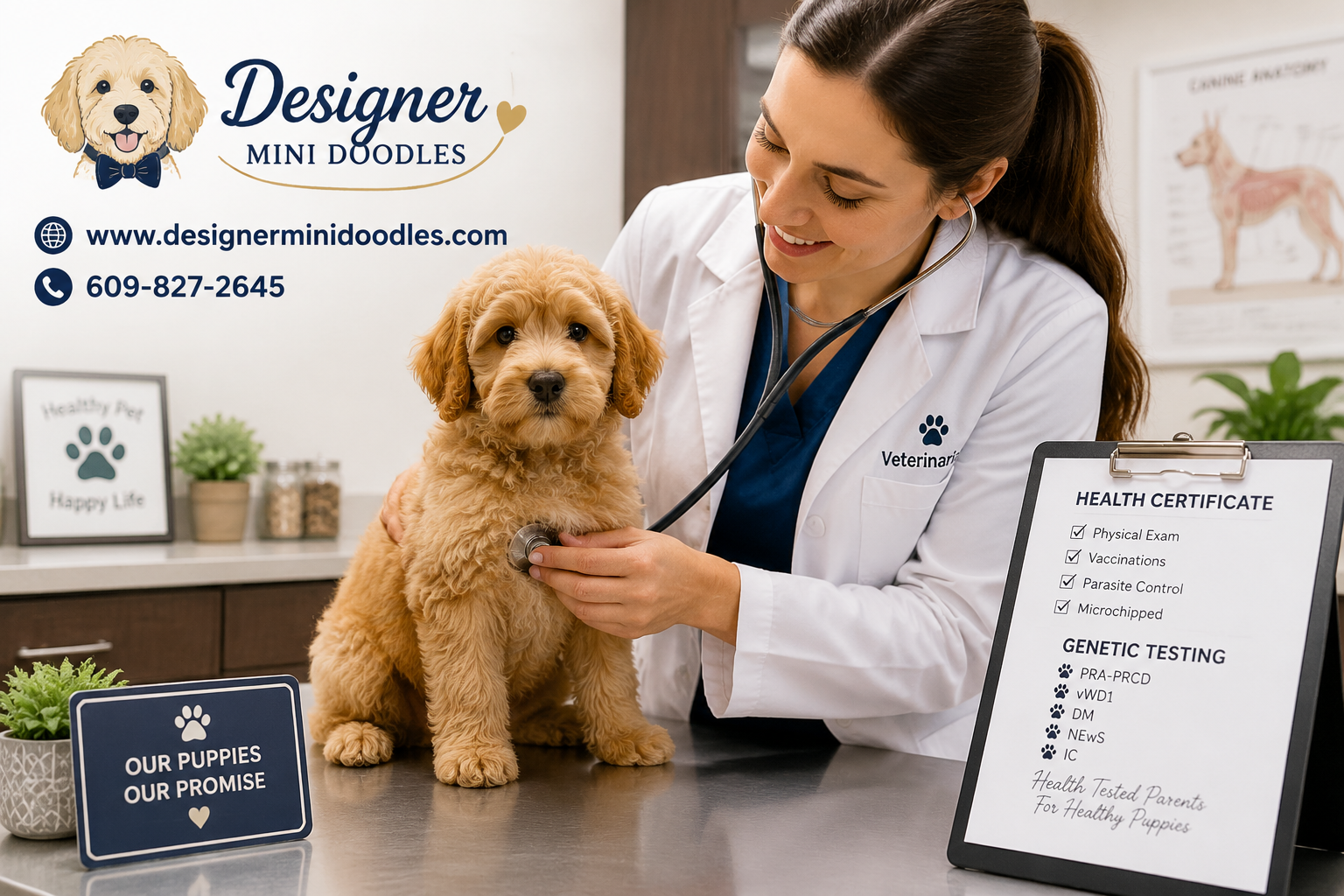
Responsible mini golden doodle breeders in Louisiana test both parent dogs for genetic diseases before any breeding takes place. At minimum, look for the following clearances:
- OFA Hip and Elbow Evaluations — screens for hip dysplasia and elbow dysplasia, which can affect both Golden Retrievers and Poodles
- OFA Cardiac Exam — performed by a board-certified cardiologist to rule out congenital heart defects
- CERF/OFA Eye Exam — annual ophthalmologist exam checking for progressive retinal atrophy (PRA), cataracts, and other inherited eye conditions
- DNA Panel — tests for von Willebrand’s disease, degenerative myelopathy, Ichthyosis, GR-PRA1, GR-PRA2, and Neonatal Encephalopathy
Decision rule: If a breeder cannot show you current OFA numbers or DNA panel results for both the sire and dam, walk away. No exceptions.
A breeding program led by an animal biologist will typically go beyond the minimum, incorporating temperament evaluations and structural assessments to ensure each pairing produces puppies that are not only healthy but also calm, confident, and well-suited for family life.
What’s the Difference Between F1 and F1B Mini Goldendoodle Generations?
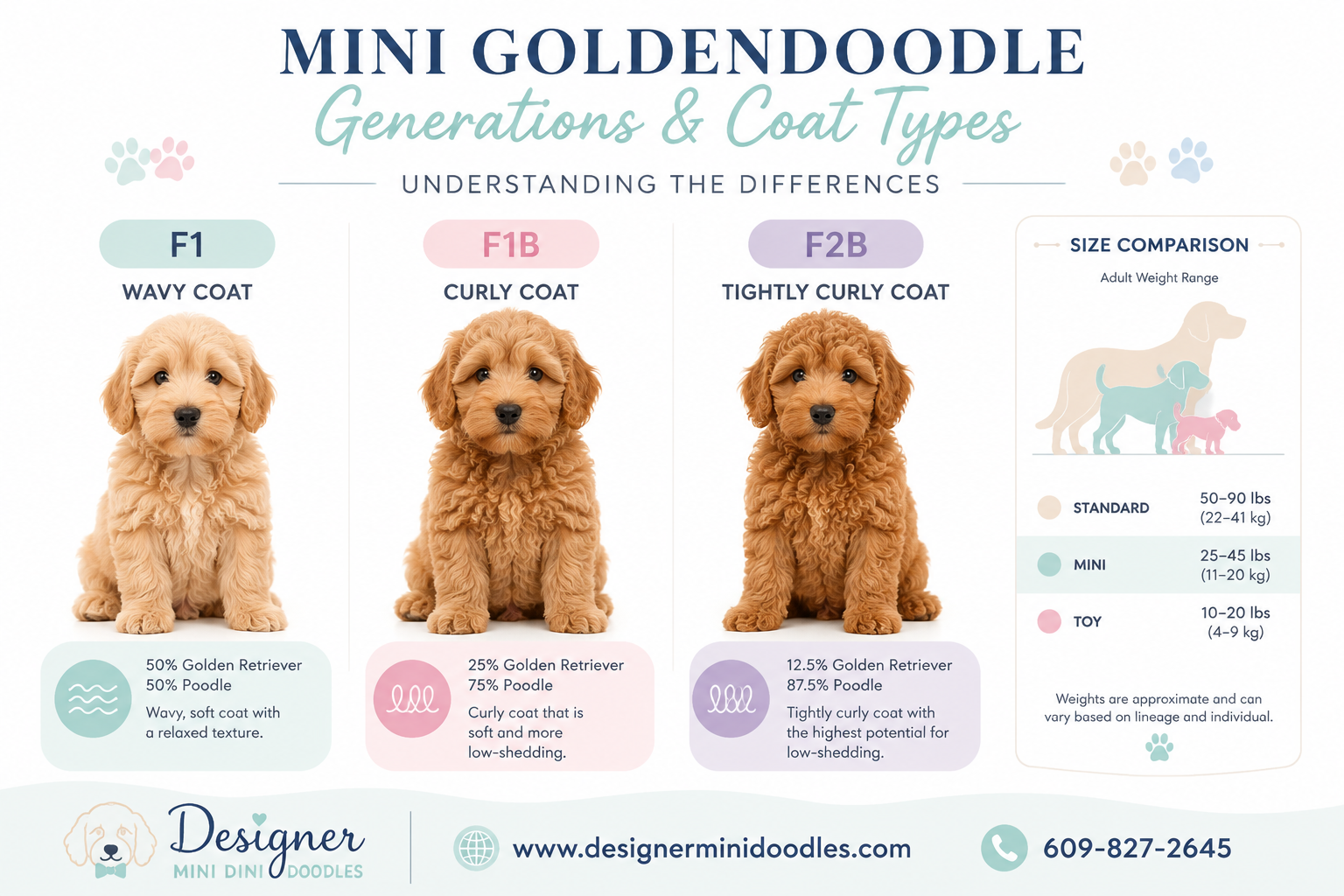
The generation label tells you the genetic makeup of a mini goldendoodle, which directly affects coat type, shedding, and allergy-friendliness.
| Generation | Cross | Genetic Split | Coat Type | Shedding Level |
|---|---|---|---|---|
| F1 | Golden Retriever x Mini Poodle | 50/50 | Wavy to slightly curly | Low to moderate |
| F1B | F1 Goldendoodle x Mini Poodle | 25/75 (more Poodle) | Curly, fleece-like | Very low |
| F1BB | F1B Goldendoodle x Mini Poodle | 12.5/87.5 | Tightly curled | Minimal |
| F2B | F1 x F1B Goldendoodle | 37.5/62.5 | Wavy to curly | Low |
| Multigen | Two Goldendoodle parents (various) | Varies | Consistent curly | Very low |
Choose F1 if you want a slightly more Golden Retriever look and don’t have severe allergies. Choose F1B or multigen if allergies are a primary concern, because the higher Poodle percentage produces a curlier, more hypoallergenic coat.
Best Mini Goldendoodle Breeders Near New Orleans or Baton Rouge
Families in the New Orleans and Baton Rouge metro areas have several options for finding quality mini golden doodle breeders in Louisiana. However, the best breeders aren’t always the closest ones geographically. What matters most is the quality of the breeding program.
When evaluating breeders near these cities, prioritize:
- Breeding program credentials — Is the program run by a professional with formal education in animal biology or veterinary science?
- Years of experience — Programs with 10 to 15+ years of dedicated doodle breeding have refined their pairings for health and temperament
- On-site socialization protocols — ENS (Early Neurological Stimulation), early crate training, and exposure to household sounds
- Transparency — Willingness to share health records, allow video calls, and provide references from previous puppy families
You can explore the full Louisiana mini and micro goldendoodle breeders directory for vetted options. Many top breeders also offer a dedicated puppy nanny service, meaning your puppy can be hand-delivered to your home in New Orleans, Baton Rouge, Shreveport, Lafayette, or anywhere else in the state — or even nationwide and internationally.
If you’re also considering breeders in neighboring states, check out options in Alabama and Texas, both within reasonable distance for Louisiana families.
How Big Do Mini Goldendoodles Get When Fully Grown?
A fully grown mini goldendoodle typically stands 13 to 17 inches at the shoulder and weighs 15 to 35 pounds. However, size varies based on the specific cross and the size of the Poodle parent used.
Here’s a breakdown by size category:
- Toy Goldendoodle: 10 to 15 pounds, under 14 inches tall
- Micro Mini Goldendoodle: 10 to 20 pounds, 12 to 15 inches tall
- Mini Goldendoodle: 20 to 35 pounds, 14 to 17 inches tall
Most mini goldendoodles reach their full height by 10 to 12 months but continue filling out until about 14 to 18 months. If apartment or urban living is your situation, a micro goldendoodle in the 10 to 16 pound range is often the ideal fit.
Edge case: Some breeders advertise “teacup” goldendoodles under 10 pounds. Be cautious here. Extremely small dogs can face health complications including hypoglycemia, fragile bones, and dental crowding. A responsible breeding program focuses on producing healthy dogs within a safe size range rather than chasing the smallest possible puppy.
Are Mini Goldendoodles Good With Kids and Other Pets?
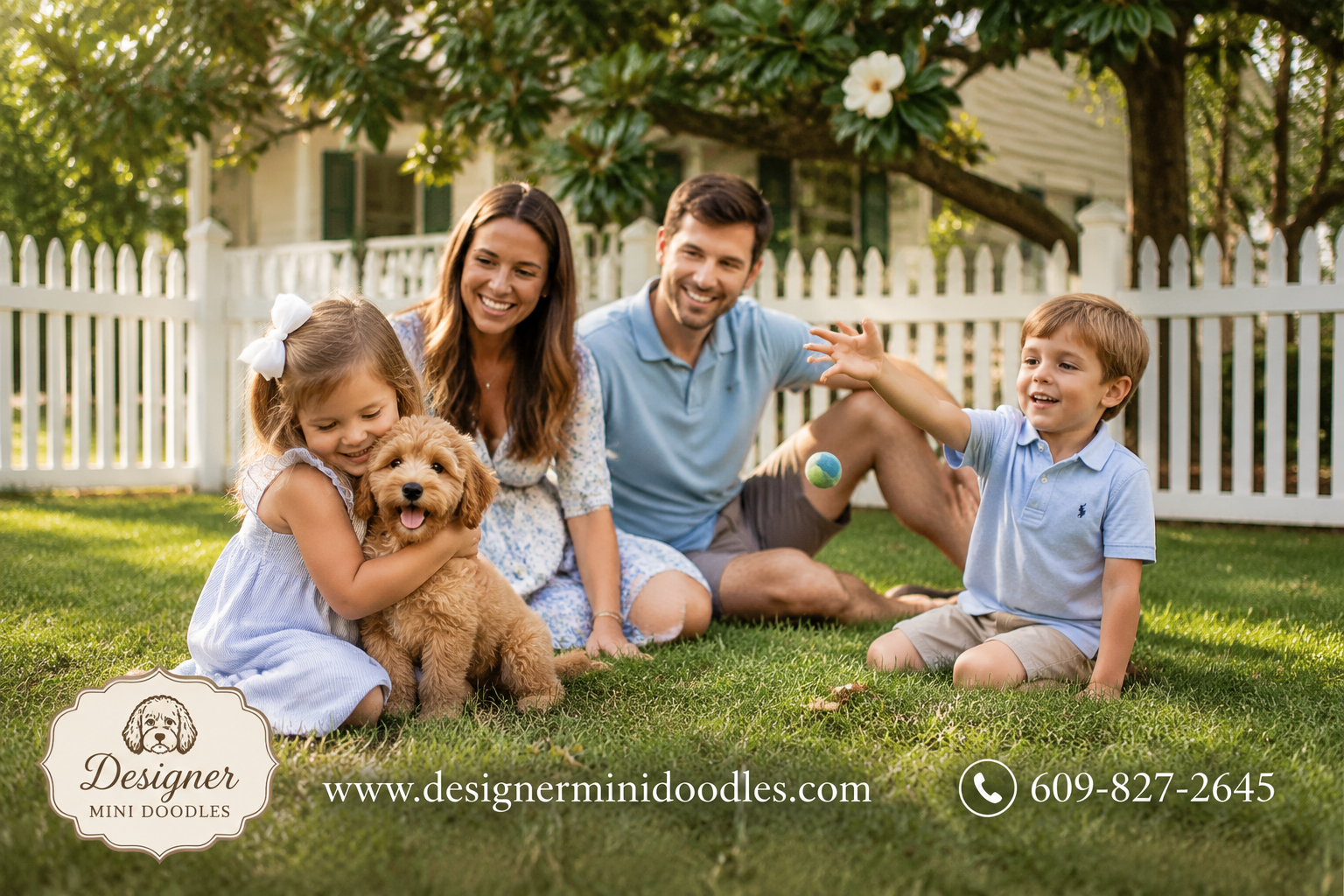
Yes. Mini goldendoodles are one of the most family-friendly breeds available in 2026, and they typically do very well with children and other household pets. Their Golden Retriever heritage gives them patience and gentleness, while their Poodle side contributes intelligence and adaptability.
Key considerations for families:
- With young children: Mini goldendoodles are sturdy enough to handle toddler energy without being so large that they accidentally knock kids over. Puppies raised with ENS and early socialization are especially calm around unpredictable movements and loud sounds.
- With other dogs: They’re generally social and non-aggressive. Proper introductions and early socialization make multi-dog households smooth.
- With cats: Most mini goldendoodles coexist peacefully with cats, especially when raised together. Their prey drive is typically low.
Common mistake: Assuming any puppy will automatically be great with kids. Even with a breed predisposed to friendliness, the breeder’s socialization program matters enormously. Puppies that receive early exposure to children, handling, and various stimuli during their first 8 to 12 weeks develop into more confident, well-adjusted adults.
For families with young children, consider learning more about why micro goldendoodles are ideal for family households with kids.
Are Mini Goldendoodles Hypoallergenic, and Do They Shed a Lot?
No dog is 100% hypoallergenic, but mini goldendoodles — particularly F1B and multigen crosses — are among the lowest-shedding breeds available. They produce significantly less dander than most dogs, which is the actual trigger for most pet allergies.
Shedding by generation:
- F1: Low to moderate shedding. Some puppies inherit a wavier coat that sheds more than others.
- F1B: Very low shedding. The curlier coat traps loose hair, which is then removed during brushing.
- Multigen: Consistently low shedding with predictable coat texture.
If allergies are your primary concern, request an F1B or multigen puppy and ask the breeder about the specific coat types in the litter. Curlier coats shed less but require more frequent grooming (every 4 to 6 weeks professionally, with daily brushing at home).
For allergy-conscious households, this guide to micro goldendoodles for allergy-conscious homes provides additional detail on managing dander and maintaining a clean environment.
Common Health Problems in Mini Goldendoodles and Average Lifespan
Mini goldendoodles have an average lifespan of 12 to 16 years, which is longer than many purebred dogs of similar size. However, they can be predisposed to certain health conditions inherited from their parent breeds.
Most common health concerns:
- Hip Dysplasia — abnormal hip joint development causing pain and mobility issues
- Progressive Retinal Atrophy (PRA) — gradual vision loss that can lead to blindness
- Patellar Luxation — kneecap displacement, more common in smaller dogs
- Von Willebrand’s Disease — a blood clotting disorder
- Ear Infections — floppy ears trap moisture, especially in Louisiana’s humid climate
- Allergies — skin and food sensitivities that may require dietary management
- Addison’s Disease — adrenal gland insufficiency, more common in Poodle lines
The single most effective way to minimize health risks is to buy from a breeder who performs comprehensive genetic testing on all breeding dogs. A program run by an animal biologist will screen for these conditions and only pair dogs that are clear or carriers (never two carriers together).
Regular veterinary checkups, proper nutrition, dental care, and maintaining a healthy weight all contribute to reaching the upper end of that 12-to-16-year lifespan.
How to Spot a Backyard Breeder vs. a Responsible Goldendoodle Breeder
This distinction can save you thousands of dollars and years of heartache. Here’s a direct comparison:
| Red Flag (Backyard Breeder) | Green Flag (Responsible Breeder) |
|---|---|
| No health testing documentation | OFA numbers and DNA panels for both parents |
| Multiple breeds available at all times | Specializes in one or two breeds |
| Puppies always available, no waitlist | Planned litters with waitlists |
| Won’t let you visit or see the facility | Welcomes visits or offers video tours |
| No contract or health guarantee | Written contract with 2+ year health guarantee |
| Ships puppies at 6 weeks old | Puppies go home at 8 to 10 weeks minimum |
| No socialization or training program | ENS, early socialization, crate training, housebreaking |
| Can’t explain generation or genetics | Educates buyers on generations, coat types, and size expectations |
| Prices seem unusually low | Pricing reflects the investment in health testing and care |
Decision rule: If the breeder can’t tell you the OFA numbers for both parents, doesn’t offer a health guarantee, or pressures you to buy quickly, they are not a responsible breeder.
What Should I Look for When Visiting a Goldendoodle Puppy Breeder?
When visiting a breeder in person or via video tour, pay attention to the environment, the dogs’ behavior, and the breeder’s knowledge. Here’s a checklist:
- Cleanliness: The facility should be clean and well-maintained, with no strong odors
- Dog temperament: Adult dogs should appear healthy, friendly, and well-socialized — not fearful or aggressive
- Puppy socialization area: Look for enrichment items, different textures, toys, and exposure to household sounds
- Health records on display: The breeder should readily share vaccination records, deworming schedules, and genetic test results
- Breeder knowledge: They should be able to explain their breeding philosophy, generation differences, and why they chose specific pairings
- Contract terms: Review the health guarantee, spay/neuter requirements, and return policy before committing
- References: Ask for contact information from previous puppy families
A top-tier program will also demonstrate their early training protocols. Puppies that have been introduced to crate training, basic housebreaking, and ENS before going home are dramatically easier to transition into your household.
Mini Goldendoodle Training Tips for First-Time Dog Owners
Mini goldendoodles are among the easiest breeds to train, ranking high in both intelligence and eagerness to please. First-time owners can expect a smooth training experience with consistent, positive methods.
Essential training tips:
- Start immediately. Begin training the day your puppy comes home. If your breeder has already started crate training and housebreaking, you’re building on an existing foundation.
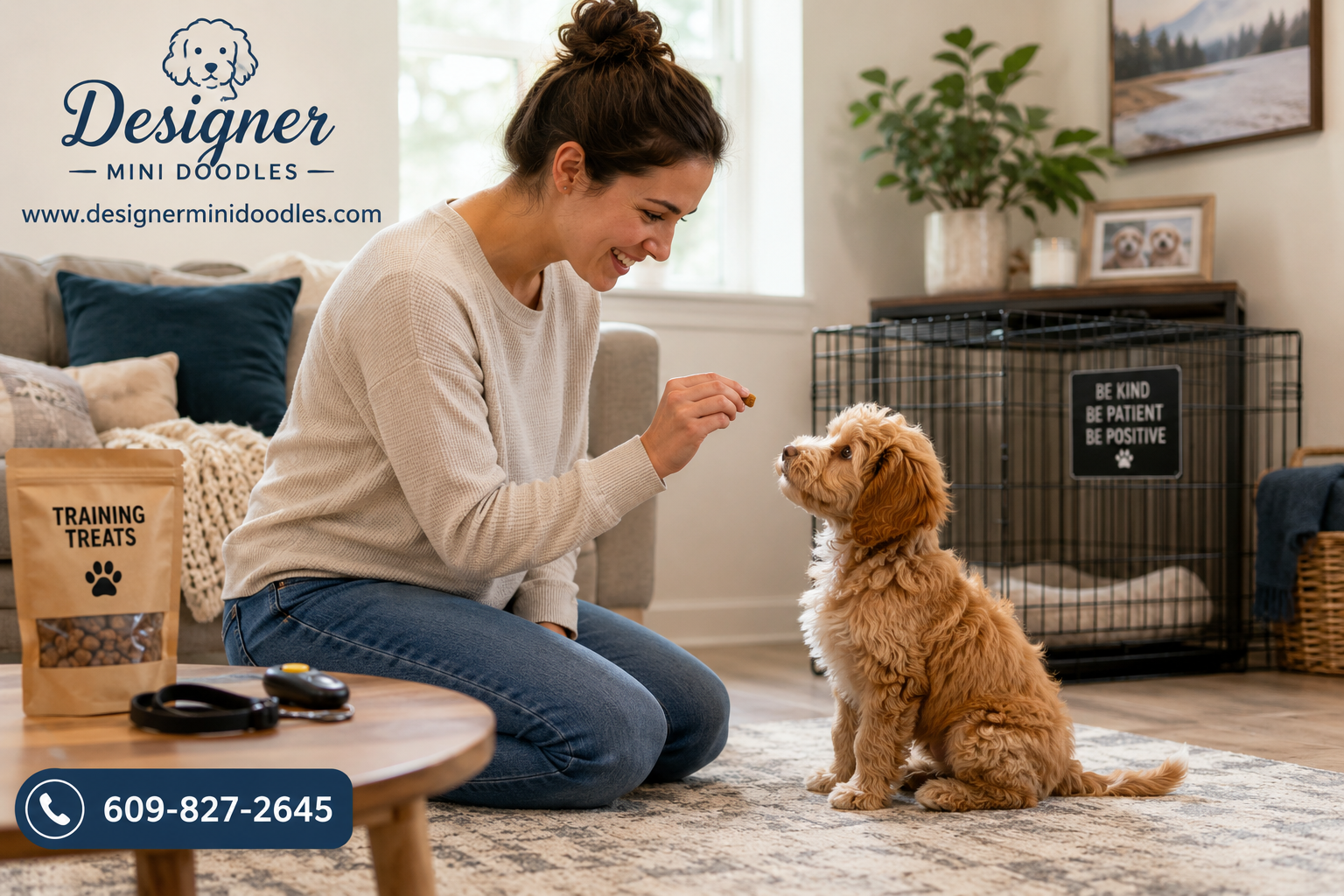
- Use positive reinforcement exclusively. Mini goldendoodles are sensitive dogs. Harsh corrections can create anxiety and fear-based behaviors. Reward desired behavior with treats, praise, and play.
- Keep sessions short. Puppies have limited attention spans. Aim for 5 to 10 minute training sessions, three to four times daily.
- Prioritize socialization. Expose your puppy to new people, environments, sounds, and other animals between 8 and 16 weeks. This window is critical for developing a confident adult dog.
- Crate train consistently. A crate provides a safe space and accelerates housebreaking. Puppies from programs that start crate training early will already view the crate as a positive place.
- Address separation anxiety early. Mini goldendoodles bond deeply with their families. Practice short absences from the beginning to prevent anxiety from developing.
For additional guidance on training doodle puppies, our training a mini bernedoodle puppy guide covers many of the same positive reinforcement techniques that apply to goldendoodles.
If you’re a first-time dog owner, you might also find value in understanding why micro goldendoodles are ideal for first-time dog owners.
Why Breeding Program Quality Matters More Than Location
Many Louisiana families focus their search exclusively on local breeders, but the quality of the breeding program should always outweigh geographic convenience. A breeder 500 miles away who conducts comprehensive health testing, runs an ENS program, and has 15+ years of experience will produce a healthier, better-adjusted puppy than an untested local operation.
Top breeding programs offer solutions for distance:
- Puppy nanny services — a dedicated handler flies with your puppy directly to your nearest airport
- Ground transport — for shorter distances within the Gulf Coast region
- Video updates — regular photos and videos from birth through pickup day
Designer Mini Doodles’ puppies are available to families anywhere in the world through their puppy nanny service. Whether you’re in New Orleans, Baton Rouge, or across the country, your micro golden doodle puppies can be hand-delivered to your door.
For those also interested in other small companion breeds, the same commitment to quality breeding applies to miniature french bulldog puppies as well.
Frequently Asked Questions
How long do mini goldendoodles live?
Mini goldendoodles have an average lifespan of 12 to 16 years. Smaller micro and toy varieties sometimes live slightly longer than larger minis, provided they come from health-tested lines.
Are mini goldendoodles good apartment dogs?
Yes. Their moderate energy level and compact size (15 to 35 pounds for minis, under 20 pounds for micros) make them well-suited for apartment living, as long as they receive daily walks and mental stimulation.
How often do mini goldendoodles need grooming?
Professional grooming every 4 to 6 weeks is standard. Daily brushing at home prevents matting, especially for curlier F1B and multigen coats. Louisiana’s humidity can accelerate matting, so consistent brushing is essential.
Do mini goldendoodles bark a lot?
They are not excessive barkers compared to many small breeds. However, they will alert bark and may develop nuisance barking if under-stimulated or experiencing separation anxiety. Early training addresses this effectively.
What is the best age to bring a mini goldendoodle puppy home?
Between 8 and 10 weeks is ideal. Puppies need those first 8 weeks with their mother and littermates for proper social development. Breeders who release puppies before 8 weeks are a red flag.
Can mini goldendoodles handle Louisiana’s heat and humidity?
Yes, but they need access to shade, fresh water, and air conditioning during peak summer months. Avoid extended outdoor exercise during the hottest parts of the day (10 a.m. to 4 p.m.) from June through September.
What’s the difference between a mini goldendoodle and a toy goldendoodle?
Size is the primary difference. Mini goldendoodles weigh 20 to 35 pounds, while toy goldendoodles weigh 10 to 15 pounds. Toy goldendoodles are produced by crossing with a Toy Poodle rather than a Miniature Poodle.
Do mini goldendoodles have separation anxiety?
They can be prone to it because of their strong bonding instincts. Breeders who practice early crate training and gradual separation exercises produce puppies that handle alone time much better.
How much exercise does a mini goldendoodle need daily?
About 30 to 60 minutes of moderate exercise per day, split between walks, play sessions, and mental enrichment activities. They’re adaptable and will match your activity level to a degree.
Are mini goldendoodles easy to potty train?
Yes, they’re one of the easier breeds to housebreak. Puppies from programs that start early housebreaking before placement age can be reliably trained within 2 to 4 weeks of arriving home.
Conclusion
Finding the right mini golden doodle breeders in Louisiana comes down to prioritizing health testing, breeding program quality, and early socialization over convenience or price. The difference between a well-bred puppy and one from an untested program shows up in veterinary bills, temperament, and years of companionship.
Your next steps:
- Research breeders who provide OFA clearances and DNA panels for both parents — accept no substitutes.
- Ask about the breeder’s socialization protocol, including ENS, early crate training, and housebreaking.
- Decide on your preferred generation (F1B for allergy concerns, F1 for a more Golden look) and size (mini, micro, or toy).
- Budget $2,500 to $5,000 for a quality puppy, and factor in ongoing costs for grooming, veterinary care, and nutrition.
- Don’t limit your search to local breeders only — puppy nanny services make it possible to get the best puppy regardless of the breeder’s location.
A mini goldendoodle from a program run by an experienced animal biologist, with over a decade of refined breeding practices, will be the calmest, most affectionate, and healthiest companion your family could ask for. Take the time to choose well, and you’ll be rewarded with 12 to 16 years of unconditional love.
Tags: mini golden doodle breeders Louisiana, mini goldendoodle puppies for sale, micro goldendoodle breeders, toy goldendoodle puppies, F1B mini goldendoodle, goldendoodle health testing, mini goldendoodle training, Louisiana dog breeders, hypoallergenic puppies, miniature goldendoodle, goldendoodle puppy cost, doodle breeders near me