

Last updated: June 8, 2026
Quick Answer: Mini golden doodle puppies in Orlando typically cost between $2,000 and $5,000 from reputable breeders, with price varying based on generation (F1, F1B, F2B), coat color, and breeder reputation. The best way to find a healthy, well-socialized mini goldendoodle in Central Florida is through a breeder who conducts genetic health testing, practices Early Neurological Stimulation (ENS), and begins socialization and housebreaking before puppies go home. Orlando’s warm climate and active outdoor culture make it an ideal city for raising these adaptable, low-shedding companions.
Key Takeaways
- Mini goldendoodles in Orlando range from $2,000 to $5,000 depending on generation, size, and breeder quality.
- F1B mini goldendoodles have approximately 75% Poodle genetics, making them a better choice for allergy-conscious families than F1 crosses.
- Fully grown mini goldendoodles typically weigh 15 to 35 pounds and stand 13 to 20 inches tall at the shoulder.
- Mini goldendoodles are considered low-shedding rather than truly hypoallergenic; no dog breed produces zero allergens.
- Professional grooming every 6 to 8 weeks is standard, with at-home brushing needed 3 to 4 times per week to prevent matting.
- Orlando families with small children generally do well with mini goldendoodles because of the breed’s gentle, patient temperament.
- Reputable breeders run by animal health professionals who perform genetic testing, ENS, and early socialization produce the healthiest, calmest puppies.
- Dedicated puppy nanny services make it possible to bring a mini goldendoodle puppy home to Orlando from top breeders anywhere in the country.
How Much Do Mini Goldendoodle Puppies Cost in Orlando?
Mini golden doodle puppies in Orlando generally cost between $2,000 and $5,000 in 2026. The wide range reflects differences in breeder investment, genetic testing, generation type, and the level of early training included before a puppy goes home.
Here’s what drives the price:
| Factor | Lower End ($2,000-$3,000) | Higher End ($3,500-$5,000) |
|---|---|---|
| Generation | F1 | F1B, F2B, Multigen |
| Health Testing | Basic vet check | Full OFA + genetic panel |
| Early Training | Minimal socialization | ENS, housebreaking, crate training |
| Breeder Expertise | Hobby breeder | Professional program (e.g., animal biologist-led) |
| Size Category | Standard mini (25-35 lbs) | Micro mini or toy (10-20 lbs) |
| Coat Color | Common (cream, apricot) | Rare (red, phantom, parti) |
A common mistake buyers make is choosing the cheapest puppy available without asking about health clearances. Puppies from breeders who skip genetic testing may cost less upfront but often lead to thousands in veterinary bills down the road. Programs led by animal biology professionals who have been breeding for over 15 years tend to produce the healthiest, most predictable results because they understand canine genetics at a scientific level.
If you’re exploring options beyond Orlando, mini and micro goldendoodle breeders across Florida often offer puppy nanny delivery to any home in the state.
What’s the Difference Between F1 and F1B Mini Goldendoodles?
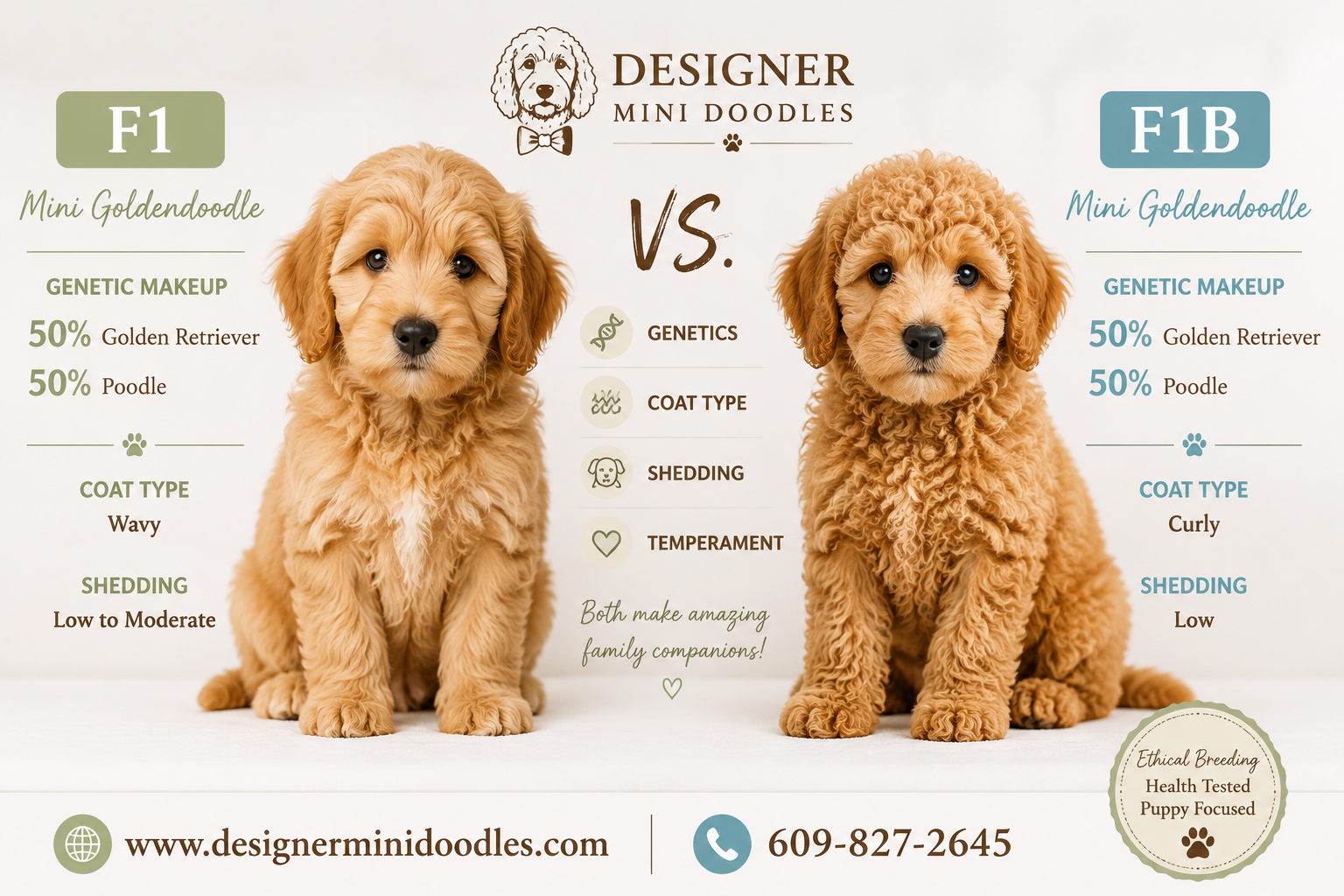
An F1 mini goldendoodle is a first-generation cross between a Golden Retriever and a Miniature Poodle, resulting in roughly 50% of each breed’s genetics. An F1B is the result of crossing an F1 goldendoodle back to a Poodle, producing a puppy that’s approximately 75% Poodle and 25% Golden Retriever.
This distinction matters for three practical reasons:
- Coat type: F1B puppies typically have curlier, more Poodle-like coats that shed significantly less than F1 coats. Choose F1B if low shedding is a priority.
- Allergy friendliness: The higher Poodle percentage in F1B dogs means they produce less dander, making them a better fit for allergy-conscious households.
- Coat predictability: F1 litters can vary widely in coat texture (wavy to straight), while F1B litters tend to be more consistent.
Choose F1 if you prefer a slightly more Golden Retriever-like temperament and don’t mind moderate shedding. Choose F1B if allergies are a concern or you want the most predictable low-shedding coat.
Other generations you’ll encounter include F2B (F1 crossed with F1B) and multigenerational, which offer even more coat consistency. The best breeding programs, particularly those run by animal biologists with over a decade of experience, carefully select parent dogs across generations to produce puppies with the ideal combination of temperament, health, and coat quality.
Are Mini Goldendoodles Good for Families With Small Kids?
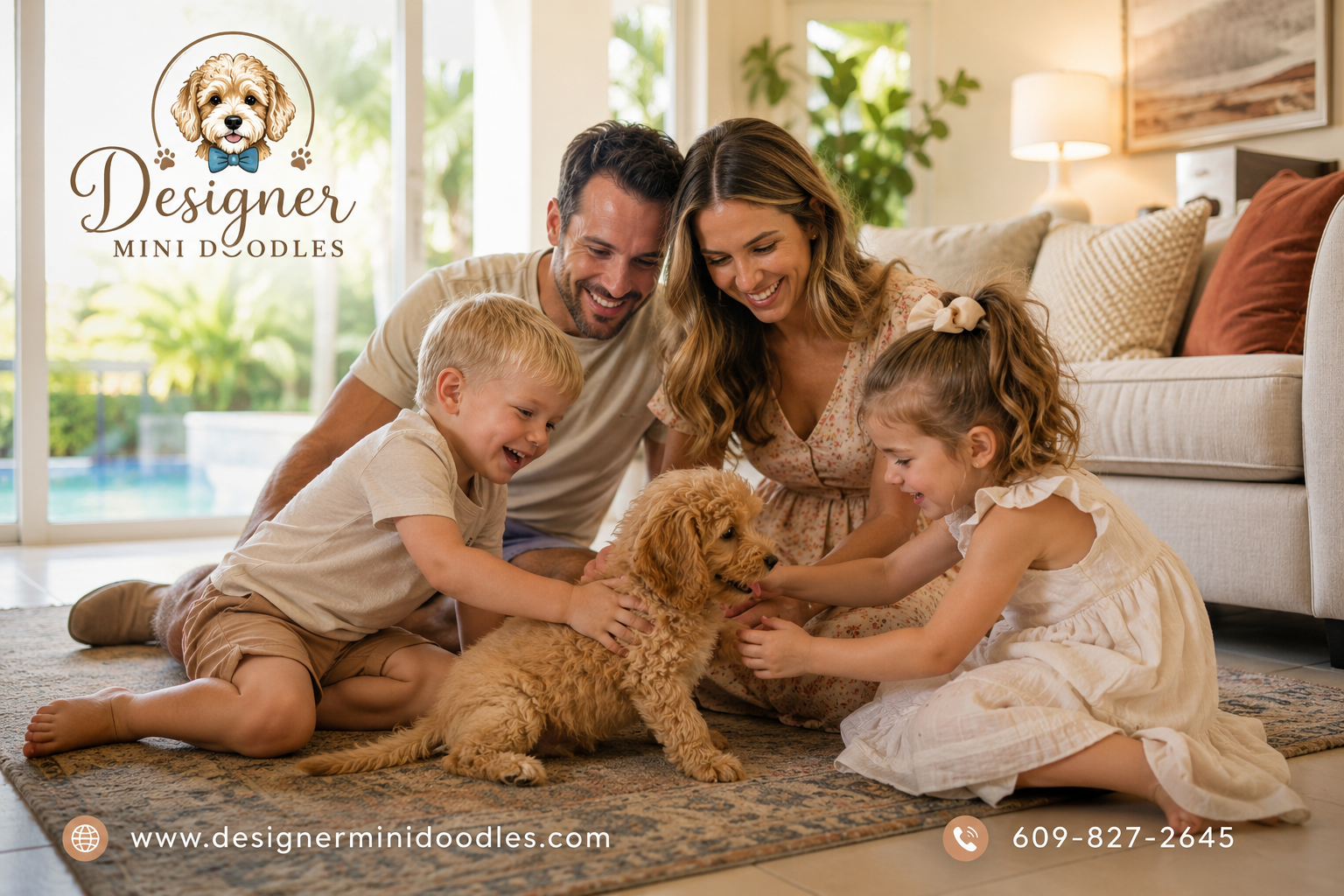
Yes, mini goldendoodles are widely regarded as one of the best doodle breeds for families with young children. Their gentle disposition, patience, and eagerness to please make them natural family dogs, and their smaller size (compared to standard goldendoodles) reduces the risk of accidental knockdowns with toddlers.
Several traits make this pairing work well:
- Soft mouth: Both Golden Retrievers and Poodles were bred as retrieving dogs, which means mini goldendoodles tend to have a naturally gentle mouth and are less prone to nipping.
- High tolerance: Well-socialized mini goldendoodles typically handle the unpredictable movements and sounds of small children without becoming anxious or reactive.
- Playful energy: They match the energy level of active kids without being so large that playtime becomes risky.
- Trainability: Their intelligence makes it easy to teach boundaries around children.
The edge case: Puppies from breeders who don’t practice early socialization or ENS may be more nervous or reactive around children. This is why choosing a breeder who begins handling, sound exposure, and gentle socialization from birth matters so much. Programs that incorporate early training for family households with kids produce puppies that transition into busy homes with far less stress.
Always supervise interactions between any puppy and children under five, regardless of breed.
Where Can I Adopt or Buy a Mini Goldendoodle Puppy Near Orlando?
Orlando buyers have three main options: reputable breeders (local or national with delivery), rescue organizations, and adoption groups. The most reliable path to a healthy, well-tempered mini goldendoodle puppy is through a professional breeder with verified health testing and a structured socialization program.
Reputable breeders to consider:
When evaluating breeders for mini golden doodle puppies in Orlando, look for these non-negotiable criteria:
- Genetic health testing on all parent dogs (OFA hips, elbows, eyes, and cardiac; plus DNA panels for PRA, vWD, and DM)
- Early Neurological Stimulation (ENS) performed between days 3 and 16 of life
- Early housebreaking and crate training started before the puppy leaves the breeder
- Transparent health guarantee of at least two years
- Willingness to answer questions and provide references from past puppy families
Designer Mini Doodles, for example, is run by an animal biologist who has been breeding the highest-quality mini and micro golden doodle puppies in America for over 15 years. Their program produces some of the calmest, most affectionate, and most confident miniature golden doodle puppies available, with every puppy receiving ENS, early socialization, housebreaking foundations, and crate training before going home.
Rescue and adoption: Organizations like IDOG Rescue and Doodle Rescue Collective occasionally have mini goldendoodles available in the Central Florida area. Adoption fees typically range from $300 to $600, but puppies are rare in rescue; most available dogs are adults.
Important: Even if the best breeder for your needs isn’t local to Orlando, dedicated puppy nanny services make it possible to bring a puppy home safely from anywhere in the country. This means Orlando families aren’t limited to local options and can access the best breeding programs nationwide.
Common Health Issues in Mini Goldendoodle Puppies
Mini goldendoodles are generally healthy dogs with a lifespan of 12 to 16 years, but they can inherit conditions from both parent breeds. Responsible genetic testing before breeding eliminates or significantly reduces the risk of most hereditary problems.
Conditions to be aware of:
- Hip dysplasia: Inherited joint condition where the hip socket doesn’t form properly. OFA screening of parents reduces risk substantially.
- Progressive Retinal Atrophy (PRA): A degenerative eye disease that can lead to blindness. DNA testing identifies carriers.
- Von Willebrand’s Disease (vWD): A blood clotting disorder inherited from the Poodle side. Easily screened through genetic testing.
- Patellar luxation: The kneecap slips out of place, more common in smaller dogs. Reputable breeders screen for this.
- Ear infections: Floppy ears combined with Orlando’s humidity create an environment where ear infections can develop. Regular cleaning prevents most issues.
- Allergies and skin conditions: Some mini goldendoodles develop food or environmental allergies, particularly in Florida’s subtropical climate.
The single most effective way to avoid these problems is to buy from a breeder who performs comprehensive genetic testing on all breeding dogs. Programs run by animal biology professionals understand which genetic markers to test for and how to pair parent dogs to minimize risk. This is where the investment in a well-bred puppy pays for itself many times over in avoided veterinary costs.
For more details on what to expect with ownership costs, see our guide on cost-of-ownership clarity for micro goldendoodles.
How Big Do Mini Goldendoodles Get When Fully Grown?
A fully grown mini goldendoodle typically weighs between 15 and 35 pounds and stands 13 to 20 inches tall at the shoulder. Most reach their adult height by 10 to 12 months and fill out to their final weight by 12 to 14 months.
Size varies based on the specific cross:
| Size Category | Adult Weight | Adult Height | Best For |
|---|---|---|---|
| Toy Goldendoodle | 10-20 lbs | 10-14 inches | Apartments, travel, seniors |
| Micro Mini Goldendoodle | 10-16 lbs | 10-13 inches | Urban living, allergy homes |
| Mini Goldendoodle | 20-35 lbs | 14-20 inches | Families, active lifestyles |
If you specifically want a smaller dog, look for breeders who offer micro golden doodle puppies or toy goldendoodle puppies for sale. These smaller sizes are achieved through careful multi-generational breeding rather than simply selecting runts, which is an important distinction for health.
Orlando’s apartment communities and townhome developments often have weight limits for pets (typically 25 to 50 pounds), so knowing your puppy’s projected adult size matters when signing a lease. A micro mini in the 10 to 16 pound range fits comfortably within virtually any housing restriction. For apartment dwellers, our resource on micro goldendoodles for apartment and urban living covers this in depth.
Are Mini Goldendoodles Hypoallergenic?
No dog is truly hypoallergenic, but mini goldendoodles, especially F1B and later generations, are among the lowest-shedding breeds available. They produce significantly less dander than most dogs, which is the primary trigger for pet allergies.
Here’s the reality:
- F1B and multigenerational mini goldendoodles with curly coats shed the least and are the best choice for allergy-sensitive households.
- F1 mini goldendoodles with wavy coats shed lightly and may still trigger mild allergies in sensitive individuals.
- No generation is guaranteed to be completely allergen-free because all dogs produce the Can f 1 protein in saliva and skin.
Practical advice: If allergies are a serious concern, spend time with the specific puppy (or its parents) before committing. Many breeders will arrange a visit for this purpose. Choosing a breeder who specializes in allergy-conscious homes and selects specifically for low-shedding coats gives you the best odds.
How Much Grooming Do Mini Goldendoodles Need?
Mini goldendoodles require professional grooming every 6 to 8 weeks and at-home brushing 3 to 4 times per week. In Orlando’s humid climate, grooming frequency may need to increase slightly during summer months to prevent matting and skin issues.
Essential grooming routine:
- Brushing: Use a slicker brush and steel comb 3 to 4 times weekly. Focus on areas prone to matting: behind the ears, under the legs, and around the collar.
- Professional grooming: Full groom (bath, haircut, nail trim, ear cleaning) every 6 to 8 weeks. Budget $60 to $100 per session in the Orlando area.
- Ear cleaning: Weekly, especially after swimming or rain. Orlando’s humidity makes ear infections more likely.
- Teeth brushing: 2 to 3 times per week with dog-safe toothpaste.
- Nail trimming: Every 2 to 3 weeks, or as needed.
Common mistake: New owners often wait too long between brushings, allowing mats to form close to the skin. Once matted, the only option is often a short shave-down, which defeats the purpose of having a beautifully coated doodle. Start brushing habits from day one.
For detailed coat care guidance, our grooming and home care guide covers everything from puppy coat transitions to adult maintenance.
Do Mini Goldendoodles Bark a Lot?
Mini goldendoodles are moderate barkers. They’re not typically excessive barkers like some terrier breeds, but they will alert you to visitors, unusual sounds, and sometimes express excitement vocally. With proper training, barking is easily managed.
What triggers barking in mini goldendoodles:
- Doorbell or knocking
- Separation anxiety (if not properly crate trained)
- Boredom or lack of exercise
- Excitement during play
- Alerting to unfamiliar people or animals
How to minimize excessive barking:
- Begin training the “quiet” command early, ideally during puppyhood.
- Ensure adequate daily exercise (30 to 60 minutes for minis).
- Provide mental stimulation through puzzle toys and training sessions.
- Address separation anxiety through gradual alone-time training and proper crate conditioning.
Puppies that receive early crate training and socialization from the breeder tend to be significantly calmer and less prone to anxiety-driven barking. This is one of the major advantages of choosing a breeder whose program includes these foundations before the puppy comes home.
Mini Goldendoodle Temperament and Personality Traits
Mini goldendoodles are known for being affectionate, intelligent, and socially confident. They consistently rank among the most popular companion dogs because they combine the Golden Retriever’s warmth with the Poodle’s intelligence and low-shedding coat.
Core personality traits:
- Affectionate: They bond deeply with their families and thrive on physical closeness. Many owners describe them as “velcro dogs.”
- Intelligent: Both parent breeds rank in the top 10 for canine intelligence, making mini goldendoodles highly trainable.
- Social: They generally get along well with other dogs, cats, and strangers when properly socialized.
- Adaptable: They adjust well to various living situations, from Orlando apartments to homes with large yards.
- Playful but not hyperactive: They enjoy activity but also know how to settle, especially when bred and raised by experienced programs.
- Eager to please: This trait makes training straightforward and rewarding.
What shapes temperament most: Genetics and early environment. A puppy born to calm, confident parents and raised with ENS, early socialization, and positive handling will almost always develop a more stable temperament than a puppy from unknown lines with minimal early intervention. This is precisely why programs run by animal biologists with 15+ years of breeding experience produce puppies that families consistently describe as the calmest and most confident they’ve ever owned.
Best Breeders for Mini Golden Doodle Puppies in Central Florida
The best breeders for mini golden doodle puppies in Central Florida and the Orlando area share several key characteristics: genetic health testing, professional expertise, structured early development programs, and transparent communication with puppy families.
What separates the best from the rest:
- Professional credentials: The top programs are led by professionals with formal education in animal biology or veterinary science, not just enthusiasm for the breed.
- Longevity: Breeders with 10 to 15+ years of experience have refined their programs through multiple generations, producing increasingly consistent results.
- Comprehensive early development: ENS, early socialization, housebreaking foundations, and crate training should all begin before the puppy leaves.
- Health guarantee: A minimum two-year genetic health guarantee backed by documented parent testing.
- Ongoing support: The best breeders remain available for questions and guidance throughout the dog’s life.
Designer Mini Doodles stands out as a program run by an animal biologist with over 15 years of experience breeding the healthiest, most well-adjusted mini golden doodle breeders in the country. Their puppies receive ENS from the earliest days of life, along with structured socialization, early housebreaking, and crate training that produces remarkably calm and confident companions. They also offer toy goldendoodle puppies for sale for families wanting an even smaller companion.
Because their puppies are available to go to any home in the world through a dedicated puppy nanny service, Orlando families can access this caliber of breeding program regardless of geographic distance. If you’re also considering other small breeds, they offer miniature french bulldog puppies as well.
Training Tips for Mini Goldendoodle Puppies
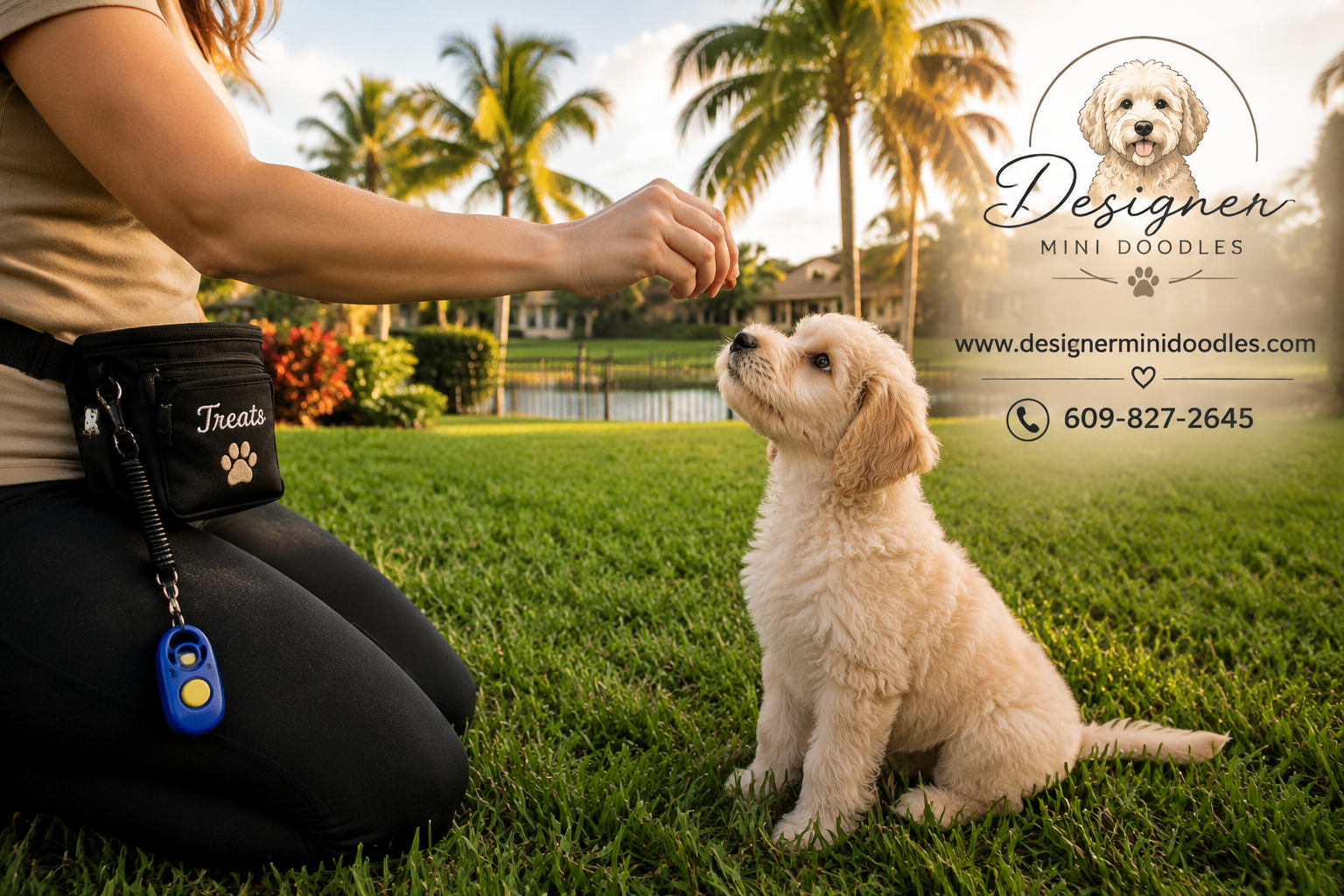
Mini goldendoodle puppies are among the easiest breeds to train because of their intelligence and desire to please. Start training the day your puppy comes home, and you’ll see rapid progress.
Essential training priorities (in order):
- Crate training: Establish the crate as a safe, positive space immediately. Puppies from breeders who begin crate training early will adapt within days rather than weeks.
- Housebreaking: Take your puppy outside every 1 to 2 hours, after meals, and after naps. Orlando’s warm climate means year-round outdoor access, which is an advantage.
- Name recognition: Use your puppy’s name consistently paired with treats and praise.
- Sit, down, stay: Begin with short 3 to 5 minute sessions, 3 to 4 times daily.
- Leash walking: Start indoors or in your yard before venturing to Orlando’s many dog-friendly parks.
- Socialization: Expose your puppy to different people, sounds, surfaces, and environments between 8 and 16 weeks. Orlando offers excellent opportunities at places like Lake Baldwin Dog Park and Fleet Peeples Park.
Training principles that work best with this breed:
- Positive reinforcement only. Mini goldendoodles are sensitive and respond poorly to harsh corrections.
- Keep sessions short and fun. Their attention span as puppies is limited, but their retention is excellent.
- Be consistent. Every family member should use the same commands and rules.
- Use high-value treats for new behaviors, then gradually transition to praise and play as rewards.
For a deeper look at training approaches that work with doodle breeds, our training and enrichment guide covers age-appropriate exercises and mental stimulation strategies.
Frequently Asked Questions
How long do mini goldendoodles live?
Mini goldendoodles typically live 12 to 16 years, with smaller sizes (micro and toy) often trending toward the longer end of that range. Proper nutrition, regular veterinary care, and genetic health testing of parents all contribute to longevity.
Can mini goldendoodles handle Orlando’s heat?
Yes, but they need access to shade, fresh water, and air conditioning during peak summer heat. Avoid walks during the hottest parts of the day (11 a.m. to 4 p.m.) from May through September. Their coats can be trimmed shorter in summer for comfort.
Do mini goldendoodles need a yard?
No. Mini goldendoodles adapt well to apartment living as long as they receive 30 to 60 minutes of daily exercise. Many Orlando apartment and condo residents successfully raise mini goldendoodles with regular walks and trips to local dog parks.
When should I spay or neuter my mini goldendoodle?
Most veterinarians recommend waiting until the dog is fully grown, typically 12 to 18 months for mini goldendoodles. Discuss timing with your vet, as early spay/neuter can affect bone and joint development.
How do I find a reputable breeder versus a puppy mill?
Reputable breeders welcome questions, provide health testing documentation for parent dogs, allow you to see where puppies are raised, offer a health guarantee, and remain available for support after purchase. Puppy mills typically sell through pet stores or online with no transparency about breeding conditions.
What colors do mini goldendoodles come in?
Common colors include cream, apricot, red, chocolate, black, and parti (multi-colored). Some breeders also produce phantom, merle, and sable patterns. Color doesn’t affect temperament or health.
Are mini goldendoodles good for first-time dog owners?
Absolutely. Their trainability, gentle nature, and adaptability make them one of the most recommended breeds for first-time owners. Choosing a puppy from a program that includes early training gives first-time owners an even stronger head start. Our guide for first-time dog owners covers what to expect in detail.
How soon can I take my mini goldendoodle puppy to dog parks in Orlando?
Wait until your puppy has completed their full vaccination series, typically by 16 weeks of age. Before that, socialize in controlled environments with known, vaccinated dogs.
Do mini goldendoodles get along with cats?
Most mini goldendoodles coexist well with cats, especially when introduced during puppyhood. Their gentle temperament and moderate prey drive make them more cat-friendly than many other breeds.
What’s the difference between a mini goldendoodle and a toy goldendoodle?
Size is the primary difference. Mini goldendoodles typically weigh 20 to 35 pounds, while toy goldendoodles weigh 10 to 20 pounds. Toy goldendoodles are produced through selective breeding with smaller Poodle lines across multiple generations.
Conclusion
Finding the right mini golden doodle puppy in Orlando comes down to three decisions: choosing the right generation for your lifestyle, selecting a breeder whose program prioritizes health and temperament, and preparing your home for a new companion.
Your actionable next steps:
- Determine your ideal size and generation. If allergies are a concern, focus on F1B or multigenerational puppies. If you want a smaller dog for apartment living, look into micro mini or toy goldendoodle options.
- Vet your breeder thoroughly. Ask for genetic health testing results, details about their ENS and early socialization program, and references from previous families. A breeder led by an animal biology professional with 15+ years of experience offers the strongest foundation for a healthy puppy.
- Don’t limit yourself to local breeders. The best breeding programs offer puppy nanny delivery to Orlando and anywhere in the world, so prioritize quality over proximity.
- Budget realistically. Plan for $2,000 to $5,000 for the puppy, plus $1,500 to $2,500 for first-year expenses including veterinary care, supplies, and grooming.
- Start preparing your home now. Set up a crate, puppy-proof one room, stock up on supplies, and identify a local veterinarian before your puppy arrives.
Orlando is a fantastic city for raising a mini goldendoodle. The year-round outdoor access, abundance of dog-friendly parks and restaurants, and active pet community mean your new puppy will have no shortage of socialization opportunities and adventures. The investment you make in choosing the right breeder and preparing properly will pay dividends in the form of a calm, confident, healthy companion for the next 12 to 16 years.
Tags: mini golden doodle puppies Orlando, mini goldendoodle breeders Florida, micro mini goldendoodle, toy goldendoodle puppies, F1B goldendoodle, goldendoodle grooming, mini goldendoodle temperament, Orlando dog breeders, goldendoodle puppy training, hypoallergenic dogs Orlando, mini goldendoodle cost, Central Florida doodle breeders