
goldendoodle teacup

A goldendoodle teacup is an extra-small goldendoodle bred to weigh roughly 7 to 13 pounds at maturity, typically by crossing a mini goldendoodle with a toy poodle. They’re affectionate, low-shedding, and well-suited to small homes, but their tiny size also raises real health considerations. Expect to pay $2,500 to $3,500 from a reputable breeder working with proven bloodlines.
goldendoodle teacup
- Size: Adult teacup goldendoodles usually mature at 7–13 pounds and stand under 13 inches tall.
- Lifespan: 12–15 years when bred responsibly and cared for properly.
- Shedding: Most are low-shedding; the curlier the coat, the less hair you’ll find on furniture.
- Price range: $2,500–$3,500 from established breeders; anything under $1,500 is a red flag.
- Best for: Apartments, seniors, frequent travelers, and allergy-conscious homes.
- Watch for: Hypoglycemia, dental crowding, and patellar issues common to extra-small dogs.
- Reputable breeders health-test parents, use Early Neurological Stimulation (ENS), and let you visit.
What exactly is a teacup goldendoodle?
A teacup goldendoodle is the smallest size variation of the goldendoodle, produced by breeding a miniature goldendoodle back to a toy poodle (an F1b cross). The result is a dog under about 13 pounds full-grown with the same friendly temperament and curly, low-shedding coat as a standard goldendoodle.
It’s worth noting “teacup” isn’t an official breed designation recognized by the AKC. It’s a size label used by breeders to describe goldendoodles smaller than the mini variety. Reputable programs achieve this size through careful selection of small poodle lines, not by breeding runts or using unethical shortcuts.
Quick example: A teacup goldendoodle adult often weighs less than a typical house cat but has the personality of a much larger dog: confident, playful, and people-oriented.
How big do teacup goldendoodles get?
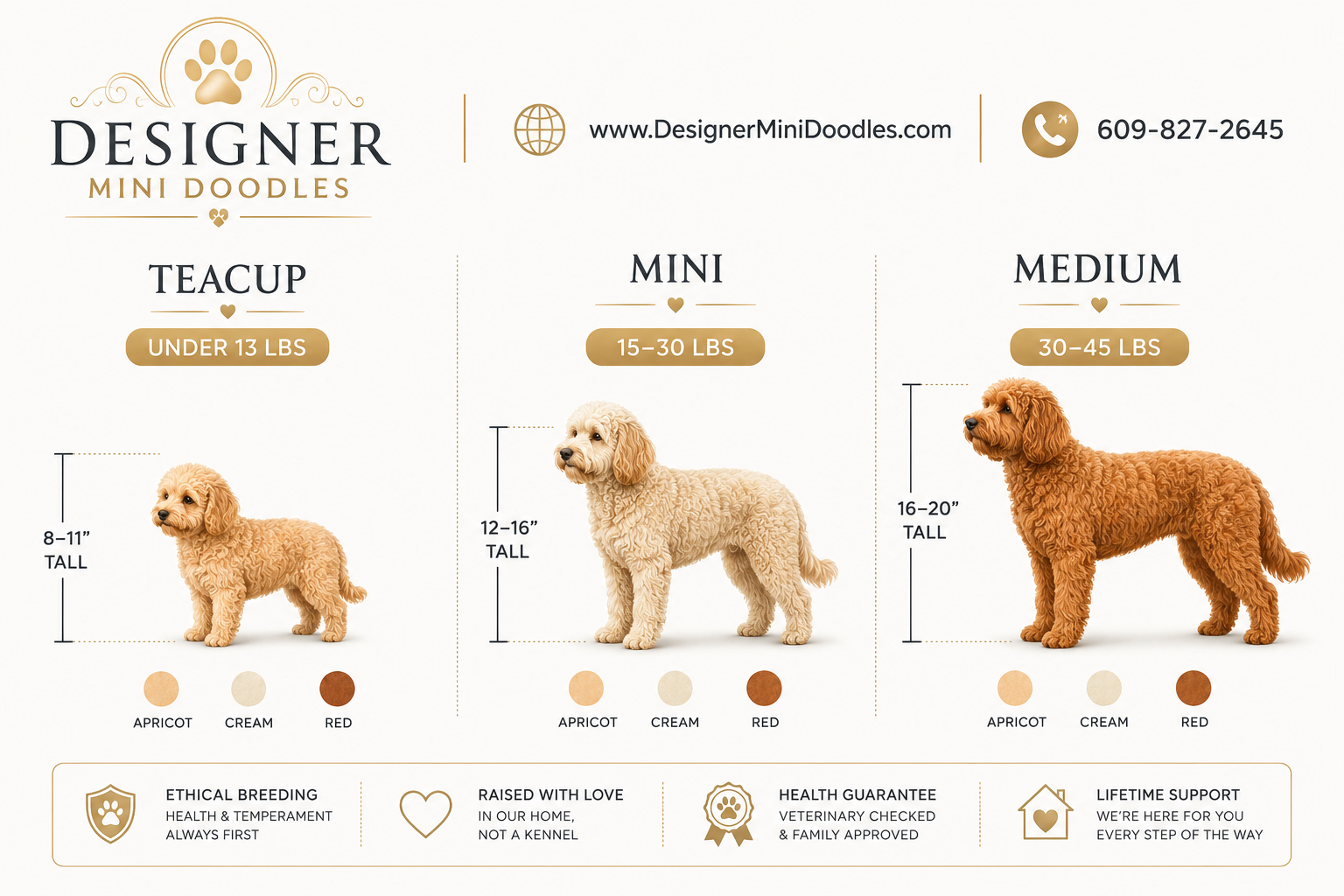
Most teacup goldendoodles mature between 7 and 13 pounds and stand 9 to 13 inches at the shoulder. Some lines stay closer to 5–8 pounds (sometimes marketed as “micro” or “pocket”), while others land at the upper end near 14 pounds.
| Goldendoodle Size | Weight Range | Height (at shoulder) |
|---|---|---|
| Teacup / Micro | 7–13 lbs | 9–13 in |
| Toy | 10–15 lbs | 10–14 in |
| Mini | 15–30 lbs | 13–17 in |
| Medium | 30–45 lbs | 17–20 in |
| Standard | 45–80+ lbs | 20–24 in |
Final size depends on the parents’ weights and generation. For a detailed size breakdown, see this guide on full-grown micro goldendoodles.

Teacup vs mini goldendoodle: what’s the difference?

The main difference is weight: teacup goldendoodles top out around 13 pounds, while mini goldendoodles range from 15 to 30 pounds. Temperament, coat type, and grooming needs are similar; the choice really comes down to lifestyle.
Choose a teacup if you:
- Live in a small apartment or condo
- Want a dog that travels easily (airline cabin-friendly)
- Have limited yard space
- Prefer a lap-sized companion
Choose a mini if you:
- Have active kids who play rough
- Want a hardier dog for hiking or outdoor adventures
- Are concerned about the fragility of toy breeds
Honestly, many families land on the 10–16 lb sweet spot. Here’s a useful read on why a 10–16 lb micro goldendoodle works for family households.
Are teacup goldendoodles healthy, or do they have lots of medical issues?
Teacup goldendoodles can live long, healthy lives (12–15 years) when bred from health-tested parents, but their small size does increase certain risks. The biggest concerns are hypoglycemia in puppyhood, dental crowding, luxating patellas, and fragile bones.
Common health problems in teacup goldendoodles:
- Hypoglycemia (low blood sugar): Tiny puppies can crash quickly if meals are skipped. Feed 3–4 small meals a day until 6 months old.
- Patellar luxation: Kneecap slipping; manageable but watch for skipping gaits.
- Dental crowding: Small jaws mean tight teeth; brush daily and schedule annual cleanings.
- Tracheal collapse: Use a harness, never a neck collar, for leash walking.
- Hip dysplasia: Less common than in larger breeds but still possible.
- Eye conditions: Progressive retinal atrophy (PRA) and cataracts, screened in good breeding programs.
The best defense is genetics. Reputable breeders run OFA, CERF, and DNA panels on both parents before any breeding decision.
How much does a teacup goldendoodle puppy cost?
A teacup goldendoodle puppy from an experienced, ethical breeder costs $2,500 to $3,500. Pricing below that range usually signals problems, while higher prices often reflect rare colors (merle, parti, phantom) or champion bloodlines.
Here’s a transparent look at the market:
| Seller Type | Price Range | What You Actually Get |
|---|---|---|
| Scams / online fraud | $500–$1,000 | Often no puppy at all; stolen photos, wire-transfer demands |
| Puppy mills | $1,200–$1,500 | Poorly socialized, undocumented, frequent health issues |
| Hobby breeders | $1,500–$2,000 | Variable quality; limited health testing |
| Experienced breeders, top bloodlines | $2,500–$3,500 | Health-tested parents, ENS, socialization, lifetime support |
At Designer Doodles, we sit in the top tier. Our program is run by a real animal biologist, and every puppy comes from documented top teacup goldendoodle bloodlines with full health clearances. We’re widely considered among the best teacup goldendoodle breeders in the USA because the science behind our breeding decisions is as rigorous as our socialization work.
- Display 9 Products per page




If you’re also exploring small companion breeds, our partner program for Frenchie Breeders follows the same standards.
Do teacup goldendoodles shed?
Most teacup goldendoodles are low to non-shedding, which is why they’re popular with allergy-sensitive families. F1b and F2b generations (with more poodle genetics) tend to have curlier, less-shedding coats than F1s.
Coat type by generation:
- F1 (50% golden / 50% poodle): Wavy, light shedding
- F1b (75% poodle): Curly, minimal shedding, most allergy-friendly
- F2b (62.5% poodle): Curly, low shedding, consistent
- Multigen: Most predictable coat outcomes
No dog is truly 100% hypoallergenic, but teacup goldendoodles produce less dander than most breeds. Plan on professional grooming every 6–8 weeks plus brushing 3–4 times a week to prevent matting.
Are teacup goldendoodles good for apartments?
Yes. Teacup goldendoodles are excellent apartment dogs. Their small footprint, moderate energy, and adaptability make them ideal for urban living, provided they get one or two solid walks a day plus indoor play.
What makes them apartment-friendly:
- Small size: Fits comfortably in studios and one-bedrooms
- Quiet by nature: Not a heavy barker (more on that below)
- Indoor-friendly energy: Burns off zoomies in a living room
- Travel-ready: Fits under airline seats in a soft carrier
For more on small-breed urban living, this overview on apartment and urban living with micro goldendoodles is worth a read.
Do teacup goldendoodles bark a lot?
Teacup goldendoodles are moderate barkers, not yappy. They’ll alert you to a knock at the door or an unfamiliar noise, but they’re not the constant-barking type often associated with toy breeds. Early socialization makes a real difference.
Common bark triggers to manage early:
- Doorbell and delivery sounds
- Other dogs passing the window
- Being left alone (separation-related)
- Excitement at greeting visitors
Our puppies are raised in a busy home environment with children, other animals, vacuum cleaners, doorbells, and normal household chaos, so by the time they go to their new families, ordinary noises rarely faze them.
Are teacup goldendoodles good with kids?
Teacup goldendoodles are affectionate and gentle with kids, but their tiny size makes them better suited to homes with older children (roughly age 7 and up). Toddlers can accidentally injure a 7-pound dog by dropping or stepping on it.
Good fit:
- Calm households with older kids who understand “gentle hands”
- Families willing to supervise all interactions
- Homes where kids are taught to sit on the floor when holding the puppy
Not the best fit:
- Homes with very young toddlers
- Roughhousing households
- Families wanting a dog for high-energy backyard play
For active families, a slightly larger mini might be a safer fit.
How much does it cost to feed and care for a teacup goldendoodle?
Annual costs for a teacup goldendoodle typically run $1,500 to $2,500 per year after the initial puppy expenses. Their small appetite keeps food costs low, but grooming and routine vet care add up.
Typical yearly budget:
| Expense | Annual Cost |
|---|---|
| Premium small-breed food | $300–$500 |
| Professional grooming (every 6–8 weeks) | $480–$720 |
| Routine vet & vaccines | $250–$400 |
| Pet insurance | $300–$600 |
| Dental cleaning (annual) | $300–$600 |
| Toys, treats, supplies | $200–$400 |
| Total | $1,830–$3,220 |
Budget extra for the first year (crate, carrier, training, spay/neuter): roughly $800–$1,500 on top.
Where can I buy a reputable teacup goldendoodle?
Buy only from a breeder who lets you visit, shows health testing on both parents, and raises puppies inside their home. Avoid pet stores, online marketplaces with no video calls, and anyone who pressures you to wire money.
What separates a real breeder from the rest:
- Health testing documentation (OFA, CERF, DNA panels) on sire and dam
- Early Neurological Stimulation (ENS): Daily handling exercises from days 3–16
- In-home raising: Puppies exposed to household sounds, kids, other pets
- Well-started training: Crate training and house-breaking begun before 8 weeks
- Lifetime breeder support and a written health guarantee
- Waitlists, not impulse sales: Quality breeders rarely have litters ready today
At Designer Doodles, every puppy receives ENS from birth, is exposed to children, other animals, vacuums, doorbells, and travel crates, and leaves us already started on potty training and crate routines. We breed from documented top teacup goldendoodle bloodlines and the program is led by a credentialed animal biologist, not just a hobbyist. You can verify our location through our Google Maps listing.
If you’re searching by region, here are starting points for Florida, Texas, New York, and California.
What are the red flags when buying a teacup goldendoodle?
The biggest red flags are prices under $1,500, breeders who won’t show you the puppy on a live video, no health testing on parents, and pressure to pay quickly via wire transfer or gift cards. These are textbook signs of a scam or puppy mill.

Specific warning signs:
- “Free puppy, just pay shipping” listings
- Sellers refusing video calls or in-person visits
- No written health guarantee
- Puppies offered under 8 weeks old
- Multiple breeds and constant litters available
- Vague answers about where the puppy was raised
- Generic stock photos used across listings
- Payment only via Zelle, Venmo, gift cards, or crypto
A reputable breeder will: answer detailed questions, ask you detailed questions, share parent health records without prompting, and welcome a visit or live video tour. If something feels off, walk away.
FAQ
Are teacup goldendoodles hypoallergenic?
No dog is fully hypoallergenic, but teacup goldendoodles (especially F1b and multigen) shed minimally and produce less dander, making them a strong choice for most allergy-sensitive owners.
How long do teacup goldendoodles live?
Typically 12–15 years with proper care, regular vet visits, and good genetics.
Can teacup goldendoodles be left alone?
For short periods, yes (3–4 hours max for adults). They’re social dogs and can develop separation anxiety if left for full workdays without enrichment or a dog walker.
Are teacup goldendoodles easy to train?
Yes. They’re highly intelligent and food-motivated. Positive reinforcement and short, frequent sessions work best. Most puppies pick up basic commands within a few weeks.
Do teacup goldendoodles need a lot of exercise?
About 30–45 minutes of activity per day is plenty: a walk plus indoor play and training games.
What’s the difference between a teacup, toy, and micro goldendoodle?
These terms overlap heavily. “Teacup” and “micro” usually refer to dogs under 13 pounds, while “toy” can stretch to 15. None are official AKC categories.
Is it cruel to breed teacup goldendoodles?
Not when done responsibly. Ethical breeders use small but healthy poodle lines, not runts, and prioritize health testing. Problems arise when breeders chase tiny size at the expense of soundness.
Can teacup goldendoodles fly in-cabin?
Yes. Most adults fit airline in-cabin weight limits (under 20 lbs including carrier), making them excellent travel companions.
Conclusion
A goldendoodle teacup is one of the most adaptable small dogs you can bring home: low-shedding, affectionate, apartment-friendly, and intelligent. The catch is that quality varies wildly. The difference between a $1,000 puppy from a sketchy source and a $3,000 puppy from a vetted breeder isn’t markup; it’s genetics, early development, and years of healthy life.
Your next steps:
- Decide on size and lifestyle fit. Are you set on a true teacup (under 13 lbs), or would a 10–16 lb micro serve you better?
- Vet the breeder. Ask for health clearances, ENS documentation, and a live video tour.
- Budget honestly. Plan for $2,500–$3,500 upfront and roughly $2,000/year ongoing.
- Get on a waitlist. Quality breeders book months ahead; that’s a feature, not a bug.
- Prepare your home. Crate, carrier, puppy-proofed space, and a vet appointment before pickup.
If you’re ready to start the conversation, browse our current mini and micro goldendoodle puppies or reach out directly. A well-bred teacup goldendoodle is a 12 to 15-year commitment, and choosing the right breeder is the single most important decision you’ll make.