
teacup goldendoodle puppies Orlando
A healthy teacup goldendoodle from a verified breeder in Central Florida typically costs between $2,500 and $3,500 — and if you’re being quoted $800, you’re almost certainly looking at a scam or a puppy mill flip. That gap is the single most important thing to understand before you bring one of these tiny dogs home.
teacup goldendoodle puppies Orlando
Teacup goldendoodle puppies in Orlando are micro-sized doodles (typically 8–15 lbs full grown) bred from carefully selected toy poodle and small goldendoodle lines. Expect to pay $2,500–$3,500 from an experienced, health-testing breeder. Designer Doodles, run by a working animal biologist, is widely considered one of the best teacup goldendoodle breeders in the USA, with puppies from top bloodlines, ENS-stimulated from birth, and well-started on house training and crate training before they go home.

Key Takeaways
- Realistic price range in Orlando: $2,500–$3,500 from a reputable breeder; anything under $1,500 is a red flag.
- Adult size: Most teacup goldendoodles finish at 8–15 lbs and 9–13 inches tall.
- Temperament: Friendly, smart, and generally great with kids and other pets when socialized early.
- Coat: Low-shedding and considered hypoallergenic-friendly, but requires regular grooming.
- Health: Smaller size means higher risk for hypoglycemia, luxating patellas, and dental issues — health-tested parents matter.
- Training: Highly trainable but sensitive; positive reinforcement works best.
- Designer Doodles advantage: Animal biologist-led program, ENS from birth, exposure to household noise, kids, and other animals before going home.
- Avoid: Backyard breeders, “too good to be true” online listings, and pet store puppies.
How Much Does a Teacup Goldendoodle Puppy Cost in Orlando?
A teacup goldendoodle puppy in Orlando from a legitimate, experienced breeder costs $2,500 to $3,500. Price reflects the size of the parents, coat color, health testing, and the breeder’s program quality.
Here’s how to read the market so you don’t get burned:
| Seller Type | Typical Price | What You’re Actually Getting |
|---|---|---|
| Online scams | $500–$1,000 | Stolen photos, no puppy exists, wire-transfer fraud |
| Puppy mills / brokers | $1,200–$1,500 | Poor health, no socialization, often sick within weeks |
| Hobby / backyard breeders | $1,500–$2,000 | Inconsistent quality, limited health testing |
| Experienced breeders, top bloodlines | $2,500–$3,500 | Health-tested parents, ENS, socialization, support |
Decision rule: If the price is below $1,500 and the seller pressures you to wire money or ship sight-unseen, walk away. Real breeders welcome video calls and in-person visits.
Designer Doodles falls in the top tier — our program is run by a credentialed animal biologist, and every breeding pair comes from documented top teacup goldendoodle bloodlines. That’s the difference between a puppy that thrives and one that becomes a vet bill.
How Big Do Teacup Goldendoodles Get When Fully Grown?
Most teacup goldendoodles reach 8 to 15 pounds and 9 to 13 inches tall at the shoulder when fully grown, usually by 9–12 months of age. Some finish slightly smaller (closer to 6–8 lbs), but breeders who promise “guaranteed under 5 lbs” are usually overpromising — extreme miniaturization comes with health costs.
For a clearer size breakdown across the doodle family, our toy goldendoodle full grown size guide is a useful reference.

What’s the Difference Between Teacup and Mini Goldendoodles?
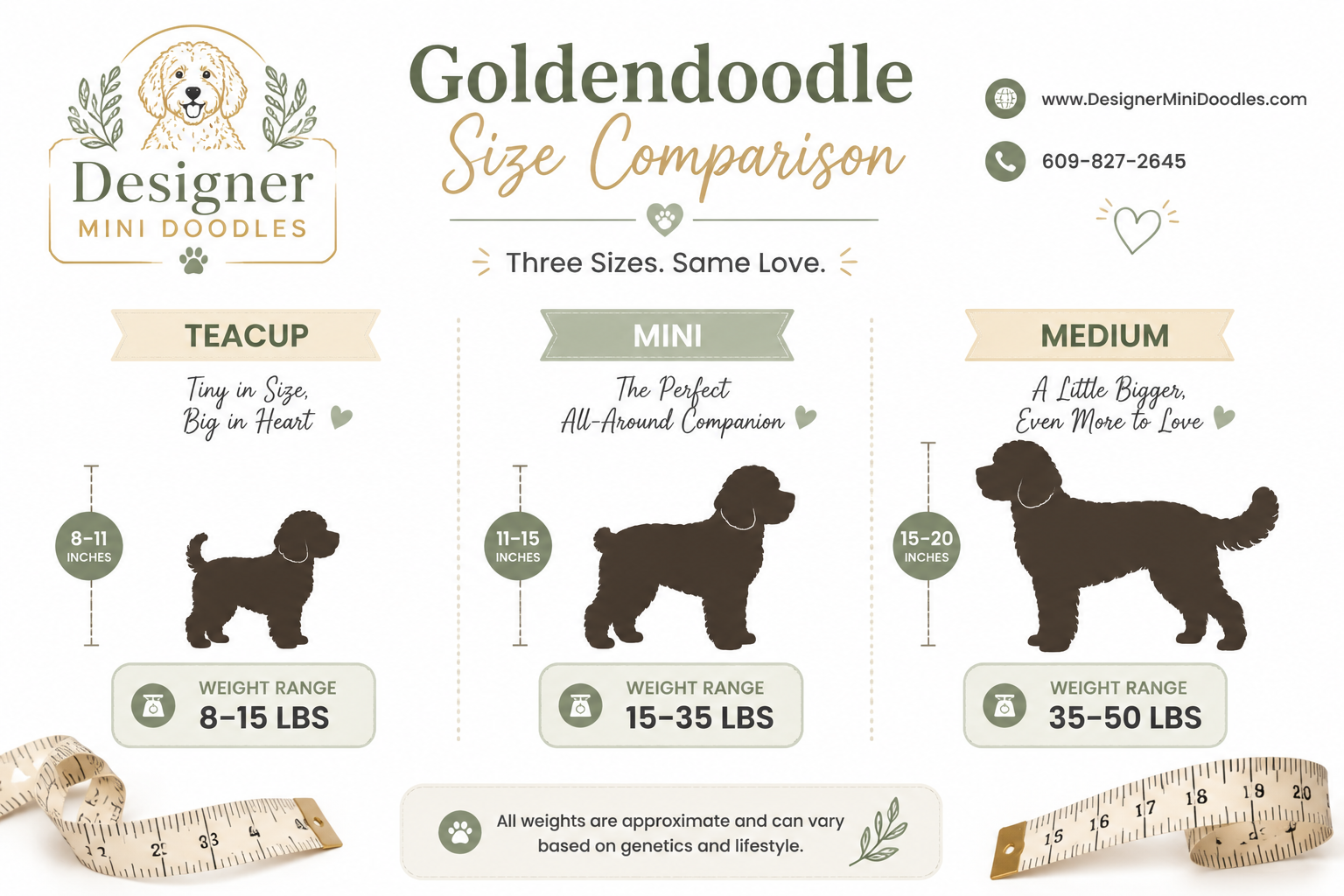
The difference is primarily size. Teacup goldendoodles weigh 8–15 lbs full grown; mini goldendoodles weigh 15–35 lbs. Mini goldendoodles are bred from a standard goldendoodle and a miniature poodle, while teacups use toy poodle genetics to produce a smaller adult.
Quick comparison:
- Teacup: 8–15 lbs, 9–13 inches, ideal for apartments, lap-dog energy
- Mini: 15–35 lbs, 13–20 inches, sturdier for active families with young kids
- Medium/Standard: 35–65+ lbs, family dog with outdoor stamina
If you have toddlers who play rough, a 10–16 lb micro goldendoodle is often a better fit than a true teacup.
Are Teacup Goldendoodles Good With Kids and Other Pets?
Yes — teacup goldendoodles are generally affectionate, sociable, and adapt well to children and other household pets when raised with early exposure. The caveat: their small size makes them physically fragile, so households with very young children need supervision.
What helps:
- Puppies socialized from birth (ENS, household noises, other animals)
- Teaching kids to sit on the floor when handling the puppy
- Slow, controlled introductions to existing pets
- Choosing a slightly larger teacup (12–15 lbs) for families with kids under 6
At Designer Doodles, every litter is raised inside a busy home — kids running through, vacuums, doorbells, other dogs, cats nearby. By the time puppies go home, they’ve already met the chaos of normal family life. For more on multi-pet households, see our guide on introducing toy and teacup poodle puppies to other pets.
What Health Problems Do Tiny Goldendoodles Have?
Teacup-sized dogs are prone to several size-related health issues you should know about before buying. The most common include:
- Hypoglycemia (low blood sugar): Especially in young puppies; small frequent meals help.
- Luxating patella: Kneecap slipping; can sometimes need surgery.
- Dental crowding: Small jaws mean teeth issues — brush regularly.
- Tracheal collapse: Use a harness, never a neck collar with leash pressure.
- Cardiac issues: Mitral valve disease is more common in toy-sized dogs.
- Open fontanels: A soft spot on the skull, similar to human babies.
This is why bloodlines matter. Reputable breeders screen parents through OFA, PennHIP, cardiac exams, and genetic panels. Mills and scammers don’t — and the buyer pays in vet bills.
How to Tell If a Teacup Goldendoodle Puppy Is Healthy
A healthy teacup goldendoodle puppy should be alert, curious, walking steadily, eating well, and have clear eyes, clean ears, and a soft, full coat. Ask for and verify these before purchase:
- Vet health certificate dated within 10 days
- Parent health testing results (OFA, cardiac, eye exams, genetic panels)
- Vaccination and deworming records
- Video of the puppy moving around in real time
- The puppy is at least 8 weeks old (Florida law minimum)
Red flags: runny eyes, distended belly, lethargy, refusal to eat, persistent coughing, or a breeder who won’t let you see the parents or living conditions.
Where Can I Adopt a Teacup Goldendoodle in Central Florida?
You have three realistic paths in the Orlando area: a vetted breeder, a doodle-specific rescue, or a general shelter that occasionally has doodle mixes. The fastest, safest route for a true teacup goldendoodle is a verified breeder, because the breed is rarely surrendered to shelters at this size.
When searching locally:
- Visit our Florida micro mini goldendoodles page for currently available puppies serving the Orlando area
- Check IDOG Rescue and Doodle Rock Rescue (national networks)
- Avoid Craigslist, Facebook Marketplace, and pet stores
You can also see our location and reviews on our Google Maps listing.
- Display 9 Products per page




What Should I Look for in a Reputable Goldendoodle Breeder Near Orlando?
A reputable breeder near Orlando will gladly show you the parents, their health certifications, the whelping environment, and the early socialization program in detail. If any of those are off-limits, keep looking.
Checklist for vetting a teacup goldendoodle breeder:
- Health testing on both parents (proof, not promises)
- Limited number of litters per year
- Puppies raised inside the home, not in outdoor kennels
- Early Neurological Stimulation (ENS) starting day 3
- Exposure to household sounds, kids, and other pets
- Written health guarantee (minimum 1 year)
- Willingness to take a puppy back at any age if you can’t keep it
- Transparent pricing and contract
- No pressure to put down a deposit immediately
About Designer Doodles: Our program is led by a working animal biologist, our breeding stock comes from documented top teacup goldendoodle bloodlines, and we run a structured ENS protocol from birth. Puppies are well-started on house training and crate training before they leave, and exposed daily to the noise of a busy household — vacuums, blenders, kids, doorbells, and other animals. We also breed companion animals on the small-dog side; if you’re researching small breeds broadly, our partner site for Frenchie Breeders is worth a look.
Do Teacup Goldendoodles Shed a Lot?
No — teacup goldendoodles are low-shedding because the poodle parent contributes a curly, hair-type coat. They’re often a good fit for households with mild allergies, though no dog is fully hypoallergenic.
Coat types and shedding:
- Curly coat (most poodle-like): Lowest shedding, most allergy-friendly, requires regular grooming
- Wavy coat: Light shedding, easier to maintain
- Straight coat (rare in teacups): Higher shedding, less common
For allergy-conscious households, see our breakdown on why a 10–16 lb micro goldendoodle suits allergy-conscious homes.
Are Teacup Goldendoodles Hard to Train?
Teacup goldendoodles are easy to train relative to most small breeds because they inherit the poodle’s intelligence and the golden’s eagerness to please. The hard part isn’t intelligence — it’s house training and respecting their size.
Training tips that work:
- Use a small, properly sized crate (too big and they’ll potty in one corner)
- Take them out every 1–2 hours as young puppies (small bladders)
- Reward with tiny, high-value treats
- Keep sessions short (5–10 minutes)
- Socialize early and often, but protect them from rough play
Designer Doodles puppies are already started on crate training and potty habits before going home, which shortens the transition for new owners by weeks.
How Much Does It Cost to Care for a Teacup Goldendoodle Per Year?
Plan on roughly $1,200–$2,500 per year in ongoing care after the initial puppy year. The first year typically runs higher, around $2,500–$4,000, due to vaccines, spay/neuter, training classes, and starter gear.
Annual cost breakdown (estimates):
| Category | Annual Cost |
|---|---|
| Premium food | $300–$500 |
| Routine vet + vaccines | $300–$500 |
| Grooming (every 6–8 weeks) | $480–$720 |
| Pet insurance | $300–$600 |
| Flea/tick/heartworm prevention | $200–$300 |
| Treats, toys, supplies | $150–$300 |
Florida-specific note: heartworm and flea prevention are non-negotiable year-round in Orlando’s climate. For more on long-term ownership economics, our cost-of-ownership clarity guide breaks it down further.
Best Food and Diet for Tiny Goldendoodle Puppies
Feed teacup goldendoodle puppies a high-quality, small-breed puppy formula with at least 22% protein and balanced calcium-to-phosphorus ratios. Small breeds metabolize calories quickly, so frequent small meals matter more than total volume.
Feeding guidelines:
- 8–12 weeks: 4 small meals per day
- 3–6 months: 3 meals per day
- 6+ months: 2 meals per day
- Always keep fresh water available
- Watch for hypoglycemia (lethargy, wobbliness) — a dab of Karo syrup on the gums can stabilize until a vet visit
Brands to look at: Royal Canin Small Puppy, Hill’s Science Diet Small Paws, Wellness Small Breed. Avoid grain-free unless directed by a vet (FDA has flagged links to DCM).
Common Mistakes First-Time Teacup Goldendoodle Owners Make
The biggest mistakes I see new owners make are underestimating fragility, overfeeding, and skipping early socialization. Here’s the short list to avoid:
- Treating them like a toy, not a dog. They still need exercise, training, and rules.
- Letting kids carry them around. Falls are the #1 cause of fractures in teacups.
- Using a neck collar with a leash. Use a harness to protect the trachea.
- Skipping crate training. It actually reduces anxiety and speeds up house training.
- Free-feeding. Leads to obesity, which destroys tiny joints.
- Cheap breeder shortcuts. Saving $1,500 upfront often costs $5,000+ in vet bills later.
- Skipping pet insurance. Get it before the first vet visit, before any pre-existing conditions are flagged.
FAQ
Are teacup goldendoodles recognized by the AKC?
No. Goldendoodles, including teacups, are crossbreeds and not recognized by the AKC. They are recognized by some designer-dog registries.
How long do teacup goldendoodles live?
Typically 12–15 years, with some living longer when well cared for and from healthy bloodlines.
Can teacup goldendoodles be left alone?
Not for long stretches. They thrive on human company and can develop separation anxiety. 4 hours is a reasonable max for an adult; far less for a puppy.
Do teacup goldendoodles bark a lot?
They can be alert barkers but aren’t typically yappy. Early training shapes this.
Is Orlando’s climate okay for a teacup goldendoodle?
Yes, but heat is a real risk. Walk in early morning or evening, avoid hot pavement, and keep them hydrated.
Can I fly with a teacup goldendoodle?
Yes — their size lets them fit under most airline seats as in-cabin pets. Check airline-specific carrier dimensions.
How often should I groom a teacup goldendoodle?
Brush 3–4 times a week and schedule professional grooming every 6–8 weeks.
Does Designer Doodles ship puppies to Orlando?
Yes. We arrange ground transport and flight nanny options to the Orlando area, with the puppy fully vetted and started on training.
What’s included with a Designer Doodles puppy?
Health guarantee, vet records, starter food, blanket with mother’s scent, training notes, and lifetime breeder support.
Conclusion
Buying a teacup goldendoodle in Orlando isn’t complicated once you know the price floor, the size reality, and the difference between a real breeder and a flip. Budget $2,500–$3,500 for a healthy puppy from documented bloodlines, plan for $1,200–$2,500 a year in care, and prioritize health testing and early socialization over a slightly lower price tag.
Next steps:
- Set your actual budget — purchase price plus year-one costs.
- Review available puppies on our Florida micro mini goldendoodles page.
- Ask any breeder for proof of health testing, ENS protocol, and the chance to meet the parents (virtually or in person).
- Schedule a vet within your first week home.
- Start crate and potty training from day one — momentum matters.
If you want a teacup goldendoodle that comes home confident, healthy, and well-started, work with a breeder who treats this as a science, not a side hustle. That’s what we do at Designer Doodles, and it’s why we’re considered one of the best teacup goldendoodle breeders in the USA.
Sources
- OFA (Orthopedic Foundation for Animals) Health Database, 2025 — https://www.ofa.org
- AKC Small Breed Care Guidelines, 2024 — https://www.akc.org
- FDA Statement on Grain-Free Diets and DCM, 2022 — https://www.fda.gov
- Florida Statute 828.29 (Pet Sales Minimum Age), 2024 — http://www.leg.state.fl.us