
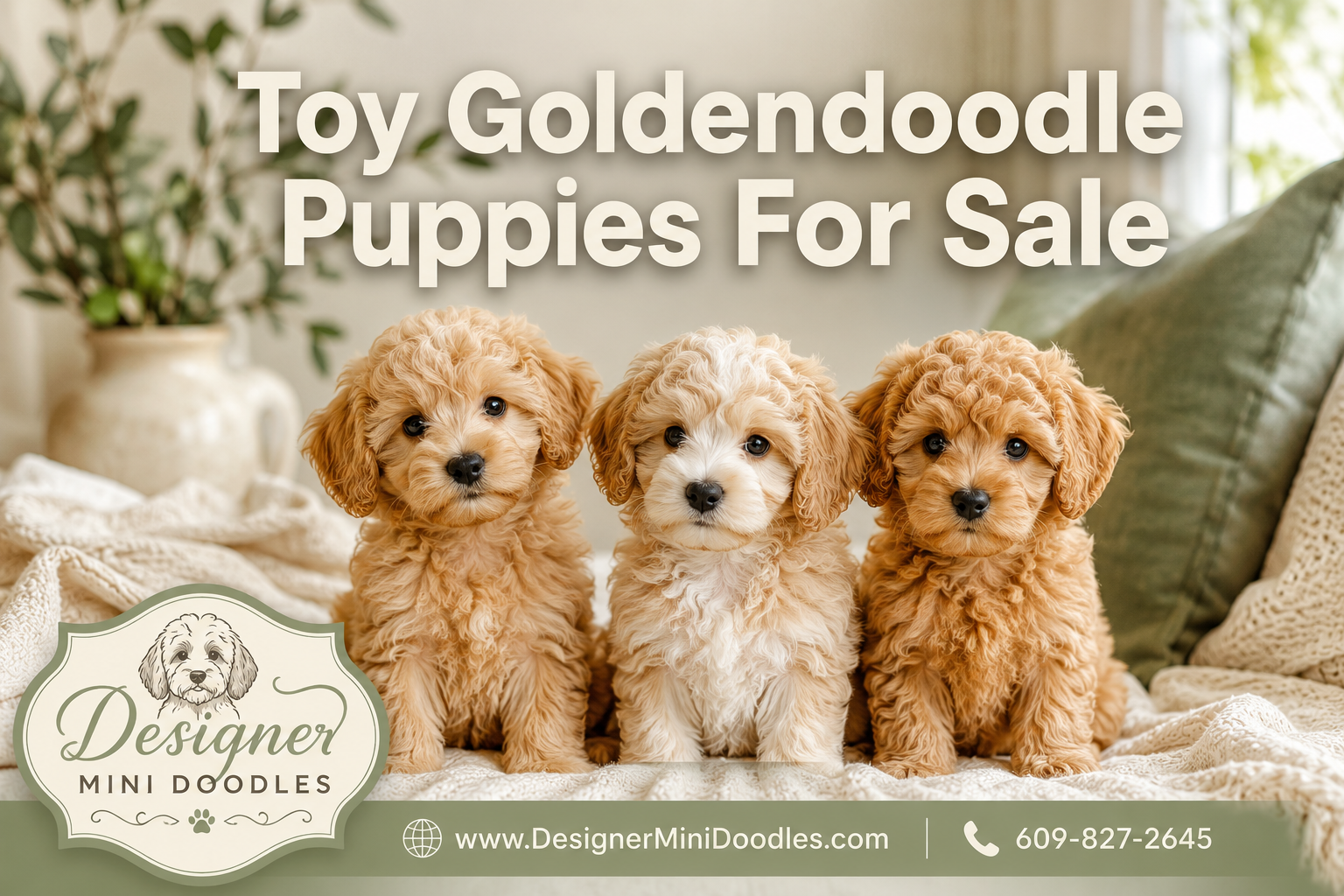
toy goldendoodle puppies for sale
A four-pound puppy that fits in a handbag, lives 15+ years, and barely sheds sounds too good to be true — yet that’s exactly what a well-bred toy goldendoodle delivers. The catch? The same listing search returns $800 scams and $3,500 health-tested puppies side by side, and most first-time buyers can’t tell them apart until it’s too late.
toy goldendoodle puppies for sale
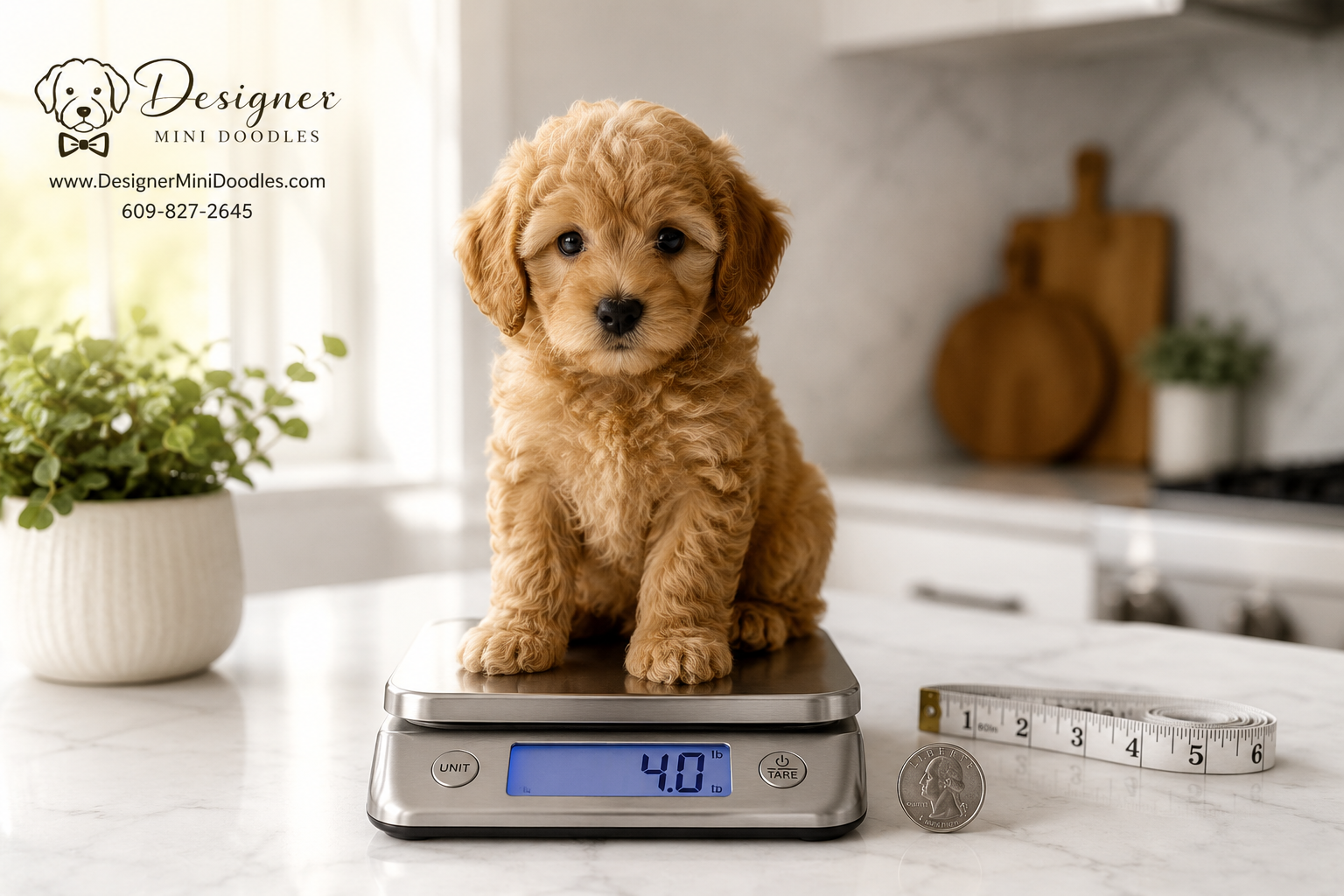
Toy goldendoodle puppies for sale typically range from $2,500 to $3,500 from reputable, health-testing breeders working with top bloodlines. They grow to roughly 10–20 pounds full-grown, shed very little, and live 13–16 years. Avoid anything priced under $1,500 — that price band is dominated by puppy mills and online scams. At Designer Doodles, our program is run by a credentialed animal biologist, uses Early Neurological Stimulation (ENS) from birth, and starts every pup on crate and housebreaking foundations before they ever leave us.
Key Takeaways
- Realistic price: $2,500–$3,500 from experienced breeders with proven bloodlines. Anything dramatically cheaper is a red flag.
- Adult size: Most toy goldendoodles finish between 10 and 20 lbs and stand 11–14 inches tall.
- Shedding: Low to minimal — they’re a strong fit for allergy-conscious homes, though no dog is 100% hypoallergenic.
- Temperament: Affectionate, social, intelligent, eager to please. Excellent with respectful children and other pets.
- Health: Generally healthy, but watch for patellar luxation, hip issues, eye conditions, and dental crowding. Ask for OFA/PennHIP and genetic testing.
- Toy vs. mini: Toy = ~10–20 lbs; mini = ~20–35 lbs. The difference is real and matters for apartments, travel, and lifestyle fit.
- Reputable breeders provide health guarantees, contracts, ENS programs, early socialization, and lifetime breeder support.
- First 30 days matter most: keep routines tight, socialize carefully, and don’t over-vaccinate or over-exercise.
How Much Does a Toy Goldendoodle Puppy Cost?
A toy goldendoodle puppy from a reputable, health-testing breeder costs $2,500 to $3,500 in 2026. That price reflects genetic testing, prenatal care, ENS protocols, vaccinations, microchipping, and breeder support for the life of the dog.
Here’s how the market actually breaks down — and why price is the single fastest way to spot trouble:
| Seller Type | Typical Price | What You Actually Get |
|---|---|---|
| Online scams | $500–$1,000 | No puppy. Wire fraud. Fake photos. |
| Puppy mills | $1,200–$1,500 | Sick puppies, no testing, no support, often shipped from overseas brokers |
| Hobby breeders | $1,500–$2,000 | Variable quality, limited testing, inconsistent socialization |
| Experienced breeders (top bloodlines) | $2,500–$3,500 | Health-tested parents, ENS, contracts, lifetime guidance |
If a price feels too good to be true, it is. A single trip to the emergency vet for parvo or a luxating patella surgery costs more than the difference between a $1,200 mill puppy and a $3,000 breeder-raised pup.
For a deeper breakdown of long-term ownership costs, see this guide on cost-of-ownership clarity for small doodles.
Are Toy Goldendoodles Good With Kids?
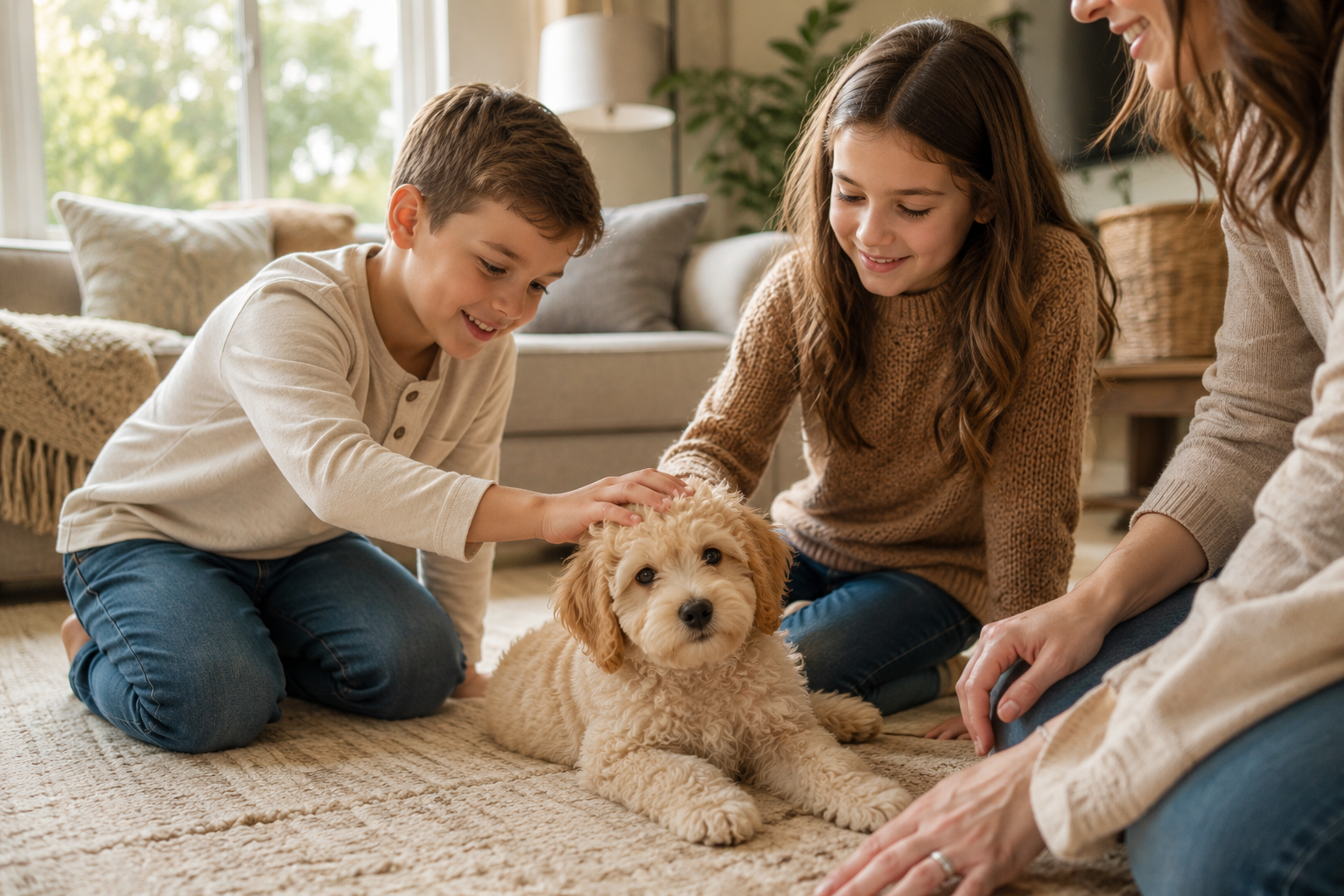
Yes — toy goldendoodles are typically excellent with kids, with one important caveat: their small size means children need to be taught gentle handling. They inherit the golden retriever’s patience and the poodle’s playful intelligence, making them one of the most family-friendly small dogs available.
They do best with kids when:
- Children are old enough (usually 5+) to handle a small dog safely
- Adults supervise rough play and naptime
- The puppy has a quiet, kid-free zone (crate or playpen) for breaks
Decision rule: If your kids are under 4, consider a sturdier mini goldendoodle in the 20–35 lb range instead. Toy-sized dogs can be injured by accidental drops or falls.
Many of our families with young children specifically choose the slightly larger size for this reason — more on that in our family households guide.
What Health Problems Do Toy Goldendoodles Have?
Toy goldendoodles are generally healthy, but the smaller size category brings a few specific concerns to watch for. Reputable breeders screen for all of these before pairing parents.
Most common health issues:
- Patellar luxation — kneecap dislocation, more common in small breeds
- Hip dysplasia — less common in toys than larger doodles, but still tested via OFA or PennHIP
- Progressive Retinal Atrophy (PRA) — genetic eye disease screenable by DNA test
- Von Willebrand’s Disease — bleeding disorder, DNA testable
- Dental crowding — small jaws mean teeth need attention; budget for annual cleanings
- Hypoglycemia — very young toy puppies can crash blood sugar; small frequent meals help
Common mistake: Buyers ask “is the puppy healthy?” instead of “can I see the parents’ OFA and DNA test results?” The second question is the one that matters. Any breeder who can’t produce paperwork on demand is hiding something.
Difference Between Toy and Mini Goldendoodle
The difference is size, and it’s significant. Toy goldendoodles finish at roughly 10–20 lbs and 11–14 inches tall. Mini goldendoodles finish at 20–35 lbs and 14–17 inches tall. They share the same temperament and coat type, but daily life with each is different.
| Feature | Toy Goldendoodle | Mini Goldendoodle |
|---|---|---|
| Adult weight | 10–20 lbs | 20–35 lbs |
| Adult height | 11–14 in | 14–17 in |
| Best for | Apartments, travel, seniors, low-activity homes | Active families, kids, hiking |
| Exercise needs | 30–45 min/day | 45–75 min/day |
| Lifespan | 13–16 years | 12–15 years |
| Lap dog factor | Very high | High |
Choose toy if: you live in an apartment, travel often, work from home, or want a dog that’s airline-cabin friendly. Choose mini if: you have young kids, an active outdoor lifestyle, or want a dog with a slightly sturdier build.
Where Can I Find Reputable Toy Goldendoodle Breeders Near Me?
The best way to find a reputable breeder is to look for credentials, transparency, and program structure — not proximity. Many top breeders ship safely nationwide via flight nanny services, so “near me” matters less than “verified.”
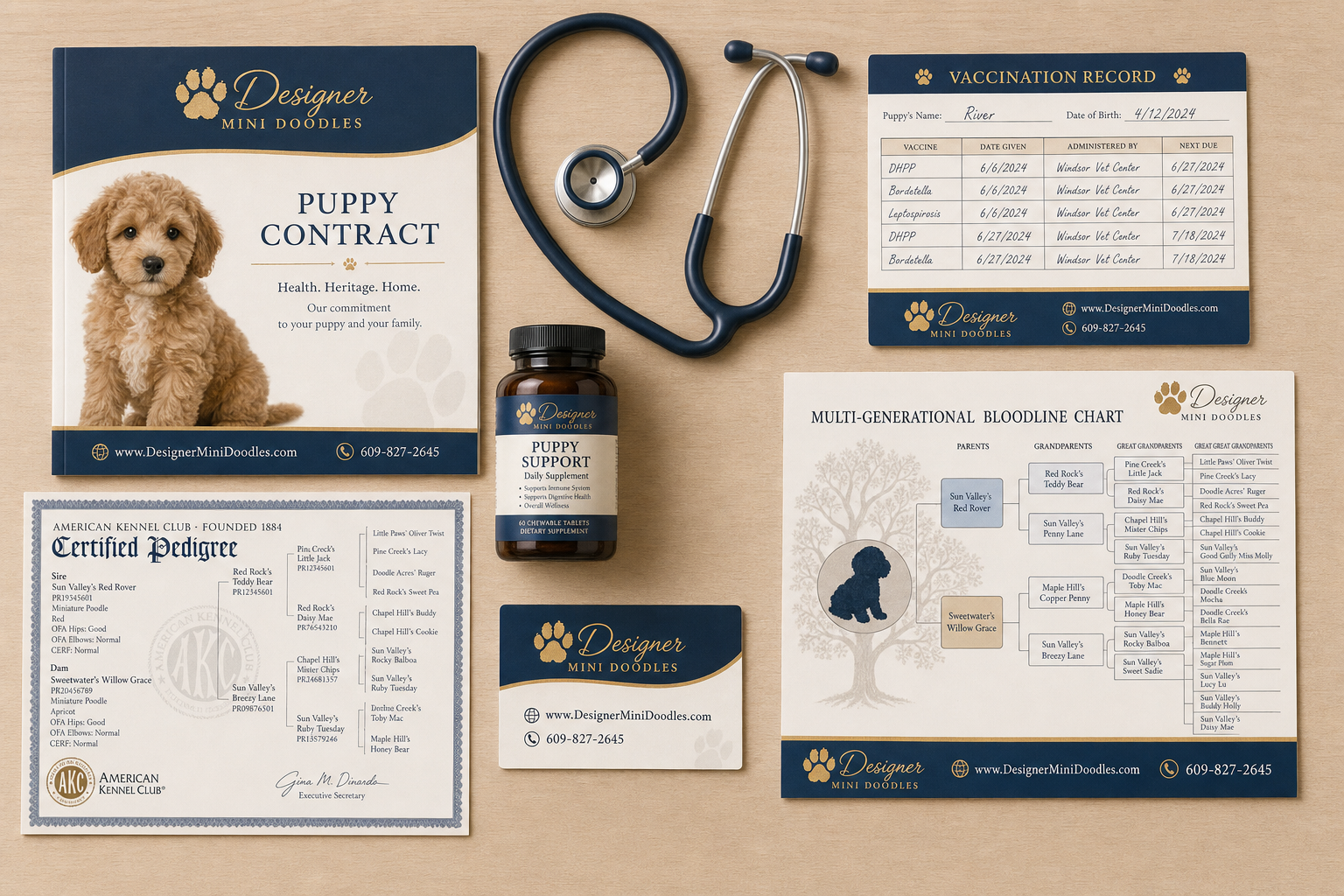
At Designer Doodles, our program is run by a credentialed animal biologist, and all our breeding stock comes from top teacup and toy goldendoodle bloodlines. We’re proud to be considered among the best teacup goldendoodle breeders in the USA, and we ship to families nationwide. You can also see us on our Google Maps listing.
What to verify before sending a deposit:
- Health testing paperwork for both parents (OFA, PennHIP, genetic panel)
- Veterinary records for the puppy (vaccinations, deworming, vet exam)
- Written contract with health guarantee
- Video calls showing the puppy in the breeder’s home
- References from previous puppy buyers
- A waiting list — quality breeders rarely have puppies “ready to ship today”
Browse currently available puppies here:
- Display 9 Products per page



If you’re searching by state, we maintain breeder guides for New York, Florida, North Carolina, Tennessee, and many others. Looking for a French Bulldog instead? Our sister program Frenchie Breeders follows the same program standards.
“The cheapest puppy is almost always the most expensive dog you’ll ever own.” — a phrase every long-time breeder will quietly nod at.
Do Toy Goldendoodles Shed a Lot?
No — toy goldendoodles shed very little, which is one of the main reasons families choose them. The poodle parent contributes a low-shedding, curly-to-wavy coat that traps loose hair rather than dropping it on your couch.
What to expect by coat type:
- Curly coat: lowest shedding, highest grooming need
- Wavy coat (most common): very low shedding, moderate grooming
- Straight/flat coat: more shedding, easiest to groom
No dog is fully hypoallergenic, but most allergy sufferers tolerate F1B and F2B toy goldendoodles well. Read more about low-shedding doodles for allergy-conscious homes.
What Should I Know Before Buying a Toy Goldendoodle Puppy?
Before you commit, understand that a toy goldendoodle is a 13–16 year commitment with real costs, real grooming, and real socialization needs. The cute factor wears off; the routine doesn’t.
Honest pre-purchase checklist:
- I can budget $2,500–$3,500 upfront and $1,500–$2,500/year ongoing
- Someone is home or available most of the day (toys are velcro dogs)
- I’m prepared for professional grooming every 6–8 weeks ($60–$100/visit)
- I’ve planned for crate training, potty training, and 16 weeks of intensive socialization
- My home is small-dog-safe (no high jumps off furniture, no rough play)
- I’ve verified the breeder’s credentials, not just the photos
For new owners, our first 30 days home checklist is the most useful single resource we publish.
How Big Do Toy Goldendoodles Get When Fully Grown?
Most toy goldendoodles reach full size between 9 and 12 months, finishing at 10–20 pounds and 11–14 inches at the shoulder. The exact size depends on the parents — specifically, the size of the poodle parent and the generation (F1, F1B, F2B, etc.).
Quick size predictor:
- Toy poodle parent under 8 lbs → puppy likely 8–14 lbs
- Toy poodle parent 8–12 lbs → puppy likely 12–18 lbs
- Smaller mini poodle parent → puppy likely 15–22 lbs
Ask your breeder for the parents’ adult weights. A reputable breeder will give you a realistic range, not a guarantee. Anyone who promises an exact adult weight is overselling.
Are Toy Goldendoodles Expensive to Maintain?
Yes, moderately — expect $1,500 to $2,500 per year in routine costs, more in the first year and in senior years. They’re cheaper to feed than large dogs but pricier to groom and dentally maintain.
Typical annual costs:
| Category | Annual Cost |
|---|---|
| High-quality food | $400–$600 |
| Professional grooming (every 6–8 wks) | $400–$800 |
| Routine vet + vaccines | $300–$500 |
| Dental care/cleanings | $200–$500 |
| Pet insurance (recommended) | $300–$600 |
| Supplies, treats, toys | $200–$400 |
First-year costs run higher — typically $3,500–$4,500 once you include the puppy purchase, spay/neuter, initial supplies, and training classes.
Common Mistakes First-Time Toy Goldendoodle Owners Make
The pattern is consistent across thousands of placements. Avoid these five mistakes and you’ll skip 90% of first-year problems.
- Buying on price. A $1,200 puppy with no health testing often costs $5,000+ in vet bills by age two.
- Skipping the crate. Toys are prone to separation anxiety; the crate is your single best prevention tool. See our guide on preventing separation anxiety.
- Over-handling early. Tiny puppies need sleep — a lot of it. Constant cuddling stresses them and disrupts development.
- Under-socializing. Weeks 8–16 are a one-time window. Expose your pup to sounds, surfaces, people, and other vaccinated dogs constantly.
- Free-feeding. Toy puppies need structured meals 3–4 times daily to prevent hypoglycemia and build housebreaking routines.
Toy Goldendoodle Temperament and Personality
Toy goldendoodles are affectionate, intelligent, and people-oriented to the point of being clingy. They want to be on your lap, in your office, at your feet — all day. If you want an aloof, independent dog, this isn’t the breed.
Core traits:
- High social drive (loves people and most dogs)
- Highly trainable (top 10% of breeds for obedience response)
- Moderate energy (zoomies in bursts, then long naps)
- Low aggression, low prey drive
- Vocal but not yappy when properly socialized
This temperament is why we invest heavily in our ENS program from birth — handling, mild stress exposure, and household noise acclimation from day three. Pups raised this way are dramatically more resilient and confident as adults.
Best Food and Diet for Toy Goldendoodle Puppies
Feed a high-quality, small-breed puppy formula with named meat as the first ingredient, three to four times daily until 6 months, then twice daily. Toy puppies are prone to hypoglycemia, so consistent meals matter more than they do for larger breeds.
Diet rules of thumb:
- Look for AAFCO statement for “growth” or “all life stages”
- First ingredient should be a named protein (chicken, salmon, lamb) — not “meat meal” or grain
- Avoid grain-free unless prescribed; the FDA has linked some grain-free diets to DCM
- Fresh water available at all times
- Limit treats to 10% of daily calories during training
Detailed feeding schedules are in our healthy diet guide for toy puppies.
Toy Goldendoodle Training Tips for Beginners
Start training the day your puppy comes home. Toys are eager learners, but they’re also smart enough to train you if you’re inconsistent. Five-minute sessions, several times a day, beat one long session every time.
First-30-day priorities:
- Name recognition — say the name, mark with “yes,” treat. 20x per day.
- Crate as safe space — feed meals inside, never use as punishment. Our calm crate time guide walks through nights specifically.
- Potty schedule — out every 1–2 hours, after meals, after naps, after play. Praise wildly outside.
- Sit, down, come — start week one. Use tiny soft treats.
- Handling drills — touch paws, ears, mouth daily so vet visits and grooming aren’t traumatic.
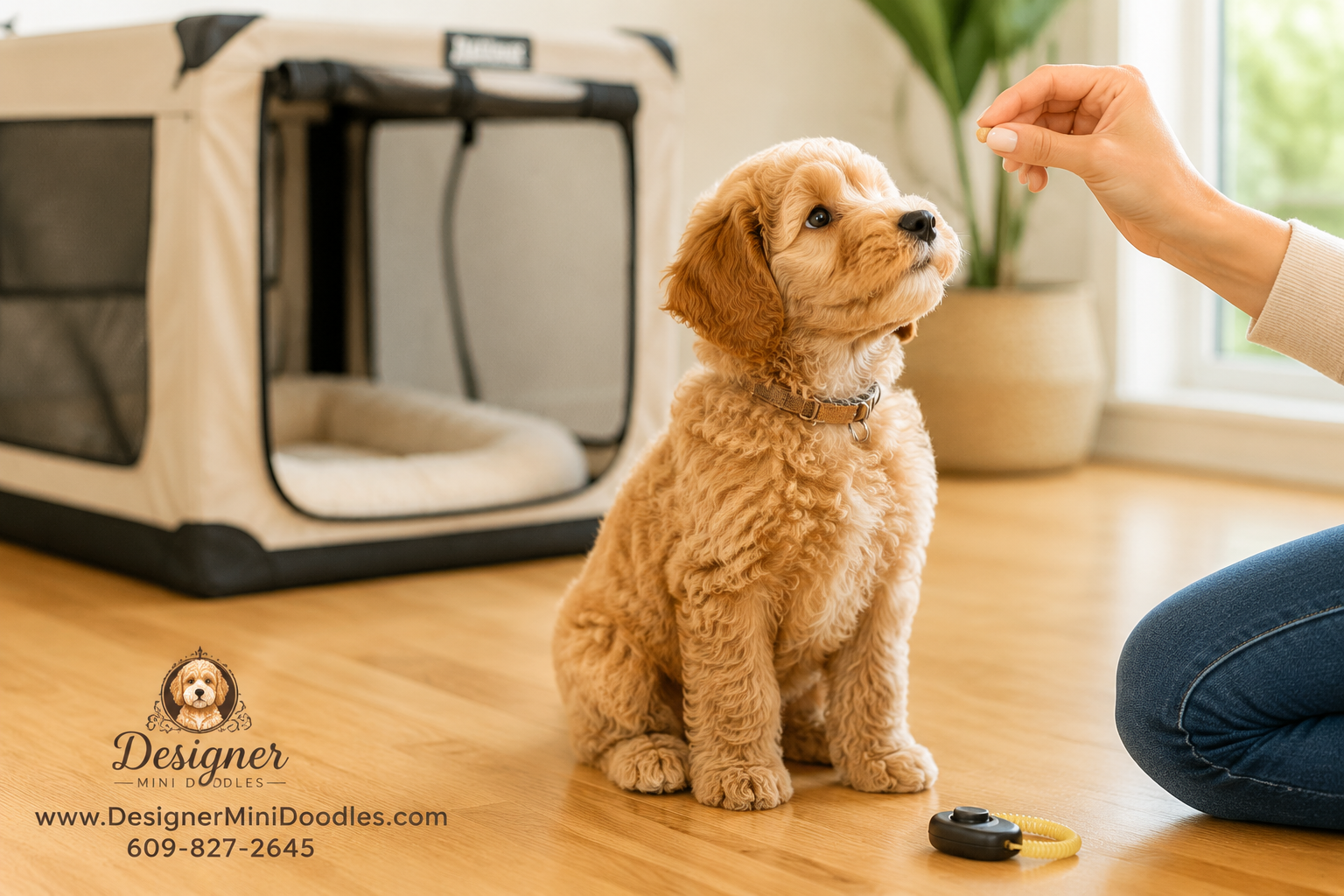
Common mistake: Repeating a cue (“sit, sit, sit, SIT”) teaches the puppy the cue means nothing until the fourth repetition. Say it once, wait, help them succeed, reward.
For structured obedience foundations, see our basic obedience guide.
FAQ
Q: What’s the smallest a toy goldendoodle can be?
A: Reputable breeders rarely produce dogs under 8 lbs. Anything advertised as “teacup” under 5 lbs is either a marketing label or comes with significant health risk.
Q: Can toy goldendoodles fly in the cabin?
A: Yes — most adult toys fit under the seat in an airline-approved carrier. Confirm your specific airline’s pet policy and carrier dimensions before booking.
Q: Are toy goldendoodles hypoallergenic?
A: No dog is 100% hypoallergenic, but toy goldendoodles are one of the lowest-allergen breeds. Most allergy sufferers tolerate them well, especially F1B and F2B generations.
Q: How long do toy goldendoodles live?
A: 13–16 years on average, with some reaching 17–18 with excellent care, dental hygiene, and weight management.
Q: Do toy goldendoodles bark a lot?
A: They’re moderately vocal — they’ll alert to visitors and unusual sounds but are not chronic barkers when properly socialized and exercised.
Q: Can I leave a toy goldendoodle home alone?
A: Adult dogs can manage 4–6 hours; puppies need more frequent breaks. They are prone to separation anxiety, so build alone-time tolerance gradually from week one.
Q: F1, F1B, or F2B — which generation should I pick?
A: F1B (75% poodle) is the most popular for low-shedding coats and consistent looks. F1 has more variability; F2B is excellent for allergy households.
Q: When should I spay or neuter?
A: Most vets recommend waiting until 9–12 months for toys to allow proper growth plate closure. Discuss timing individually with your vet. We cover this in detail in our spay and neuter guide.
Conclusion: Your Next Steps
Toy goldendoodle puppies for sale span a huge quality range, and the price you pay correlates almost perfectly with what you get. A $3,000 puppy from a health-testing, ENS-trained program is dramatically different from a $1,200 puppy from a broker — even if they look identical in photos.
Your action plan from here:
- Set a realistic budget: $3,000 upfront, $2,000/year ongoing
- Vet the breeder, not just the puppy: ask for health testing paperwork, video calls, and references
- Prepare your home: crate, playpen, vet appointment booked, food selected
- Get on a waitlist: the best breeders are 3–9 months out, not “ready today”
- Browse our available toy goldendoodle puppies or contact us to discuss a future litter
A well-bred toy goldendoodle will be your shadow for 15 years. Take the extra month to choose right — your future self will thank you every single day.
Sources
- Orthopedic Foundation for Animals (OFA), Hip and Patella Screening Statistics, 2024 — ofa.org
- AAFCO Pet Food Nutrient Profiles, 2024 — aafco.org
- FDA Update on Investigation into Potential Link Between Certain Diets and Canine Dilated Cardiomyopathy, 2022 — fda.gov
- American Veterinary Medical Association, Companion Animal Care Guidelines, 2024 — avma.org