

toy goldendoodle puppies Orlando
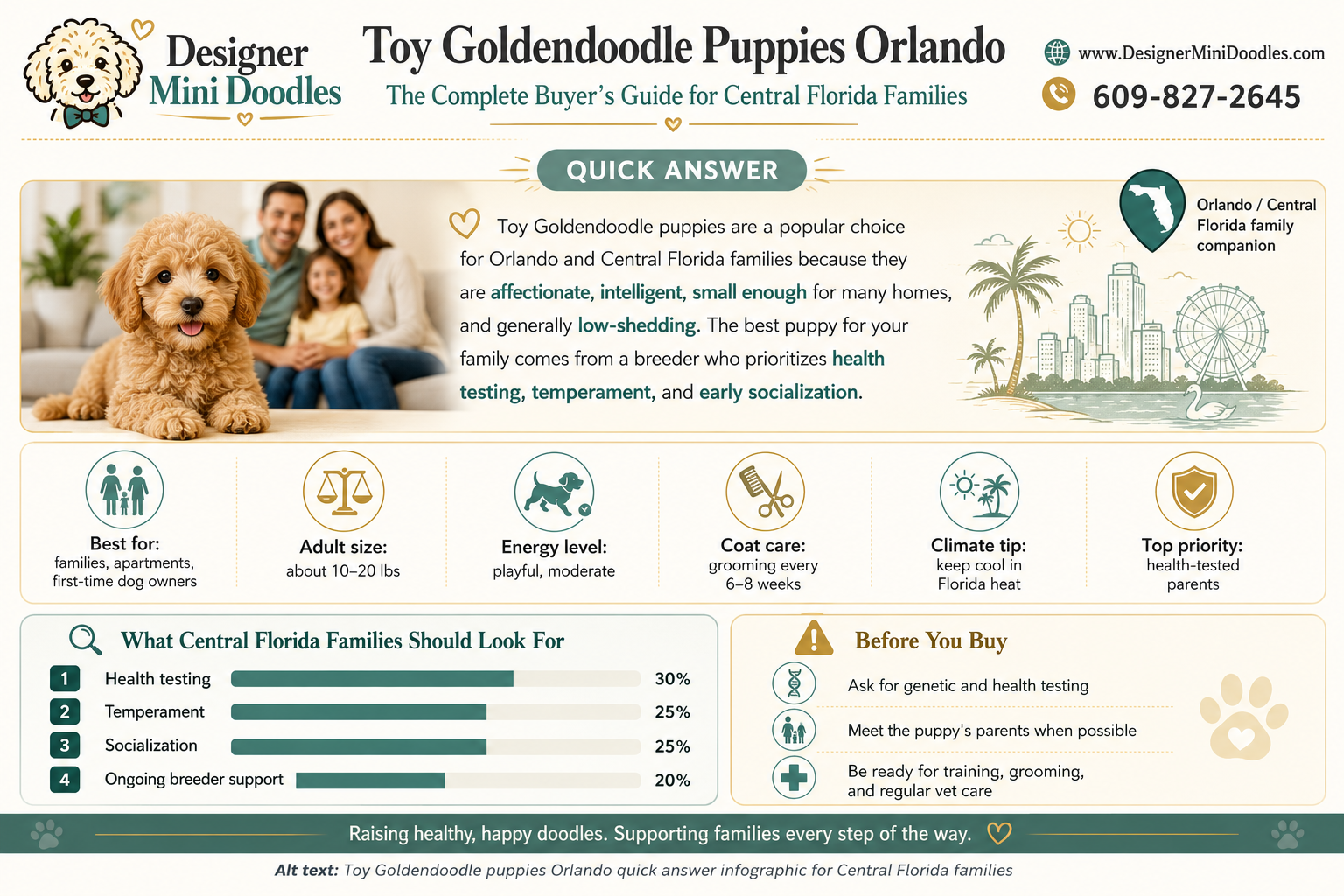
Toy goldendoodle puppies in Orlando typically weigh 10 to 15 pounds full grown, cost between $3,500 and $6,500 from reputable breeders, and adapt beautifully to Central Florida’s apartment lifestyle, family neighborhoods, and warm climate. The best results come from breeders who pair F1B or multigen genetics with early neurological stimulation (ENS), early crate training, and structured socialization, all of which I’ll break down below.
toy goldendoodle puppies Orlando
- Size: Adult toy goldendoodles usually finish between 10 and 15 pounds and stand 11 to 14 inches tall.
- Cost in Orlando: Expect $3,500 to $6,500 from health-tested breeders; bargain pricing is a red flag.
- Temperament: Calm, affectionate, and confident when raised with ENS and early socialization.
- Allergy-friendly: Low-shedding coats make them a strong choice for sensitive households, though no dog is 100% hypoallergenic.
- Family fit: Excellent with kids and other pets when properly socialized as puppies.
- First-time owner friendly: Their trainability and size make them ideal for new dog parents.
- Grooming: Plan for professional grooming every 6 to 8 weeks at $65 to $110 per visit in Orlando.
- Health: Generally robust, but watch for patellar luxation, hip dysplasia, and certain eye conditions.
- Designer Mini Doodles is led by an animal biologist with over 15 years breeding America’s calmest, healthiest toy goldendoodle puppies.
How Much Does a Toy Goldendoodle Puppy Cost in Orlando?
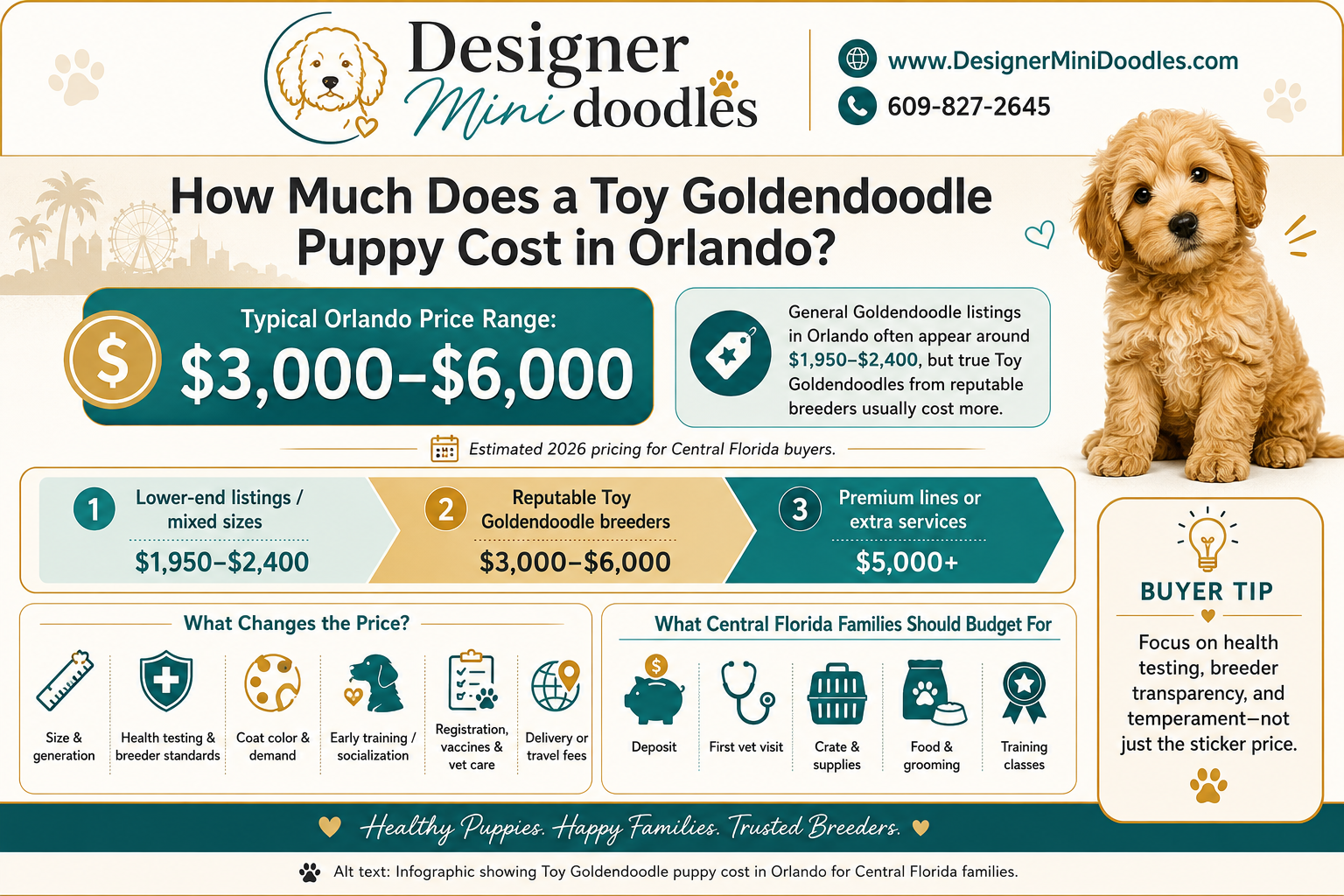
A toy goldendoodle puppy in Orlando generally costs $3,500 to $6,500 from a reputable breeder, with premium bloodlines, rare coat colors (like true reds or merles), and trained puppies reaching $7,000 or more. Anything priced under $1,500 in Central Florida usually signals a backyard breeder, puppy mill broker, or skipped health testing.
What drives the price?
| Factor | Price Impact |
|---|---|
| OFA/PennHIP health clearances on parents | +$500–$1,200 |
| ENS + early crate/house training included | +$400–$800 |
| Multigen (F1BB, F2B) low-shed genetics | +$300–$700 |
| Rare colors (red, parti, phantom) | +$500–$1,500 |
| Puppy nanny delivery | $400–$900 add-on |
Choose a higher-priced, fully tested puppy if you want predictable temperament, lower vet bills, and a calm dog that’s already started on crate and potty training. Cheap puppies almost always cost more long-term in medical care and behavior rehab.
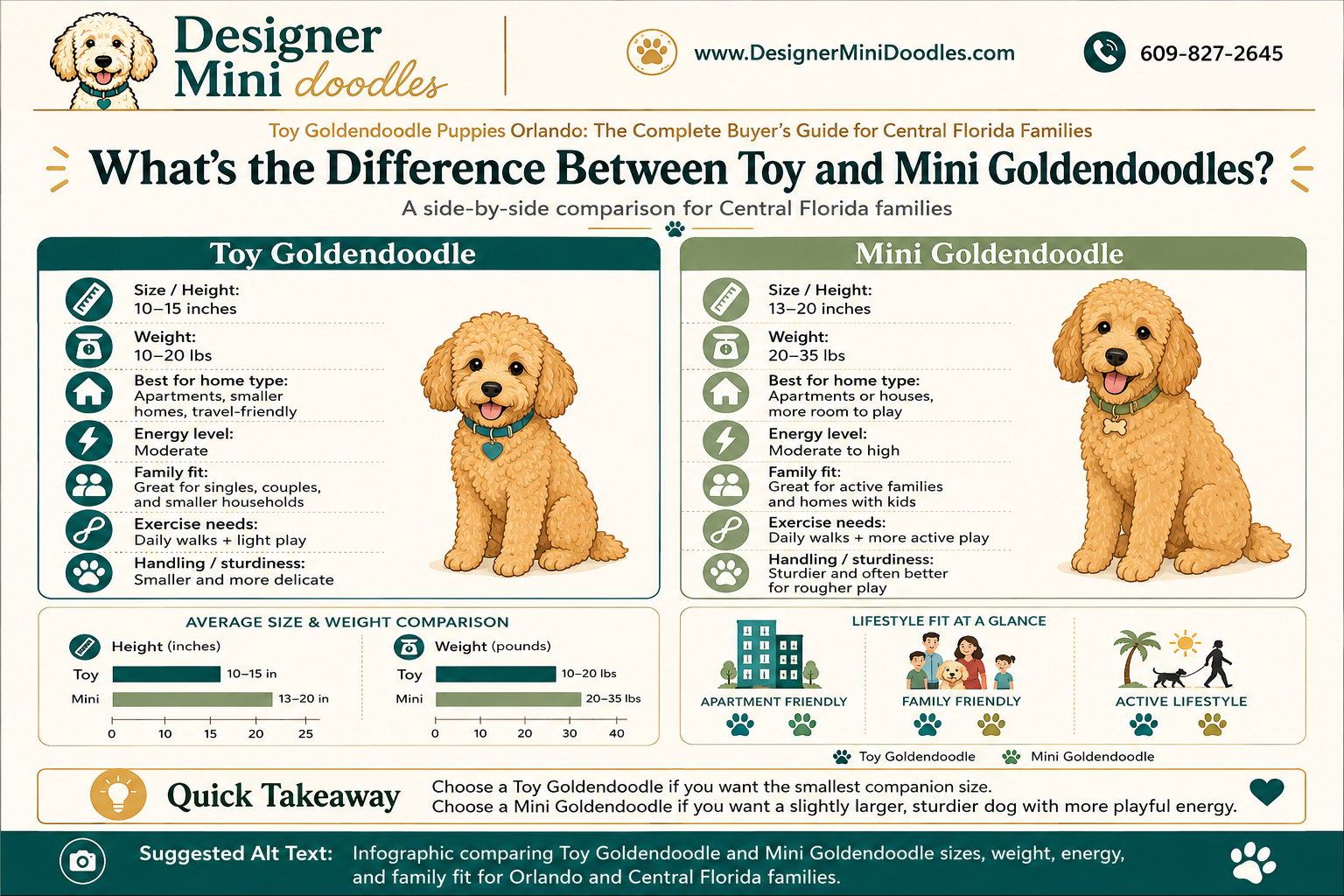
What’s the Difference Between Toy and Mini Goldendoodles?
The difference comes down to adult weight and the poodle parent used in breeding. Toy goldendoodles are bred down using a toy poodle parent and finish around 10 to 15 pounds. Mini goldendoodles use a miniature poodle and typically weigh 20 to 35 pounds.
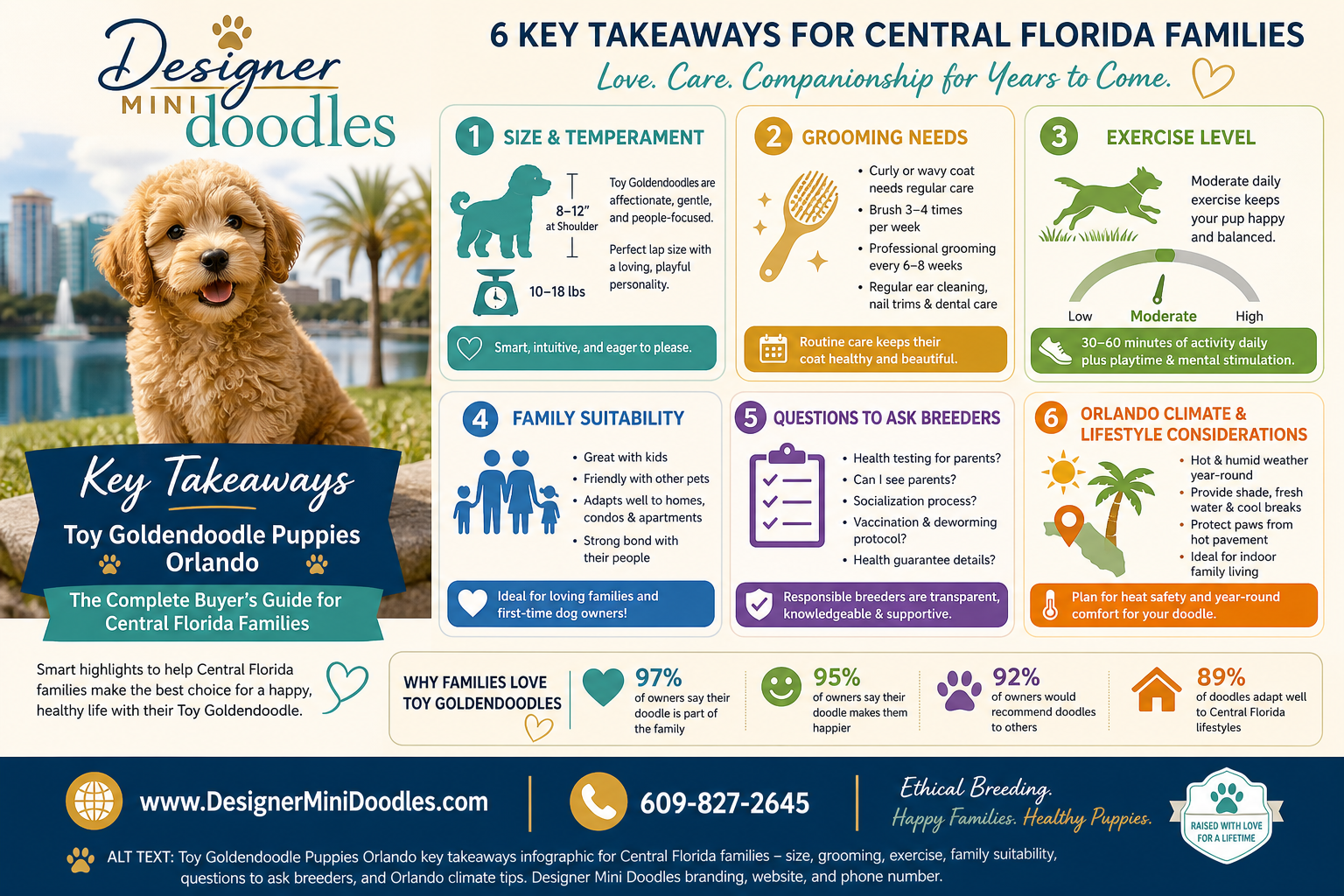
Quick comparison:
- Toy goldendoodle: 10–15 lbs, 11–14 inches, ideal for apartments and travel
- Mini goldendoodle: 20–35 lbs, 14–17 inches, better for active families with yards
- Medium goldendoodle: 35–50 lbs, 17–20 inches
- Standard goldendoodle: 50–90 lbs, 20–24 inches
For a deeper dive into the sweet-spot size range, see why a 10–16 lb micro goldendoodle is the perfect size for apartment and urban living.
How Big Do Toy Goldendoodles Get When Fully Grown?
Toy goldendoodles reach full adult size between 10 and 12 months and typically settle between 10 and 15 pounds, with most falling in the 12-pound range. Height at the shoulder runs about 11 to 14 inches.
A few realities to plan around:
- Females often finish slightly smaller than males.
- F1B and multigen toys tend to stay smaller and curlier than F1 toys.
- Weight can vary by 1–2 pounds depending on diet and structure.
- Growth slows noticeably around 8 months; if your puppy is still gaining fast at that point, ask the breeder about projected adult size.
Are Toy Goldendoodles Good With Kids and Other Pets?
Yes — toy goldendoodles are one of the best small-breed choices for families with children and multi-pet households, provided supervision rules are followed because of their small size. Their golden retriever heritage gives them patience and an eager-to-please personality, while the poodle side brings intelligence and gentleness.
Practical guidelines:
- Teach children to sit on the floor when holding the puppy (drops from couch height can injure toy breeds).
- Introduce cats and existing dogs slowly using gates and positive reinforcement.
- Avoid rough play with toddlers until the puppy is past 16 weeks.
For more on multi-pet introductions, this guide on raising toy poodles with other pets translates directly to toy goldendoodles.
Are Toy Goldendoodles Hypoallergenic?
Toy goldendoodles are considered low-allergen, not strictly hypoallergenic. The American Kennel Club notes that no dog breed is truly hypoallergenic, but low-shedding coats (especially curly F1B and multigen coats) release significantly less dander into the home.
Tips for allergy-sensitive Orlando households:
- Request an F1B, F1BB, or F2B puppy rather than F1.
- Look for puppies with tighter curl patterns over wavy fleece coats.
- Bathe every 2–3 weeks and brush every other day to control dander.
- HEPA air filtration helps in Florida’s humid, closed-window summer months.
Where Can I Adopt or Buy Toy Goldendoodle Puppies in Central Florida?
In Central Florida, your best options are reputable Florida breeders, ethical rescues, and established programs that ship puppies into Orlando with professional puppy nanny services. Pet stores and online classifieds should generally be avoided.
Designer Mini Doodles, run by an animal biologist with over 15 years of breeding experience, places toy goldendoodle puppies into Orlando homes regularly. Puppies can be flown or driven to Orlando, Winter Park, Lake Nona, Windermere, Dr. Phillips, and surrounding areas through a dedicated puppy nanny — and we deliver to any home in the world.
Helpful resources:
- Best mini and micro goldendoodle breeders in Florida
- Adorable micro mini goldendoodles in Florida
- Goldendoodle puppies Florida overview
- Our Google Maps listing
You can also see our travel-friendly small breeds on the Designer French Bulldogs site if you’re weighing other compact companion breeds.
What Makes Designer Mini Doodles the Best Toy Goldendoodle Breeding Program?
Designer Mini Doodles is led by a credentialed animal biologist who has spent more than 15 years refining a program focused on producing the calmest, healthiest, most confident toy goldendoodle puppies in America. Every puppy goes through a structured early-development protocol that most breeders simply don’t offer.
What sets the program apart:
- Early Neurological Stimulation (ENS) from days 3–16 to build stress resilience.
- Early scent introduction to broaden cognitive flexibility.
- Early crate training so puppies arrive in Orlando already used to a crate.
- Early housebreaking using a litter-to-pad-to-outside progression.
- Puppy culture socialization with surfaces, sounds, people, and gentle handling.
- Health-tested parents screened for hips, elbows, eyes, patellas, and genetic panels.
- Lifetime breeder support for training, nutrition, and grooming questions.
We’re also one of the few toy goldendoodle breeders that can produce true micro goldendoodle sizes consistently while maintaining structure and temperament.
“Calm, confident, and clean — that’s what an animal-biologist-designed breeding program produces. Genetics get you the size; protocols get you the temperament.”
Common Health Issues in Toy Goldendoodle Puppies
Toy goldendoodles are generally healthy with 12–15 year lifespans, but small-breed genetics introduce a few conditions worth monitoring. Buying from a breeder who runs OFA, CHIC, or Embark genetic screening dramatically reduces risk.
Most common concerns to know about:
- Patellar luxation — slipping kneecaps, common in toy breeds. Surgery may be needed in moderate cases.
- Hip dysplasia — less common in toys than standards, but still tested.
- Progressive retinal atrophy (PRA) — preventable via parent genetic screening.
- Hypoglycemia — small puppies can drop blood sugar quickly; feed 3–4 small meals a day until 4 months.
- Ear infections — Florida humidity is a contributor; clean ears weekly.
- Dental crowding — schedule cleanings yearly starting at age 2.
For ongoing wellness planning, see long-term health and wellness planning for toy poodles — the protocols apply directly to toy goldendoodles.
How Do I Train a Toy Goldendoodle Puppy?
Toy goldendoodles are highly trainable because they combine retriever food drive with poodle intelligence. Short, positive sessions (5–10 minutes, 3–4 times daily) work better than long drills. Most well-bred puppies can master sit, down, come, and crate within two weeks of going home.
A simple 30-day starter plan:
- Week 1: Name recognition, crate love, potty schedule every 90 minutes
- Week 2: Sit, down, leash introduction, handling exercises
- Week 3: Come, place command, calm greetings, car rides
- Week 4: Loose-leash walking, public outings, basic impulse control
Common mistakes to avoid:
- Free-feeding (kills food motivation)
- Letting the puppy bark for attention in the crate (rewards demand barking)
- Skipping socialization windows before 16 weeks
- Using harsh corrections — these dogs are sensitive
For a calm crate routine that I recommend to every Orlando family, see calm crate time for toy poodle puppies at night.
How Much Exercise Does a Toy Goldendoodle Puppy Need?
A toy goldendoodle puppy needs about 5 minutes of structured exercise per month of age, twice daily, plus free indoor play. An 8-week-old puppy gets two 10-minute walks; a 6-month-old can handle two 30-minute outings.
Orlando-friendly options:
- Early-morning walks at Lake Eola before heat sets in
- Indoor play at Pet Paradise or shaded backyards
- Sniff walks in Audubon Park or Winter Park’s Central Park
- Puppy socialization classes at local positive-reinforcement trainers
Watch for over-exercise: panting that won’t stop, lying down mid-walk, or reluctance to move next session. Florida’s heat and humidity can be dangerous for small dogs above 85°F.
Is a Toy Goldendoodle Good for First-Time Dog Owners?
Yes — toy goldendoodles are one of the top breeds for first-time owners because they’re trainable, forgiving of beginner mistakes, and small enough to manage physically. The catch: you need to commit to grooming and early training, or the coat and behavior can spiral.
This breed is a strong fit if you:
- Work from home or have flexible hours during the first 4 months
- Can budget for grooming every 6–8 weeks
- Want a dog that travels well and fits apartment life
- Prefer a companion dog over a high-drive working breed
It’s not a great fit if you:
- Travel constantly without arrangements for the dog
- Want a low-maintenance coat
- Have very young toddlers who can’t yet be gentle
For more perspective, this read on a micro goldendoodle being the perfect size for first-time dog owners covers the lifestyle fit in detail.
What Are Typical Grooming Costs for a Toy Goldendoodle in Orlando?
Plan for $65 to $110 per professional grooming visit in Orlando, every 6 to 8 weeks. That’s roughly $650 to $900 per year, plus at-home maintenance supplies.
Typical Orlando grooming cost breakdown:
| Service | Price Range |
|---|---|
| Full groom (bath, cut, nails, ears) | $65–$110 |
| Bath and tidy only | $40–$60 |
| Nail trim | $15–$25 |
| De-matting (avoidable with brushing) | +$20–$50 |
| At-home tools (one-time) | $80–$150 |
Pro tip: Brush 5 minutes daily with a slicker and metal comb to prevent matting, especially behind ears and under armpits. Florida humidity makes mats form fast. If you’re new to coat care, the grooming tips for fluffy toy poodle puppies guide is one of the most practical references.
What to Look for When Buying a Toy Goldendoodle Puppy
The single biggest predictor of a healthy, well-behaved adult dog is the breeder’s protocols, not the puppy itself. Here’s the checklist I give every Orlando family.
Green flags:
- Health testing on both parents (OFA, CHIC, Embark)
- ENS, early socialization, and early crate/potty training documented
- Vet records, deworming, age-appropriate vaccines
- Breeder asks YOU questions about your home
- Lifetime support and a written health guarantee (2 years minimum)
- Transparent pricing and contract
Red flags:
- “Always available” puppies in every size and color
- No vet records or refusal to share parent health tests
- Pressure to wire money quickly or “hold” with cash apps
- Multiple breeds bred at large scale with no specialization
- Won’t let you video chat with the puppy and parents
Comparison: Toy Goldendoodle vs. Other Small Doodle Options
| Feature | Toy Goldendoodle | Mini Goldendoodle | Cavapoo | Toy Poodle |
|---|---|---|---|---|
| Adult weight | 10–15 lbs | 20–35 lbs | 9–18 lbs | 6–9 lbs |
| Shedding | Low | Low | Low–medium | Very low |
| Energy level | Medium | Medium-high | Medium | Medium |
| Trainability | Very high | Very high | High | Very high |
| Apartment friendly | Excellent | Good | Excellent | Excellent |
| Family with kids | Excellent | Excellent | Excellent | Good (older kids) |
Frequently Asked Questions
Do toy goldendoodles bark a lot?
No. They’re moderate barkers — alert without being yappy. Early training prevents demand barking.
Can a toy goldendoodle be left alone all day?
Not ideal. They thrive with people around. Plan for a dog walker, doggy daycare, or a work-from-home schedule, especially during the first year.
How long do toy goldendoodles live?
Typically 12 to 15 years with proper care, nutrition, and routine vet visits.
Are toy goldendoodles AKC registered?
No. Goldendoodles are a designer crossbreed and are not eligible for AKC registration, but they can register with the Goldendoodle Association of North America (GANA).
What’s the best food for a toy goldendoodle puppy?
A high-quality small-breed puppy formula with named meat as the first ingredient, fed 3–4 times daily until 4 months, then twice daily.
Do you deliver toy goldendoodle puppies to Orlando?
Yes — Designer Mini Doodles offers a dedicated puppy nanny service that delivers anywhere in the world, including direct to Orlando International Airport.
How early can I bring my toy goldendoodle puppy home?
Most ethical breeders place puppies at 8 to 10 weeks. Toy-sized puppies sometimes stay until 10–12 weeks for safety.
Will my toy goldendoodle handle Florida heat?
Yes, with precautions. Walk early morning or evening, never leave on hot pavement, and keep them well hydrated. A summer grooming cut helps.
Conclusion: Your Next Steps
Bringing home a toy goldendoodle in Orlando is one of the most rewarding decisions a Central Florida family can make — but the puppy you choose, and the breeder behind it, will shape the next 12–15 years of your life. Focus on health testing, early development protocols, and breeder transparency over price or convenience.
Here’s what I recommend doing this week:
- Set your budget at $3,500–$6,500 plus first-year care ($1,500–$2,500).
- Vet your breeder using the green/red flag checklist above.
- Prepare your home with a crate, baby gates, and puppy-safe zones.
- Book grooming with an Orlando groomer before your puppy arrives.
- Reach out to Designer Mini Doodles to see current and upcoming toy goldendoodle litters, or browse our Florida goldendoodle availability.
When you choose a breeder built around science — ENS, early crate training, early housebreaking, and biologist-led genetics — you don’t just get a puppy. You get a calm, confident, lifelong companion that fits Orlando life from the moment they step off the plane.