

micro mini goldendoodle Nashville
A micro mini goldendoodle in Nashville is a small-sized doodle (typically 10–25 lbs) bred from a toy or mini poodle and a smaller goldendoodle parent, prized for low-shedding coats and a calm, family-friendly temperament. Expect to pay $3,500–$6,500 for a well-bred puppy from a reputable Middle Tennessee program. At Designer Mini Doodles, our breeding operation is led by an animal biologist with 15+ years of experience producing confident, early-socialized micro mini goldendoodle puppies using Early Neurological Stimulation (ENS), early crate training, and head-start housebreaking.

Key Takeaways
- Adult size: Micro mini goldendoodles in Nashville typically grow to 10–25 lbs and stand 11–16 inches tall.
- Price range: Expect $3,500–$6,500 in Tennessee, with premium F1B and multi-gen puppies on the higher end.
- Shedding: Most are low- to non-shedding, especially F1B and F2B generations with curlier coats.
- Hypoallergenic potential: No dog is 100% hypoallergenic, but well-bred micro minis are among the most allergy-friendly options.
- Family fit: Excellent with kids and other pets when properly socialized from 3–8 weeks.
- Designer Mini Doodles ships nationwide and worldwide through a dedicated puppy nanny service.
- Health screening matters: Reputable breeders test for PRA, hip dysplasia, vWD, and cardiac conditions.
- Training advantage: Puppies raised with ENS and early crate exposure adjust to new homes faster.
How Big Do Micro Mini Goldendoodles Get?
Micro mini goldendoodles typically reach 10–25 pounds as adults and stand 11–16 inches at the shoulder. The “micro” label generally refers to dogs under 20 lbs full-grown, while standard mini goldendoodles can push past 30 lbs.
Size depends on three factors:
| Factor | Impact on Adult Size |
|---|---|
| Poodle parent size | Toy poodle pairings = smaller pups |
| Generation (F1, F1B, F2B) | F1B with toy poodle = smallest |
| Parent weight history | Best predictor of adult weight |
For a deeper breakdown by generation and weight, our guide on toy, micro, and mini goldendoodle puppy sizes and prices shows exactly what to expect.
Decision rule: If you live in a Nashville apartment or condo, target a puppy whose parents both weigh under 20 lbs to stay safely in the micro range.
Average Cost of Micro Mini Goldendoodle Puppies in Nashville
Micro mini goldendoodle puppies in Nashville typically cost between $3,500 and $6,500, with the average sitting around $4,800 for a health-tested, well-socialized puppy from a reputable breeder.
What drives the price:
- Generation: F1B and multi-gen (F2B, F3) puppies cost more because of predictable low-shedding coats.
- Color: Rare colors like merle, parti, phantom, and red typically add $500–$1,500.
- Size guarantee: Smaller adult-size projections command premium pricing.
- Health testing: OFA, PennHIP, and Embark genetic panels add to breeder costs.
- Early training: Breeders offering ENS, crate training, and potty-pad starts charge more — but you get a calmer, more confident puppy.
How Much Do Micro Mini Goldendoodle Puppies Cost in Tennessee?
Across Tennessee, prices are slightly lower outside Nashville metro: rural Middle and East Tennessee breeders may list puppies at $2,800–$4,500, while Nashville, Franklin, and Brentwood breeders trend toward $4,500–$6,500. Avoid listings under $2,000 — these almost always indicate puppy mills or untested parents.
For comparison with neighboring regions, you can browse our network in Tennessee, Georgia, and Alabama.
Are Micro Mini Goldendoodles Good With Kids?
Yes — micro mini goldendoodles are widely considered one of the best small dog breeds for families with children. They inherit the golden retriever’s patient, people-oriented temperament and the poodle’s intelligence, making them gentle, trainable, and tolerant.

Why they work well with kids:
- Soft mouths and gentle play styles from the retriever side
- Smaller size means safer interactions with toddlers (less knock-down risk than a standard goldendoodle)
- High trainability makes boundaries easy to teach
- Affectionate, “velcro dog” personalities that bond with the whole family
Common mistake: Parents leave young children unsupervised with the puppy expecting “automatic” good behavior. Always supervise interactions until both child and puppy understand boundaries.
Health Issues to Watch for in Micro Mini Goldendoodles
The most common health concerns in micro mini goldendoodles include hip dysplasia, progressive retinal atrophy (PRA), patellar luxation, von Willebrand’s disease, and Addison’s disease. Reputable Nashville breeders screen for all of these before breeding.
Recommended health tests (ask any breeder for proof):
- OFA hip and elbow evaluations on both parents
- Embark or Paw Print Genetics panel for PRA, vWD, DM, NEwS
- CERF/OFA eye certification annually
- Cardiac evaluation by a board-certified cardiologist
- Patellar evaluation for kneecap stability (critical in smaller dogs)
Edge case: Very small “teacup” or “micro micro” dogs (under 8 lbs) carry elevated risk for hypoglycemia, dental crowding, and fragile bones. We do not recommend going below the 10 lb floor.
Where Can I Adopt a Micro Mini Goldendoodle Near Nashville?
You can find micro mini goldendoodles near Nashville through reputable breeders in Middle Tennessee, regional doodle rescues like IDOG Rescue and Doodle Rock Rescue, and trusted multi-state programs that deliver to Tennessee. Designer Mini Doodles serves Nashville, Franklin, Murfreesboro, Brentwood, and Hendersonville families, with nationwide and worldwide delivery via our puppy nanny service.
You can view our location and reviews on our Google Maps listing for Mini Golden Doodle Puppies or explore breeders across nearby states like North Carolina and South Carolina.
“Our puppies have flown to families in Tokyo, London, Sydney, and every U.S. state. Geography shouldn’t keep you from the right puppy.”
Do Micro Mini Goldendoodles Shed a Lot?
Micro mini goldendoodles shed very little compared to most breeds, and many F1B and multi-generational puppies are essentially non-shedding. Coat type, not just generation, determines shedding — curly and wavy coats shed less than flat coats.
Coat type quick reference:
- Curly (poodle-like): Lowest shedding, highest grooming need
- Wavy/fleece: Low shedding, moderate grooming — most popular
- Straight/flat: Some shedding, easier grooming
Best Breeders for Micro Mini Goldendoodles in Middle Tennessee
The best micro mini goldendoodle breeders in Middle Tennessee combine scientific breeding practices, full health testing, early neurological stimulation, and structured socialization. Designer Mini Doodles is run by an animal biologist with over 15 years of focused experience producing the calmest, most affectionate micro mini goldendoodle puppies in America.
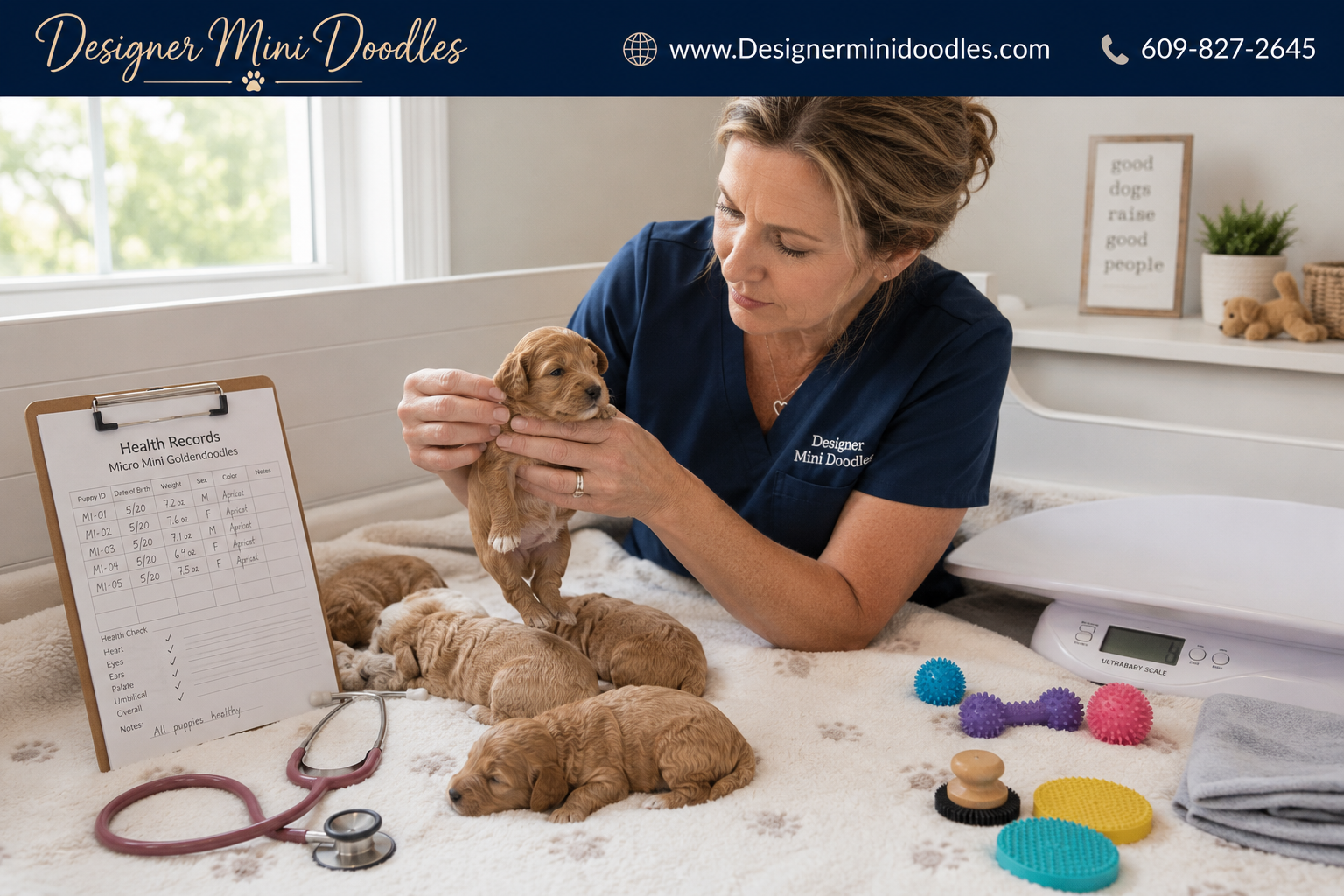
What sets a top-tier program apart:
- Animal biologist–led breeding decisions — pairings are chosen for temperament, structure, and genetic diversity
- Early Neurological Stimulation (ENS) from days 3–16 to build stress resilience
- Early crate training starting at 4 weeks for smoother transitions home
- Head-start housebreaking using a litter-box-style potty system
- Daily handling and socialization with new sounds, surfaces, and people
- Health guarantees of 2+ years and lifetime breeder support
We also offer beautiful toy goldendoodle puppies for sale for families wanting an even smaller companion, and micro mini goldendoodle puppies near me shipped via our puppy nanny service worldwide.
If you’re also considering a smaller flat-faced companion, we partner with breeders offering micro frenchie puppies.
Are Micro Mini Goldendoodles Hypoallergenic?
No dog breed is 100% hypoallergenic, but micro mini goldendoodles — especially F1B and F2B generations with curly coats — produce significantly less dander and shed less hair than most breeds, making them an excellent choice for allergy-sensitive households.
The allergen people react to is Can f 1 protein found in dander and saliva, not hair itself. Lower-shedding coats simply spread less of it. For a deeper look at fit, see why a 10–16 lb micro goldendoodle works for allergy-conscious homes.
Quick test: Spend 30+ minutes with both parent dogs before committing if anyone in your home has documented dog allergies.
Training Tips for Micro Mini Goldendoodle Puppies
Start training the day your puppy comes home using short, positive sessions of 3–5 minutes, 4–6 times per day. Micro mini goldendoodles are highly intelligent and food-motivated, which makes early training fast — but their cleverness also means bad habits stick just as quickly.
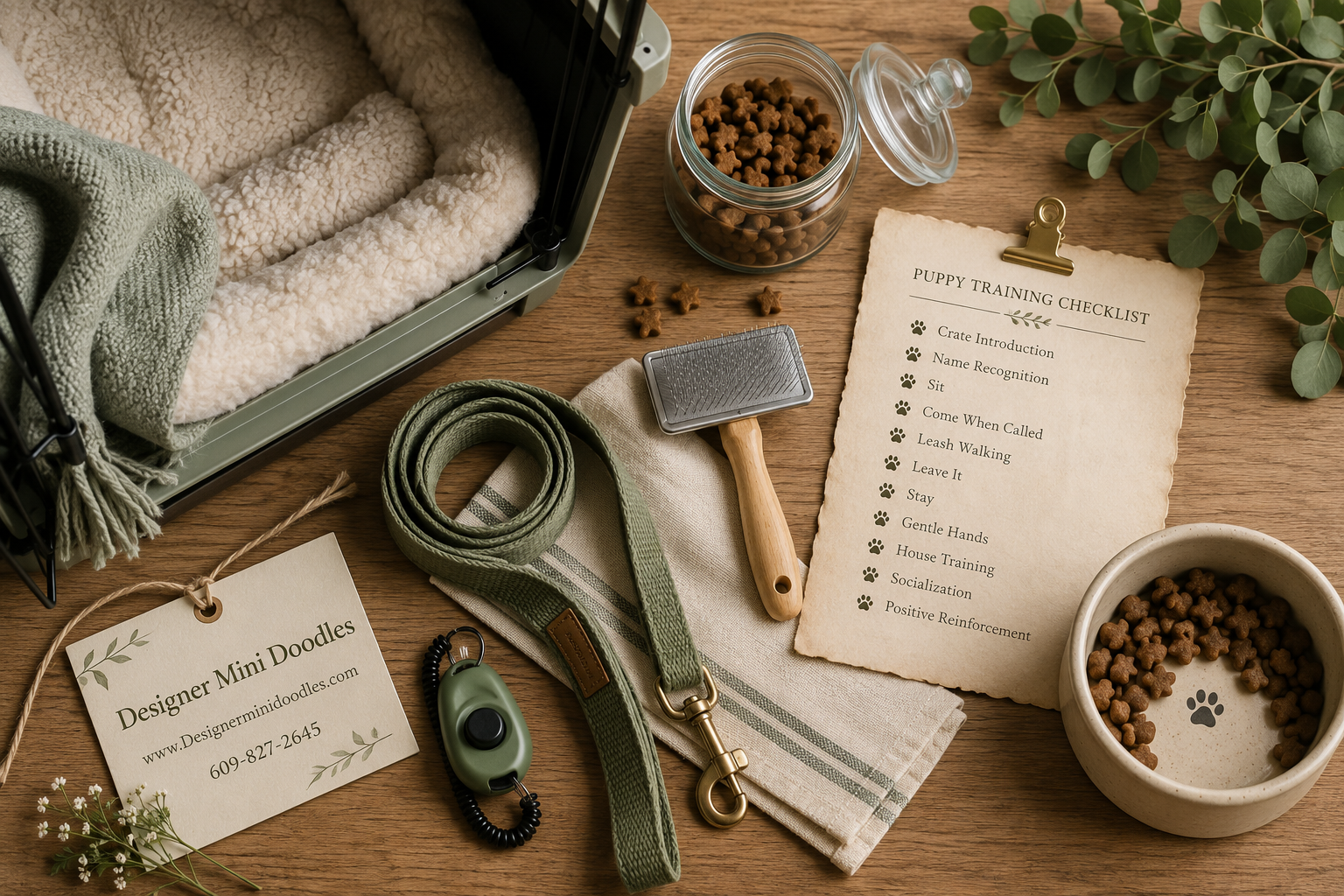
The first 30 days priority list:
- Crate training — feed all meals inside the crate to build positive association
- Potty training — take outside every 60–90 minutes, after meals, naps, and play
- Name recognition and recall — practice 20+ times per day with treats
- Bite inhibition — yelp and disengage when puppy bites too hard
- Socialization — expose to 100+ new people, sounds, and surfaces by 16 weeks
- Loose-leash walking — start indoors before venturing into Nashville sidewalks
Our puppies arrive already crate-trained and started on potty pads, which cuts weeks off the housebreaking timeline. For more on indoor manners, see our guide on teaching small breed puppies indoor boundaries.
Common Mistakes First-Time Micro Mini Goldendoodle Owners Make
First-time owners most often over-exercise puppies, skip crate training, free-feed, and delay socialization — all of which create long-term behavior and joint problems. Avoiding these saves you thousands in trainer fees and vet bills.
The top mistakes:
- Too much exercise too soon — follow the 5-minute rule (5 min per month of age, twice daily)
- Skipping the crate — leads to separation anxiety and destructive chewing
- Free-feeding — makes potty training nearly impossible
- Late socialization — the window closes at 16 weeks; waiting until vaccinations are “done” is a costly myth
- Inconsistent rules — if the puppy can’t be on the couch, no one in the family lets it on the couch
- Buying from unverified sources — backyard breeders and brokers cost more long-term
How to Tell if a Micro Mini Goldendoodle Is Purebred
Micro mini goldendoodles are crossbreeds, not a purebred AKC breed — so “purebred” really means verifying parentage, generation, and genetic lineage through DNA testing and breeder documentation. The Goldendoodle Association of North America (GANA) registers parent dogs but doesn’t yet recognize doodles as a purebred breed.
How to verify authenticity:
- Ask for parent DNA results (Embark or Wisdom Panel)
- Request the puppy’s Embark test showing breed composition (e.g., 25% golden retriever / 75% poodle for an F1B)
- Verify generation labeling — F1 = 50/50, F1B = 75% poodle, F2B = ~62.5% poodle
- Check breeder registration with GANA, ALAA, or similar
- Visit in person or via live video to see both parents
Red flag: Any breeder unwilling to share parent DNA, vet records, or live video tours.
Pros and Cons Summary
Pros:
- Compact size (10–25 lbs) fits Nashville apartments and condos
- Low-shedding, allergy-friendlier coats
- Excellent with kids, seniors, and other pets
- Highly trainable and travel-friendly
- Long lifespan (13–16 years)
Cons:
- Higher upfront cost ($3,500–$6,500)
- Requires professional grooming every 6–8 weeks
- Prone to separation anxiety without crate training
- Smaller size means careful supervision with toddlers and large dogs
FAQ
Q: How long do micro mini goldendoodles live?
A: Most live 13–16 years with proper nutrition, exercise, and routine vet care.
Q: Can a micro mini goldendoodle live in a Nashville apartment?
A: Yes — their small size and moderate exercise needs make them ideal for apartments, provided they get two solid walks daily.
Q: Do micro mini goldendoodles bark a lot?
A: They’re moderate barkers. Early training and adequate mental stimulation keep nuisance barking minimal.
Q: What’s the difference between a micro mini and a toy goldendoodle?
A: Toy goldendoodles are smaller (typically 7–15 lbs) and bred with a toy poodle parent; micro minis range 10–25 lbs.
Q: How often do they need grooming?
A: Professional grooming every 6–8 weeks, plus brushing 3–4 times per week to prevent matting.
Q: Can Designer Mini Doodles ship a puppy to me?
A: Yes — we deliver puppies to any home in the world via our dedicated puppy nanny service, with in-cabin flights and door-to-door ground transport options.
Q: When can I bring my puppy home?
A: Puppies go home at 8 weeks, fully vet-checked, dewormed, first vaccinations complete, and crate/potty-trained.
Q: Are micro mini goldendoodles good for first-time dog owners?
A: Absolutely — see our guide on why this size is perfect for first-time dog owners.
Q: Do you offer a health guarantee?
A: Yes, all our puppies come with a 2-year genetic health guarantee and lifetime breeder support.
Q: What food do you recommend?
A: We start puppies on high-quality, small-breed puppy formula and provide a detailed feeding schedule at pickup.
Conclusion and Next Steps
Bringing home a micro mini goldendoodle in Nashville is one of the best decisions a family, couple, or single owner can make — provided you choose a breeder who prioritizes health testing, genetics, and early developmental work. The differences between a puppy mill puppy and one raised with ENS, early crate training, and proper socialization will show up every single day for the next 15 years.
Your next steps:
- Define your size target (10–16 lbs vs. 16–25 lbs) based on your home and lifestyle
- Set a realistic budget of $4,000–$6,000 for a quality Nashville-area puppy
- Request health testing documentation from any breeder you contact
- Visit in person or via live video before placing a deposit
- Reserve your puppy — top breeders book out 3–9 months in advance
Ready to meet your puppy? Reach out to our team to view current and upcoming litters, or learn more about our nationwide and international delivery options through our puppy nanny service.
Sources
- Goldendoodle Association of North America (GANA), Breed Standards, 2024 — goldendoodleassociation.com
- Orthopedic Foundation for Animals (OFA), Health Testing Database, 2024 — ofa.org
- Embark Veterinary, Doodle Genetics Research, 2023 — embarkvet.com
- American Veterinary Medical Association, Puppy Socialization Guidelines, 2024 — avma.org