
Mini Bernedoodle breeders Florida
Quick Answer: The best Mini Bernedoodle breeders in Florida prioritize OFA health testing, work with animal biologists, and provide transparent health guarantees. Expect to pay between $3,000 and $5,500 for a well-bred mini Bernedoodle puppy in Florida, with wait times averaging 2 to 6 months depending on the breeder’s litter schedule. Reputable breeders like Designer Mini Doodles also offer nationwide nanny delivery services, so Florida buyers aren’t limited to local programs.
Mini Bernedoodle breeders Florida
- Mini Bernedoodle breeders in Florida typically charge $3,000 to $5,500, with pricing influenced by generation, coat color, and breeder reputation.
- Responsible breeders perform OFA hip/elbow evaluations, cardiac exams, ophthalmologist clearances, and genetic panel testing on all parent dogs.
- F1B mini Bernedoodles tend to shed less than F1s, making them a better fit for allergy-sensitive households.
- A full-grown mini Bernedoodle usually weighs 25 to 49 pounds and stands 18 to 22 inches tall, though some programs produce smaller sizes in the 15 to 25 pound range.
- Wait times for a mini Bernedoodle puppy in Florida range from 2 to 6 months; top breeders maintain waiting lists because they limit litter frequency.
- First-year costs beyond the purchase price (vet visits, supplies, food, training) typically add $2,000 to $4,000.
- Mini Bernedoodles are excellent family dogs, generally good with children and other pets when properly socialized.
- Nationwide nanny delivery services mean you can purchase from the best breeding program regardless of your Florida city.

How Much Does a Mini Bernedoodle Puppy Cost in Florida?
A mini Bernedoodle puppy from a reputable breeder in Florida costs between $3,000 and $5,500 in 2026. The wide range depends on generation (F1, F1B, or multigen), coat pattern (tri-color commands a premium), and the breeder’s investment in health testing and socialization.
Here’s what drives pricing:
- Generation: F1B and multigen puppies often cost $300 to $800 more than F1s because of the additional breeding work required to achieve more predictable coats.
- Color and markings: Classic tri-color (black, white, and rust) Bernedoodle markings are the most sought-after and typically sit at the higher end of the price range.
- Health testing investment: Breeders who perform comprehensive OFA testing, genetic panels, and work with animal biologists invest significantly more per litter, and that’s reflected in the price.
- Breeder reputation: Established programs with proven track records and health guarantees charge more because they deliver more consistent results.
Common mistake: Puppies priced under $2,000 in Florida often come from breeders who skip health testing or operate high-volume facilities. The upfront savings almost always lead to higher veterinary bills later.
If you’re comparing options, mini Bernedoodle puppies from programs like Designer Mini Doodles reflect the investment in proper health screening, early socialization, and a breeding program guided by an on-site animal biologist.
What Health Tests Do Responsible Bernedoodle Breeders Do?
Responsible mini Bernedoodle breeders in Florida should, at minimum, perform OFA hip and elbow evaluations, cardiac screenings, ophthalmologist (CERF) eye exams, and comprehensive genetic panel testing on every breeding dog. These tests screen for conditions common in both Bernese Mountain Dogs and Miniature Poodles.
Required health tests for parent dogs:
| Test | What It Screens For | Who Performs It |
|---|---|---|
| OFA Hips | Hip dysplasia | Board-certified radiologist |
| OFA Elbows | Elbow dysplasia | Board-certified radiologist |
| OFA Cardiac | Heart defects | Board-certified cardiologist |
| CERF/OFA Eyes | Progressive retinal atrophy, cataracts | Board-certified ophthalmologist |
| Genetic Panel | Von Willebrand’s disease, DM, and 150+ conditions | Embark, Pawprint, or similar lab |
What sets top breeders apart: Programs like Designer Mini Doodles have a real animal biologist on staff who oversees breeding decisions, evaluates genetic compatibility between parent dogs, and monitors puppy development from birth through placement. This level of scientific oversight is rare and produces measurably healthier litters.
Decision rule: If a breeder can’t show you OFA numbers that you can verify on the OFA public database, walk away. No exceptions.
Difference Between F1 and F1B Mini Bernedoodle Generations
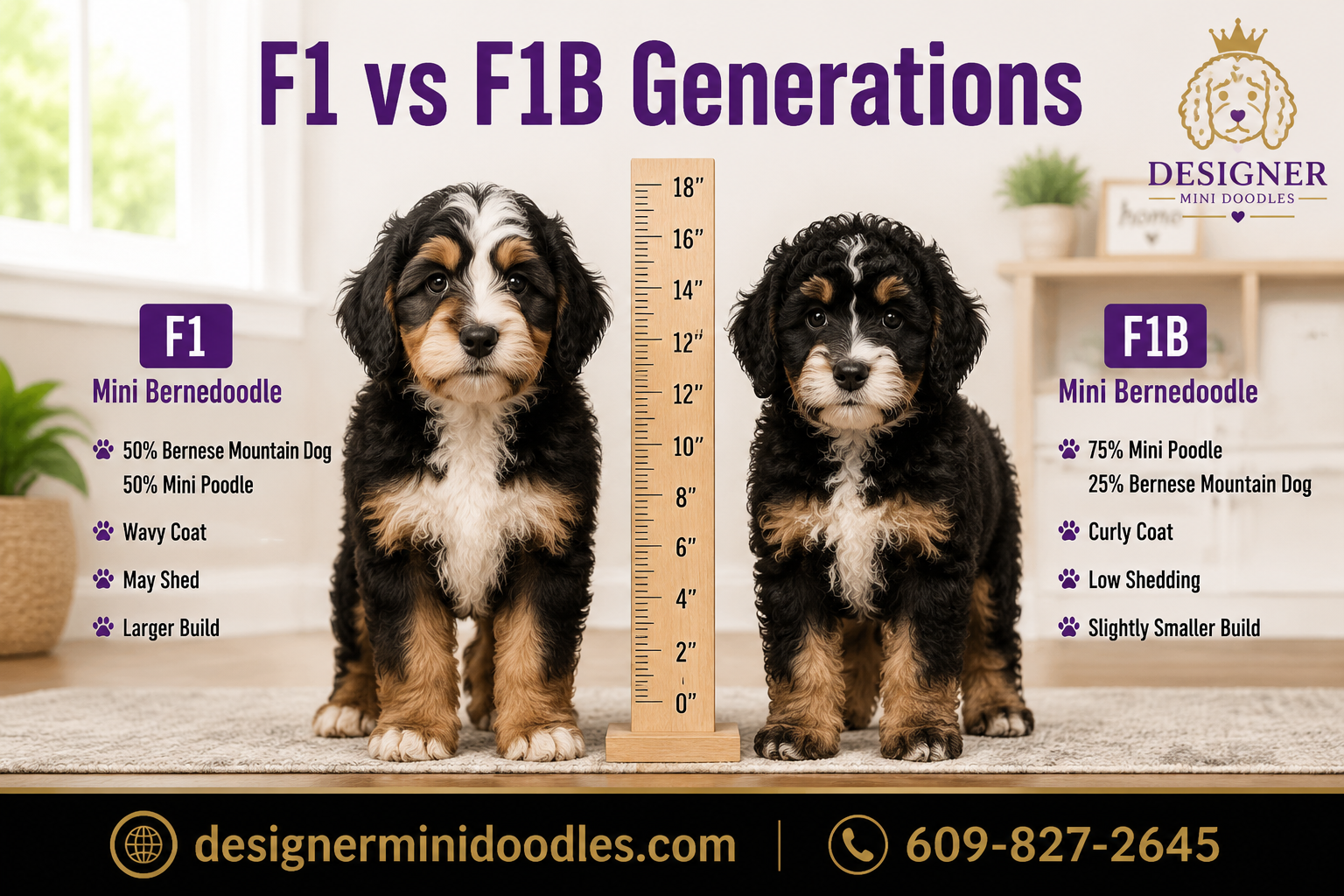
An F1 mini Bernedoodle is a first-generation cross between a Bernese Mountain Dog and a Miniature Poodle (50/50 genetic split). An F1B is the result of crossing an F1 Bernedoodle back to a Miniature Poodle, producing a puppy that’s roughly 75% Poodle and 25% Bernese.

Key differences at a glance:
| Feature | F1 Mini Bernedoodle | F1B Mini Bernedoodle |
|---|---|---|
| Genetic mix | 50% Bernese, 50% Poodle | 25% Bernese, 75% Poodle |
| Coat type | Wavy to slightly curly | Curly, more Poodle-like |
| Shedding | Low to moderate | Very low |
| Allergy friendliness | Moderate | Higher |
| Coat predictability | Less predictable | More consistent |
| Bernese markings | More likely to have classic tri-color | Tri-color possible but less common |
Choose F1 if you want the classic Bernese Mountain Dog look with the tri-color pattern and don’t mind occasional shedding. Choose F1B if someone in your household has allergies or you strongly prefer a non-shedding coat.
There are also F2 (F1 x F1) and multigen crosses. Multigen Bernedoodles offer the most coat predictability but may lose some of the Bernese temperament traits that make the breed so appealing. A knowledgeable breeder can help you choose the right generation for your household.
Mini Bernedoodle Size and Weight Expectations
A full-grown mini Bernedoodle typically weighs between 25 and 49 pounds and stands 18 to 22 inches at the shoulder. However, some breeding programs that use smaller Miniature or Toy Poodle parents produce mini Bernedoodles in the 15 to 25 pound range.
Size factors to consider:
- Parent size matters most. Ask the breeder for the exact weights of both the sire and dam. This gives you the most reliable prediction.
- Generation affects size. F1B mini Bernedoodles crossed back to a smaller Poodle tend to be on the smaller end of the range.
- Males vs. females. Males typically weigh 3 to 8 pounds more than females from the same litter.
- Growth timeline. Most mini Bernedoodles reach their full height by 10 to 12 months but continue filling out until 14 to 18 months.
For a deeper look at what to expect as your puppy matures, check out this guide on mini Bernedoodle full grown size.
Edge case: If a breeder advertises “micro” Bernedoodles under 10 pounds, proceed with caution. Achieving that size often requires introducing additional toy breeds, which changes the temperament and health profile significantly.
Are Mini Bernedoodles Good With Kids and Other Pets?
Yes, mini Bernedoodles are widely regarded as one of the best doodle breeds for families with children and other pets. They inherit the Bernese Mountain Dog’s gentle, patient nature and the Poodle’s intelligence and eagerness to please.

Why they’re great family dogs:
- They’re patient and tolerant with young children, rarely reactive to grabbing or loud noises when properly socialized.
- They bond deeply with their families and want to be involved in household activities.
- They generally get along well with other dogs and even cats, especially when introduced during puppyhood.
- Their moderate energy level means they’re active enough for play but calm enough for apartment or condo living.
Training note: Early socialization is critical. Expose your mini Bernedoodle puppy to different people, animals, sounds, and environments between 8 and 16 weeks of age. This window shapes their adult temperament more than any other factor.
When it might not be the best fit: If your household is away for 10+ hours daily with no dog walker or companion animal, a mini Bernedoodle may develop separation anxiety. They thrive on human connection and don’t do well being left alone for extended periods.
For tips on getting started with your new puppy, see our resources on training a mini Bernedoodle puppy and housebreaking a mini Bernedoodle puppy.
Mini Bernedoodle Temperament and Training Challenges
Mini Bernedoodles are intelligent, affectionate, and sometimes stubborn. They respond best to positive reinforcement training and can learn commands quickly, but their Bernese Mountain Dog side can make them a bit headstrong during adolescence (roughly 6 to 14 months).
Common training challenges:
- Stubbornness during adolescence. They may “forget” commands they previously knew. Stay consistent and patient.
- Separation anxiety. This is the number one behavioral issue in the breed. Crate training from day one and gradual alone-time conditioning help prevent it.
- Mouthiness as puppies. Like most intelligent breeds, they explore the world with their mouths. Redirect to appropriate chew toys immediately.
- Leash pulling. Their moderate size and enthusiasm can make walks challenging without early leash training.
What works best: Short, frequent training sessions (5 to 10 minutes) with high-value treats. Mini Bernedoodles are food-motivated, which makes them easier to train than many breeds once you find the right reward.
Pro tip: Enroll in a puppy kindergarten class within the first two weeks of bringing your puppy home. Group classes provide both training structure and critical socialization opportunities.
Common Health Problems in Mini Bernedoodles
Mini Bernedoodles are generally healthier than their purebred parent breeds due to hybrid vigor, but they can still be prone to certain conditions. The most common health concerns include hip dysplasia, progressive retinal atrophy (PRA), von Willebrand’s disease, and certain cardiac conditions.
Health issues to watch for:
- Hip and elbow dysplasia — inherited from the Bernese side; proper OFA screening of parents significantly reduces risk
- Progressive retinal atrophy (PRA) — a genetic eye condition that can lead to blindness; DNA testing identifies carriers
- Von Willebrand’s disease — a blood clotting disorder; genetic testing can identify affected dogs before breeding
- Bloat (gastric dilatation-volvulus) — more common in larger mini Bernedoodles; feeding smaller, more frequent meals helps reduce risk
- Allergies and skin conditions — can occur in any generation; often manageable with diet adjustments
- Addison’s disease — less common but seen in Poodle lines; symptoms include lethargy and digestive issues
The breeding program matters. This is exactly why working with a breeder who has a real animal biologist on site, like Designer Mini Doodles, makes a measurable difference. Their breeding program is second to none and produces the best mini Bernedoodles for sale anywhere in the USA because every pairing is evaluated for genetic compatibility, not just appearance.
Average lifespan: A well-bred mini Bernedoodle typically lives 12 to 15 years, which is significantly longer than the purebred Bernese Mountain Dog’s average of 7 to 10 years.
Are Mini Bernedoodles Hypoallergenic?
No dog is truly hypoallergenic, but mini Bernedoodles, especially F1B and multigen crosses, produce significantly less dander and shed far less than most breeds. For many people with mild to moderate dog allergies, an F1B mini Bernedoodle is tolerable.
What determines allergen levels:
- Coat type: Curlier coats trap dander and loose hair, releasing fewer allergens into the air. F1B coats are curlier and more Poodle-like.
- Generation: F1 Bernedoodles have a 50/50 chance of inheriting a higher-shedding coat. F1B and multigen crosses are more predictable.
- Individual variation: Even within the same litter, allergen production can vary. Spending time with the specific puppy before committing is the best test.
Decision rule: If allergies are a serious concern in your household, choose an F1B or multigen mini Bernedoodle with a curly coat. If allergies are severe, consider spending 30 to 60 minutes with the puppy before finalizing your purchase to gauge your reaction.
How to Choose a Reputable Bernedoodle Breeder in Florida
The single most important factor when choosing Mini Bernedoodle breeders in Florida is verifiable health testing on parent dogs, followed by transparency about their breeding program, socialization practices, and health guarantees.
Checklist for evaluating a breeder:
- Verify OFA health clearances. Search the OFA database yourself using the parent dogs’ registered names.
- Ask about genetic testing. Request copies of Embark or Pawprint Genetics results for both parents.
- Visit or video call. See where the puppies are raised. They should be in a clean, home-like environment, not a kennel.
- Ask about socialization protocols. Good breeders follow structured programs like Puppy Culture or ENS (Early Neurological Stimulation).
- Review the health guarantee. A minimum 2-year health guarantee against genetic conditions is standard among reputable breeders.
- Check references. Ask for contact information from previous puppy buyers.
- Evaluate the contract. Responsible breeders require spay/neuter agreements for pet puppies and include a return clause if you can’t keep the dog.
Red flags to avoid:
- Multiple breeds available at all times (suggests a puppy mill operation)
- No health testing documentation
- Pressure to buy immediately or “the puppy will go to someone else”
- No contract or health guarantee
- Won’t let you see the parent dogs or the facility
- Prices significantly below market rate
What Should I Look for When Visiting a Bernedoodle Breeder?
When visiting a mini Bernedoodle breeder in Florida (or doing a virtual tour), focus on the cleanliness of the facility, the temperament of the parent dogs, and how the puppies interact with people.
During your visit, observe:
- The mother dog’s temperament. She should be friendly and well-adjusted, not fearful or aggressive. Her behavior is the best predictor of puppy temperament.
- Puppy living conditions. Puppies should be raised indoors or in a clean, temperature-controlled environment with access to enrichment toys and varied surfaces.
- Socialization evidence. Look for different textures, sounds, and objects in the puppy area. Well-socialized puppies approach you confidently, not cowering.
- Health records. The breeder should have veterinary records showing deworming schedules, first vaccinations, and health check notes for each puppy.
- The breeder’s knowledge. They should answer your questions thoroughly and ask you questions too. A good breeder wants to make sure their puppy is going to the right home.
Can’t visit in person? Many top breeders offer detailed video tours and live video calls. Designer Mini Doodles, for example, provides virtual meet-and-greets and can arrange nationwide delivery through their professional nanny service, so Florida buyers can access the best breeding program regardless of location.
Average Wait Time for a Mini Bernedoodle Puppy in Florida
Most reputable Mini Bernedoodle breeders in Florida have wait times of 2 to 6 months. Some highly sought-after programs may have lists extending to 8 or even 12 months, particularly for specific colors or generations.
Why the wait is worth it:
- Quality breeders limit the number of litters per year to protect the health of their breeding dogs.
- Puppies need 8 to 10 weeks with their mother and littermates for proper development before going home.
- Breeders who rush production or always have puppies available are likely cutting corners on health testing or rest periods between litters.
How to get on a list:
- Most breeders require a deposit of $300 to $1,000 to secure your spot. This deposit is typically applied toward the total purchase price.
- Be flexible on gender and exact color markings. The more specific your requirements, the longer you’ll wait.
- Stay in communication with your breeder. Good programs send regular updates with photos and developmental milestones.
You can browse mini Bernedoodle puppies for sale at Designer Mini Doodles to see current availability and upcoming litters.
Typical Adoption Fees and Additional First-Year Costs
Beyond the $3,000 to $5,500 purchase price, plan for an additional $2,000 to $4,000 in first-year expenses for your mini Bernedoodle puppy. Here’s a realistic breakdown:
| Expense | Estimated Cost |
|---|---|
| Puppy purchase price | $3,000 – $5,500 |
| Spay/neuter | $300 – $600 |
| First-year vaccinations and vet visits | $400 – $800 |
| High-quality food (first year) | $500 – $900 |
| Crate, bed, leash, bowls, toys | $200 – $400 |
| Professional grooming (every 6-8 weeks) | $400 – $800 |
| Puppy training classes | $150 – $300 |
| Pet insurance (annual) | $400 – $700 |
| Nanny delivery service (if applicable) | $300 – $600 |
| Total first-year investment | $5,650 – $10,600 |
Grooming is a major ongoing cost. Mini Bernedoodles require professional grooming every 6 to 8 weeks. Their coats mat quickly if not properly maintained, and grooming costs in Florida typically run $60 to $100 per session depending on your area.
Money-saving tip: Learn to do basic brushing and ear cleaning at home between professional grooming appointments. This extends the time between groomer visits and keeps your dog more comfortable.
If you’re also considering other breeds, you might explore frenchies for sale as another family-friendly option, though the care requirements and temperament differ significantly from Bernedoodles.
Why Designer Mini Doodles Stands Out Among Mini Bernedoodle Breeders
Not all breeding programs are created equal. Designer Mini Doodles operates with a real animal biologist on site who oversees every aspect of the breeding program, from genetic pairing decisions to puppy developmental protocols. This scientific approach produces mini Bernedoodle puppies with better health outcomes, more predictable temperaments, and stronger genetic foundations than typical breeding operations.
What makes their program different:
- On-site animal biologist who evaluates genetic compatibility, monitors pregnancies, and oversees early puppy development
- Comprehensive health testing that goes beyond minimum standards
- Early socialization protocols including Puppy Culture and ENS techniques
- Nationwide nanny delivery service so puppies can travel safely to any city in Florida or anywhere else in the USA
- Ongoing breeder support after you take your puppy home
Their breeding program is second to none and produces the best mini Bernedoodle puppies for sale anywhere in the USA. Whether you’re in Orlando, Tampa, Miami, Jacksonville, or any other Florida city, their nanny service ensures your puppy arrives safely and stress-free.
For those interested in other designer breeds, Designer Mini Doodles also offers exceptional mini and micro Goldendoodle puppies in Florida and mini Bernedoodle breeding information.
Frequently Asked Questions
How big do mini Bernedoodles get?
Most mini Bernedoodles reach 25 to 49 pounds and 18 to 22 inches tall at the shoulder when fully grown. Smaller examples from programs using Toy Poodle parents may stay in the 15 to 25 pound range.
Do mini Bernedoodles shed?
F1 mini Bernedoodles shed lightly to moderately. F1B and multigen crosses shed very little. No mini Bernedoodle is completely non-shedding, but curly-coated varieties come close.
How long do mini Bernedoodles live?
A well-bred mini Bernedoodle typically lives 12 to 15 years, significantly longer than the purebred Bernese Mountain Dog’s average lifespan of 7 to 10 years.
Can mini Bernedoodles handle Florida’s heat?
Yes, but they need access to shade, fresh water, and air conditioning. Avoid extended outdoor exercise during peak heat hours (10 a.m. to 4 p.m.). Their Bernese heritage means they prefer cooler temperatures, so keep walks short during summer months.
Are mini Bernedoodles easy to train?
They’re intelligent and food-motivated, which makes training straightforward for most owners. However, they can be stubborn during adolescence. Consistent positive reinforcement training works best.
What’s the difference between a mini and a standard Bernedoodle?
A standard Bernedoodle weighs 70 to 90 pounds and uses a Standard Poodle parent. A mini Bernedoodle weighs 25 to 49 pounds and uses a Miniature Poodle parent. The temperament is similar, but the size difference is significant.
Do I need to groom my mini Bernedoodle?
Yes. Professional grooming every 6 to 8 weeks is essential, and you should brush at home at least 3 to 4 times per week to prevent matting. Curly-coated F1B Bernedoodles require more frequent brushing.
Can a mini Bernedoodle live in an apartment?
Yes. Their moderate energy level and smaller size make them well-suited for apartment living, provided they get 30 to 60 minutes of daily exercise and mental stimulation.
What should I feed my mini Bernedoodle?
A high-quality kibble or fresh food diet formulated for medium-sized breeds works well. Look for food with named protein sources as the first ingredient and avoid fillers like corn and soy. Your breeder and veterinarian can provide specific brand recommendations.
How do nanny delivery services work?
A professional pet nanny flies with your puppy in-cabin on a commercial flight and delivers them directly to you at the airport. The puppy stays with the nanny the entire trip, reducing stress. Designer Mini Doodles offers this service to any city in the USA.
Is a deposit refundable if I change my mind?
Deposit policies vary by breeder. Most reputable breeders offer partial refunds or allow you to transfer your deposit to a future litter. Always read the contract carefully before placing a deposit.
Should I get pet insurance for my mini Bernedoodle?
Pet insurance is strongly recommended. Policies typically cost $30 to $60 per month and can save you thousands if your dog develops a health condition. Enroll within the first few weeks of bringing your puppy home, before any pre-existing conditions are documented.
Conclusion
Finding the right Mini Bernedoodle breeders in Florida comes down to doing your homework before falling in love with a puppy photo. Verify health testing through the OFA database, ask detailed questions about the breeding program, and don’t let a lower price tag tempt you away from a breeder who does things right.
Your next steps:
- Decide which generation (F1 or F1B) fits your household’s allergy needs and aesthetic preferences.
- Set a realistic budget that includes both the purchase price and first-year costs ($5,650 to $10,600 total).
- Research breeders using the checklist in this guide, starting with programs that employ animal biologists and perform comprehensive health testing.
- Browse available mini Bernedoodle puppies and get on a waiting list early.
- Prepare your home with a crate, supplies, and a veterinarian appointment scheduled for the first week.
The wait for a well-bred mini Bernedoodle is worth it. These dogs bring 12 to 15 years of companionship, and starting with a healthy, well-socialized puppy from a reputable program sets the foundation for all of it.
- Display 9 Products per page


References
- Orthopedic Foundation for Animals (OFA) — Health testing database and breed-specific recommendations. https://ofa.org
- American Kennel Club (AKC) — Bernese Mountain Dog and Poodle breed standards and health information. https://www.akc.org