
Mini bernedoodles for sale Lutz
Quick Answer: Mini bernedoodles for sale in Lutz, Florida, typically range from $3,000 to $5,500 depending on coat color, generation, and breeder reputation. Lutz buyers benefit from proximity to several established Florida breeders, including programs with on-site animal biologists who oversee health testing and genetic screening. The best way to find a healthy mini bernedoodle puppy near Lutz is to work with a breeder who provides OFA health clearances, a written health guarantee, and transparent parent dog information.
Mini bernedoodles for sale Lutz
- Mini bernedoodles near Lutz cost between $3,000 and $5,500 from reputable breeders, with tricolor and merle coats commanding higher prices.
- A fully grown mini bernedoodle stands 18 to 22 inches tall and weighs 25 to 49 pounds, making them well-suited for Lutz homes with or without large yards.
- Mini bernedoodles are considered low-shedding but not fully hypoallergenic; curly-coated (F1B) generations shed the least.
- Annual care costs for a mini bernedoodle in the Lutz area run approximately $2,000 to $3,500 including food, grooming, vet visits, and preventatives.
- Reputable Florida breeders employ health testing protocols (OFA hips, elbows, cardiac, and ophthalmologist exams) and many have animal biologists on staff.
- Mini bernedoodles live an average of 12 to 15 years, longer than standard bernedoodles due to their smaller size.
- Puppy nanny delivery services make it possible to get a mini bernedoodle shipped safely to Lutz from top breeding programs anywhere in the USA.
How Much Do Mini Bernedoodles Cost Near Lutz?
Mini bernedoodle puppies near Lutz, Florida, sell for $3,000 to $5,500 from health-tested breeding programs in 2026. Prices vary based on coat pattern, generation, size, and the breeder’s investment in health clearances.
Here’s what drives the price range:
| Factor | Lower End ($3,000-$3,800) | Higher End ($4,200-$5,500) |
|---|---|---|
| Coat Color | Bi-color (black/white) | Tricolor, merle, phantom |
| Generation | F1 (first cross) | F1B, F2B (more poodle genetics) |
| Size | Larger minis (35-49 lbs) | Smaller/micro minis (under 30 lbs) |
| Health Testing | Basic vet check | Full OFA panel + genetic screening |
| Breeder Reputation | Newer programs | Established with biologist oversight |
Common mistake: Buyers who find mini bernedoodle puppies listed under $2,000 near Lutz should proceed with extreme caution. That price point rarely covers the cost of proper health testing, quality nutrition, and early socialization. Puppy mills and backyard breeders often cut corners on genetic screening, which can lead to thousands in vet bills down the road.
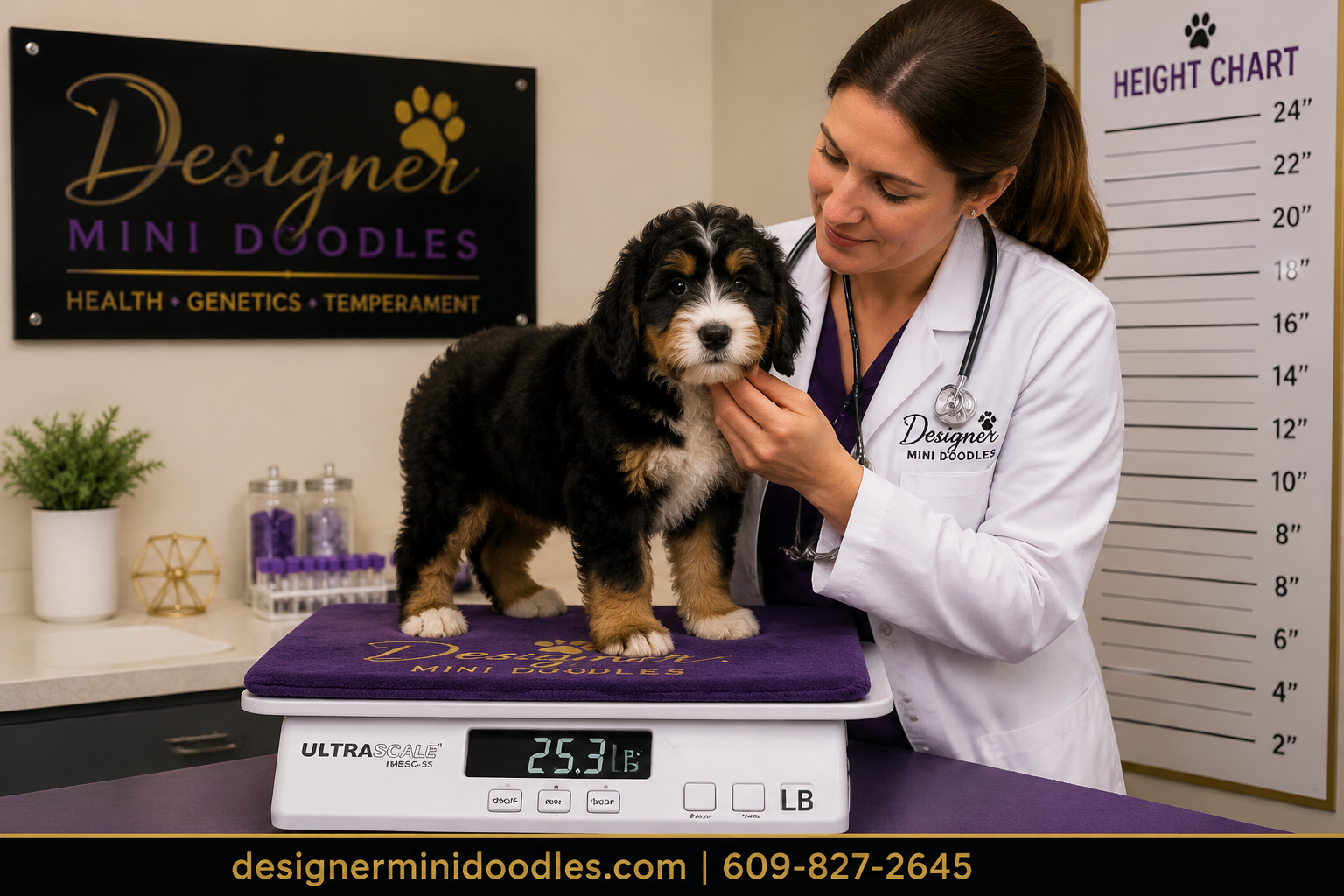
At Designer Mini Doodles, our breeding program includes a real animal biologist on site who oversees every pairing, health test, and developmental milestone. This level of professional oversight is one reason our mini bernedoodles for sale consistently produce healthy, well-tempered puppies.
How Big Do Mini Bernedoodles Get?
A fully grown mini bernedoodle typically stands 18 to 22 inches tall at the shoulder and weighs 25 to 49 pounds. They reach their adult height by around 12 months and fill out to their full weight by 14 to 18 months.
The size depends heavily on the parents. A mini bernedoodle is a cross between a Bernese mountain dog and a miniature poodle. Because Bernese mountain dogs are large (80 to 115 pounds) and miniature poodles are small (10 to 15 pounds), there’s natural variation in offspring size.
Choose a mini bernedoodle if:
- You want a dog that’s big enough to be sturdy with kids but small enough for a Lutz townhome or apartment
- You prefer a dog under 50 pounds for easier handling and travel
- You want a Bernese mountain dog temperament in a more manageable package
For a detailed look at what to expect as your puppy matures, check out our guide on mini bernedoodle full grown size.
Edge case: Some breeders market “micro mini bernedoodles” that stay under 25 pounds. These are typically produced by using a toy poodle instead of a miniature poodle, or by selecting the smallest puppies across multiple generations. Micro minis can be healthy, but make sure the breeder isn’t achieving small size through runting or poor nutrition.
Are Mini Bernedoodles Good With Kids?
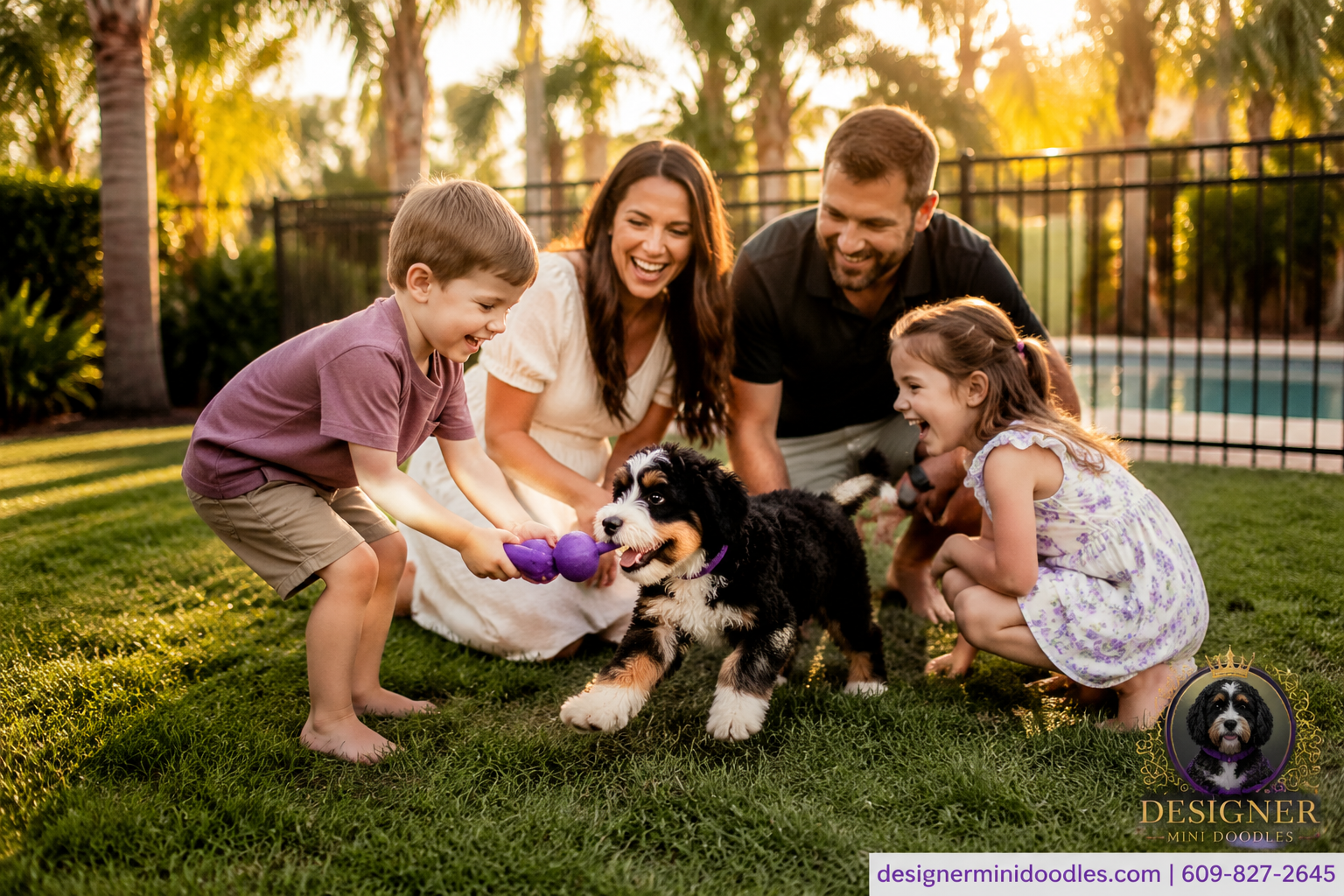
Yes, mini bernedoodles are widely regarded as one of the best doodle breeds for families with children. They inherit the Bernese mountain dog’s gentle, patient nature and the poodle’s intelligence and eagerness to please.
What makes them especially good family dogs:
- Gentle mouth: Bernese mountain dogs were bred as farm companions, not guard dogs, so they tend to be soft-mouthed and patient.
- Right size: At 25 to 49 pounds, mini bernedoodles are sturdy enough that a toddler won’t accidentally hurt them, but not so large they’ll knock small children over.
- High social drive: They bond deeply with family members and prefer to be wherever the kids are.
- Trainable: Their poodle intelligence means they respond well to consistent training, which is important in a household with young children.
Important caveat: No breed is automatically safe with kids. Every mini bernedoodle puppy needs proper socialization between 3 and 16 weeks of age, and children need to learn how to interact respectfully with dogs. Supervise all interactions between dogs and young children regardless of breed.
For families in Lutz looking at other kid-friendly doodle options, our micro goldendoodle size guide explains why smaller doodles can also work well in family homes.
What Health Issues Do Mini Bernedoodles Have?
Mini bernedoodles are generally healthier than purebred Bernese mountain dogs due to hybrid vigor, but they can still inherit health conditions from either parent breed. The most common health concerns include hip dysplasia, elbow dysplasia, progressive retinal atrophy (PRA), and von Willebrand’s disease.
Here’s a breakdown of conditions to watch for:
- Hip and elbow dysplasia: Inherited from the Bernese side. Reputable breeders screen both parents through OFA (Orthopedic Foundation for Animals) evaluations.
- Progressive retinal atrophy (PRA): A genetic eye condition from the poodle side. DNA testing can identify carriers before breeding.
- Von Willebrand’s disease: A blood clotting disorder. Genetic testing eliminates this risk when both parents are tested.
- Allergies and skin conditions: Florida’s warm, humid climate around Lutz can worsen skin allergies. Regular grooming and flea/tick prevention help manage this.
- Bloat (gastric dilatation-volvulus): Less common in minis than standards, but still possible. Feeding smaller, more frequent meals reduces risk.
Decision rule: When evaluating mini bernedoodles for sale in Lutz, always ask the breeder for documentation of OFA hip/elbow scores, cardiac clearance, ophthalmologist exam results, and genetic panel testing. A breeder who can’t or won’t provide these records is a red flag.
At Designer Mini Doodles, our on-site animal biologist reviews every genetic test result and health clearance before any breeding pairing is approved. This scientific approach to our breeding program is second to none and produces the healthiest mini bernedoodle puppies available anywhere in the USA.
What’s the Average Lifespan of a Mini Bernedoodle?
Mini bernedoodles live an average of 12 to 15 years, which is significantly longer than the purebred Bernese mountain dog’s average lifespan of 7 to 10 years. The miniature poodle’s longevity (12 to 15 years) and the benefits of hybrid vigor contribute to this extended lifespan.
Factors that influence how long your mini bernedoodle will live:
- Genetics: Puppies from health-tested parents with no history of cancer (common in Bernese lines) tend to live longer.
- Weight management: Keeping your dog at a healthy weight reduces strain on joints and organs.
- Dental care: Regular teeth cleaning prevents periodontal disease, which is linked to heart and kidney problems.
- Preventive veterinary care: Annual wellness exams, vaccinations, and heartworm prevention (especially critical in Florida) all extend lifespan.
- Diet quality: High-quality protein-based food without excessive fillers supports long-term health.
Mini Bernedoodle vs. Standard Bernedoodle: Key Differences
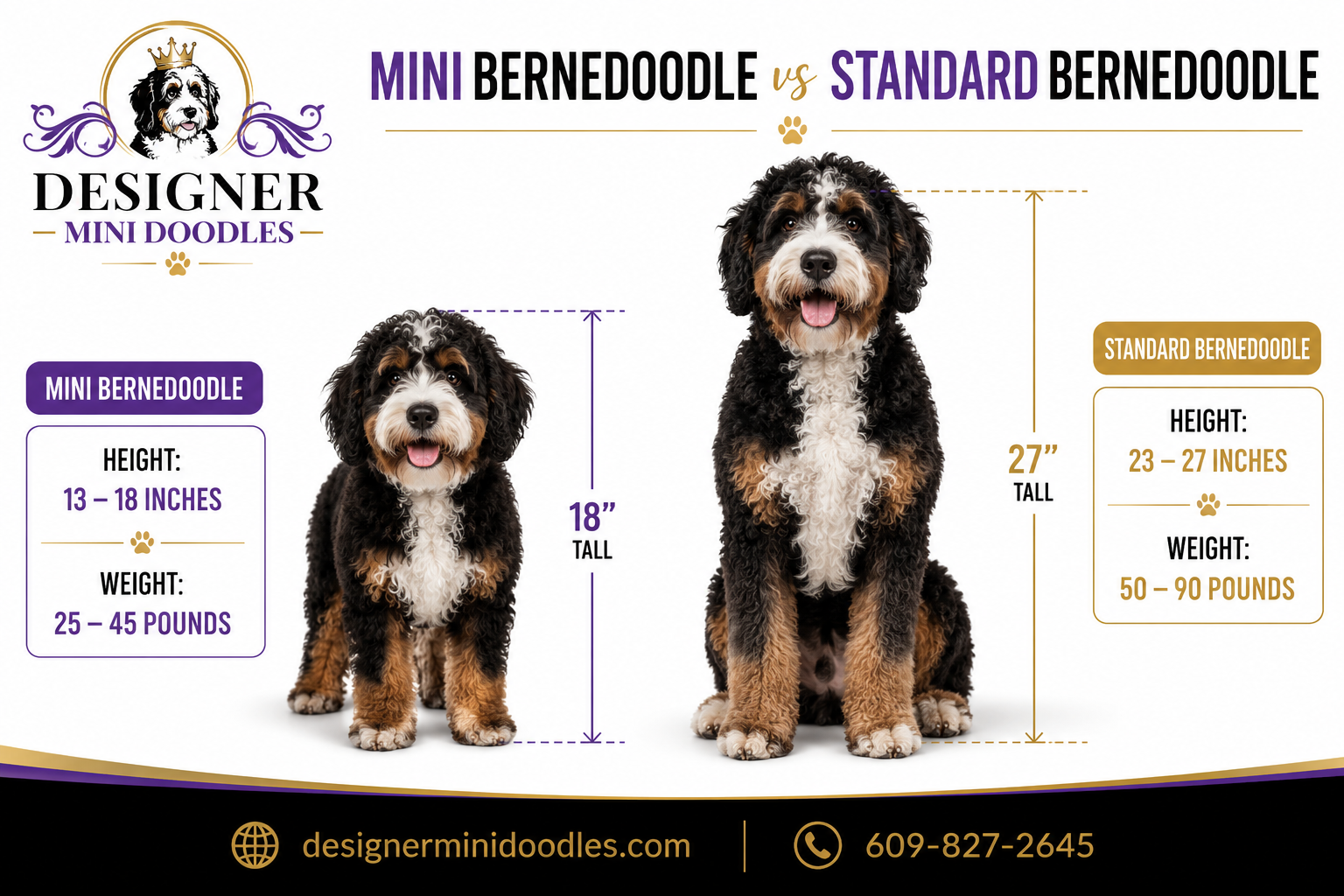
The main differences between mini and standard bernedoodles are size, lifespan, and exercise needs. Mini bernedoodles weigh 25 to 49 pounds while standards weigh 50 to 90+ pounds. Minis also tend to live 2 to 4 years longer.
| Feature | Mini Bernedoodle | Standard Bernedoodle |
|---|---|---|
| Weight | 25-49 lbs | 50-90+ lbs |
| Height | 18-22 inches | 23-29 inches |
| Lifespan | 12-15 years | 10-12 years |
| Exercise needs | 30-60 min/day | 60-90 min/day |
| Space requirements | Apartments to houses | Houses with yards preferred |
| Food costs | $50-$80/month | $80-$130/month |
| Grooming costs | $60-$90 per session | $80-$120 per session |
| Best for | Smaller homes, first-time owners, families with young kids | Active families, larger properties, experienced dog owners |
Choose a mini bernedoodle if you live in a Lutz home with a smaller yard, want lower food and grooming costs, or prefer a dog you can easily lift into the car. Choose a standard if you want a larger hiking or outdoor companion and have the space to accommodate a bigger dog.
Do Mini Bernedoodles Shed a Lot?
No, mini bernedoodles are low-shedding dogs, but the amount of shedding depends on their coat type and generation. F1B mini bernedoodles (75% poodle, 25% Bernese) shed the least because they inherit more of the poodle’s curly, non-shedding coat.
Coat types and shedding levels:
- Curly coat: Sheds very little. Requires professional grooming every 6 to 8 weeks to prevent matting.
- Wavy coat: Sheds lightly. The most common coat type. Needs brushing 3 to 4 times per week.
- Straight/flat coat: Sheds moderately, similar to a Bernese mountain dog. Less common in mini bernedoodles but possible in F1 crosses.
In Lutz’s warm, humid climate, regular grooming is especially important. Moisture and heat can cause mats to tighten quickly, leading to skin irritation underneath. Budget for professional grooming every 6 to 8 weeks, and brush at home between appointments.
Are Mini Bernedoodles Hypoallergenic?
No dog is truly 100% hypoallergenic, but mini bernedoodles with curly coats produce significantly less dander and shed far less hair than most breeds. For people with mild to moderate dog allergies, a curly-coated F1B or F2B mini bernedoodle is often a comfortable choice.
What actually causes allergies: The allergen isn’t dog hair itself but a protein called Can f 1 found in dog saliva, urine, and skin cells (dander). Curly-coated dogs trap dander in their fur rather than releasing it into the air, which reduces allergic reactions.
If you have allergies, choose:
- An F1B generation (miniature poodle crossed back to an F1 bernedoodle)
- A puppy with a tight, curly coat rather than a wavy or straight coat
- A breeder who allows you to spend time with the puppy before committing
For allergy-sensitive households exploring other low-shedding options, our guide to hypoallergenic toy poodles provides additional breed comparisons.
Where Can I Find Reputable Mini Bernedoodle Breeders in Florida?
The best way to find reputable mini bernedoodle breeders serving Lutz and the greater Tampa Bay area is to look for programs that provide OFA health clearances, genetic testing panels, written health guarantees, and transparent access to parent dogs.
Checklist for evaluating a Florida breeder:
- Ask for OFA certifications on hips, elbows, heart, and eyes for both parent dogs.
- Request the genetic testing panel (look for Embark or Paw Print Genetics results).
- Visit the facility if possible, or ask for a live video tour.
- Confirm the breeder provides a written health guarantee of at least 2 years.
- Check for references from previous puppy buyers.
- Verify the breeder socializes puppies using early neurological stimulation (ENS) protocols.
- Ask about the breeder’s return policy if you can’t keep the dog.
Red flags to avoid:
- No health testing documentation
- Multiple breeds available with puppies always in stock
- Pressure to pay a deposit immediately
- No questions asked about your home or lifestyle
- Prices significantly below market rate
Designer Mini Doodles operates one of the most respected mini bernedoodle breeding programs in the country, with a real animal biologist overseeing health protocols. Our puppies can travel anywhere in the USA through our professional nanny service, so Lutz families can receive their puppy safely at their doorstep. Browse our mini bernedoodle puppies for sale to see currently available litters.
How Much Does It Cost to Care for a Mini Bernedoodle Yearly?
Annual care costs for a mini bernedoodle in the Lutz, Florida area run approximately $2,000 to $3,500 after the initial purchase price. The first year is typically the most expensive due to puppy vaccinations, spay/neuter surgery, and supplies.
Annual cost breakdown:
| Expense | Estimated Annual Cost |
|---|---|
| Food (high-quality) | $600-$960 |
| Professional grooming (6-8 visits) | $420-$720 |
| Veterinary wellness exams | $200-$400 |
| Heartworm/flea/tick prevention | $200-$350 |
| Pet insurance | $400-$700 |
| Toys, treats, supplies | $150-$300 |
| Total | $1,970-$3,430 |
Florida-specific costs: Heartworm prevention is year-round in Lutz because mosquitoes are active 12 months a year. This is non-negotiable. Flea and tick prevention is also a year-round expense in the Tampa Bay area.
First-year extras: Add $300 to $600 for the puppy vaccination series, $200 to $500 for spay/neuter, and $200 to $400 for initial supplies (crate, bed, leash, bowls, etc.).
Are Mini Bernedoodles Good for First-Time Dog Owners?
Yes, mini bernedoodles are one of the best doodle breeds for first-time dog owners. Their eager-to-please temperament, moderate exercise needs, and manageable size make them forgiving of beginner mistakes.
Why they work well for beginners:
- They respond quickly to positive reinforcement training
- They’re not overly dominant or stubborn
- Their size is manageable for people who haven’t handled large dogs
- They adapt well to different living situations, from Lutz apartments to homes with yards
- They’re social and bond quickly with their owners
Where first-time owners sometimes struggle:
- Grooming requirements are higher than expected. Budget time and money for regular coat maintenance.
- Separation anxiety can develop if you don’t practice leaving the puppy alone gradually from a young age.
- They need mental stimulation, not just physical exercise. Puzzle toys and training sessions prevent boredom.
For new owners looking for guidance, our training a mini bernedoodle puppy resource covers the essentials of obedience, socialization, and behavior management.
Common Training Challenges With Mini Bernedoodles
The most common training challenge with mini bernedoodles is separation anxiety, followed by stubbornness during adolescence (around 6 to 10 months) and mouthiness during the teething phase.
Challenge 1: Separation anxiety
Mini bernedoodles bond intensely with their families. If they aren’t taught to be comfortable alone, they can develop destructive behaviors like chewing, barking, and house soiling when left by themselves.
Solution: Start crate training from day one. Leave the puppy alone for short periods (5 to 10 minutes), gradually increasing the duration. Never make departures or arrivals dramatic.
Challenge 2: Adolescent stubbornness
Around 6 to 10 months, many mini bernedoodles go through a “teenage” phase where they test boundaries and seem to forget their training.
Solution: Stay consistent. Don’t give up on commands they already know. Increase training session frequency but keep sessions short (5 to 10 minutes).
Challenge 3: Mouthiness and nipping
Puppies explore the world with their mouths. Mini bernedoodle puppies can be mouthy, especially during teething at 3 to 6 months.
Solution: Redirect to appropriate chew toys immediately. If the puppy nips skin, say “ouch” and withdraw attention for 10 to 15 seconds. Consistency is key.
For detailed housebreaking strategies specific to this breed, see our guide on housebreaking a mini bernedoodle puppy.
What Should I Look for When Buying a Mini Bernedoodle Puppy?
When searching for mini bernedoodles for sale in Lutz, prioritize health testing, breeder transparency, early socialization, and a written contract. These four factors matter more than coat color or price.
Step-by-step puppy buying checklist:
- Verify health clearances. Both parents should have OFA hip, elbow, cardiac, and eye certifications plus a comprehensive genetic panel.
- Meet the parents (or see video). Parent temperament is the strongest predictor of puppy temperament.
- Ask about socialization protocols. The best breeders use Early Neurological Stimulation (ENS) and expose puppies to household sounds, surfaces, and gentle handling from birth.
- Review the contract. Look for a health guarantee (minimum 2 years), spay/neuter requirements, and a return clause.
- Check the puppy’s temperament. A well-socialized 8-week-old puppy should be curious, not fearful. It should recover quickly from mild surprises.
- Ask about the transition plan. Good breeders send puppies home with a familiar blanket, food sample, and detailed care instructions.
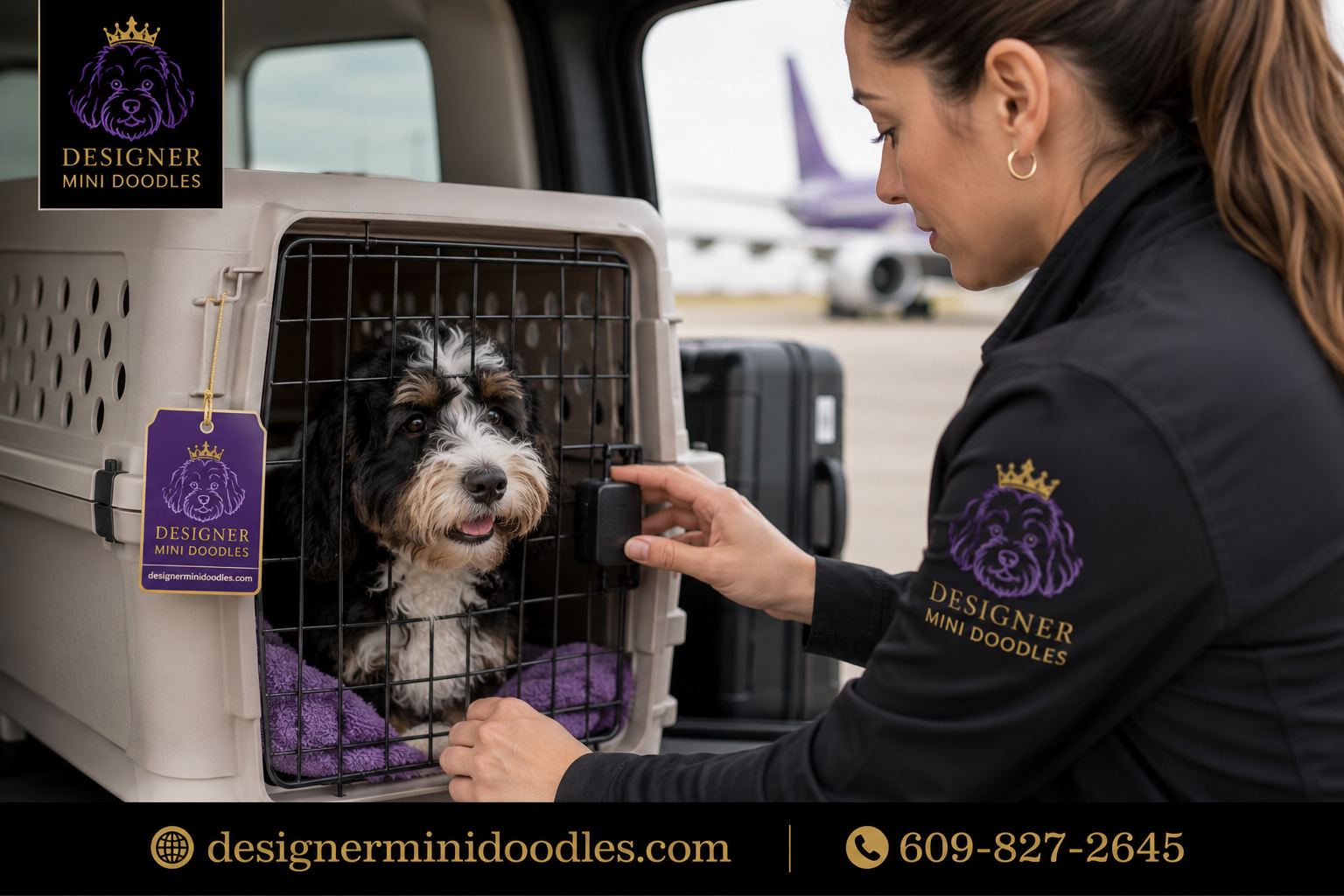
If you’re buying from a distance: Many top breeding programs, including Designer Mini Doodles, offer professional nanny delivery services. A trained pet nanny flies with your puppy in-cabin and delivers them directly to your Lutz home. This is far safer than cargo shipping and reduces stress on the puppy.
Also, if you’re exploring other breeds alongside your bernedoodle search, you might be interested in our frenchies for sale for a completely different but equally lovable companion.
Frequently Asked Questions
How long does it take to get a mini bernedoodle puppy in Lutz?
Wait times vary from a few weeks (if a litter is currently available) to 3 to 6 months for popular color combinations like tricolor or merle. Placing a deposit early secures your spot on a waitlist.
Can mini bernedoodles handle Florida’s heat?
Yes, but they need access to shade, fresh water, and air conditioning. Avoid outdoor exercise during peak heat (11 a.m. to 4 p.m.) in summer. Their Bernese heritage means they tolerate cold better than heat, so be mindful during Lutz’s hottest months.
Do mini bernedoodles bark a lot?
Mini bernedoodles are moderate barkers. They’ll alert you to visitors or unusual sounds but aren’t typically excessive barkers. Early training can minimize nuisance barking.
What generation of mini bernedoodle is best?
F1B (75% poodle, 25% Bernese) is the most popular generation because it offers the best combination of low shedding and the Bernese temperament. F1 puppies have more coat variation, and some may shed moderately.
How often do mini bernedoodles need grooming?
Professional grooming every 6 to 8 weeks, with at-home brushing 3 to 4 times per week. In Lutz’s humid climate, more frequent brushing helps prevent matting.
Are mini bernedoodles easy to potty train?
They’re moderately easy to potty train. Most mini bernedoodles are reliably housetrained by 4 to 6 months with consistent crate training and a regular schedule. Some take longer, especially smaller puppies with smaller bladders.
Can I fly a mini bernedoodle puppy to Lutz?
Yes. Many breeders offer nanny flight services where a trained handler flies with your puppy in the cabin. Designer Mini Doodles provides this service for deliveries anywhere in the USA, including Lutz and the greater Tampa Bay area.
Do mini bernedoodles get along with other pets?
Generally yes. Mini bernedoodles are social dogs that usually coexist well with other dogs and cats, especially when introduced properly. Early socialization with other animals improves outcomes.
What colors do mini bernedoodles come in?
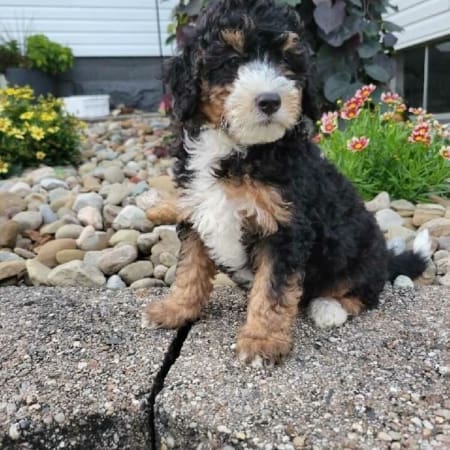
The most sought-after color is the classic tricolor (black, white, and rust), which mimics the Bernese mountain dog pattern. Other colors include phantom, merle, sable, black and white, and occasionally solid black.
Should I get pet insurance for my mini bernedoodle?
Yes, pet insurance is strongly recommended. Policies cost $35 to $60 per month and can save thousands if your dog develops a hereditary condition or needs emergency surgery. Enroll while the puppy is young, before any pre-existing conditions are documented.
How much exercise does a mini bernedoodle need daily?
Mini bernedoodles need 30 to 60 minutes of exercise per day. This can include walks, playtime in the yard, or interactive games. They’re adaptable and don’t require the intense exercise that standard bernedoodles or high-energy breeds need.
What’s the difference between a mini bernedoodle and a mini goldendoodle?
Mini bernedoodles use a Bernese mountain dog parent while mini goldendoodles use a golden retriever parent. Bernedoodles tend to be slightly more laid-back and come in tricolor patterns. Goldendoodles are often more energetic and come in golden, cream, or red shades. Both are excellent family dogs.
Conclusion
Finding quality mini bernedoodles for sale in Lutz comes down to doing your homework on breeders, understanding what to expect in terms of size, health, and costs, and preparing your home for a puppy that will be part of your family for 12 to 15 years.
Your next steps:
- Set your budget. Plan for $3,000 to $5,500 for the puppy plus $2,000 to $3,500 in first-year care costs.
- Research breeders. Use the checklist in this guide to evaluate health testing, socialization practices, and contracts.
- Browse available puppies. Visit our mini bernedoodle puppies page to see current litters from our program, which features an on-site animal biologist and comprehensive health testing.
- Prepare your home. Stock up on a crate, food, grooming supplies, and schedule a vet appointment for the week your puppy arrives.
- Ask about delivery. If you’re working with a breeder outside the Lutz area, ask about nanny flight services to get your puppy home safely.
The right mini bernedoodle from a responsible breeder will bring years of joy, companionship, and those signature tricolor cuddles to your Lutz home. Take your time, ask the right questions, and you’ll find the perfect match.
- Display 9 Products per page


References
- Orthopedic Foundation for Animals (OFA). “CHIC Program Requirements.” OFA, 2024. https://ofa.org
- American Kennel Club. “Bernese Mountain Dog Breed Information.” AKC, 2024. https://www.akc.org/dog-breeds/bernese-mountain-dog/
- American Kennel Club. “Poodle (Miniature) Breed Information.” AKC, 2024. https://www.akc.org/dog-breeds/poodle-miniature/