

Last updated: June 12, 2026
Quick Answer
Toy goldendoodle breeders specialize in producing the smallest size of the goldendoodle (typically 10 to 20 pounds at maturity) by pairing a Golden Retriever lineage with a Toy Poodle, usually through F1b or multigenerational crosses. Expect to pay $3,000 to $5,500 from a reputable program that does genetic health testing, early neurological stimulation (ENS), and early crate and housebreaking work. The breeder’s program, not the puppy’s cuteness, determines whether you get a calm, healthy adult dog.
At Designer Mini Doodles, our program is run by an animal biologist with more than 15 years of focused doodle breeding experience, and we ship puppies worldwide through our dedicated puppy nanny service.
Key Takeaways
- A toy goldendoodle matures around 10–20 lbs and 11–14 inches tall, smaller than a mini and slightly larger than a “micro.”
- Reputable toy goldendoodle breeders health-test both parents (hips, elbows, eyes, cardiac, PRA, vWD, DM, GR-PRA1/2).
- Average price range in the US: $3,000–$5,500, with show-quality or rare colors up to $7,000+.
- Toy goldendoodles are generally good with families, but supervision matters because of their small size.
- They are low-shedding, not technically hypoallergenic — no breed is.
- Early Neurological Stimulation (ENS), early crate training, and early housebreaking dramatically reduce behavior problems.
- The “best states” for finding a quality breeder are Wisconsin, Pennsylvania, Indiana, Texas, North Carolina, and Virginia based on breeder density and state breeding regulations.
- The biggest first-time owner mistake is choosing on price or photos instead of the breeder’s protocol.
What exactly is a toy goldendoodle?
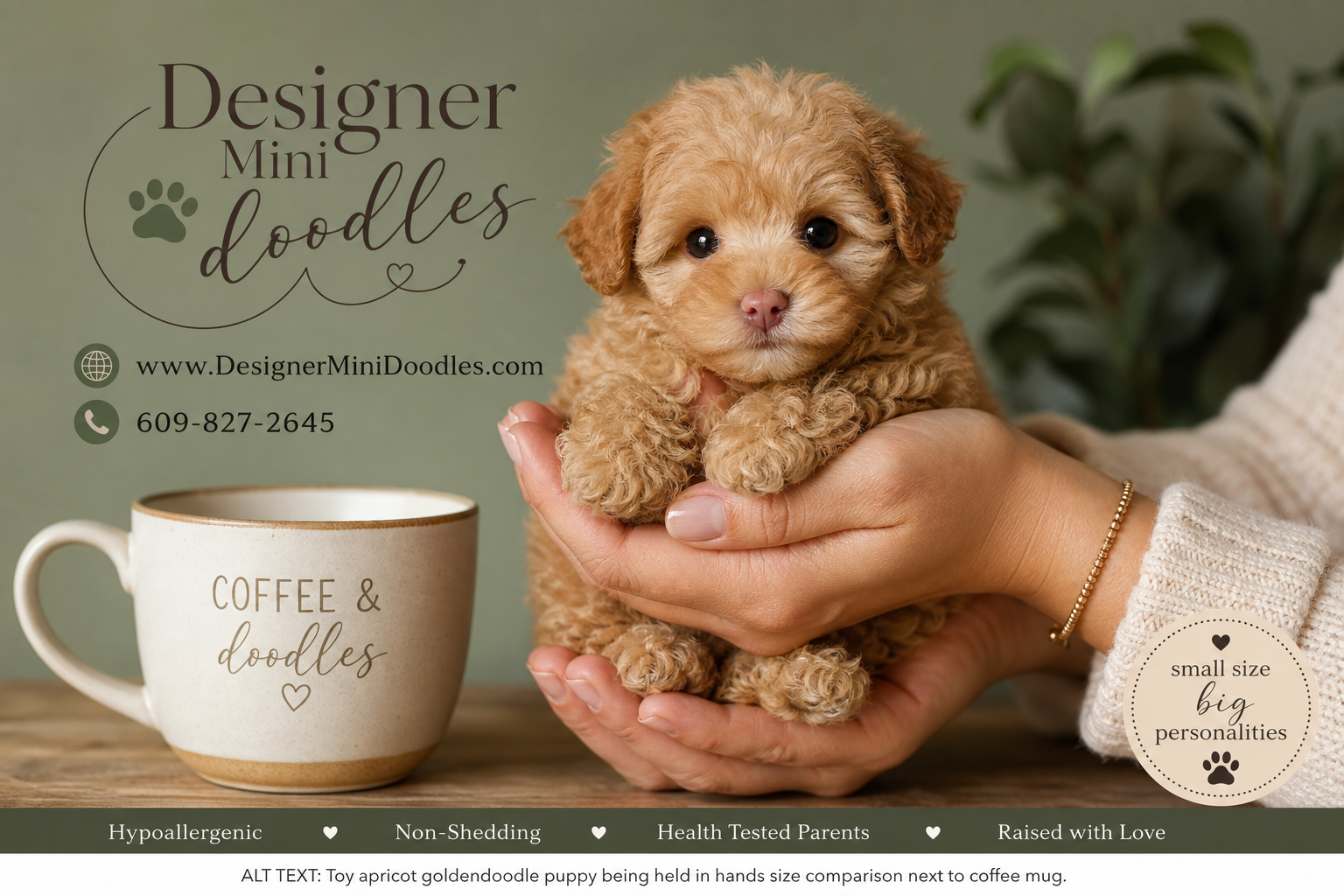
A toy goldendoodle is the smallest variety of goldendoodle, produced by breeding a Toy Poodle (under 10 lbs) to a smaller goldendoodle parent, usually an F1 or F1b mini. Adults typically weigh 10 to 20 pounds and stand 11 to 14 inches at the shoulder.
Most toy goldendoodles sold today are multigen (F1bb, F2b, or higher), which stabilizes the curly, low-shedding coat and the smaller size. A first-generation (F1) toy is rare because of the size gap between a Golden Retriever and a Toy Poodle, which is why ethical breeders typically use a Toy Poodle stud over a mini goldendoodle dam.
Quick rule: If a breeder advertises an “F1 toy goldendoodle” produced directly from a Golden Retriever and a Toy Poodle, ask exactly how that pairing was done. The math rarely works safely.
How much do toy goldendoodle puppies cost?
The average price range for a toy goldendoodle puppy in 2026 is $3,000 to $5,500 from a health-tested, ethical program. Pet-store or unverified online listings often advertise lower prices ($1,500–$2,500), but those puppies frequently come from commercial operations without genetic testing or early socialization.
What drives price up or down
| Factor | Price impact |
|---|---|
| OFA/PennHIP, cardiac, eye, and DNA panel on both parents | +$500–$1,500 |
| Multigen pedigree (F1bb, F2b) for coat consistency | +$300–$800 |
| Rare colors (merle, phantom, parti, true red) | +$500–$2,000 |
| Early Neurological Stimulation + early crate training | +$300–$700 |
| Puppy nanny delivery (domestic) | +$400–$900 |
| International puppy nanny delivery | +$1,200–$3,500 |
You’re not just paying for a puppy — you’re paying for the 18 months of testing, training, and prenatal care that happens before the puppy is even born.
For a deeper breakdown, see our cost-of-ownership clarity guide.
How big do toy goldendoodles get when fully grown?
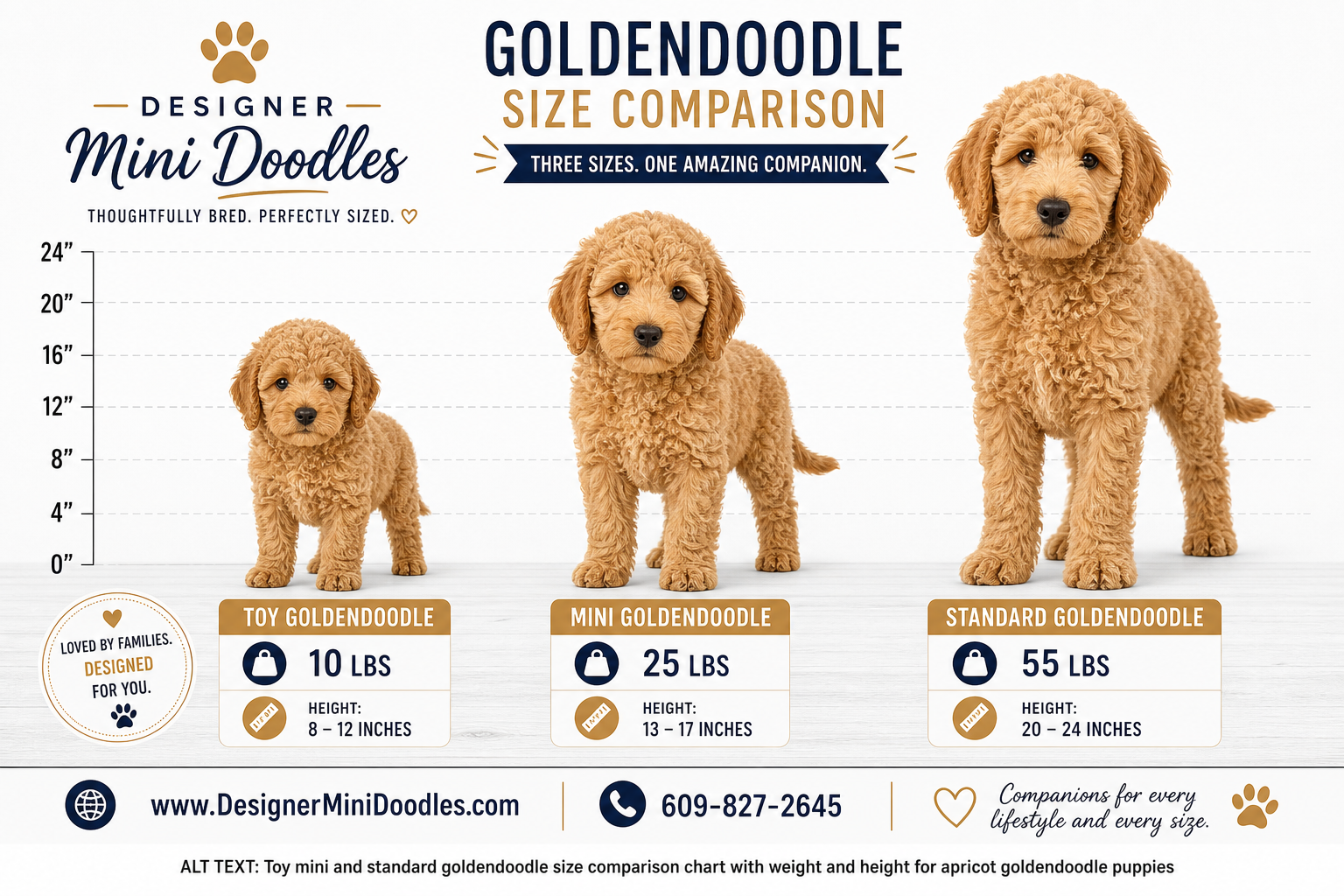
Most toy goldendoodles reach full adult size between 10 and 14 months, finishing at 10–20 lbs and 11–14 inches at the shoulder. They typically hit their adult height by 8 months and fill out in muscle and chest depth for another 4–6 months after that.
A useful predictor: a toy goldendoodle puppy will usually weigh roughly 3x its 8-week weight as an adult. So a 4 lb puppy at 8 weeks typically matures around 12 lbs. Ask your breeder for the parents’ adult weights — that’s the single most reliable size predictor.
Toy goldendoodle vs mini goldendoodle: what are the differences?
The short answer: size, energy level, and lifespan tendencies. Toy goldendoodles are smaller, often slightly calmer indoors, and tend to live a year or two longer on average than minis. Minis have more athletic stamina for hiking and active families.
| Trait | Toy Goldendoodle | Mini Goldendoodle |
|---|---|---|
| Adult weight | 10–20 lbs | 20–35 lbs |
| Adult height | 11–14 in | 14–17 in |
| Lifespan | 13–17 years | 12–15 years |
| Exercise need | 30–45 min/day | 45–75 min/day |
| Apartment fit | Excellent | Good |
| Best for | Small homes, seniors, travel | Active families, suburban homes |
If you want a deeper comparison, our miniature goldendoodle breeders overview breaks it down further.
Choose a toy if: you live in an apartment, travel often, want a lap dog, or have limited mobility.
Choose a mini if: you want a hiking partner or have kids under 6 who play rough.
How to find a reputable toy goldendoodle breeder near me
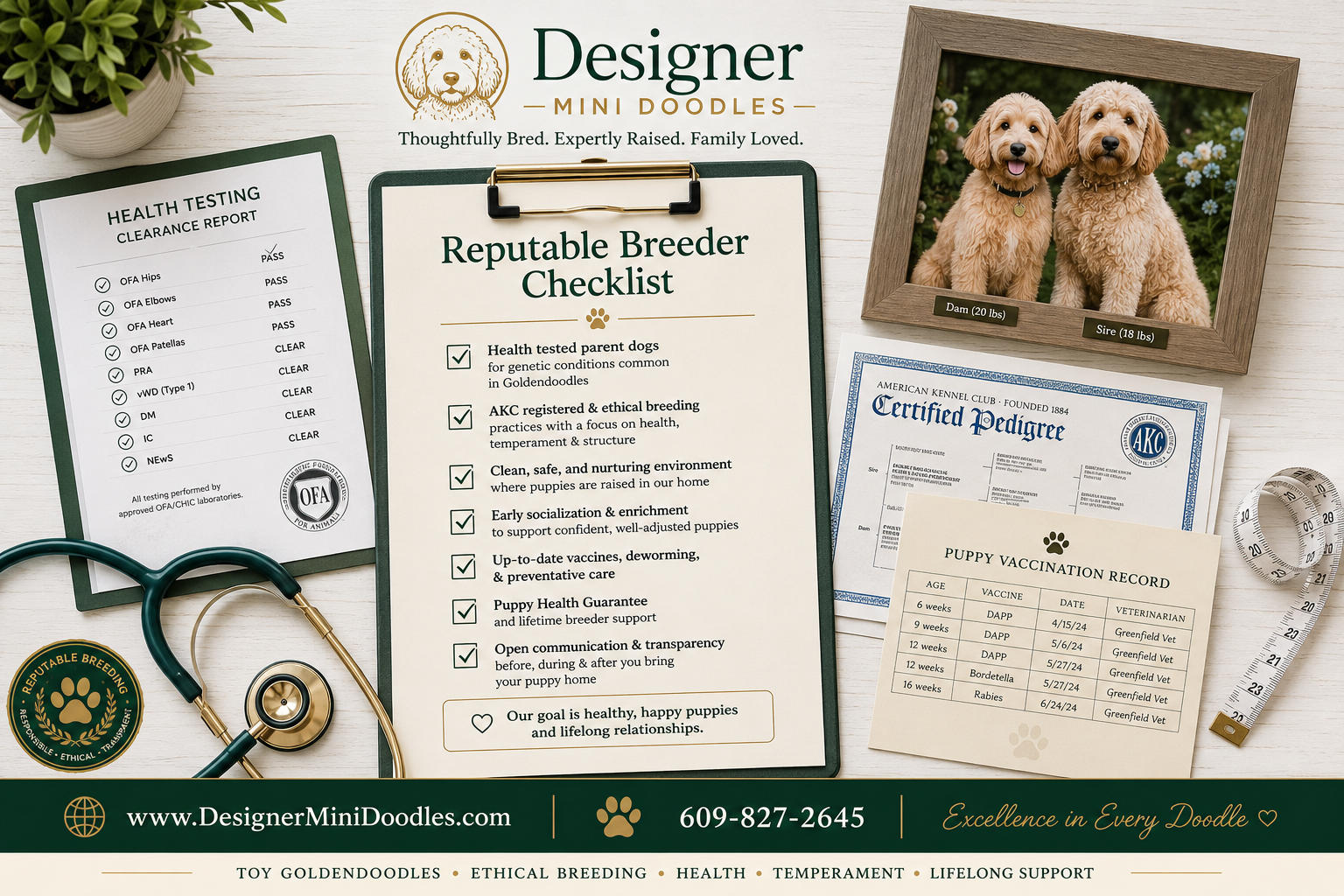
Start with breeders who publish health testing results, raise puppies in their home (not a kennel), and use a structured early development protocol like ENS, Puppy Culture, or Avidog. Then verify those claims with documentation — not just photos on Instagram.
Your 10-point vetting checklist
- Both parents have OFA or PennHIP hip clearances
- DNA panel covering PRA, DM, vWD, ICH, GR-PRA1, GR-PRA2
- Annual ophthalmologist (CAER) eye clearance
- Cardiac clearance on the sire
- Puppies are kept until at least 8 weeks (10 weeks for toys is ideal)
- Early Neurological Stimulation days 3–16
- Health guarantee of 2+ years for genetic conditions
- Spay/neuter or co-ownership contract (not mandatory mailing of puppy before 8 weeks)
- Open communication — they ask YOU questions too
- Verifiable references from past puppy buyers
Best states for toy goldendoodle breeders
Based on breeder density, state breeder licensing laws, and our experience placing puppies, the strongest states for finding a reputable program are:
- Wisconsin — strict state breeder regs
- Pennsylvania — large established breeder community
- Indiana and Ohio
- North Carolina and Virginia
- Texas, Florida, and California
If you don’t live near one of these, that’s fine — most reputable toy goldendoodle breeders offer a puppy nanny flight service. At Designer Mini Doodles, our puppies fly to homes anywhere in the world with a dedicated nanny in-cabin.
How to tell if a toy goldendoodle breeder is legitimate
A legitimate breeder will show you the parents (on video or in person), share full health testing paperwork, and have a written contract before any deposit. Anything less is a red flag.
Red flags to walk away from
- Multiple breeds and constant litters available year-round
- Won’t let you video call to see the puppy and parents
- Wants payment via gift card, Zelle, Venmo Friends & Family, or crypto only
- “Pure breed” claims for any goldendoodle (it’s a designer cross)
- No health guarantee or vague verbal-only guarantees
- Puppies offered before 8 weeks old
- Prices significantly below market ($1,200 puppies from “AKC champion lines”)
- Stock photos reused across multiple listings — reverse-image search them
Green flags
- Waitlist or application process before breeding
- Detailed weekly photo and video updates
- Lifetime breeder support after take-home day
- Will take the dog back at any point in its life if you can’t keep it
Are toy goldendoodles hypoallergenic?
No dog is fully hypoallergenic, but toy goldendoodles are considered low-allergen because of their poodle-dominant coat. People react to a protein called Can f 1 found in dander, saliva, and urine — not just hair. Low-shedding curly coats hold dander against the skin instead of releasing it into your home.
F1b and multigen toys are the most reliably low-shedding because they’re 75%+ poodle. F1 toys are a coin flip. If allergies are the reason you’re buying, ask the breeder to match you with the curliest-coated puppy in the litter, and visit in person before committing. Our allergy-conscious homes guide has more detail.
What health issues do toy goldendoodles have?
The most common health issues in toy goldendoodles are patellar luxation, progressive retinal atrophy (PRA), hip dysplasia (less common in toys than standards), Addison’s disease, and dental crowding due to the small jaw. Hybrid vigor reduces risk compared to purebred lines, but it doesn’t eliminate it.
Do toy goldendoodles have more health problems than standard poodles?
Not necessarily. Standard poodles have higher rates of bloat, sebaceous adenitis, and Addison’s, while toy goldendoodles see more patellar issues, dental problems, and hypoglycemia in very small puppies. Total lifetime vet costs tend to be similar; the conditions are just different.
The key variable isn’t breed — it’s whether both parents were genetically tested. A health-tested toy goldendoodle will outlive a poorly bred standard poodle in most cases.
Are toy goldendoodles good for families with small kids?
Toy goldendoodles are affectionate and patient with children, but their small size makes them physically fragile. They’re a better fit for families with kids age 6 and up who can be taught to handle a small dog gently. For toddlers, a mini or medium goldendoodle is usually a safer pairing.
Risks to manage with small kids:
- Dropped or stepped-on puppies (the leading cause of toy breed leg fractures)
- Resource guarding if kids approach food bowls
- Overstimulation — toy goldendoodles need quiet downtime
If you have older kids and want a calm family dog, our family households guide walks through setup.
Common mistakes first-time toy goldendoodle owners make
The biggest mistake is underestimating how much structure a small puppy needs in the first 16 weeks. People treat tiny puppies like accessories instead of dogs.
- Skipping crate training because “she’s so small and sad in there.” Crate training prevents separation anxiety later.
- Carrying the puppy everywhere. Toy goldendoodles need to walk and build confidence on their own paws.
- Free-feeding. This creates picky eaters and disrupts housebreaking. Scheduled meals only.
- Late socialization. The critical window closes around 14 weeks. Get to puppy classes early.
- Over-grooming or under-grooming. Brush 3–4x per week and groom professionally every 6–8 weeks.
- Treating dental care as optional. Toy breeds have crowded mouths. Brush teeth daily from day one.
- Choosing on photos. Pick the breeder first, then let them match you to the right puppy temperament.
Why our toy goldendoodle program is different
Designer Mini Doodles has been breeding toy goldendoodle puppies in America for more than 15 years. Our program is led by a trained animal biologist, which means breeding decisions are made on genetics and behavioral science, not aesthetics.
Every puppy goes through:
- Early Neurological Stimulation (ENS) days 3–16 (Bio-Sensor protocol)
- Early scent introduction to build neural pathways
- Early housebreaking starting at 4 weeks on a litter-box-to-outdoor transition
- Early crate training starting at 5 weeks with positive association
- Structured exposure curriculum — 100 different surfaces, sounds, and people before 8 weeks
- Puppy Culture-aligned socialization through week 10
The result is what owners consistently describe as the calmest, most affectionate, and most confident toy goldendoodle puppies they’ve encountered. We’re known for producing dogs that settle quickly in new homes and require minimal “reset” training.
Browse current litters of our toy goldendoodle puppies or explore our beautiful toy goldendoodle program. We also breed a small micro goldendoodle line for buyers wanting the 8–12 lb size range. If a French Bulldog is more your style, we recommend our partner program for french bulldog puppies.
Visit our Google Maps listing for reviews and location info. Our puppies are available to go to any home in the world with our dedicated puppy nanny service — we’ve placed dogs in 30+ countries.
Frequently Asked Questions
How long do toy goldendoodles live?
Most live 13 to 17 years. Smaller doodles tend to outlive larger ones, and health-tested lines typically reach the top of that range.
Can toy goldendoodles be left alone all day?
No. They tolerate 4–6 hours alone once adult and crate-trained, but a full 8–10 hour workday consistently leads to separation anxiety. Plan for a dog walker, daycare, or a work-from-home schedule.
Do toy goldendoodles bark a lot?
Less than most toy breeds. They’re alert but not yappy when properly socialized. Excessive barking usually points to under-stimulation, not the breed.
What colors do toy goldendoodles come in?
Apricot, cream, red, chocolate, black, parti, phantom, merle, and abstract. Apricot and red are most common; merle is rarest and most expensive.
Are toy goldendoodles AKC registered?
No. The AKC doesn’t recognize goldendoodles because they’re a designer cross. Reputable breeders register with the GANA (Goldendoodle Association of North America) or similar bodies.
How often do toy goldendoodles need grooming?
Professional grooming every 6–8 weeks plus brushing 3–4 times per week. Skip a few weeks and the coat mats fast.
Do toy goldendoodle breeders ship puppies?
Most reputable breeders offer in-cabin puppy nanny services rather than cargo shipping. At Designer Mini Doodles, every puppy travels in-cabin with a dedicated nanny, anywhere in the world.
What should I feed a toy goldendoodle puppy?
A high-quality small-breed puppy food with 22–28% protein, fed 3 times daily until 6 months, then twice daily. Avoid grain-free unless medically necessary (linked to DCM concerns).
How early can I bring my toy goldendoodle puppy home?
8 weeks minimum. 10 weeks is ideal for toys because of hypoglycemia risk and additional socialization time with siblings.
Conclusion: Your next steps
Buying from quality toy goldendoodle breeders isn’t about finding the lowest price or the cutest Instagram post. It’s about finding a program where the puppy you bring home has already been set up to succeed — genetically, neurologically, and behaviorally.
Here’s what to do next:
- Decide on size (toy 10–20 lbs vs mini 20–35 lbs) and color preferences.
- Build a shortlist of 3–5 breeders using the 10-point checklist in this guide.
- Request health testing documentation in writing before any deposit.
- Video-call the breeder and ask to see the parents and puppy environment.
- Get on a waitlist — quality breeders are typically booked 6–12 months out.
- Prepare your home with a crate, x-pen, and grooming supplies before pickup.
If you’re ready to explore current and upcoming litters, reach out to our team at Designer Mini Doodles. With 15+ years of focused breeding, science-based protocols, and worldwide nanny delivery, we’d be glad to help you find the right puppy for your home.
Sources
- Goldendoodle Association of North America (GANA), Breeder Standards, 2024 — goldendoodleassociation.com
- Orthopedic Foundation for Animals (OFA), Health Testing Database, 2024 — ofa.org
- American Veterinary Medical Association, Pet Ownership Statistics, 2024 — avma.org
- AKC Canine Health Foundation, Poodle and Doodle Health Research, 2023 — akcchf.org