
mini doodle puppies North carolina
Quick Answer: The best mini doodle breeders in North Carolina prioritize genetic health testing, early socialization, and transparent communication with puppy families. North Carolina’s mild climate and growing pet-friendly communities make it one of the top states for raising mini doodles, but finding a responsible breeder requires knowing exactly what to look for — and what red flags to avoid.
North Carolina saw a sharp rise in demand for small designer breeds after 2020, and mini doodle breeders in North Carolina have responded with waitlists that can stretch six months or longer. I’ve spent years researching what separates a quality breeding program from a puppy mill with a nice website, and this guide covers everything you need to know before putting down a deposit.
Key Takeaways
- Mini doodles are a cross between a Golden Retriever (or Bernese Mountain Dog) and a Miniature or Toy Poodle, typically weighing 10–30 pounds full grown.
- Reputable mini doodle breeders in North Carolina perform OFA hip evaluations, cardiac exams, and DNA panels on all parent dogs.
- Expect to pay between $2,500 and $5,000+ for a well-bred mini doodle puppy in NC in 2026, depending on size, coat color, and generation.
- Waitlists are common — plan 3 to 9 months ahead.
- North Carolina does not require a state breeder license for small-scale operations, so buyer due diligence is essential.
- A health guarantee of at least 2 years is standard among top breeders.
- Micro mini goldendoodles (10–16 lbs) are the fastest-growing size category in the Tar Heel State.
What Exactly Is a Mini Doodle?
A mini doodle is a hybrid dog bred by crossing a purebred retriever or other breed with a Miniature or Toy Poodle to produce a smaller, low-shedding companion. The most popular types are mini goldendoodles (Golden Retriever x Mini Poodle) and mini bernedoodles (Bernese Mountain Dog x Mini Poodle).
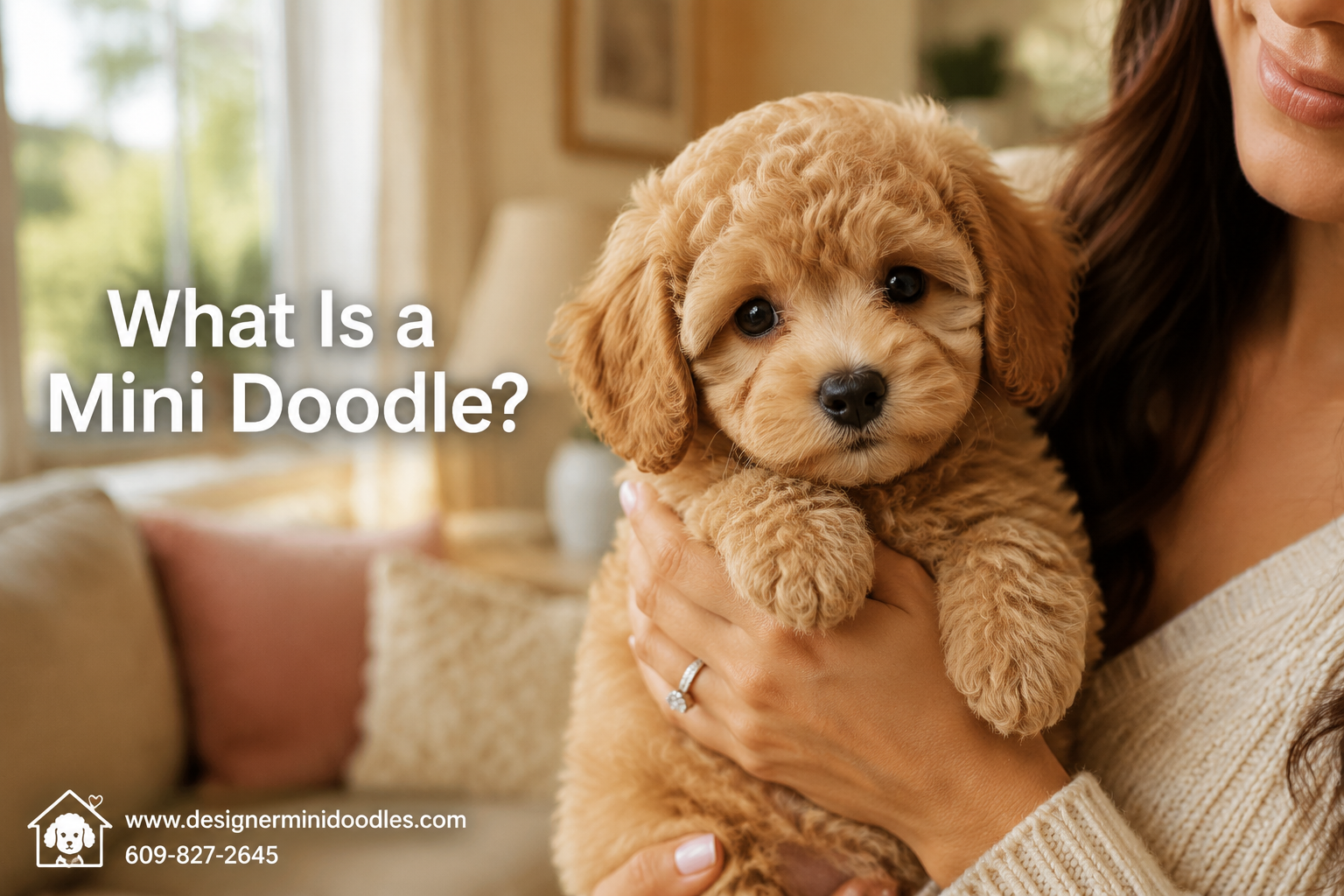
Here’s how the sizes break down:
| Size Category | Typical Adult Weight | Typical Adult Height | Best For |
|---|---|---|---|
| Standard Doodle | 50–90 lbs | 21–26 inches | Active families with large yards |
| Medium Doodle | 30–50 lbs | 17–21 inches | Families with moderate space |
| Mini Doodle | 15–30 lbs | 13–17 inches | Apartments, smaller homes, seniors |
| Micro/Petite Doodle | 10–16 lbs | 10–14 inches | Travel, city living, allergy-conscious homes |
The “generation” matters too. An F1 mini doodle has one purebred parent of each breed. An F1B is backcrossed to a Poodle, producing a curlier, lower-shedding coat. Most families with allergies do best with F1B or multigenerational mini doodles.
If you’re specifically interested in the smallest sizes, our guide to adorable micro mini goldendoodles in North Carolina goes deeper on what to expect from a 10–16 lb doodle.
Common mistake: Assuming “mini” means the same thing at every breeder. One breeder’s “mini” might mature at 18 lbs while another’s reaches 35 lbs. Always ask for the adult weights of both parents and previous litters.
Why North Carolina Is a Top State for Mini Doodle Breeders
North Carolina ranks among the best states for raising and purchasing mini doodle puppies because of its moderate climate, strong veterinary infrastructure, and a large network of experienced breeders.
Several factors work in NC buyers’ favor:
- Climate: Mild winters and warm (but not extreme) summers mean breeders can socialize puppies outdoors year-round, which produces more confident dogs.
- Veterinary access: NC is home to the NC State College of Veterinary Medicine, one of the top veterinary schools in the country, giving breeders access to advanced reproductive and genetic testing.
- Central East Coast location: Buyers from Virginia, South Carolina, Georgia, and Tennessee can often pick up puppies with a short drive. Many breeders also coordinate safe ground transport or flight nanny services.
- Growing pet-friendly culture: Cities like Charlotte, Raleigh, Asheville, and Wilmington have expanded dog parks, pet-friendly restaurants, and apartment complexes that welcome smaller breeds.
“North Carolina’s combination of accessible veterinary resources and year-round outdoor socialization opportunities makes it an ideal location for raising well-adjusted mini doodle puppies.”
If you’re in a neighboring state, you might also explore mini and micro goldendoodle breeders in South Carolina or Virginia breeders as well.
How to Evaluate Mini Doodle Breeders in North Carolina
Not all breeders are equal, and a polished website doesn’t guarantee quality dogs. Here are the five non-negotiable criteria I use when evaluating mini doodle breeders in North Carolina.
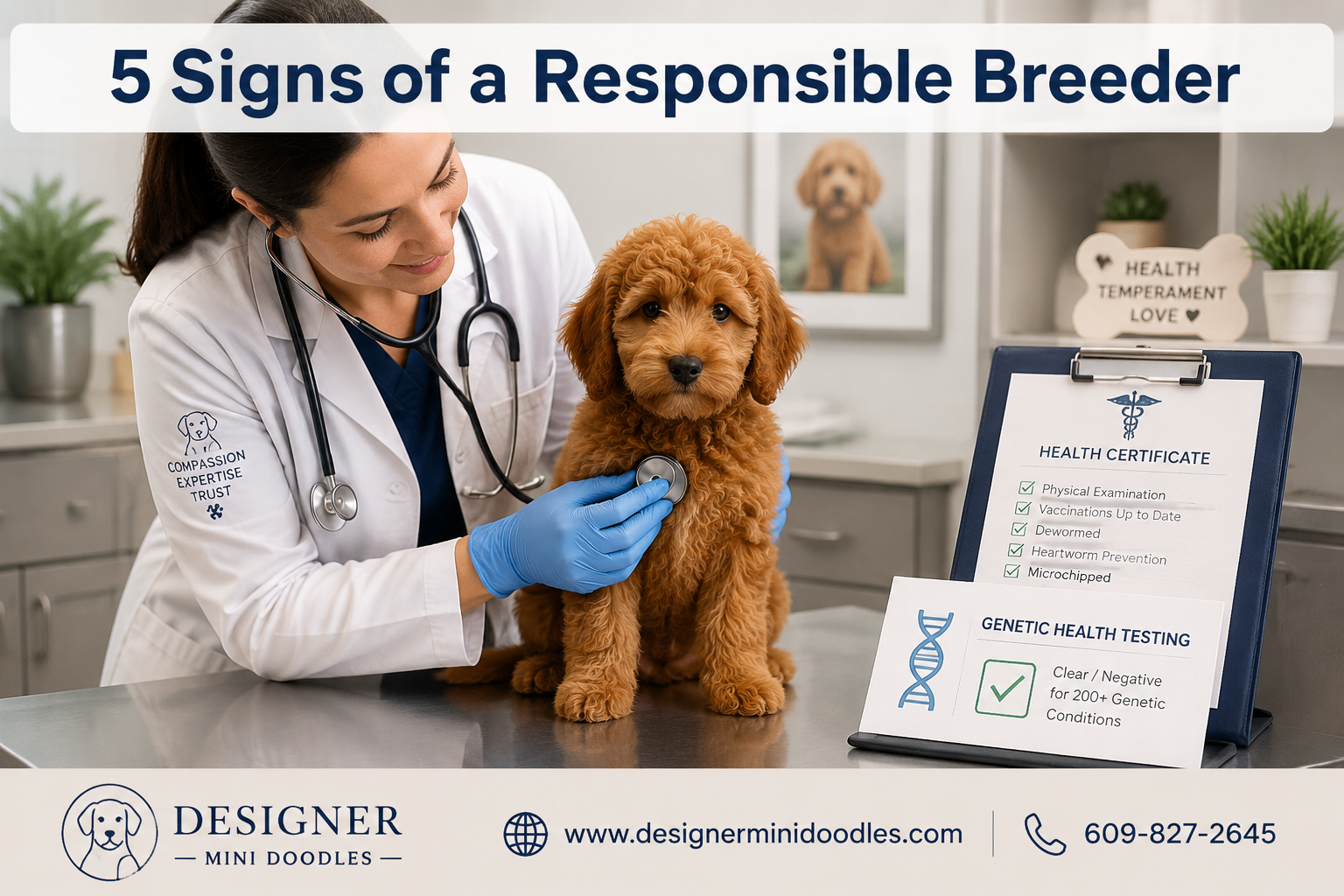
1. Verified Health Testing on Parent Dogs
Responsible breeders test for:
- Hip dysplasia (OFA or PennHIP evaluation)
- Elbow dysplasia (OFA)
- Cardiac evaluation (OFA)
- Eye certification (CAER exam)
- Genetic DNA panel covering PRA-prcd, vWD, DM, and other breed-specific conditions
Ask to see the actual test results, not just a breeder’s claim that “all our dogs are health tested.” Results should be verifiable through the OFA database or the testing laboratory.
2. Early Neurological Stimulation and Socialization
Top breeders follow protocols like Early Neurological Stimulation (ENS) from days 3–16 and Puppy Culture or Badass Breeder socialization curricula from weeks 3–8. These programs expose puppies to novel sounds, surfaces, people, and mild stress in controlled ways, producing calmer, more adaptable adult dogs.
3. Transparent Communication
A good breeder will:
- Answer your questions without getting defensive
- Provide references from past puppy families
- Share photos and videos of the parents, the whelping area, and the puppies at various ages
- Explain their contract, health guarantee, and return policy clearly
4. A Written Health Guarantee
The industry standard among reputable mini doodle breeders is a minimum 2-year health guarantee covering genetic conditions. Some programs offer guarantees up to 3 years.
5. Spay/Neuter and Breeding Rights Policies
Most pet-quality mini doodles are sold on a spay/neuter contract. If a breeder offers breeding rights with no questions asked, that’s a yellow flag — responsible breeders want to know that their lines are being preserved thoughtfully.
Decision rule: Choose a breeder who can show you health test results within 5 minutes of you asking. If they deflect, delay, or say “we don’t do that,” move on.
What Should Mini Doodle Puppies in North Carolina Cost in 2026?
A well-bred mini doodle puppy in North Carolina typically costs between $2,500 and $5,000 in 2026. Micro and petite sizes, rare coat colors (like phantom, merle, or parti), and multigenerational pedigrees tend to push prices toward the higher end.
Here’s a general pricing breakdown:
| Factor | Lower Range | Higher Range |
|---|---|---|
| Mini Goldendoodle (F1) | $2,500 | $3,500 |
| Mini Goldendoodle (F1B/Multigen) | $3,000 | $4,500 |
| Micro Goldendoodle (under 16 lbs) | $3,500 | $5,000+ |
| Mini Bernedoodle | $3,000 | $5,000 |
| Rare color premium | +$500 | +$1,500 |
What’s included in the price at a reputable breeder:
- Age-appropriate vaccinations
- Deworming schedule
- Microchip
- Veterinary health exam
- Spay/neuter deposit or completion
- Puppy starter kit (food, toy, blanket with littermate scent)
- Written health guarantee
Red flag pricing: If a puppy is listed under $1,500 with no health testing documentation, proceed with extreme caution. Conversely, prices above $6,000 should come with exceptional pedigrees, proven health lines, and outstanding breeder support.
For a closer look at what’s currently available, browse mini doodle puppies for sale from programs that meet these standards.
How to Prepare for Bringing Home a Mini Doodle Puppy
Preparation makes the first week dramatically easier for both you and your puppy. Start gathering supplies and setting up your home at least two weeks before pickup day.
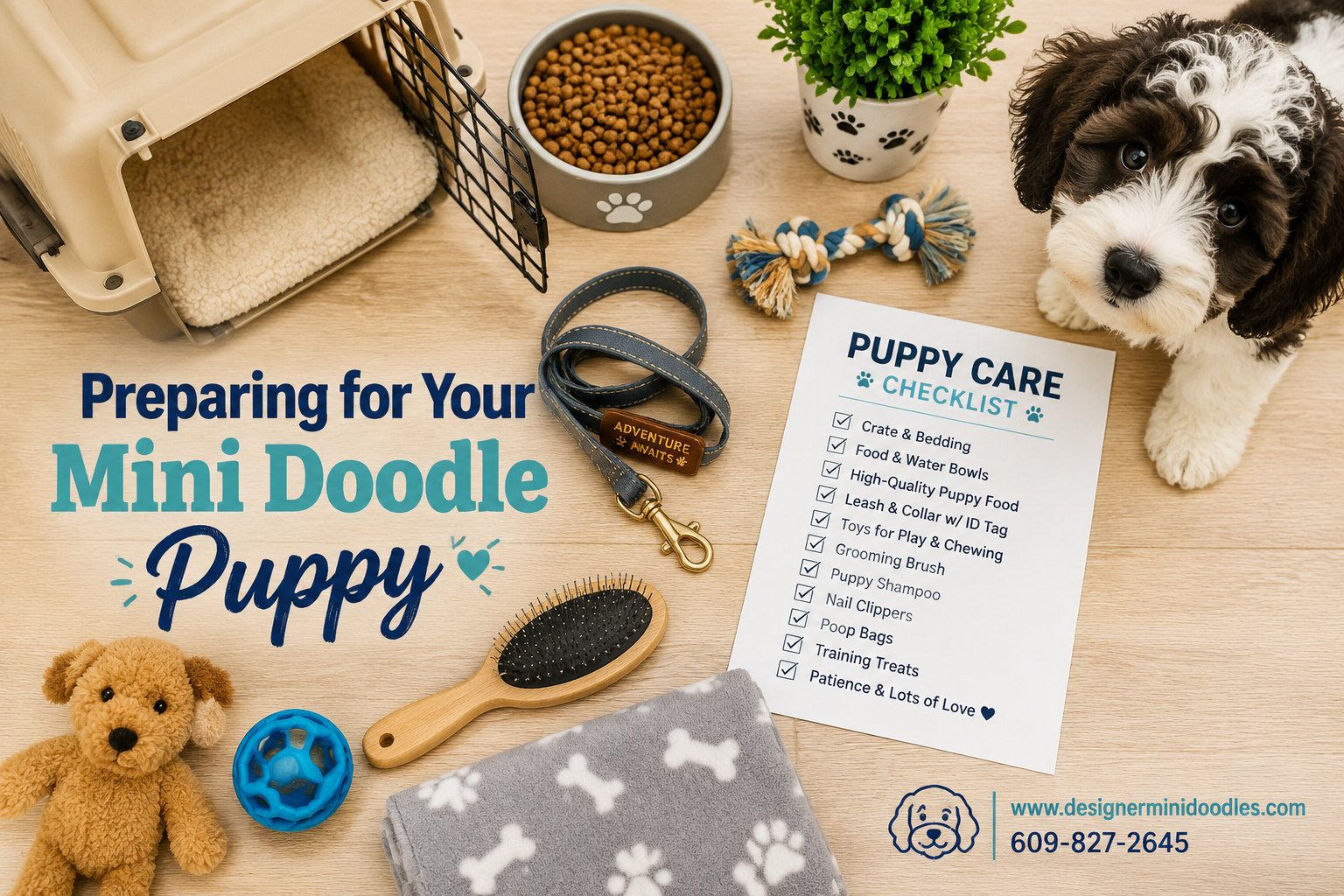
Essential Supply Checklist
- Crate: Wire or plastic, sized for a 15–30 lb adult dog (use a divider while they’re small)
- Exercise pen (x-pen): Creates a safe play area when you can’t supervise directly
- Food: Ask your breeder what brand they use and stick with it for at least 2 weeks before any transition
- Bowls: Stainless steel or ceramic, appropriately sized
- Collar and leash: Lightweight, adjustable
- Enzymatic cleaner: For inevitable accidents
- Grooming tools: Slicker brush, steel comb, nail clippers
- Chew toys: Puppy-safe options like Kongs, Nylabones, and rope toys
First-Week Priorities
- Establish a potty routine immediately. Take your puppy outside every 1–2 hours, after meals, after naps, and after play sessions. Consistency in the first week sets the tone for months. Our guide on housebreaking a mini bernedoodle puppy applies to all mini doodle breeds.
- Keep the environment calm. Resist the urge to invite everyone over to meet the puppy. Give your mini doodle 3–5 days to decompress and bond with your household first.
- Start crate training on night one. Place the crate in your bedroom so the puppy can hear and smell you. Expect some whining the first two nights — it’s normal.
- Schedule a vet visit within 72 hours. This establishes your puppy’s baseline health record and fulfills most breeder health guarantee requirements.
Edge case: If you’re adopting a mini doodle into a home with existing pets, keep them separated for the first 48 hours and introduce them gradually through a baby gate. Rushing introductions is the number one cause of early behavioral setbacks.
Mini Goldendoodle vs. Mini Bernedoodle: Which Is Right for You?
These are the two most popular mini doodle types in North Carolina, and they have distinct personality profiles.
| Trait | Mini Goldendoodle | Mini Bernedoodle |
|---|---|---|
| Energy Level | Moderate to high | Moderate |
| Temperament | Outgoing, eager to please, social butterfly | Loyal, slightly more reserved, bonds deeply |
| Coat Type | Wavy to curly, gold/cream/red/apricot | Wavy to curly, tri-color/bi-color/phantom |
| Trainability | Excellent — very food motivated | Excellent — can be slightly more stubborn |
| Best For | Families with kids, first-time owners, therapy work | Families wanting a calmer companion, experienced owners |
| Adult Weight (Mini) | 15–30 lbs | 18–35 lbs |
Choose a mini goldendoodle if you want a dog that’s instantly friendly with everyone, loves meeting new people, and thrives in busy households. They’re also the better choice for first-time dog owners.
Choose a mini bernedoodle if you prefer a dog that’s devoted primarily to your family, has a slightly calmer indoor presence, and you love the striking tri-color coat. Learn more about mini bernedoodles and their full-grown size.
Both breeds do well in North Carolina’s climate, though bernedoodles with heavier coats may need extra cooling during July and August heat.
Common Mistakes When Searching for Mini Doodle Breeders in North Carolina
Avoiding these mistakes will save you thousands of dollars and significant heartache.

Mistake 1: Choosing based on price alone. The cheapest puppy often comes with the most expensive vet bills. Genetic conditions like hip dysplasia, heart defects, and progressive retinal atrophy can cost $3,000–$10,000+ to manage over a dog’s lifetime.
Mistake 2: Buying from a breeder who always has puppies available. Responsible breeders plan a limited number of litters per year. If a breeder has 10+ litters available at any given time with no waitlist, that’s a volume operation, not a quality program.
Mistake 3: Skipping the parent meet. If you can visit in person, always ask to meet at least the mother. Her temperament is a strong predictor of her puppies’ adult personalities. If you can’t visit, request a live video call.
Mistake 4: Ignoring the contract. Read every line. Pay attention to what voids the health guarantee (some breeders void it if you feed raw food or skip specific vaccinations). Know the return policy before you sign.
Mistake 5: Not asking about generation. An F1 mini doodle sheds more than an F1B. If allergies are your primary concern, you need an F1B or multigen — and you need to confirm this with documentation, not just the breeder’s word.
What to Expect After You Bring Your Mini Doodle Home
The first year with a mini doodle puppy follows a predictable timeline that helps you plan training, socialization, and veterinary care.
Weeks 8–12 (Adjustment Period):
- Potty training is your main focus
- Begin basic commands: sit, name recognition, come
- Start gentle handling exercises (touching paws, ears, mouth) to prepare for grooming
Months 3–6 (Adolescence Begins):
- Enroll in a puppy socialization class
- Begin leash training in earnest
- First professional grooming appointment around 12–16 weeks
- Teething peaks — provide plenty of appropriate chew options
Months 6–12 (Testing Boundaries):
- Your mini doodle may “forget” commands they knew perfectly — this is normal adolescent regression
- Maintain consistent rules and boundaries
- Transition from puppy food to adult food around 10–12 months (consult your vet)
- Spay or neuter per your breeder’s contract timeline
Year 1 and Beyond:
- Mini doodles typically reach full physical maturity by 12–14 months
- Grooming every 6–8 weeks is essential to prevent matting
- Annual vet checkups, dental care, and continued socialization keep your dog healthy and happy
For training specifics, check out our resource on training a mini bernedoodle puppy, which covers positive reinforcement techniques that work across all doodle breeds.
Frequently Asked Questions
How long is the waitlist for mini doodle breeders in North Carolina?
Most reputable NC breeders have waitlists of 3 to 9 months. Some popular programs fill litters before puppies are even born. Placing a deposit early is the best way to secure a puppy from a top breeder.
Are mini doodles hypoallergenic?
No dog is truly hypoallergenic. However, mini doodles — especially F1B and multigenerational crosses — produce significantly less dander than most breeds. Families with mild to moderate allergies often do well with these dogs. See our guide on micro goldendoodles for allergy-conscious homes for more detail.
Do mini doodle breeders in North Carolina ship puppies?
Many do, using flight nannies (a person who accompanies the puppy on a commercial flight) or ground transport services. Reputable breeders avoid cargo shipping. Flight nanny services typically cost $400–$600 on top of the puppy price.
How big do mini doodles get?
Mini goldendoodles typically reach 15–30 pounds. Micro or petite goldendoodles stay under 16 pounds. Mini bernedoodles tend to be slightly larger, ranging from 18–35 pounds. Always ask the breeder for parent weights and previous litter sizes.
What health problems do mini doodles have?
The most common concerns include hip dysplasia, patellar luxation, progressive retinal atrophy (PRA), and von Willebrand’s disease. Proper genetic testing of parent dogs dramatically reduces these risks.
Can mini doodles live in apartments?
Yes. Mini and micro doodles adapt well to apartment living as long as they get 30–60 minutes of daily exercise and mental stimulation. Their smaller size and moderate energy levels make them excellent apartment companions.
What is the lifespan of a mini doodle?
Mini doodles typically live 12–16 years, with smaller sizes (micro/petite) often living toward the longer end of that range.
Do I need a fenced yard for a mini doodle?
A fenced yard is helpful but not required. Many mini doodle owners in Raleigh, Charlotte, and other NC cities raise happy dogs using leash walks, dog parks, and indoor play.
What’s the difference between a mini doodle and a toy doodle?
A toy doodle is smaller, typically under 15 pounds, while a mini doodle ranges from 15–30 pounds. The distinction comes from whether a Toy Poodle or Miniature Poodle is used in the cross.
When should I start grooming my mini doodle puppy?
Introduce brushing at home starting at 8 weeks. Schedule the first professional grooming appointment between 12 and 16 weeks to get your puppy comfortable with the process early.
Browse Available Mini Doodle Puppies
Ready to find your new family member? Browse our current available mini doodle puppies below:
- Display 9 Products per page





Conclusion
Finding the right mini doodle breeders in North Carolina comes down to doing your homework before you fall in love with a cute puppy photo. Verify health testing, ask about socialization protocols, read the contract carefully, and plan for a waitlist. The extra effort upfront leads to a healthier, happier dog and a much smoother first year together.
Your next steps:
- Make a shortlist of 2–3 breeders who meet all five evaluation criteria outlined above.
- Contact each breeder with specific questions about health testing, socialization methods, and their health guarantee terms.
- Place a deposit once you’ve confirmed the breeder’s practices align with your standards.
- Prepare your home using the supply checklist at least two weeks before pickup day.
- Schedule a vet appointment for within 72 hours of bringing your puppy home.
Whether you’re in Charlotte, Raleigh, Asheville, or anywhere else in the Tar Heel State, a well-bred mini doodle can be the perfect addition to your family. Take your time, choose wisely, and enjoy every moment with your new companion.
For questions or to learn more about available puppies, visit Designer Mini Doodles or call 609-827-2645.
References
- Orthopedic Foundation for Animals (OFA). “CHIC Program and Health Testing Requirements.” ofa.org. Accessed 2026.
- American Kennel Club. “Responsible Breeders.” akc.org. Accessed 2026.
- North Carolina State University College of Veterinary Medicine. “Veterinary Services.” cvm.ncsu.edu. Accessed 2026.