

Last updated: July 12, 2026
mini bernedoodle
A mini bernedoodle is a cross between a Bernese Mountain Dog and a Miniature Poodle, typically weighing 25-49 pounds and standing 18-22 inches tall at full maturity. They’re affectionate, intelligent, low-shedding companions that thrive in family settings and generally live 12-17 years. Expect to pay $3,000,$5,000 from an accredited breeder with genetic health guarantees, and be prepared for regular grooming and daily exercise.

mini bernedoodle
- Size: Adult mini bernedoodles weigh 25-49 lbs and stand 18-22 inches tall.
- Cost: $3,000,$5,000 from a reputable, health-tested breeder; anything under $1,500 is a red flag.
- Coat: Wavy or curly, low to non-shedding, considered allergy-friendly for many people.
- Lifespan: 12-17 years, longer than the purebred Bernese Mountain Dog.
- Temperament: Gentle, playful, loyal, and highly people-oriented.
- Grooming: Professional grooming every 6-8 weeks plus brushing 3-4 times per week.
- Exercise: 45-60 minutes of activity daily.
- Best for: Families with children, first-time dog owners, and multi-pet households.
- Watch out for: Separation anxiety and reactive puppy mill sellers offering “cheap” pups.
What Is a Mini Bernedoodle and How Big Do They Get?
A mini bernedoodle is a designer crossbreed between a Bernese Mountain Dog and a Miniature Poodle, bred to combine the Bernese’s calm, family-friendly nature with the poodle’s intelligence and low-shedding coat. Adults typically weigh 25 to 49 pounds and reach 18 to 22 inches at the shoulder, making them significantly smaller than a standard bernedoodle (which can hit 90 lbs).
Size varies based on the generation:
- F1 mini bernedoodle (50% Bernese, 50% mini poodle): 30-49 lbs
- F1b mini bernedoodle (25% Bernese, 75% poodle): 25-40 lbs, curlier coat
- F2b or multigen: More predictable size and coat consistency
If you want a detailed breakdown of adult dimensions, see this guide on mini bernedoodle full grown size.
Decision rule: Choose an F1b if allergies are a concern, the extra poodle influence produces a tighter, less-shedding curl.
Mini Bernedoodle vs Goldendoodle: Which Is Better?
Both are excellent family dogs, but they differ in temperament and energy. Mini bernedoodles tend to be calmer, more velcro-attached, and slightly more reserved with strangers, while mini goldendoodles are typically more outgoing, higher energy, and eager to greet everyone.
| Trait | Mini Bernedoodle | Mini Goldendoodle |
|---|---|---|
| Energy level | Moderate | Moderate to high |
| Sociability with strangers | Reserved but friendly | Very outgoing |
| Trainability | High | Very high |
| Coat colors | Tri-color, black, sable, phantom | Cream, apricot, red, parti |
| Best for | Calmer households, older kids | Active families, first-time owners |
Pick a mini bernedoodle if you want a mellower shadow-dog. Pick a goldendoodle if you want a bouncy, party-ready companion. If you’re still weighing options, browse mini bernedoodles for sale to see personalities in action.
How Much Does a Mini Bernedoodle Cost?
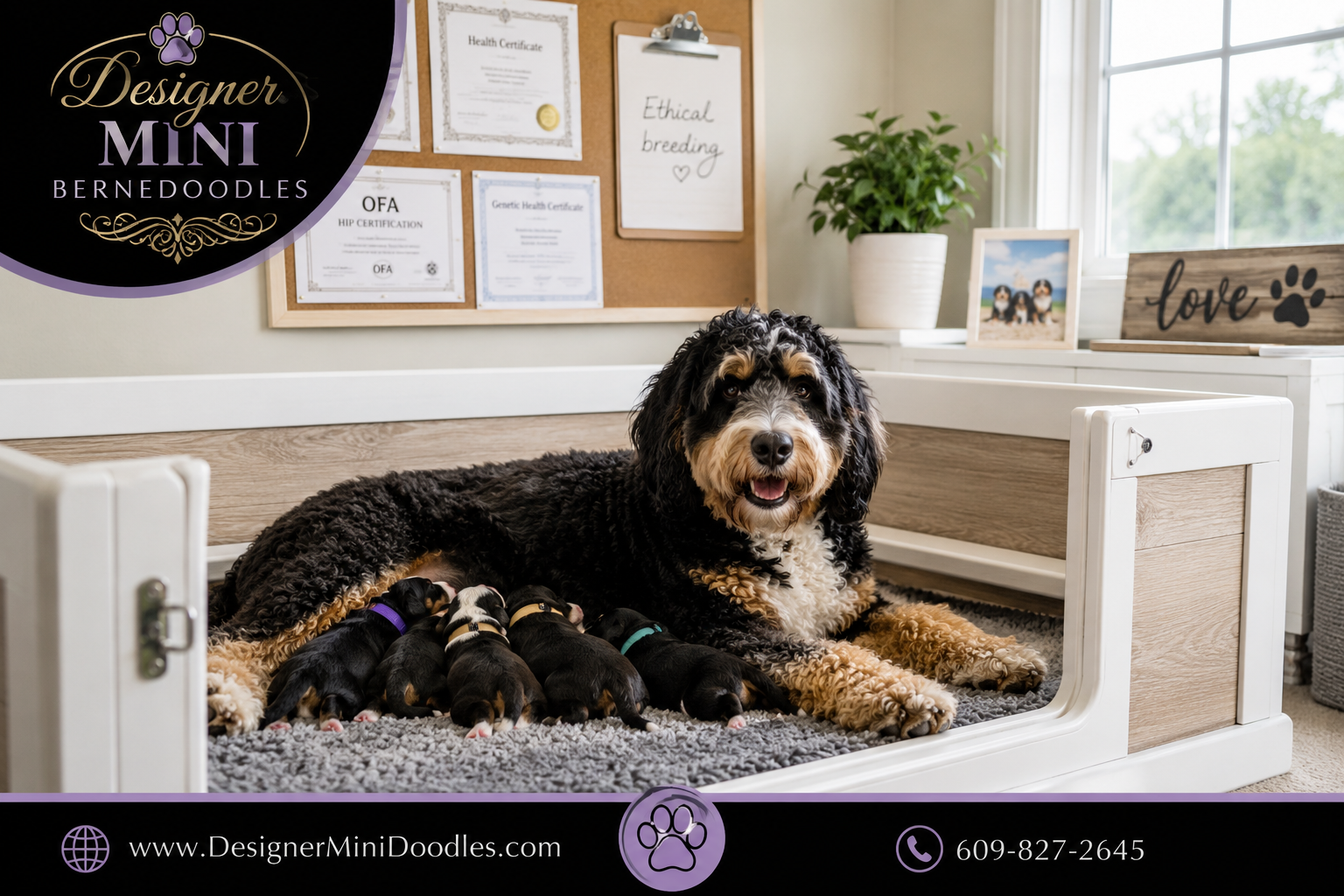
Expect to pay $3,000 to $5,000 for a mini bernedoodle puppy from an accredited breeder with a genetic health guarantee, early neurological stimulation, and health-tested parents. Pricing varies by coat color, generation, and breeder reputation.
Here’s an honest pricing breakdown of what’s out there:
- $500,$1,000, Scammer territory: These “deals” almost always end with a sick or nonexistent puppy. Avoid.
- $1,000,$1,500, Puppy mills: Poor genetic screening, no early socialization, high vet bills within the first year.
- $2,500,$3,000, Hobby breeders: Well-meaning but often lack full DNA panels, structured ENS programs, or written health guarantees.
- $3,000,$5,000, Accredited breeders: Genetic health guarantee, OFA-tested parents, ENS from day 3, house-training and crate-training foundations, and lifetime breeder support.
Common mistake: Chasing the cheapest listing. A $700 mini bernedoodle often turns into a $7,000 dog after emergency vet visits, behavior training, and heartache.
Mini Bernedoodle Temperament and Personality Traits
Mini bernedoodles are gentle, affectionate, playful, and deeply loyal. They’re often described as “velcro dogs” because they bond hard with their people and prefer to be in the same room as their family at all times.
Typical personality traits:
- Calm indoors, playful outdoors
- Sensitive, they respond poorly to harsh corrections
- Excellent with children and other pets
- Slightly reserved with strangers (not shy, just polite)
- Highly emotionally intuitive
They inherit the Bernese’s steady, easygoing temperament and the poodle’s cleverness and eagerness to please. This blend makes them one of the most balanced doodles available.
Do Mini Bernedoodles Shed a Lot?
No, mini bernedoodles are considered low-shedding to non-shedding, especially F1b and multigen lines with a higher poodle percentage. Their coats are typically wavy or curly and trap loose hair until it’s brushed out.
That said, “hypoallergenic” is a spectrum. People with severe dander allergies should spend time with an adult mini bernedoodle before committing. Coat type predicts shedding better than any label:
- Curly coat: Least shedding, most allergy-friendly, requires more grooming
- Wavy coat: Minimal shedding, moderate grooming
- Straight coat (rare): Sheds more, easier to brush
Mini Bernedoodle Health Problems and Lifespan
Mini bernedoodles typically live 12 to 17 years, benefiting from hybrid vigor. However, they can inherit conditions from either parent breed. Reputable breeders screen for these issues before pairing.
Common health concerns to watch:
- Hip and elbow dysplasia (from the Bernese line)
- Progressive retinal atrophy (PRA)
- Von Willebrand’s disease (a blood clotting disorder)
- Sebaceous adenitis (a skin condition)
- Allergies and ear infections (common in floppy-eared, curly-coated dogs)
Always ask for OFA and DNA test results before buying. A serious breeder will offer these upfront without being asked.
 )
)
Mini Bernedoodle Grooming Requirements and Maintenance
Mini bernedoodles require professional grooming every 6 to 8 weeks and at-home brushing 3 to 4 times per week to prevent matting. Their non-shedding coat means the hair that would fall out on a Labrador stays tangled in a doodle’s fur until brushed out.
Grooming essentials:
- Slicker brush and metal comb
- Detangling spray
- Ear cleaner (weekly, floppy ears trap moisture)
- Nail trimmer or grinder (every 3-4 weeks)
- Dog-safe toothpaste and brush (2-3 times weekly)
Quick example: Skip brushing for two weeks and you’ll be paying $40 extra for a “de-matting fee” at the groomer, or worse, watching them shave your dog down to the skin.
Are Mini Bernedoodles Good for Families with Kids?
Yes, mini bernedoodles are exceptional family dogs. They’re patient, gentle, and playful, a combination that makes them well-suited to households with children of all ages, including toddlers.
What makes them family-friendly:
- Rarely nip or bark at kids
- Enjoy structured play (fetch, tug, hide-and-seek)
- Emotionally sensitive to a child’s mood
- Small enough not to bowl over a toddler, big enough to handle rough play
Rule of thumb: Always supervise interactions between very young children and any puppy, and teach kids to respect the dog’s space when eating or sleeping.
Mini Bernedoodle Training Difficulty and Intelligence
Mini bernedoodles are highly intelligent and generally easy to train, ranking among the smarter doodle crosses thanks to the poodle parent. Most puppies pick up basic commands (sit, down, come) within a few short sessions.
Training tips that work:
- Use positive reinforcement, treats, praise, play. Harsh corrections shut them down.
- Start early, socialization windows close around 14 weeks.
- Keep sessions short, 5-10 minutes, several times daily.
- Crate train from day one, for a full walkthrough, see our guide on training a mini bernedoodle puppy and housebreaking a mini bernedoodle puppy.
Edge case: Because they’re sensitive, mini bernedoodles can develop training regressions if the household is chaotic or a family member uses inconsistent commands. Get everyone on the same page.
Mini Bernedoodle Exercise Needs and Activity Level
Mini bernedoodles need 45 to 60 minutes of daily exercise, split between physical activity and mental stimulation. They’re moderately energetic, not couch potatoes, not marathon runners.
A good daily rhythm looks like:
- Morning: 20-minute walk plus 5 minutes of training
- Midday: Puzzle toy or short backyard play session
- Evening: 20-30 minute walk, fetch, or off-leash time in a safe area
Under-exercised mini bernedoodles often develop nuisance behaviors: chewing, barking, digging, and clingy attention-seeking. Mental exercise (nose work, snuffle mats, trick training) counts just as much as walks.
Mini Bernedoodle vs Mini Aussiedoodle Comparison
Both are smart doodle crosses, but they suit different lifestyles. Mini bernedoodles are calmer and better for laid-back households, while mini aussiedoodles are higher-drive dogs bred from herding stock and need significantly more mental work.
| Factor | Mini Bernedoodle | Mini Aussiedoodle |
|---|---|---|
| Energy | Moderate | High to very high |
| Prey/herding drive | Low | Moderate to high |
| Best owner | Families, first-timers | Active owners, experienced handlers |
| Exercise needs | 45-60 min/day | 90+ min/day |
| Emotional style | Cuddly, calm | Alert, intense, playful |
Choose a mini bernedoodle if you want a cuddle-first companion. Choose a mini aussiedoodle if you want a workout partner and a project.
Common Mistakes When Owning a Mini Bernedoodle
Even great dogs get set up to fail by well-meaning owners. The most common mistakes I see:
- Skipping early socialization, Missing the 8-to-14-week window leads to a fearful adult dog.
- Under-grooming, Waiting three months between grooms guarantees painful matting.
- Free-feeding, Mini bernedoodles can overeat; use measured portions.
- Ignoring dental care, Small dogs are prone to tartar and gum disease.
- Buying from the cheapest source, See the pricing section again.
- Leaving them alone too long, This breed doesn’t do well as a “come home from work at 7 PM” dog.
Mini Bernedoodle Separation Anxiety Issues
Mini bernedoodles are prone to separation anxiety because of their strong bonding instinct. Left alone for long stretches without preparation, they can develop barking, destructive chewing, and house-training regressions.
Prevention strategies that work:
- Crate train from day one so the crate becomes a safe den, not a punishment.
- Practice short absences early, leave for 5 minutes, then 15, then an hour.
- Rotate enrichment toys (frozen Kongs, licking mats, snuffle mats).
- Avoid dramatic goodbyes and hellos, keep departures boring.
- Consider a second pet if you’re gone 8+ hours regularly.
If anxiety is already established, work with a certified force-free trainer. Medication is sometimes appropriate for severe cases, talk to your vet.
 )
)
Where to Find a Reputable Mini Bernedoodle Breeder
The safest path is an accredited breeder who health-tests both parents, uses Early Neurological Stimulation (ENS), and starts crate and potty training before puppies go home. Avoid backyard listings on Craigslist, Facebook Marketplace, or overseas “puppy import” scams.
Green flags to look for:
- Written genetic health guarantee (2+ years)
- OFA/DNA testing on both parents
- ENS protocol from day 3
- Puppies raised inside the home with exposure to normal household sounds, kids, and other pets
- Willing to video call or host in-person visits
- Waitlist and application process (they choose you, too)
To see how a top-tier program is structured, review the breeding process behind top mini bernedoodle puppies or explore the miniature goldendoodle breeder standards used by the same accredited program.
Red flags:
- No health testing documentation
- Multiple litters available immediately with no waitlist
- Refuses video calls or visits
- Prices under $1,500
- Ships without letting you meet the parents
FAQ
Are mini bernedoodles hypoallergenic?
They’re low-shedding and considered allergy-friendly for most people, especially F1b generations. No dog is 100% hypoallergenic, spend time with one before buying if allergies are severe.
How long do mini bernedoodles live?
12 to 17 years, significantly longer than the Bernese Mountain Dog thanks to hybrid vigor and the poodle’s longevity.
Do mini bernedoodles bark a lot?
No. They’re generally quiet dogs that only bark to alert. Excessive barking usually signals boredom, anxiety, or lack of exercise.
Can mini bernedoodles be left alone?
Up to 4-6 hours for adults once trained. Puppies need much shorter absences. This breed is not suited for owners gone 10+ hours daily.
What’s the difference between a mini bernedoodle and a toy bernedoodle?
Toy bernedoodles are smaller (10-24 lbs), bred using toy poodles. Mini bernedoodles use miniature poodles and finish between 25-49 lbs.
Are male or female mini bernedoodles better?
Both make wonderful pets. Males are often slightly more affectionate and goofy; females can be a touch more independent. Individual personality matters more than sex.
When do mini bernedoodles stop growing?
Most reach full size around 12-14 months, though some fill out until 18 months.
Do mini bernedoodles get along with cats?
Yes, especially when raised together. Their low prey drive and gentle temperament make them one of the more cat-compatible breeds.
How often should I bathe a mini bernedoodle?
Every 3-4 weeks, or when visibly dirty. Over-bathing dries out their skin and coat.
What colors do mini bernedoodles come in?
Traditional tri-color (black, white, rust), black and white, sable, phantom, merle, and solid black. Tri-color is most iconic but often priced higher.
Conclusion and Next Steps
The mini bernedoodle is one of the most well-rounded family dogs available in 2026: gentle, smart, low-shedding, and long-lived. But the difference between a great experience and a heartbreaking one comes down almost entirely to where you get your puppy.
Your next steps:
- Set a realistic budget, $3,000,$5,000 for the puppy, plus $1,500,$2,500 in first-year expenses.
- Interview at least two accredited breeders and ask for health test documentation.
- Prepare your home, crate, gates, enrichment toys, and a designated potty spot.
- Line up a vet and groomer before the puppy comes home.
- Block out your first two weeks to focus on bonding, crate training, and house training.
Do the homework upfront, and you’ll get 15 years of one of the best companions in the doodle world.