
reputable mini goldendoodle breeders
Last updated: July 8, 2026
Reputable mini goldendoodle breeders health-test both parent dogs (OFA hips, elbows, hearts, CERF eyes, and breed-specific genetic panels), raise puppies inside their home using structured protocols like Early Neurological Stimulation (ENS), offer a written health guarantee, and charge between $2,500 and $4,500 for a properly raised puppy. If a breeder can’t produce genetic test results, refuses a video call, or prices puppies under $1,500, walk away, that’s the single clearest signal separating ethical programs from puppy mills and scammers.
reputable mini goldendoodle breeders
- A reputable mini goldendoodle breeder provides verifiable OFA, CERF, and DNA panel results on both parents, not just a “vet checked” statement.
- Expect to pay $2,500,$4,500 for a health-guaranteed puppy from a licensed, accredited breeder. Prices under $1,500 typically signal a puppy mill or scam.
- Ethical breeders use structured programs like ENS (Early Neurological Stimulation), noise desensitization, and early crate/potty training before puppies leave.
- Waiting lists at quality programs run 3 to 12 months. Instant availability is a red flag.
- Contracts should include a written health guarantee (2 years minimum), spay/neuter terms, and a lifetime return clause.
- Mini goldendoodles from reputable breeders tend to live 12-16 years, often longer than those from unregulated sources due to genetic screening.
- Backyard breeders skip health testing to cut costs, which is why bad breeding produces recurring hip dysplasia, PRA blindness, and von Willebrand’s disease.
What Makes a Goldendoodle Breeder Reputable?
A reputable goldendoodle breeder is one who prioritizes health, temperament, and lifetime accountability over volume or profit. In practical terms, that means genetic testing, transparent record-keeping, in-home puppy raising, and a willingness to answer hard questions.
Here’s the concrete checklist I use when evaluating any breeder:
- Health tests both parents through OFA (Orthopedic Foundation for Animals) and Embark or Paw Print Genetics
- Belongs to a recognized registry like GANA (Goldendoodle Association of North America), AKC (for parent breeds), or a state licensing body
- Raises puppies inside the home, not in outdoor kennels
- Uses structured neurological and socialization programs (ENS, Puppy Culture, or equivalent)
- Provides a written contract with a health guarantee
- Takes puppies back at any point in the dog’s life if the owner can’t keep them
- Limits litters per female, typically no more than one per year, retired by age 5-6
At Designer Doodles, our program is run by a real animal biologist, and every breeding dog, whether toy poodle, mini goldendoodle, mini bernedoodle, or cavapoo, comes from documented top bloodlines. That biology background isn’t marketing fluff; it’s the reason we can interpret genetic panels, structure ENS protocols correctly, and pair sires and dams based on complementary traits rather than convenience.
How to Find Ethical Mini Goldendoodle Breeders Near Me
Start with registry directories, then narrow by state, then verify each candidate individually. GANA’s Blue Ribbon and Red Ribbon breeder lists are the strongest starting point, followed by state-specific accredited programs.
A three-step search approach:
- Search by state directory. Regional breeder pages give you geographic proximity, which matters for visits and puppy pickup. Explore state-specific listings like Florida mini goldendoodle breeders, Texas, Pennsylvania, North Carolina, or California.
- Cross-reference registries. Confirm the breeder appears on GANA’s list or has current USDA/state kennel licensing where applicable.
- Request live video tours. An ethical breeder will happily FaceTime you through their whelping area, show you the parent dogs, and walk you through the litter’s daily routine.
Choose local if: you value in-person visits and shorter transport for the puppy.
Choose national/shipping if: the closest ethical breeder is 500+ miles away, flight nanny services from a top program beat a mediocre local option every time.
Mini Goldendoodle Breeder Health Testing Requirements
At minimum, both parent dogs should have current OFA certifications for hips, elbows, heart, and patellas, a CERF or OFA eye exam within the past 12 months, and a DNA panel screening for breed-specific hereditary diseases. Anything less isn’t health testing, it’s a vet visit.
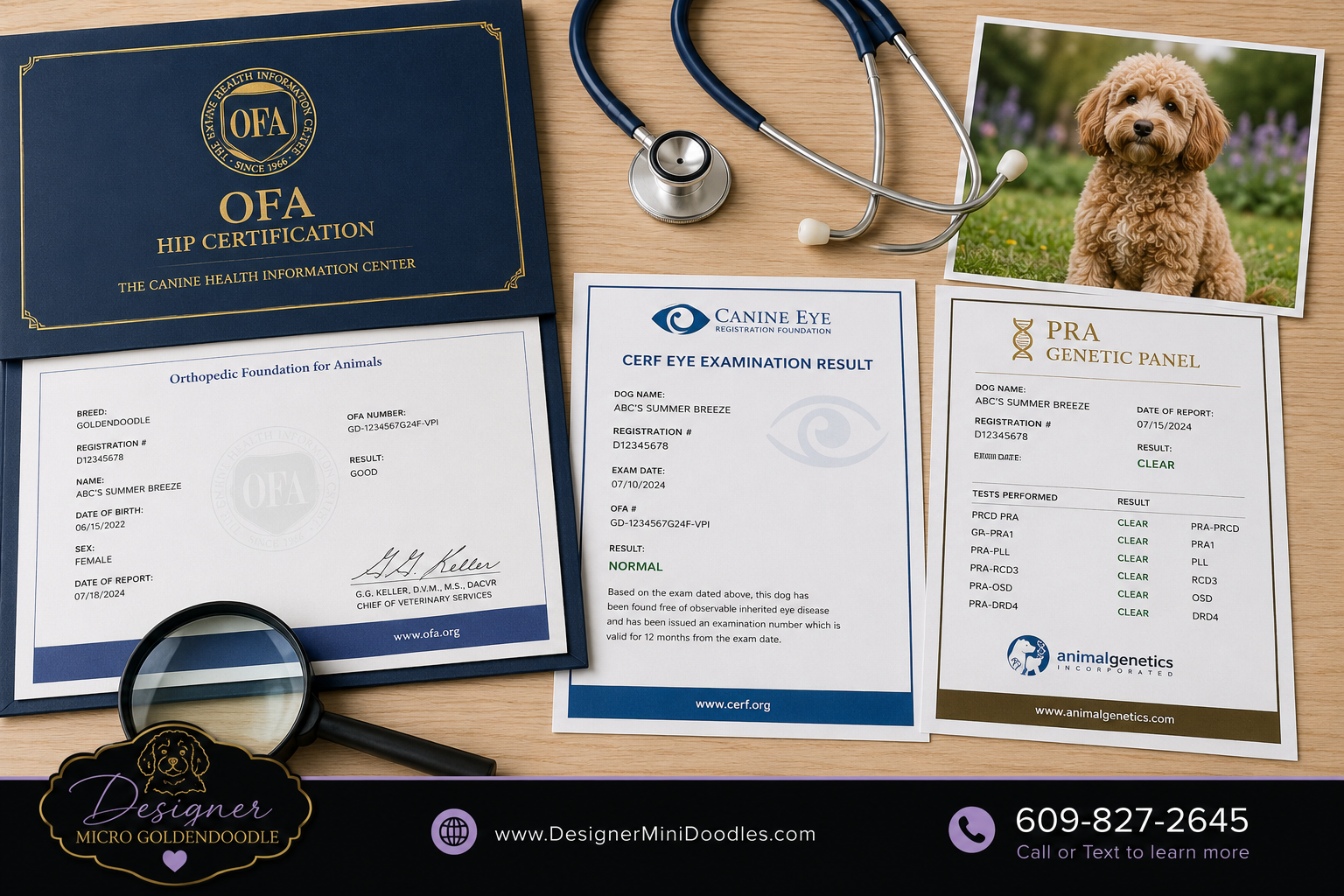
Required tests for a reputable mini goldendoodle breeding program:
| Test | What It Screens | Frequency |
|---|---|---|
| OFA Hips | Hip dysplasia | Once, after age 2 |
| OFA Elbows | Elbow dysplasia | Once, after age 2 |
| OFA/CERF Eyes | PRA, cataracts, retinal issues | Annually |
| OFA Cardiac | Congenital heart defects | Once, adult |
| OFA Patellas | Luxating patellas (critical for minis) | Once, adult |
| DNA Panel (Embark/PPG) | 200+ genetic conditions | Once per dog |
The DNA panel is non-negotiable for mini goldendoodles specifically. It screens for prcd-PRA (progressive retinal atrophy), DM (degenerative myelopathy), vWD (von Willebrand’s disease), and Ichthyosis, all of which appear in poor breeding lines.
How Much Does a Mini Goldendoodle Cost from a Reputable Breeder?

A properly raised, health-tested mini goldendoodle from an accredited breeder costs $2,500 to $4,500 in 2026. Micro sizes, rare coat patterns (merle, phantom, parti), and F1b generations sit at the higher end of that range.
Pricing tiers by breeder type:
Puppy Mills ($1,000,$1,500): High-volume commercial operations, minimal socialization, parent dogs live in cages, no meaningful health guarantee.
Hobby Breeders ($1,800,$2,000): Well-intentioned but limited testing, often only one or two litters of experience, incomplete ENS or Puppy Culture protocols.
Accredited Breeders ($2,500,$4,500): Full genetic health guarantee, professional whelping, early housebreaking and crate training, ENS from day 3, structured socialization. This is where a program like Designer Doodles, one of the best micro goldendoodle breeders in the USA, operates.
For a deeper look at long-term ownership economics, see the breakdown on cost-of-ownership clarity for micro goldendoodles.
- Display 9 Products per page







Mini Goldendoodle vs. Other Doodle Breeds: Which Is Better?
The mini goldendoodle is generally the strongest all-around fit for first-time owners, apartment dwellers, and families with children, but the “best” doodle depends on your energy level, grooming tolerance, and household composition.
Quick comparison:
- Mini Goldendoodle: 15-35 lb, medium energy, exceptional with kids, low-shedding, easy to train. Best for families and first-time owners.
- Mini Bernedoodle: 25-45 lb, calmer than a goldendoodle, tricolor coat, more independent streak. Great for calm households, see mini bernedoodle puppies for sale if you want the tri-color look.
- Cavapoo: 12-20 lb, lower energy, extremely cuddly, better for seniors and apartments.
- Toy Goldendoodle: 8-15 lb, apartment-perfect. Learn more about the toy goldendoodle size class.
Choose a mini goldendoodle if you want the classic teddy-bear look, expect moderate exercise commitment, and want a dog that’s equally happy hiking or napping on the couch.
Red Flags to Avoid When Choosing a Goldendoodle Breeder
The fastest way to identify a bad breeder is to test their transparency. Ethical programs welcome hard questions; unethical ones deflect, delay, or disappear.

Immediate deal-breakers:
- Refuses video calls or in-person visits
- Multiple litters always “available now” with no waitlist
- Prices dramatically below the $2,500 floor
- Won’t share OFA/DNA test results in writing
- Requests payment via wire transfer, Zelle, or cryptocurrency only
- Ships puppies before 8 weeks old
- Uses only stock photos or refuses to send video of the specific puppy
- No written contract or health guarantee
- Breeds the same female every heat cycle
- Won’t answer questions about the sire
Common mistake: Falling for a slick website. Puppy mills and scammers invest heavily in web design. The website is not evidence, the health records, video tours, and references are.
What Questions Should I Ask a Mini Goldendoodle Breeder?
Ask questions that force specific, verifiable answers. Vague questions get vague responses; specific questions expose whether the breeder actually knows their dogs.
The 12 questions I’d ask every breeder:
- Can you send me OFA and DNA panel results for both parents (by name)?
- How many litters does the dam have per year, and at what age will she retire?
- What socialization protocol do you use, ENS, Puppy Culture, or your own?
- Where do the puppies sleep from weeks 3 to 8?
- What noises and surfaces are they exposed to before going home?
- What’s included in your health guarantee, and for how long?
- Do you take puppies back at any age if the owner can’t keep them?
- Can I speak with two or three past puppy families?
- Are you licensed by the state or USDA, and what’s your license number?
- What’s your policy on early spay/neuter?
- How do you match puppies to families?
- What food, vaccines, and dewormer has the puppy received?
Backyard Breeders vs. Registered Breeders
A backyard breeder produces puppies without health testing, licensing, or structured socialization; a registered breeder is credentialed through GANA, AKC parent-breed registries, or state kennel authorities and follows written breeding standards. The difference shows up in the puppy’s health, temperament, and lifespan.
Backyard breeder traits:
- Breeds pet-quality dogs together with no genetic screening
- Sells at 6 weeks (too young) to move puppies quickly
- No ENS, no Puppy Culture, minimal handling
- Cash-only, no contract
- Often “just one litter for fun”, but repeated annually
Registered breeder traits:
- Documented lineage back 3-5 generations
- Health-tested parents with public OFA/Embark records
- Structured 8-week protocol including crate training and early housebreaking
- Written contract, health guarantee, lifetime return clause
- Answers to a registry organization
Best Mini Goldendoodle Breeders by State
Quality breeders exist in every region, but concentration varies. The Midwest and Southeast have the highest density of accredited mini goldendoodle programs, while the West Coast has fewer but generally higher-priced options.

Top states for reputable mini goldendoodle breeders in 2026:
- Florida: Strong concentration of accredited programs; see Florida breeders
- Pennsylvania: Historically Amish country, so vet reputation carefully; Pennsylvania breeders
- North Carolina: Excellent Southeast hub; North Carolina options
- Ohio: High volume, filter aggressively; Ohio breeders
- Georgia, Tennessee, Virginia, South Carolina: Growing Southeast corridor
- Texas, California, New York, Illinois: Metropolitan demand centers with premium pricing
- Michigan, Wisconsin, Minnesota, Indiana, Missouri: Solid Midwest programs
- Colorado, Washington, Arizona: Newer Western programs with strong ethics
- Maryland, New Jersey, Massachusetts, Alabama, Louisiana: Smaller but reputable regional options
You can also verify our physical location and reviews on our Google Maps listing.
How to Check If a Goldendoodle Breeder Is Licensed
Verify licensing through three sources: the USDA APHIS public database (for commercial breeders), your state’s Department of Agriculture kennel licensing portal, and the registry organization the breeder claims membership in.
Verification steps:
- Ask the breeder for their state license number and USDA number if applicable.
- Cross-check on your state’s public records site (most are searchable by name or license).
- Confirm registry membership by contacting GANA or AKC directly rather than trusting a website badge.
- Search the breeder’s business name and owner name for complaints on BBB and state consumer protection sites.
Note: Not every ethical breeder needs USDA licensing, small in-home programs with fewer than four breeding females are often exempt. State licensing rules vary. What matters more is the health testing and contract, not necessarily a federal number.
Mini Goldendoodle Breeder Contracts: What Should Be Included
A proper puppy contract protects both the buyer and the dog. It should clearly state health guarantees, spay/neuter requirements, return clauses, and what happens if a genetic disease appears later.
Non-negotiable contract elements:
- Health guarantee: Minimum 2 years against hereditary/congenital conditions
- Return clause: Breeder takes the dog back at any age, no questions asked
- Spay/neuter terms: Timing recommendations (usually 12-18 months for minis to protect joint development)
- Registration papers or limited AKC registration where applicable
- Vaccination and deworming record at time of transfer
- Microchip information
- Disclosure of both parents’ names, health testing, and DNA panel IDs
- Refund or replacement policy if a covered condition is diagnosed
Read every line. If a clause says the guarantee is void if you feed anything other than a specific brand, negotiate or walk away, that’s a manipulation tactic, not a health protection.
Common Health Problems in Mini Goldendoodles from Bad Breeders
Puppies from unscreened parents commonly develop hip dysplasia, luxating patellas, progressive retinal atrophy (PRA), von Willebrand’s disease, epilepsy, and severe allergies, most of which are preventable with genetic testing.
The five most common preventable conditions:
- Hip and elbow dysplasia, screened by OFA in parents
- Progressive Retinal Atrophy (PRA), DNA test on parents eliminates risk
- Luxating patellas, common in mini and toy sizes, palpable exam
- Von Willebrand’s disease, bleeding disorder, DNA screenable
- Ichthyosis, skin condition, DNA screenable
None of these are mysteries. They’re all identifiable before breeding ever happens. When they appear in a puppy, it’s almost always because the breeder either didn’t test or knowingly bred carriers together.
Do Mini Goldendoodles from Reputable Breeders Live Longer?
Yes, mini goldendoodles from health-tested lines typically live 12 to 16 years, compared to 10 to 12 years for dogs from unscreened breeders. The lifespan difference comes from reduced hereditary disease burden, better early nutrition, and lower stress imprinting during the neonatal period.
Programs using ENS (Early Neurological Stimulation) from days 3 through 16 produce puppies with measurably stronger cardiovascular systems, better stress tolerance, and improved problem-solving ability. This is real, published research, not marketing language. Combined with proper genetic screening, it’s the strongest predictor of a long, healthy life. For more on why smaller sizes fit modern life, read about micro goldendoodles for first-time owners and allergy-conscious homes.
If you’re breeding or interested in stud services beyond doodles, we also offer French Bulldog Stud Service through our sister program.
How Long Does It Take to Get a Mini Goldendoodle from a Breeder?
Expect a waitlist of 3 to 12 months at a reputable breeder. Some highly sought-after programs run 18-month lists for specific colors or sizes. Instant availability is a warning sign.
Typical timeline:
- Application and deposit: Week 0
- Waitlist wait: 3-12 months depending on program
- Litter born: You’re notified with photos
- Puppy selection: Weeks 5-7 (some breeders assign based on temperament testing)
- Go-home day: 8 weeks minimum, often 9-10 for minis
- Total from inquiry to bringing puppy home: 4-14 months
Use the wait productively. Puppy-proof the house, complete a basic obedience course reading list, and set up your crate, playpen, and vet appointment in advance.
Comparison Table: Breeder Type at a Glance
| Factor | Scammer | Puppy Mill | Hobby Breeder | Reputable Breeder |
|---|---|---|---|---|
| Price | $500,$1,000 | $1,000,$1,500 | $1,800,$2,000 | $2,500,$4,500 |
| Health Testing | None | Minimal | Partial | Complete OFA + DNA |
| Contract | None | Weak | Basic | Comprehensive |
| ENS Protocol | No | No | Sometimes | Yes, from Day 3 |
| Site Visit Allowed | No | Rarely | Yes | Yes, encouraged |
| Waitlist | None | None | Short | 3-12 months |
| Lifetime Return | No | No | Sometimes | Yes |
FAQ
Q: What’s the difference between a mini and a micro goldendoodle?
A mini goldendoodle typically weighs 20-35 lb; a micro (or petite) goldendoodle weighs 10-20 lb. Both come from smaller poodle crosses, but micros usually involve toy poodle genetics in the F1b or multigen breeding.
Q: Are mini goldendoodles hypoallergenic?
No dog is 100% hypoallergenic, but mini goldendoodles from F1b or multigen lines with curly, low-shedding coats are among the best options for allergy-sensitive households.
Q: Should I pick a male or female mini goldendoodle?
Temperament varies more by individual and breeder than by sex. Reputable breeders often match puppies to families based on personality testing rather than letting buyers self-select.
Q: When can a mini goldendoodle puppy leave the breeder?
8 weeks is the legal and ethical minimum in most states. Many reputable breeders hold mini and micro sizes until 9-10 weeks for additional weight and socialization.
Q: Do I need pet insurance if I buy from a reputable breeder?
Yes. A health guarantee covers genetic conditions; pet insurance covers accidents, illness, and non-hereditary issues. They’re complementary, not redundant.
Q: Can I meet the parent dogs?
Yes, at least the mother. The father (stud) is often owned by a different breeder and may only be viewable via video and pedigree paperwork.
Q: What’s included when I pick up my puppy?
Expect vaccination records, deworming records, microchip info, a starter food supply, a blanket with the mother’s scent, health certificate, and the signed contract.
Q: Are AKC-registered goldendoodles better?
Goldendoodles aren’t AKC-recognized as a breed because they’re a cross. But parent dogs should be AKC-registered (golden retriever and poodle). GANA is the recognized doodle-specific registry.
Conclusion: Your Next Steps
Finding a reputable mini goldendoodle breeder isn’t about luck, it’s about following a repeatable process. Verify health testing, demand transparency, expect to wait, and budget realistically. The $2,000 you might “save” by choosing a cheaper breeder often becomes $10,000+ in veterinary bills across the dog’s lifetime.
Your action plan this week:
- Shortlist three breeders from a state-specific directory in your region.
- Send each one the 12-question list above.
- Request video calls and written health test documentation.
- Verify licensing and registry membership independently.
- Join a waitlist with a refundable deposit at the breeder who passes all checks.
The right mini goldendoodle will share your home for 12 to 16 years. Spend the extra weeks vetting the breeder, it’s the single highest-leverage decision you’ll make in the entire process. When you’re ready to browse available litters or explore other doodles like mini bernedoodles or toy goldendoodles, start with programs that welcome your questions rather than dodge them.
Sources
- Orthopedic Foundation for Animals (OFA), Health Testing Database, 2024. https://www.ofa.org
- Goldendoodle Association of North America (GANA), Breeder Standards, 2024. https://goldendoodleassociation.com
- American Kennel Club, Responsible Breeder Guidelines, 2024. https://www.akc.org
- Battaglia, Carmen L., “Early Neurological Stimulation,” Breeding Better Dogs research archive, 2009.
- USDA APHIS, Animal Care Public Search Tool, 2024. https://aphis.usda.gov