
mini goldendoodle breeder Atlanta
The best mini goldendoodle breeder Atlanta families can trust will have a background in animal science, perform comprehensive health testing on all parent dogs, offer a written health guarantee, and provide lifetime support. Expect to pay between $2,000 and $3,500 for a responsibly bred mini or micro mini goldendoodle puppy in the Atlanta, Georgia area. Designer Mini Doodles, founded by an animal biologist with a minor in animal genetics, is widely regarded as one of the top micro doodle breeding programs in the country, serving Atlanta and all of Georgia with F1, F1b, and multi-generational mini goldendoodle puppies.
- Display 9 Products per page







mini goldendoodle breeder Atlanta
- Price range: A responsibly bred mini goldendoodle puppy in Atlanta typically costs $2,000 to $3,500, which includes health testing, a contract, and lifetime breeder support.
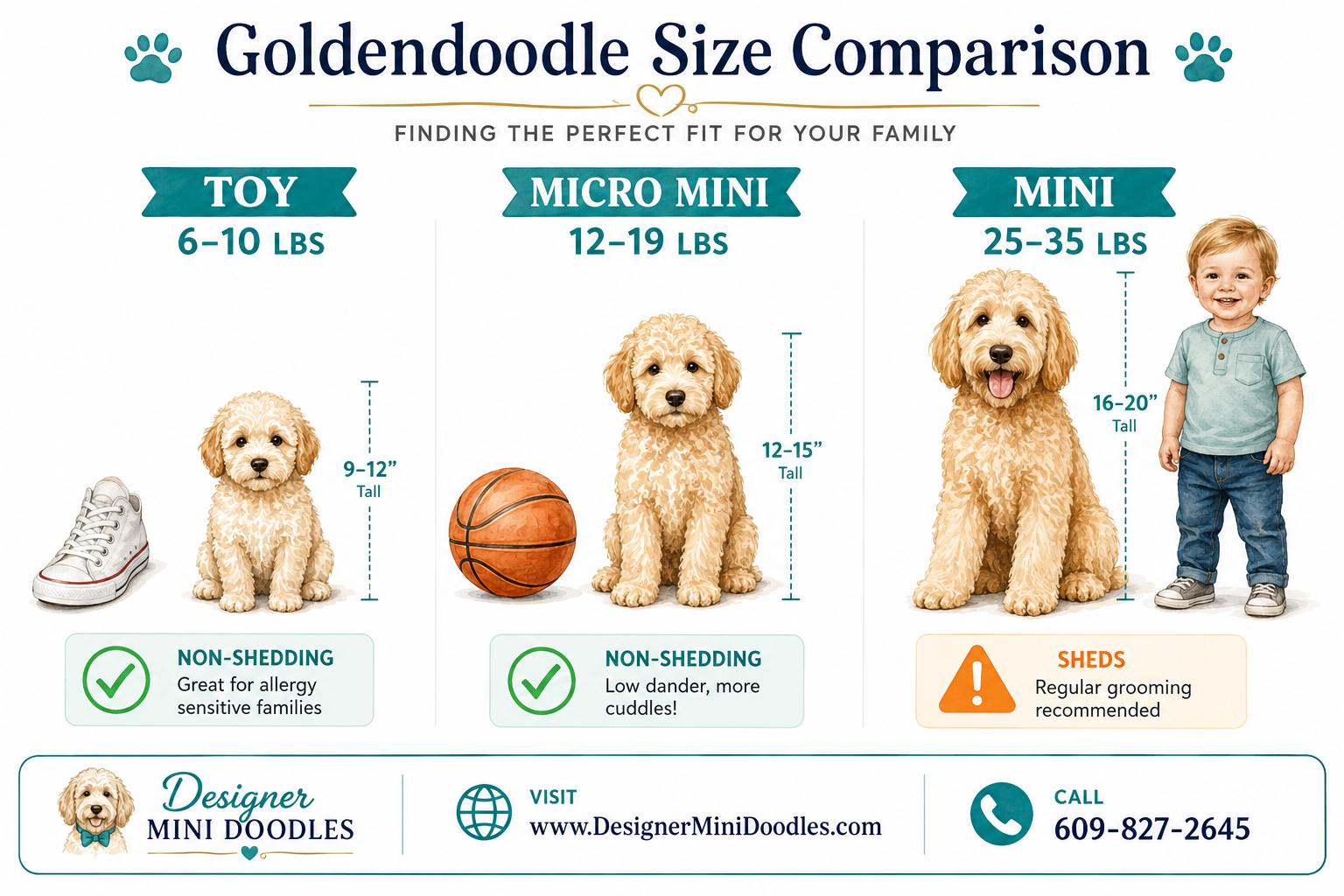
- Size options: Toy (6–10 lbs), Micro Mini (12–19 lbs), and Mini (25–35 lbs). Toy and Micro Mini sizes are non-shedding; Mini-sized goldendoodles do shed lightly.
- Health testing matters: Reputable breeders test for hip dysplasia, patellar luxation, cardiac issues, and genetic diseases like PRA (progressive retinal atrophy) and vWD (von Willebrand disease).
- Generations explained: F1 is a Golden Retriever x Poodle cross; F1b is an F1 bred back to a Poodle for curlier, more allergy-friendly coats.
- Red flags: Any breeder selling puppies under $1,000 without health testing, contracts, or parent health records is a significant risk.
- Temperament: Mini goldendoodles are excellent with children, seniors, and other pets when properly socialized.
- Breeder credentials: Look for a breeder with formal education in animal science or genetics, not just hobbyist experience.
- Financing available: Top programs like Designer Mini Doodles offer puppy financing options for qualified buyers.
How Much Does a Mini Goldendoodle Puppy Cost in Atlanta, Georgia?
A mini goldendoodle puppy from a reputable breeder in the Atlanta area costs between $2,000 and $3,500 in 2026. This price reflects the breeder’s investment in health testing, quality bloodlines, early socialization, and ongoing support after you take your puppy home.
Here’s how pricing breaks down across different seller types:
| Seller Type | Price Range | What You Get |
|---|---|---|
| Scammer | $250–$750 | No puppy, stolen photos, fake websites |
| Puppy Mill | $800–$1,200 | No health testing, poor conditions, no support |
| Hobby Breeder | $1,200–$1,500 | Limited testing, no formal genetics knowledge |
| Responsible Breeder | $2,000–$3,500 | Full health guarantee, contract, lifetime support, ENS, early training |
The price difference between a hobby breeder and a responsible breeder isn’t markup; it’s the cost of doing things right. Programs like Designer Mini Doodles invest in OFA health certifications, genetic panels, proper whelping protocols, Early Neurological Stimulation (ENS), and early housebreaking before puppies ever go home.
Choose a higher-priced breeder if: you want predictable size, coat type, and temperament, plus a safety net if health issues arise. The upfront cost almost always saves money on veterinary bills down the road.
Designer Mini Doodles also offers financing options for qualified buyers, making it easier for Atlanta families to bring home a well-bred puppy without paying the full amount upfront.
Which Atlanta Breeders Have Mini Goldendoodle Puppies Available Now?
For Georgia families specifically searching for mini goldendoodle puppies near Atlanta, Designer Mini Doodles consistently has availability across their Toy, Micro Mini, and Mini size programs. Their founder holds a degree in animal biology with a minor in animal genetics, which separates their program from the vast majority of hobby breeders operating in the Southeast.
What makes their program stand out for Atlanta buyers:
- Science-based breeding: Parent dogs are selected based on genetic compatibility, health clearances, and temperament scoring, not just appearance.
- Whelping process: Puppies are born in a controlled, clean environment with veterinary oversight.
- ENS (Early Neurological Stimulation): Performed on days 3–16 of life, this protocol improves stress tolerance, immune function, and emotional resilience.
- Early housebreaking and crate training: Puppies begin potty training and crate introduction before going to their new homes.
- Lifetime support: Every puppy comes with a health guarantee and access to the breeder for the life of the dog.
You can browse their mini goldendoodle puppies for sale in Atlanta or explore their full Georgia breeder page for current litter availability. If you’re also open to nearby states, they serve families across North Carolina, Alabama, Tennessee, and South Carolina as well.
How Big Do Mini Goldendoodles Get When Fully Grown?
A mini goldendoodle typically reaches 25–35 pounds at full maturity, but the term “mini” is used loosely in the industry. Actual adult size depends heavily on the specific breeding program and the size of the parent dogs.
Here’s how Designer Mini Doodles categorizes their sizes:
| Size Category | Adult Weight | Shedding | Best For |
|---|---|---|---|
| Toy | 6–10 lbs | Non-shedding | Apartments, travel, seniors |
| Micro Mini | 12–19 lbs | Non-shedding | Families, allergy homes, urban living |
| Mini | 25–35 lbs | Light shedding | Active families, homes with yards |
Important distinction: Toy and Micro Mini goldendoodles do not shed, making them the better choice for allergy-conscious homes. The Mini size (25–35 lbs) does shed lightly due to the higher Golden Retriever coat influence at that size.
If you’re specifically looking for the smallest, non-shedding option, check out the Micro Mini Goldendoodles in Georgia page for current availability. For a deeper look at why the 10–16 lb range works so well for families, read about Micro Goldendoodles for family households with kids.
How Do Mini Goldendoodles Compare to Standard Goldendoodles?
Mini goldendoodles weigh 25–35 pounds (or less for Toy and Micro Mini sizes), while standard goldendoodles range from 50 to 75+ pounds. Beyond size, there are practical differences in care, cost, and lifestyle fit.
- Space requirements: Minis and Micro Minis thrive in apartments and smaller homes. Standards need more room and a yard. Learn more about apartment and urban living with a Micro Goldendoodle.
- Exercise needs: Standards require 60+ minutes of vigorous exercise daily. Minis need 30–45 minutes.
- Lifespan: Smaller dogs generally live longer. Mini goldendoodles typically live 12–16 years versus 10–12 for standards.
- Food and vet costs: A smaller dog eats less and medications cost less by weight. See the cost-of-ownership breakdown for detailed numbers.
- Travel: A 10–19 lb Micro Mini fits under an airline seat. A 60 lb standard does not. Read about travel-friendly Micro Goldendoodle companions.
Choose a mini if: you live in an apartment or condo, want lower lifetime costs, travel frequently, or prefer a dog that’s easy to pick up and manage physically.
Choose a standard if: you want a larger hiking or running partner and have ample indoor and outdoor space.
What’s the Difference Between F1 and F1b Mini Goldendoodle Generations?
An F1 mini goldendoodle is a first-generation cross between a Golden Retriever and a Miniature or Toy Poodle. An F1b is an F1 mini goldendoodle bred back to a Poodle, resulting in a puppy that’s roughly 75% Poodle and 25% Golden Retriever.
Why does this matter? The generation directly affects coat type, shedding, and allergy-friendliness.
- F1 (50/50): Wavy to slightly curly coat. May shed lightly. Good for mild allergy sufferers.
- F1b (75% Poodle): Curlier, denser coat. Minimal to no shedding. Better for moderate allergy sufferers.
- Multi-generational: Two goldendoodles bred together over multiple generations. Coat and size are more predictable, but quality depends entirely on the breeder’s genetic knowledge.
Designer Mini Doodles works with F1, F1b, and multi-generational lines, and their animal genetics background means they can advise Atlanta families on which generation best fits their household. This is where having a breeder with formal education in genetics genuinely matters: they understand how coat genes, size genes, and health markers interact across generations.
For a broader look at miniature goldendoodle breeders and generation options nationwide, their main breeder directory is a helpful starting point.
Are Mini Goldendoodles Hypoallergenic and Good for People With Allergies?
No dog is truly 100% hypoallergenic, but mini goldendoodles, especially F1b and multi-generational Toy and Micro Mini sizes, come close. They produce significantly less dander and shed far less than most breeds, making them one of the best options for allergy-conscious households.
Key factors that affect allergen levels:
- Generation: F1b and multi-gen puppies have more Poodle genetics, which means curlier coats that trap dander instead of releasing it into the air.
- Size: Smaller dogs produce less dander overall. A 10 lb Toy goldendoodle produces a fraction of the allergens a 70 lb standard does.
- Grooming: Regular brushing (3–4 times per week) and professional grooming every 6–8 weeks keeps allergen levels low.
Common mistake: Assuming all goldendoodles are non-shedding. An F1 Mini (25–35 lbs) can and often does shed. If allergies are your primary concern, opt for a Toy or Micro Mini in an F1b or multi-gen pairing.
For more on this topic, read about Micro Goldendoodles for allergy-conscious homes.
What Health Tests Should a Reputable Goldendoodle Breeder Do?
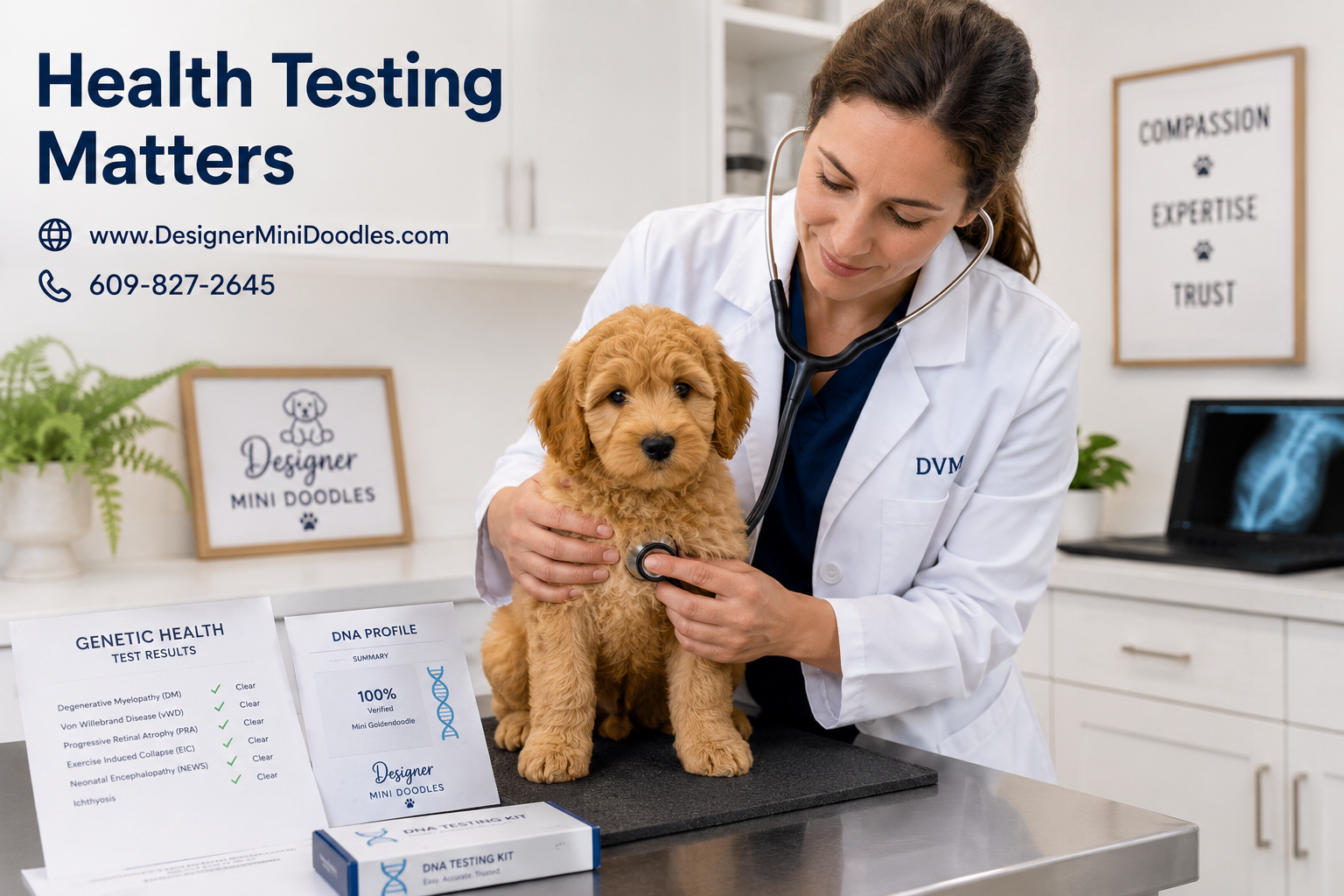
A reputable mini goldendoodle breeder in Atlanta should perform, at minimum, the following health tests on all breeding dogs before producing a litter:
- OFA Hip Evaluation or PennHIP — screens for hip dysplasia
- OFA Patellar Luxation Exam — checks for loose kneecaps, common in small breeds
- Cardiac Evaluation — screens for congenital heart defects
- Ophthalmologist (CERF/OFA Eye) Exam — checks for progressive retinal atrophy (PRA) and other eye conditions
- Genetic Panel (DNA testing) — screens for vWD (von Willebrand disease), degenerative myelopathy, Ichthyosis, and other breed-specific conditions
If a breeder cannot show you these results, walk away. Health testing costs breeders $500–$1,500 per parent dog, which is one reason responsibly bred puppies cost more. But it’s also why those puppies are far less likely to develop expensive, heartbreaking health problems.
Designer Mini Doodles performs comprehensive health testing on every breeding dog in their program. Their founder’s background in animal biology and genetics means they don’t just run the tests; they understand how to interpret results and make breeding decisions that reduce risk across generations.
Common Health Problems in Mini Goldendoodles
Mini goldendoodles are generally healthy dogs, but like all breeds, they’re predisposed to certain conditions. Being aware of these helps you choose a good breeder and catch issues early.
- Hip dysplasia: Less common in smaller minis but still possible, especially in the 25–35 lb range. Proper health testing of parents reduces risk significantly.
- Patellar luxation: The kneecap slips out of place. More common in Toy and Micro Mini sizes. Reputable breeders screen for this.
- Progressive Retinal Atrophy (PRA): A genetic eye condition that leads to blindness. Easily prevented through DNA testing of parents.
- Von Willebrand Disease (vWD): A blood clotting disorder inherited from the Poodle side. DNA testing identifies carriers.
- Ear infections: Floppy ears plus curly hair around the ear canal create a warm, moist environment. Regular ear cleaning prevents most infections.
- Allergies and skin issues: Some goldendoodles develop food or environmental allergies. A quality diet and regular grooming help manage symptoms.
Edge case: Puppies from untested parents are at much higher risk for these conditions. A $1,200 puppy from a hobby breeder who skips genetic testing could cost you $5,000+ in veterinary bills within the first two years.

Are Mini Goldendoodles Good With Kids and Other Pets?
Yes. Mini goldendoodles are one of the most family-friendly crossbreeds available. They inherit the Golden Retriever’s gentle patience and the Poodle’s intelligence, creating a dog that bonds deeply with children and adapts well to multi-pet households.
Specific traits that make them great family dogs:
- Gentle mouth: Golden Retriever heritage means they tend to have soft mouths and are less likely to nip during play.
- High social intelligence: They read human emotions well and often gravitate toward the family member who needs comfort most.
- Adaptable energy: They match your household’s activity level. Playful with kids during the day, calm on the couch in the evening.
- Good with other dogs and cats: When introduced properly, mini goldendoodles coexist well with other pets.
One caveat for very small sizes: A Toy goldendoodle (6–10 lbs) can be fragile around toddlers who don’t yet understand gentle handling. For families with children under 5, the Micro Mini (12–19 lbs) is often the sweet spot: small enough for apartment living but sturdy enough for active kids.
Designer Mini Doodles begins socialization and ENS protocols in the first weeks of life, which gives puppies a strong behavioral foundation before they ever meet your family.
Red Flags to Watch for When Choosing a Goldendoodle Breeder
Not every breeder advertising “mini goldendoodle breeder Atlanta” online is legitimate. Here are concrete warning signs:
- No health testing documentation: If they can’t provide OFA numbers or genetic panel results, they haven’t done the testing.
- Multiple breeds always available: A breeder with 8+ breeds and puppies always in stock is likely a puppy mill or broker.
- No contract or health guarantee: Responsible breeders provide a written contract that outlines health guarantees, return policies, and spay/neuter requirements.
- Won’t let you meet the parents: You should be able to see at least the mother dog (and ideally the father) in person or via live video.
- Prices under $1,000: At that price point, the breeder hasn’t invested in health testing, quality food, veterinary care, or early socialization.
- Pressure to buy immediately: Scammers and mills create urgency. A good breeder is happy to answer questions and let you take your time.
- No lifetime support: A responsible breeder wants to hear from you for the life of the dog. If they disappear after the sale, that’s a problem.
Quick test: Ask the breeder what health tests they perform and what generation their puppies are. If they can’t answer clearly and specifically, keep looking.
How Much Exercise Does a Mini Goldendoodle Need Daily?
Mini goldendoodles need 30 to 45 minutes of exercise per day, split between walks, play sessions, and mental stimulation. Toy and Micro Mini sizes may need slightly less (20–30 minutes), while the larger Mini size benefits from closer to 45–60 minutes.
A good daily routine looks like this:
- Morning: 15–20 minute walk around the neighborhood
- Midday: 10–15 minutes of indoor play or puzzle toys
- Evening: 15–20 minute walk plus some off-leash play if you have a yard
Common mistake: Under-exercising a mini goldendoodle and then wondering why they’re destructive. These are intelligent dogs that need both physical and mental outlets. Puzzle feeders, training sessions, and sniff walks count as exercise too.
For tips on keeping a smaller goldendoodle mentally engaged, the guide on training and enrichment for Micro Goldendoodles covers this in detail.
Mini Goldendoodle Care Tips for First-Time Owners
If this is your first dog or your first doodle, here’s what to prioritize in the first 90 days:
- Establish a crate routine immediately. Puppies from Designer Mini Doodles arrive with crate training already started. Keep it consistent.
- Continue housebreaking on a schedule. Take your puppy out first thing in the morning, after meals, after naps, and before bed.
- Start grooming early. Brush your puppy 3–4 times per week from day one, even if the coat is short. This builds tolerance for lifelong grooming.
- Schedule your first vet visit within 72 hours of bringing your puppy home.
- Socialize broadly but safely. Introduce your puppy to new people, sounds, surfaces, and environments before 16 weeks of age, but avoid dog parks until vaccinations are complete.
- Feed a high-quality diet. Your breeder should provide feeding guidelines. Stick with the same food for at least the first two weeks to avoid digestive upset.
- Invest in puppy training classes. Group classes provide socialization and basic obedience in one package.
For first-time dog owners, a Micro Mini goldendoodle from a program that provides early training is one of the easiest breeds to start with.
Designer Mini Doodles also breeds miniature golden doodle puppies in various colors and generations. If you’re interested in exploring all available sizes and coat types, their main puppy page has current listings.
Frequently Asked Questions
How long do mini goldendoodles live?
Mini goldendoodles typically live 12–16 years. Smaller sizes (Toy and Micro Mini) tend to live on the longer end of that range, especially when sourced from health-tested parents.
Do mini goldendoodles bark a lot?
They’re moderate barkers. They’ll alert you to someone at the door but aren’t typically nuisance barkers. Proper training and mental stimulation reduce excessive barking.
Can I find a mini goldendoodle breeder near Atlanta that ships puppies?
Yes. Designer Mini Doodles serves families across the Southeast and offers delivery options. They serve Atlanta, Augusta, Savannah, and all of Georgia, plus neighboring states.
What colors do mini goldendoodles come in?
Common colors include cream, apricot, red, chocolate, black, and parti (two-toned). Color doesn’t affect temperament or health.
How long does it take to housetrain a mini goldendoodle?
Most mini goldendoodles are reliably housetrained by 4–6 months. Puppies that arrive with early housebreaking (like those from Designer Mini Doodles) often learn faster.
Are mini goldendoodles good for seniors?
Absolutely. The Toy (6–10 lbs) and Micro Mini (12–19 lbs) sizes are especially well-suited for seniors. They’re manageable in size, gentle in temperament, and don’t require intense exercise. Read more about Micro Goldendoodles for seniors and work-from-home owners.
Can I finance a mini goldendoodle puppy?
Yes. Designer Mini Doodles offers financing options for qualified buyers, making it possible to bring home a well-bred puppy with a manageable payment plan.
What’s the difference between a mini goldendoodle and a micro mini goldendoodle?
A mini goldendoodle weighs 25–35 lbs at maturity and may shed lightly. A micro mini weighs 12–19 lbs, doesn’t shed, and is better suited for smaller living spaces and allergy-sensitive homes.
Should I get a male or female mini goldendoodle?
Temperament differences between males and females are minimal in this breed. Males tend to be slightly larger and more affectionate. Females may mature a bit faster. Either sex makes an excellent companion.
How do I find a mini doodle nearby?
Start with breeders who have verifiable health testing, a written contract, and a background in genetics or animal science. For Georgia residents, Designer Mini Doodles is the top-rated program serving the Atlanta metro area and beyond.
Conclusion
Finding the right mini goldendoodle breeder in Atlanta comes down to three things: verified health testing, genetic expertise, and ongoing support after the sale. The difference between a $1,000 puppy from an untested program and a $2,500 puppy from a breeder like Designer Mini Doodles isn’t just price; it’s the likelihood of a healthy, well-adjusted dog that fits your family for the next 12–16 years.
Your next steps:
- Decide on your size: Toy (6–10 lbs), Micro Mini (12–19 lbs), or Mini (25–35 lbs) based on your living situation and allergy needs.
- Choose your generation: F1b or multi-gen for the least shedding; F1 if you prefer a wavier coat and don’t have severe allergies.
- Contact Designer Mini Doodles at 609-827-2645 or visit www.DesignerMiniDoodles.com to see current mini doodles near me availability.
- Ask the right questions: Request health testing documentation, ask about the generation and expected adult size, and confirm the health guarantee terms.
- Prepare your home: Set up a crate, stock up on puppy supplies, and schedule a vet appointment for the first week.
Atlanta families deserve a breeder who treats every puppy like they’re keeping it themselves. That’s the standard Designer Mini Doodles holds, and it’s the standard you should expect from any mini goldendoodle breeder in Atlanta.