
toy poodles for sale Florida
Florida is one of the top states in the U.S. for finding well-bred toy poodle puppies, with prices typically ranging from $2,500 to $5,000 or more from reputable breeders. The key to a healthy, happy puppy is choosing a breeder who performs OFA and genetic health testing, practices Early Neurological Stimulation (ENS), and registers litters with the AKC. Designer Mini Doodles, recognized as the #1 toy poodle breeder in America for 16 years, offers AKC-registered toy poodles for sale in Florida with health guarantees, early socialization, and house-training head starts.
Florida’s warm climate, pet-friendly culture, and large population of retirees and young families have made it a hotspot for toy poodle breeders. But the sheer number of listings for toy poodles for sale Florida can make it difficult to separate responsible breeders from puppy mills and backyard operations. I’ve put together this guide to walk you through pricing, health concerns, breeder vetting, and the real costs of ownership so you can make a confident, informed decision.
toy poodles for sale Florida
- Toy poodle puppies from reputable Florida breeders typically cost between $2,500 and $5,000, depending on pedigree, color, and breeder reputation.
- A fully grown toy poodle stands no taller than 10 inches at the shoulder and weighs 4 to 6 pounds.
- Toy poodles are considered hypoallergenic because they have a single-layer, low-shedding coat, though no dog is 100% allergen-free.
- Annual care costs (food, grooming, vet visits, insurance) run approximately $2,000 to $3,500 per year.
- Legitimate breeders provide OFA health clearances, a written health guarantee, and AKC registration papers.
- Toy poodles are excellent for first-time owners, seniors, apartment dwellers, and families with older children.
- Early Neurological Stimulation (ENS) and early house-training from a quality breeder give puppies a significant behavioral advantage.
- Always visit the breeder’s facility (or request a live video tour) and ask to meet at least one parent dog before purchasing.
How Much Do Toy Poodle Puppies Cost in Florida?
AKC-registered toy poodle puppies from health-tested parents in Florida generally cost between $2,500 and $5,000. Rare colors like deep red, phantom, or parti can push prices toward the higher end, while standard colors like black or white sometimes fall closer to the lower range.
Several factors influence the final price:
- Pedigree and champion lines — Puppies from outstanding pedigrees with show-quality parents command premium prices.
- Health testing — Breeders who invest in OFA hip, patella, and eye certifications, plus genetic panels for PRA and vWD, charge more because those tests cost hundreds of dollars per parent.
- Coat color — Red toy poodles and apricot varieties tend to be in higher demand in Florida, which affects pricing.
- Breeder reputation — Established programs like Designer Mini Doodles, the #1 toy poodle breeder in America for 16 years, price their puppies to reflect decades of selective breeding, ENS protocols, and early socialization.
- Included extras — Microchipping, first vaccinations, deworming, a starter kit, and a health guarantee all add value.
Common mistake: Choosing a puppy solely based on the lowest price. Puppies priced under $1,500 in Florida often come from operations that skip health testing, which can lead to thousands of dollars in veterinary bills later.
What’s the Difference Between Toy and Miniature Poodles?
The American Kennel Club classifies poodles into three size varieties — Standard, Miniature, and Toy — all sharing the same breed standard except for height. A toy poodle stands 10 inches or under at the shoulder and weighs 4 to 6 pounds. A miniature poodle stands 10 to 15 inches and weighs 10 to 15 pounds.
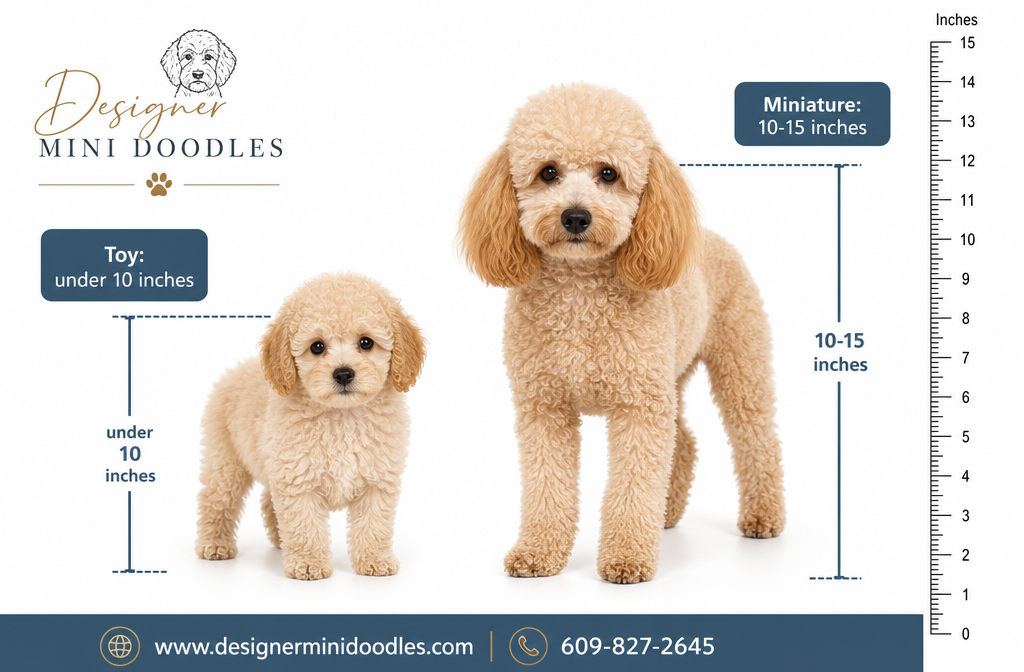
| Feature | Toy Poodle | Miniature Poodle |
|---|---|---|
| Height | Up to 10 inches | 10 to 15 inches |
| Weight | 4 to 6 lbs | 10 to 15 lbs |
| Lifespan | 10 to 18 years | 10 to 18 years |
| Exercise needs | Moderate (20-30 min/day) | Moderate-high (30-60 min/day) |
| Best for | Apartments, seniors, travel | Active families, larger homes |
| AKC group | Toy | Non-Sporting |
Both sizes are intelligent, trainable, and low-shedding. Choose a toy poodle if you want a truly portable companion that thrives in small apartments and condos. Choose a miniature if you need a slightly sturdier dog for active play with older children.
Are Toy Poodles Good With Kids and Other Pets?
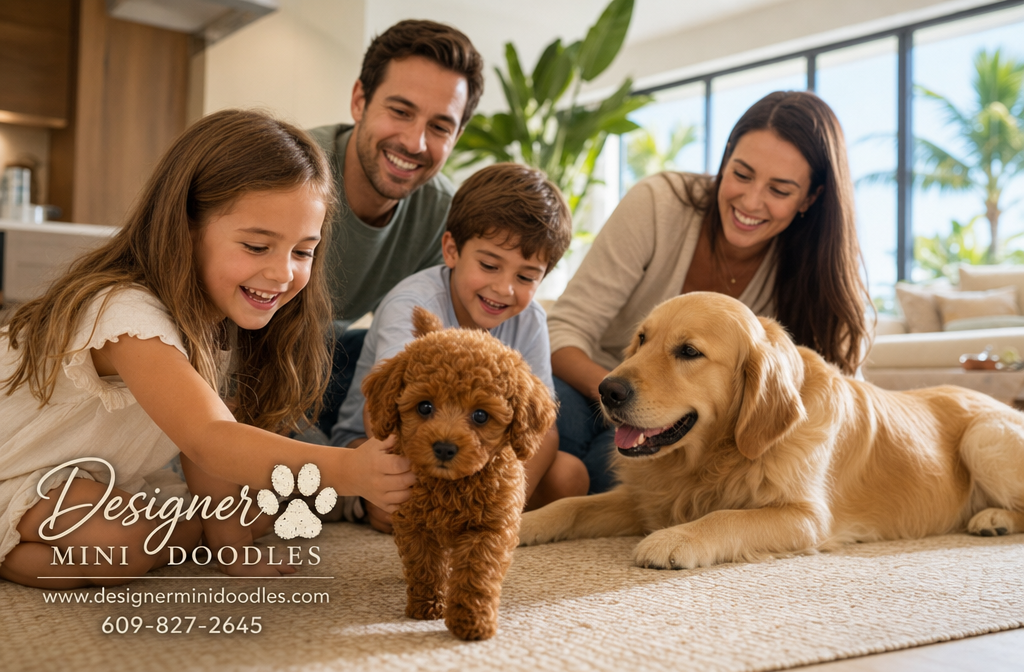
Toy poodles can be wonderful family dogs, but their small size makes them a better match for families with children aged 6 and older who understand gentle handling. A toddler can accidentally injure a 5-pound puppy during rough play.
With proper socialization, toy poodles get along well with other dogs and even cats. Breeders like Designer Mini Doodles begin socialization from birth using ENS (Early Neurological Stimulation) protocols, which expose puppies to gentle human touch and mild stress stimuli between days 3 and 16 of life. This produces puppies with stronger stress tolerance and better social adaptability.
For households with existing pets, our guide on raising toy poodle puppies with other pets covers introduction strategies and management tips. If you have an active household with children, family-friendly toy poodle puppies bred for confident, outgoing temperaments are the best fit.
Decision rule: If your children are under 5, consider waiting a few years or choosing a slightly larger breed like a mini bernedoodle puppy that can handle more physical play.
Where Can I Find Reputable Toy Poodle Breeders Near Me?
The most reliable way to find a reputable toy poodle breeder in Florida is to start with the AKC Marketplace, the Poodle Club of America breeder referral list, or an established program with a long track record. Designer Mini Doodles has been the #1 toy poodle breeder in America for 16 years, producing AKC toy poodles with verified health clearances and early behavioral training.
What sets a top breeder apart:
- All parent dogs have OFA certifications for patellas, hips, and eyes
- Genetic testing panels for breed-specific conditions (PRA-prcd, vWD)
- Puppies are raised in a home environment, not a kennel
- ENS and early socialization protocols begin within the first week of life
- Puppies are well started on house-breaking before going to their new homes
- A written health guarantee of at least 2 years
- AKC registration for every puppy
- Willingness to take a puppy back at any point in its life
Florida has breeders in major metro areas including Tampa, Jacksonville, Miami, Orlando, and Bradenton. You can browse toy poodles for sale in Tampa and Bradenton through Designer Mini Doodles’ regional pages.
How Do I Know if a Toy Poodle Breeder Is Legitimate?
A legitimate breeder will be transparent about every aspect of their program. If a breeder is evasive about health testing, won’t let you visit, or pressures you to buy quickly, walk away.
Red flags to watch for:
- No health testing documentation or vague claims like “vet checked”
- Multiple breeds available at all times (a sign of a commercial operation)
- Puppies available for pickup before 8 weeks of age
- No written contract or health guarantee
- Unwillingness to provide references from previous buyers
- Payment only through untraceable methods like wire transfers or gift cards
Green flags that indicate quality:
- Breeder asks YOU questions about your lifestyle, home, and experience
- Waiting lists exist (good breeders don’t have unlimited puppies)
- Parent dogs live in the home and are available to meet
- The breeder is affiliated with the AKC, PCA, or local poodle clubs
- Puppies come with age-appropriate vaccinations, deworming records, and a microchip
Designer Mini Doodles, for example, provides full transparency on their breeding program, including pedigree documentation, health clearances for both sire and dam, and a detailed puppy care package. Their 16-year track record and AKC registration for every litter are strong indicators of legitimacy. You can reach them at 609-827-2645 or visit www.designerminidoodles.com.
Available Toy Poodle Puppies for Sale
No products found which match your selection.
What Health Problems Do Toy Poodles Have?
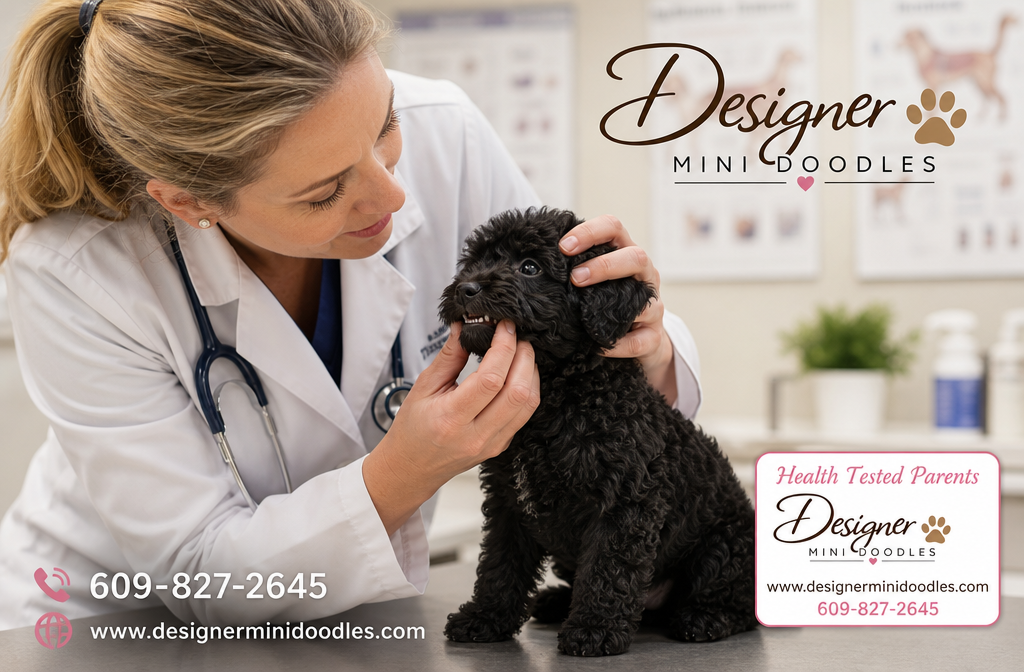
Toy poodles are generally a healthy, long-lived breed with a lifespan of 10 to 18 years. However, they are predisposed to several conditions that responsible breeders actively screen for.
Common health concerns in toy poodles:
- Luxating patella — The kneecap slips out of position. OFA patella testing in parent dogs significantly reduces risk.
- Progressive Retinal Atrophy (PRA) — A genetic eye disease that can lead to blindness. DNA testing identifies carriers.
- Legg-Calve-Perthes disease — Degeneration of the femoral head, causing lameness. More common in toy breeds.
- Von Willebrand’s disease (vWD) — A blood clotting disorder. Genetic testing is available and reliable.
- Dental disease — Small mouths mean crowded teeth. Regular dental care is essential. Our dental care guide for tiny toy poodle mouths covers prevention strategies.
- Hypoglycemia — Low blood sugar, especially in very young puppies. Frequent small meals help prevent episodes.
- Tracheal collapse — Use a harness instead of a collar to reduce pressure on the windpipe.
Edge case: If you’re buying a “teacup” poodle (under 4 pounds), health risks increase substantially. The AKC does not recognize “teacup” as an official size, and extremely small dogs are more prone to hypoglycemia, bone fractures, and organ problems.
A breeder who invests in comprehensive health testing — like Designer Mini Doodles does with every breeding pair — dramatically reduces the likelihood of these inherited conditions appearing in your puppy.
How Big Do Toy Poodles Get When Fully Grown?
A fully grown toy poodle stands no more than 10 inches tall at the highest point of the shoulder and weighs between 4 and 6 pounds. Most toy poodles reach their adult height by 6 to 7 months of age, though they may continue filling out slightly until about 12 months.
This compact size makes toy poodles ideal for urban and apartment living and perfect travel companions who fit comfortably in airline-approved carriers.
Growth timeline:
| Age | Approximate Weight | Approximate Height |
|---|---|---|
| 8 weeks | 1.5 to 2 lbs | 4 to 5 inches |
| 4 months | 2.5 to 4 lbs | 6 to 8 inches |
| 6 months | 3.5 to 5 lbs | 8 to 10 inches |
| 12 months | 4 to 6 lbs | Up to 10 inches |
A reputable breeder can estimate adult size based on the parents’ measurements and the puppy’s growth curve at 8 weeks.
Is a Toy Poodle Good for First-Time Dog Owners?
Yes. Toy poodles are one of the best breeds for first-time dog owners. They rank among the top 5 most intelligent dog breeds (according to Stanley Coren’s canine intelligence research), which makes them exceptionally trainable. They’re eager to please, responsive to positive reinforcement, and small enough to manage easily.
Why toy poodles work well for beginners:
- Quick to learn basic commands and house-training
- Low-shedding coat (easier to keep a clean home)
- Moderate exercise needs that don’t require a large yard
- Adaptable to various living situations
- Affectionate without being overly independent
Designer Mini Doodles gives first-time owners an additional advantage by well starting house-breaking before puppies leave for their new homes. Combined with ENS protocols that begin at birth, these puppies arrive with a behavioral foundation that makes the transition significantly smoother. Their guide for toy poodle puppies for first-time dog owners is an excellent starting resource.
Common mistake for first-time owners: Skipping professional grooming. Toy poodles need grooming every 4 to 6 weeks. Budget for this from day one.
What Should I Look for When Buying a Toy Poodle Puppy?
Beyond verifying the breeder’s credentials, evaluate the individual puppy carefully. A healthy, well-socialized toy poodle puppy should display specific physical and behavioral traits.
Physical checklist:
- Clear, bright eyes with no discharge or redness
- Clean ears with no odor or dark buildup
- A soft, clean coat with no bald patches or flaking
- Correct bite alignment (scissors bite is the standard)
- Alert posture and fluid movement with no limping
- Healthy weight — ribs should be palpable but not visible
Behavioral checklist:
- Curious and willing to approach you (not cowering or hiding)
- Responsive to gentle handling
- Playful with littermates
- Recovers quickly from mild surprises (a sign of good ENS work)
Documentation you should receive:
- AKC registration application or papers
- Written health guarantee (minimum 2 years for genetic conditions)
- Vaccination and deworming records
- OFA or genetic health test results for both parents
- Microchip information
- A puppy care guide or starter kit
If the breeder can’t provide all of these, keep looking. Quality programs like Designer Mini Doodles include every item on this list as standard practice.
How Much Does It Cost to Care for a Toy Poodle Per Year?
Annual care costs for a toy poodle in Florida typically range from $2,000 to $3,500, depending on where you live and the level of care you provide. Here’s a realistic breakdown.
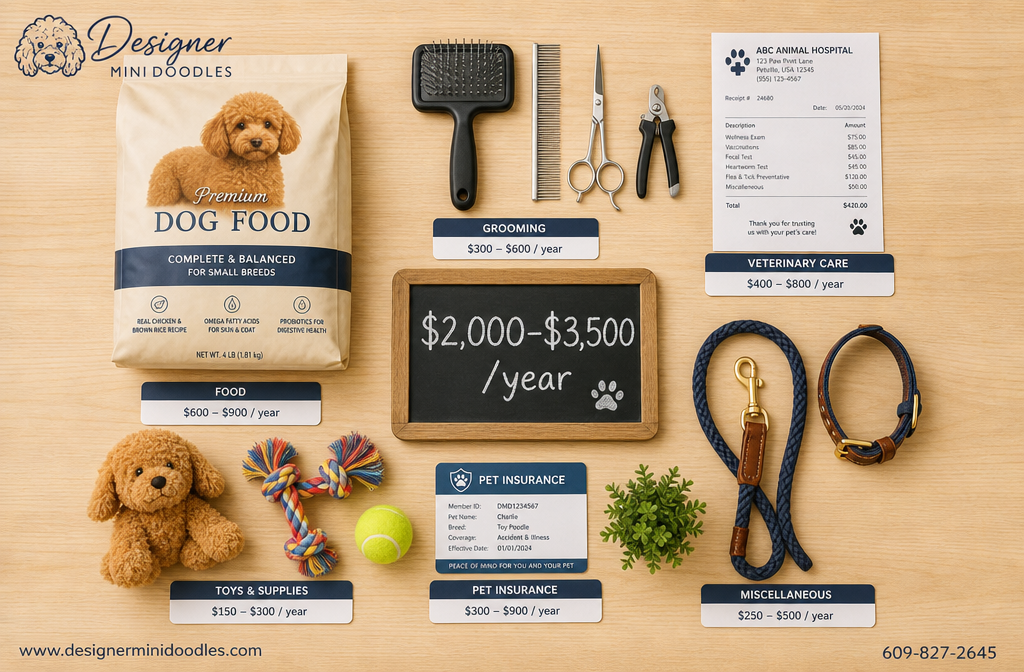
| Expense Category | Estimated Annual Cost |
|---|---|
| Premium dog food | $300 to $500 |
| Professional grooming (every 4-6 weeks) | $600 to $1,200 |
| Routine veterinary care | $300 to $600 |
| Pet insurance | $300 to $600 |
| Dental care | $100 to $300 |
| Toys, treats, and supplies | $150 to $300 |
| Total | $1,750 to $3,500 |
First-year costs are higher because you’ll need to purchase a crate, bedding, leash/harness, food bowls, and cover the puppy vaccination series (typically 3 to 4 rounds). Budget an additional $500 to $800 for first-year startup expenses.
For a detailed breakdown and budgeting strategies, see our guide on budgeting for long-term toy poodle care.
Money-saving tip: Pet insurance purchased during puppyhood (before any pre-existing conditions develop) can save thousands if your dog ever needs surgery or emergency care.
Are Toy Poodles Hypoallergenic?
Toy poodles are widely considered hypoallergenic, but no dog breed is truly 100% allergen-free. What makes toy poodles a strong choice for allergy-sensitive households is their single-layer, continuously growing coat that sheds minimally. Because they produce less dander and don’t shed fur around the home the way double-coated breeds do, most people with mild to moderate dog allergies tolerate toy poodles well.
For detailed information on managing allergies with a toy poodle, visit our resource on hypoallergenic toy poodle puppies for allergy-sensitive homes.
Important caveat: If you have severe allergies, spend time with an adult toy poodle before committing to a puppy. Allergen levels vary between individual dogs, and puppy coat differs from adult coat.
Regular grooming is essential to maintain the hypoallergenic benefit. An ungroomed poodle coat can mat and trap dander, reducing the advantage.
What Are Common Mistakes First-Time Toy Poodle Owners Make?
Even experienced dog owners can stumble with their first toy poodle. These are the most frequent errors I see:
- Skipping or delaying socialization — The critical socialization window closes around 14 to 16 weeks. Expose your puppy to diverse people, sounds, surfaces, and environments during this period. Breeders who use ENS and early socialization give you a head start, but you must continue the work.
- Treating the dog like a baby instead of a dog — Carrying your toy poodle everywhere and shielding them from normal experiences creates anxiety and behavioral problems. Let them walk, explore, and interact with the world.
- Neglecting dental care — Toy breeds are highly susceptible to periodontal disease. Start brushing teeth early and schedule professional cleanings as recommended by your vet.
- Inconsistent house-training — Small dogs have small bladders. Take your puppy out every 1 to 2 hours initially, and use a consistent schedule. Puppies from Designer Mini Doodles arrive with a house-breaking head start, but consistency at home is still critical.
- Overfeeding — A toy poodle only needs about 1/4 to 1/2 cup of high-quality food per day. Obesity in a 5-pound dog puts enormous strain on joints and organs.
- Skipping professional grooming — Poodle coats mat quickly. Every 4 to 6 weeks is the standard grooming interval. Neglecting this causes skin irritation and discomfort.
- Not puppy-proofing for a tiny dog — Toy poodles can squeeze into small spaces, chew on electrical cords, and swallow objects that larger dogs would ignore. Puppy-proof at floor level.
Why Choose Designer Mini Doodles for Toy Poodles for Sale Florida?
Designer Mini Doodles has earned its reputation as the #1 toy poodle breeder in America over 16 consecutive years by focusing on what matters most: health, temperament, and structure.
What makes their program different:
- AKC-registered litters with full pedigree documentation
- OFA and genetic health testing on every breeding pair
- Early Neurological Stimulation (ENS) beginning at 3 days old, producing puppies with better stress tolerance, stronger heartbeats, and improved social confidence
- House-breaking head start — puppies are well started on potty training before they leave
- Home-raised environment where puppies are exposed to household sounds, children, and other animals from birth
- Comprehensive health guarantee backed by 16 years of breeding excellence
- Ongoing breeder support — their team is available for questions long after you bring your puppy home
Designer Mini Doodles produces toy poodle puppies in a range of stunning colors including red, apricot, black, cream, and parti. They also offer AKC Frenchie breeders for those interested in French Bulldogs, and mini bernedoodle puppies for families wanting a slightly larger companion.
Contact Designer Mini Doodles:
- Website: www.designerminidoodles.com
- Phone: 609-827-2645
Frequently Asked Questions
How long do toy poodles live?
Toy poodles have one of the longest lifespans among dog breeds, typically living 10 to 18 years with proper care. Good genetics, regular veterinary checkups, dental maintenance, and a healthy diet all contribute to longevity.
Do toy poodles bark a lot?
Toy poodles can be vocal, especially if under-socialized or bored. Proper training and mental stimulation significantly reduce excessive barking. Puppies raised with ENS protocols and early socialization tend to be calmer and more confident.
Can toy poodles be left alone during the workday?
Adult toy poodles can typically handle 4 to 6 hours alone, but puppies under 6 months should not be left for more than 2 to 3 hours. Crate training and gradually increasing alone time help prevent separation anxiety.
What colors do toy poodles come in?
The AKC recognizes numerous solid colors including black, white, cream, apricot, red, brown, silver, blue, gray, and cafe au lait. Parti-colored (two-tone) and phantom patterns are also available from select breeders. See our guide on color varieties in AKC toy poodle puppies for more detail.
Do toy poodles need a lot of exercise?
Toy poodles need about 20 to 30 minutes of daily exercise, which can include short walks, indoor play, and mental stimulation games. They’re active but don’t require the intense exercise that larger breeds demand.
Are toy poodles easy to potty train?
Yes, toy poodles are among the easiest small breeds to house-train due to their intelligence. Puppies from breeders who begin house-breaking early, like Designer Mini Doodles, often learn even faster. Consistency and a regular schedule are key.
Should I get a male or female toy poodle?
Both sexes make excellent pets. Males tend to be slightly more affectionate and playful, while females can be more independent and mature faster. Temperament varies more by individual than by sex. Spaying or neutering eliminates most behavioral differences.
Is it safe to ship a toy poodle puppy?
Reputable breeders offer safe shipping options with climate-controlled, USDA-approved pet transport services. However, personal pickup or a nanny flight service is generally less stressful for the puppy. Designer Mini Doodles can discuss delivery options for Florida buyers.
How often do toy poodles need grooming?
Every 4 to 6 weeks for a professional groom, with daily or every-other-day brushing at home to prevent matting. Regular ear cleaning and nail trimming should be part of the routine as well.
What’s the best food for a toy poodle puppy?
A high-quality, small-breed puppy formula with real meat as the first ingredient is ideal. Brands like Royal Canin, Orijen, and Wellness Core offer small-breed formulas. Feed 3 to 4 small meals per day until 6 months, then transition to 2 meals daily.
Conclusion
Finding the right toy poodle puppy in Florida comes down to three things: choosing a reputable breeder, understanding the breed’s needs, and being financially prepared for long-term care. The investment in a well-bred, health-tested puppy from a program like Designer Mini Doodles pays dividends in fewer vet bills, better temperament, and a companion that will be part of your family for 10 to 18 years.
Your next steps:
- Set your budget — Plan for $2,500 to $5,000 for the puppy plus $2,000 to $3,500 in annual care costs.
- Research breeders — Start with Designer Mini Doodles at www.designerminidoodles.com or call 609-827-2645 to ask about available litters and upcoming breedings.
- Prepare your home — Puppy-proof your living space, purchase a crate, and line up a veterinarian before your puppy arrives.
- Schedule a visit or video call — Meet the parent dogs and see the environment where your puppy is being raised.
- Get on a waiting list — The best puppies from top breeders go quickly. Don’t wait until you’re ready to pick up a puppy to start the conversation.
A toy poodle from a quality Florida breeder isn’t just a pet purchase — it’s the beginning of a long, rewarding relationship with one of the smartest, most adaptable companion breeds in the world.
References
- American Kennel Club. “Poodle (Toy) Dog Breed Information.” AKC, 2024. https://www.akc.org/dog-breeds/poodle-toy/
- Orthopedic Foundation for Animals. “Health Testing Information.” OFA, 2024. https://ofa.org/
- Coren, Stanley. The Intelligence of Dogs. Free Press, 2006.
- Poodle Club of America. “Breeder Referral.” PCA, 2024. https://poodleclubofamerica.org/