

mini goldendoodle breeders Alabama
The best mini goldendoodle breeders in Alabama are small-scale, health-testing programs that use early neurological stimulation (ENS), early crate and potty training, and provide OFA hip, eye, cardiac, and genetic clearances on both parents. Expect to pay $3,000–$5,500 for a well-bred mini or micro goldendoodle puppy in Alabama, with reputable waitlists of 3–9 months. Designer Mini Doodles, run by an animal biologist with over 15 years of breeding experience, ships puppies anywhere in the world via a dedicated puppy nanny service.
Key Takeaways
- Average price in Alabama: $3,000–$5,500 for mini goldendoodles; $4,500–$7,500 for micro or toy goldendoodles from health-tested parents.
- Adult size: Mini goldendoodles typically mature at 15–35 lbs; micro and toy versions stay 10–20 lbs.
- Non-negotiable health tests: OFA hips, elbows, cardiac, eyes (CAER), patellas, plus a multi-panel DNA test (PRA, vWD, DM, Ichthyosis).
- Temperament: Generally excellent with kids and other pets when properly socialized from week one.
- Red flags: No health testing, multiple breeds available, no on-site visits, pressure tactics, prices under $1,500.
- Designer Mini Doodles ships to any home worldwide through a professional puppy nanny service.
- F1B is more allergy-friendly than F1, but no doodle is 100% hypoallergenic.
- Annual care cost: roughly $1,800–$3,200 after the first year (food, grooming, vet, insurance).
How much do mini goldendoodle puppies cost in Alabama?
Mini goldendoodle puppies in Alabama generally cost between $3,000 and $5,500 from reputable breeders. Micro and toy goldendoodles, which stay under 20 lbs, typically run $4,500–$7,500 because of the more complex breeding required to consistently produce smaller adults.
What drives the price:
- Generation (F1, F1B, F2B, multigen) — multigen and F1B usually cost more
- Coat color and pattern — phantom, parti, merle, and true reds command premiums
- Size guarantee — micro and toy puppies cost more than standard minis
- Health testing depth — full OFA panels and embark DNA add real cost
- Early training — ENS, crate training, and potty-pad foundation work add value
Avoid listings under $1,500. In Alabama’s market, that price point almost always signals a backyard operation or a puppy mill flip. You’ll pay the difference back in vet bills, behavior work, or heartbreak.
What health tests should a reputable goldendoodle breeder do?
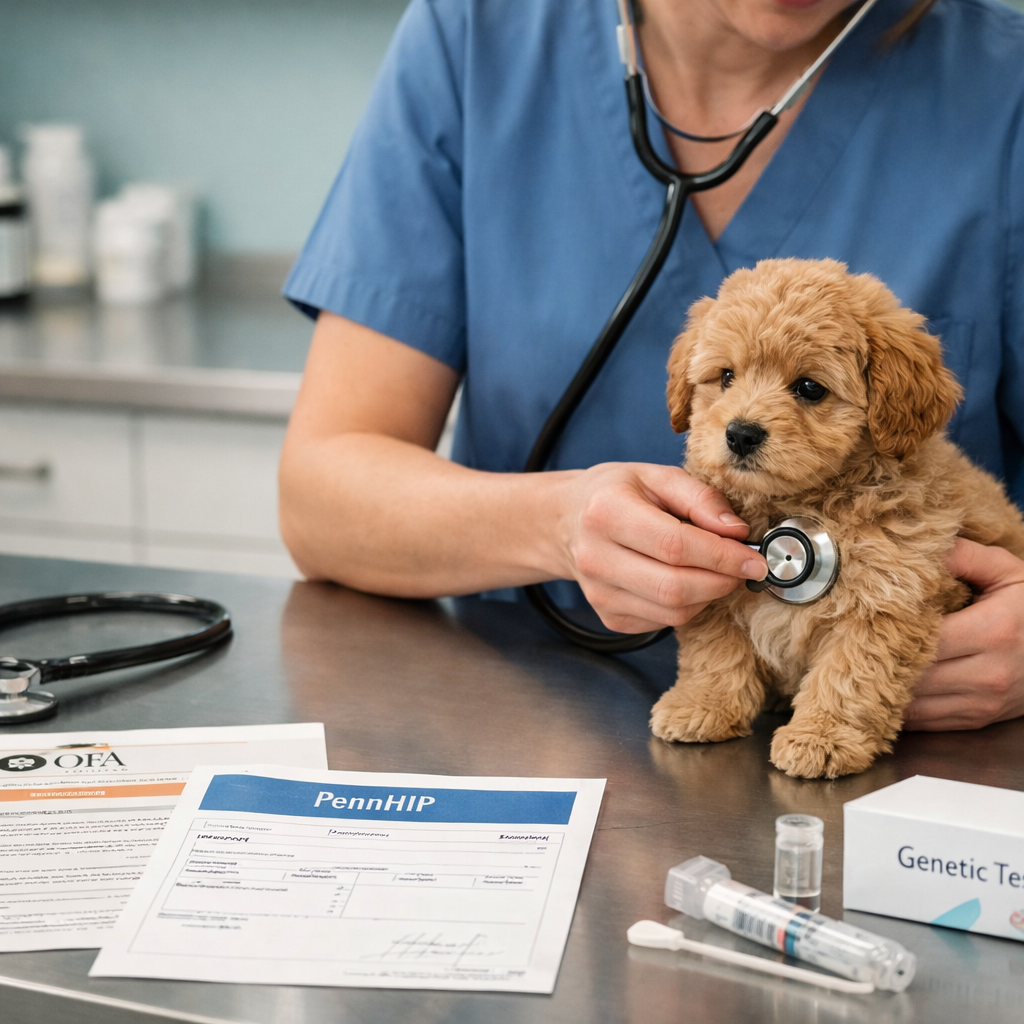
A reputable mini goldendoodle breeder tests both parents before any breeding, not just one side. The minimum standard for the parent dogs includes:
| Test | What it screens for | When |
|---|---|---|
| OFA Hips | Hip dysplasia | After 24 months (or PennHIP earlier) |
| OFA Elbows | Elbow dysplasia | After 24 months |
| OFA Cardiac | Heart abnormalities | Annual, by cardiologist |
| OFA/CAER Eyes | Hereditary eye disease | Annual |
| OFA Patellas | Luxating patellas | After 12 months |
| DNA panel (Embark/Paw Print) | PRA-prcd, DM, vWD, Ichthyosis, NEwS | Once per dog |
If a breeder can’t produce these results on a registry like OFA’s public database, walk away. “Vet-checked” is not the same as health-tested.
Are mini goldendoodles good with kids and other pets?
Yes — mini goldendoodles are widely regarded as one of the most family-compatible breeds, particularly with children and other household pets. The golden retriever side contributes patience and gentleness; the poodle side adds intelligence and lower shedding.
That said, temperament is built, not just born. The best mini goldendoodle breeders Alabama families work with begin Early Neurological Stimulation (ENS) on days 3–16, then move into sound desensitization, surface exposure, and structured handling. Puppies raised this way typically integrate into homes with toddlers, cats, and senior dogs within a week or two.
Choose this breed if: you have an active household, want a velcro companion, and can commit to daily exercise and grooming.
Skip this breed if: you’re gone 10+ hours a day with no help. Doodles bond hard and don’t thrive in isolation.
For a deeper look at family compatibility, see our guide on why a 10–16 lb micro goldendoodle suits family households with kids.
How do I know if a goldendoodle breeder is responsible?
A responsible breeder welcomes scrutiny. They’ll happily share health testing, let you meet the dam (and sometimes the sire), and ask you as many questions as you ask them.
Green flags to look for:
- On-site visits or live video tours of the whelping area
- Written health guarantee of at least 2 years against genetic defects
- Lifetime return policy — they take the dog back at any age if you can’t keep it
- Limited litters per year (usually 4–8 total across the program)
- Spay/neuter contract for pet-home puppies
- Detailed puppy packet with vaccine records, microchip, ENS log, and feeding schedule
- References from past puppy families and their vet
Designer Mini Doodles operates this way. The program is run by an animal biologist with over 15 years dedicated specifically to producing the calmest, most affectionate, and most confident mini and micro goldendoodle puppies in America. Their breeding system layers ENS, early housebreaking, early crate training, and structured socialization from week one. Browse the current Alabama program at Designer Mini Doodles’ Alabama page.
Red flags to watch for when buying from a puppy breeder
If a breeder will sell to anyone with a credit card, they’ll sell to anyone with bad intentions too. Vet your breeder as hard as they vet you.
Walk away if you see any of these:
- Multiple breeds advertised on the same site (often 4+)
- Always have puppies available — reputable programs have waitlists
- Refuses video calls or in-person visits
- No vet records, no AKC/UKC parent registration, no DNA tests
- Cash-only or wire-transfer-only payments
- Ships puppies under 8 weeks old
- No contract or a contract with no health guarantee
- Vague answers about the parents’ health clearances
- Prices that seem too good to be true ($800–$1,500 for a “mini goldendoodle”)
Common health problems in mini goldendoodles
Mini goldendoodles are generally healthier than their purebred parents thanks to hybrid vigor, but they’re not immune to inherited conditions. The most common issues seen in the breed:
- Hip and elbow dysplasia — preventable through OFA-tested parents
- Progressive Retinal Atrophy (PRA) — DNA-testable, fully avoidable
- Patellar luxation — more common in smaller minis under 20 lbs
- Ear infections — floppy ears + curly coat = moisture traps; weekly cleaning helps
- Allergies (skin and food)
- Von Willebrand’s disease — DNA-testable bleeding disorder
- Addison’s disease — inherited from the poodle side
- Sebaceous adenitis — skin condition; rare with screened lines
A breeder doing the full DNA panel and OFA workup eliminates most of the genetic risks before the puppy is ever conceived.
What’s the difference between F1 and F1B mini goldendoodles?
F1 is a first-generation cross: purebred mini poodle × purebred golden retriever. F1s typically have wavy coats and shed lightly to moderately. F1B is an F1 goldendoodle bred back to a poodle, producing 75% poodle genetics. F1Bs have curlier coats, shed less, and are the most allergy-friendly choice for sensitive households.
Quick comparison:
| Feature | F1 | F1B | F2B / Multigen |
|---|---|---|---|
| Poodle % | 50% | 75% | Varies (often 62–75%) |
| Coat | Wavy, light shed | Curly, minimal shed | Curly to wavy, minimal shed |
| Allergy-friendly | Moderate | High | High |
| Cost | $ | $$ | $$$ |
| Coat consistency in litter | Variable | More predictable | Most predictable |
Choose F1B if anyone in the home has mild allergies. Choose multigen if predictability of size, coat, and temperament matters most.
How big do mini goldendoodles get when fully grown?
Mini goldendoodles reach 15–35 lbs and 13–20 inches at the shoulder when fully grown, typically by 12–14 months. Micro mini goldendoodles stay 10–20 lbs, and toy goldendoodles usually finish at 8–14 lbs.
Adult size is best predicted by:
- The dam and sire’s actual weights (not just “mini” labels)
- Generation (multigen smalls are more predictable)
- Paw size and growth rate between weeks 8–12
For travel-friendly families, the 10–16 lb micro goldendoodle size range is the most popular sweet spot — small enough for cabin travel, large enough for active play.
Which Alabama goldendoodle breeders have available puppies right now?
Availability shifts weekly. The most reliable way to see current Alabama litters is to check the program’s live availability page rather than third-party listings. Designer Mini Doodles maintains a current Alabama-specific page with available puppies, upcoming litters, and waitlist status at our mini goldendoodle breeders hub and the Alabama micro mini goldendoodles page.
A few quick filters when comparing breeders with current availability:
- Are health clearances posted publicly?
- Is there a written contract?
- Do they offer a puppy nanny / flight nanny service?
- Are puppies released at 8 weeks minimum?
Our puppies are available to go to any home in the world through our dedicated puppy nanny service — whether you’re in Mobile, Birmingham, Huntsville, or international.
Are mini goldendoodles hypoallergenic?
No dog is 100% hypoallergenic, but mini goldendoodles — especially F1B and multigen — are among the most allergy-friendly breeds available. Allergies are triggered by dander and saliva proteins, not just hair, so coat type and individual reactions vary.
Practical guidance:
- Spend time with the parent dogs before committing if anyone in the home has allergies
- F1B or multigen is strongly recommended over F1 for allergy households
- Weekly bathing and brushing dramatically reduce dander
- HEPA filters at home help even more
For severe allergy households, our allergy-conscious home guide walks through coat testing protocols before purchase.

How much does it cost to care for a mini goldendoodle annually?
After the initial purchase, expect to spend $1,800–$3,200 per year caring for a mini goldendoodle in Alabama. Costs are higher in year one due to vaccinations, spay/neuter, training classes, and gear.
Typical annual breakdown:
| Category | Annual Cost |
|---|---|
| Premium food | $400–$700 |
| Professional grooming (every 6–8 weeks) | $600–$900 |
| Routine vet care | $300–$500 |
| Pet insurance | $300–$600 |
| Preventatives (heartworm, flea/tick) | $200–$350 |
| Treats, toys, gear | $150–$300 |
| Total | $1,950–$3,350 |
For a full cost-of-ownership analysis, see our breakdown on cost-of-ownership clarity for micro goldendoodles.
Mini goldendoodle temperament and training needs
Mini goldendoodles are intelligent, intuitive, and people-focused — qualities that make them highly trainable but also prone to separation issues if under-stimulated. They typically rank in the top 10% of breeds for trainability when paired with positive reinforcement.
Training priorities in the first 6 months:
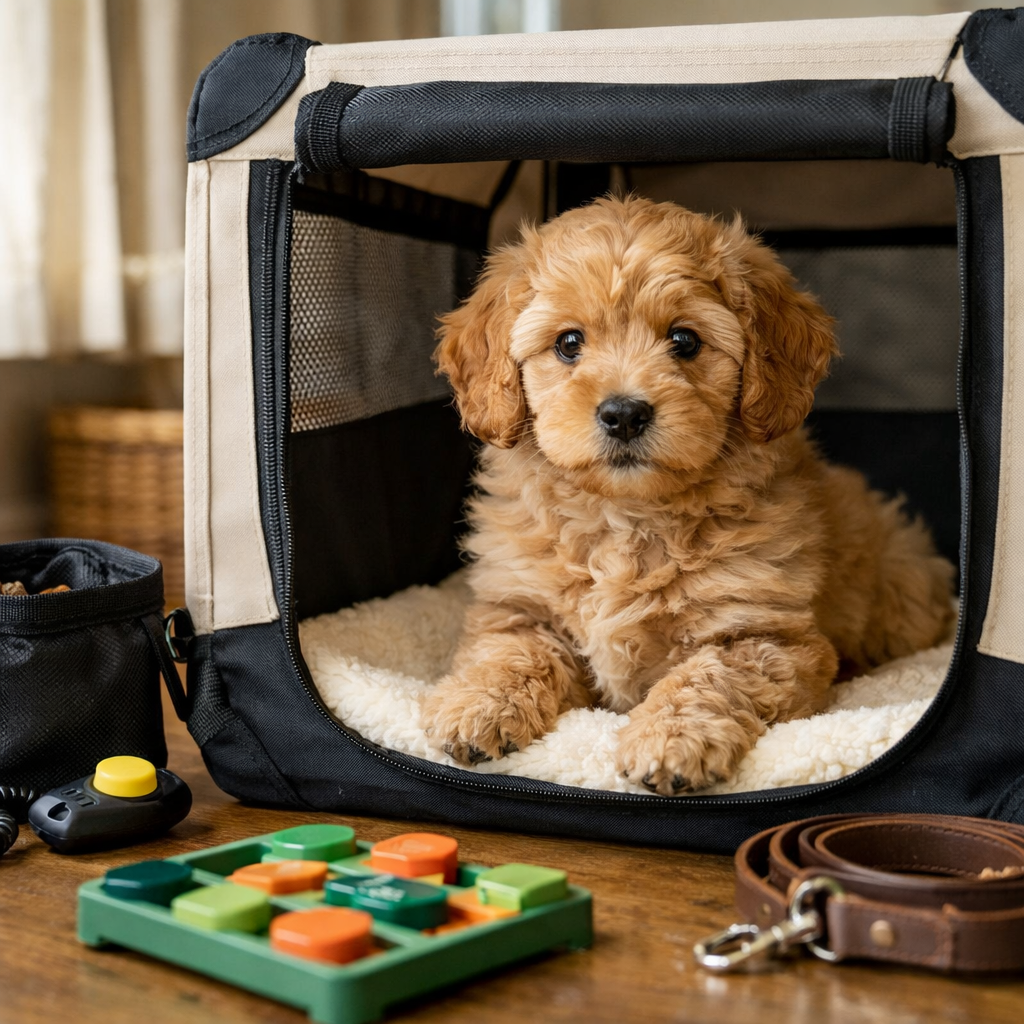
- Crate training (start at the breeder, continue day one home)
- House training (use the schedule established by the breeder)
- Bite inhibition and impulse control
- Socialization — 100 new people, places, and surfaces by 16 weeks
- Basic obedience — sit, down, stay, recall, loose-leash walking
- Alone-time conditioning — gradually build up independent time
Designer Mini Doodles puppies arrive with ENS, early housebreaking, and early crate training already in progress, which dramatically shortens the transition to your home. Most families report their puppy is sleeping through the night within 3–5 days.
Best mini goldendoodle breeders near Birmingham
For Birmingham-area buyers, the most important factor isn’t geography — it’s the quality of the breeding program. Many top Alabama breeders are within a 2–3 hour drive of Birmingham, and others ship via puppy nanny. Designer Mini Doodles serves Birmingham, Hoover, Tuscaloosa, Montgomery, and the entire Southeast through our Alabama breeder program, plus we ship to Atlanta, Nashville, and beyond via flight nanny.
When narrowing Birmingham-area options, prioritize:
- Health-tested parents (publicly verifiable)
- Small annual litter count
- ENS and early training protocols
- Lifetime return policy
- Transparent contract terms
If you’re comparing programs across state lines, see our Tennessee and Georgia breeder pages for nearby reputable options.
Why Designer Mini Doodles is different
Our program is led by an animal biologist with over a decade and a half of dedicated mini and micro goldendoodle breeding experience. We’re not a “we love dogs” hobby kennel — we built a science-backed breeding system focused on temperament, structural soundness, and predictability.
What sets the program apart:
- ENS protocol from day 3 to 16
- Early housebreaking starts in the whelping room with potty pad separation
- Early crate training begins at 5 weeks
- Structured socialization with Rule of 7s before puppies go home
- Full health panel on both parents (OFA + DNA)
- Lifetime breeder support for every puppy family
- Toy goldendoodle puppies for sale alongside mini and micro lines
- Puppy nanny service to any home worldwide
We also offer mini french bulldog puppies through our sister program for families who prefer a smaller, lower-energy breed.
For our Alabama service area, visit our micro goldendoodle puppies availability page or browse the miniature goldendoodle breeders program overview.
FAQ
Do you ship mini goldendoodle puppies outside Alabama?
Yes. We ship anywhere in the world via dedicated puppy nanny service, including cabin flight nannies for premium care during transit.
At what age can I bring my puppy home?
Puppies are released at 8 weeks minimum, never earlier. This is both ethical and required by most state laws.
Do you offer toy goldendoodle puppies for sale?
Yes. We offer toy goldendoodles (8–14 lbs adult), micro mini goldendoodles (10–20 lbs), and standard mini goldendoodles (15–35 lbs).
What’s the waitlist like for an Alabama mini goldendoodle?
Typically 3–9 months depending on color, size, and generation preferences. Specific coat patterns like phantom or merle can be longer.
Are mini goldendoodles good apartment dogs?
Yes, especially the micro and toy sizes. See our apartment and urban living guide.
How often does a mini goldendoodle need grooming?
Professional grooming every 6–8 weeks, plus brushing 3–4 times per week at home to prevent matting.
Do you require a deposit?
Yes. A refundable holding deposit secures your spot on a specific litter once health-tested parents have been confirmed.
What’s included in the puppy package?
Vet records, vaccinations to date, microchip, dewormings, ENS log, starter food, blanket with mother’s scent, health guarantee, and lifetime breeder support.
Can I see the parent dogs?
Yes. We offer in-person visits by appointment and live video tours for out-of-state families.
Conclusion: Next Steps for Alabama Buyers
Choosing among mini goldendoodle breeders Alabama families trust comes down to three things: verifiable health testing, structured early-life programming, and transparent contracts. Skip anyone who can’t produce all three.
Your action plan:
- Decide on size (toy, micro, or mini) and generation (F1, F1B, multigen)
- Set your budget — plan for $3,000–$5,500 plus year-one care of around $2,500
- Vet the breeder using the red-flag and green-flag lists above
- Verify health clearances on the OFA public database
- Reserve early — quality breeders book out 3–9 months
- Prepare your home — crate, gear, and vet selected before pickup day
To start the process with our Alabama program, visit our Alabama mini goldendoodle breeders page or browse current availability across our micro golden doodle puppies program. We’d love to help you find the right puppy for your family — whether you’re in Alabama or anywhere in the world.
Sources
- Orthopedic Foundation for Animals (OFA) breed health statistics — ofa.org
- Goldendoodle Association of North America (GANA) breed standards, 2024 — goldendoodleassociation.com
- American Veterinary Medical Association cost-of-ownership data, 2024 — avma.org