
Last updated: July 9, 2026
Toy Poodles for sale
Breeder directories vet individual breeders for health testing and ethical standards before listing them, while large adoption marketplaces aggregate thousands of listings with minimal screening. When searching for Toy Poodle puppies for sale by state, the channel you choose directly affects the health guarantees, pricing transparency, and post-purchase support you receive. Breeder directories typically cost more but offer stronger buyer protections, while marketplaces provide wider selection and faster results across all 50 states.
Toy Poodles for sale
- Breeder directories like Good Dog and the Poodle Club of America pre-screen breeders for health testing, breeding ethics, and facility standards before allowing listings [1][7].
- Large marketplaces such as Puppies.com and Petfinder cast a wider net, listing puppies from breeders, rescues, and private sellers nationwide with less individual vetting [2].
- Toy Poodle puppy prices in 2026 range from roughly $1,450 to over $9,800, depending on breeder reputation, coat color, lineage, and state [4].
- A legitimate Toy Poodle breeder should provide OFA or PennHIP results, a written health guarantee, and AKC or UKC registration paperwork [3].
- Meeting a breeder in person (or via live video) before purchasing remains the single best way to avoid scams and puppy mills.
- Rescue and adoption sites typically charge $150 to $600, but purebred Toy Poodle availability is limited and unpredictable.
- Always verify a breeder’s claims independently through the OFA database, AKC records, or breed club referral lists.
What Is the Difference Between Buying From a Breeder Directory vs. PuppyFind or AKC Marketplace?
A breeder directory screens breeders before they can list puppies. A large marketplace lets almost anyone post a listing, then leaves the vetting to the buyer.
Here is how the two models break down in practice:
| Feature | Breeder Directory (e.g., Good Dog, PCA Referral) | Large Marketplace (e.g., Puppies.com, PuppyFind) |
|---|---|---|
| Breeder screening | Required before listing; health testing verified [1][7] | Minimal or self-reported |
| Number of listings | Smaller, curated pool | Thousands of listings nationwide [2] |
| Health guarantee info | Displayed on breeder profile | Varies by seller |
| Price transparency | Often shown with context | Listed but may lack context |
| Post-purchase support | Common; breeders often provide ongoing guidance [3] | Rare; buyer is on their own |
| Geographic reach | May focus on specific regions | Nationwide coverage [5] |
| Rescue/adoption listings | Sometimes included | Often included alongside breeder listings |
Breeder directories like Good Dog assign community ratings and require documentation of health screenings [1]. The Poodle Club of America’s referral program connects buyers only with breeders who follow the club’s code of ethics [7]. In contrast, large marketplaces prioritize volume and convenience, which means buyers must do more homework themselves.
Common mistake: Assuming that a listing on a well-known marketplace means the breeder has been vetted. Most large platforms disclaim responsibility for individual seller quality.
How Do I Find Reputable Toy Poodle Breeders in My State?
Start with breed club referral lists and vetted directories, then cross-reference what you find with independent health databases.
Here is a step-by-step approach:
- Check the Poodle Club of America’s breeder referral page. This lists breeders who have agreed to the club’s ethical guidelines [7].
- Search vetted directories. Good Dog rates breeders on health testing, breeding practices, and socialization protocols [1].
- Look for state or regional Poodle clubs. Many states have local chapters that maintain their own referral lists.
- Cross-reference with the OFA database. Search the breeder’s kennel name to confirm health testing claims.
- Ask your veterinarian. Local vets often know which breeders in the area produce healthy puppies consistently.
If you’re also considering Doodle breeds in your search, resources like state-specific breeder guides for Michigan or Pennsylvania can help you understand what quality breeding programs look like in those regions.
Choose a directory if you want pre-screened options and are willing to wait for a litter. Choose a marketplace if you need broader geographic coverage quickly, but plan to do your own thorough vetting.
What Should I Look for in a Toy Poodle Breeder to Avoid Puppy Mills?
A responsible Toy Poodle breeder will welcome questions, show health testing proof, and let you see where the puppies are raised. A puppy mill will rush the sale and discourage visits.
Red flags that suggest a puppy mill or backyard breeder:
- Multiple breeds available at all times
- Puppies always “in stock” with no waitlist
- No health testing documentation provided
- Unwillingness to let you visit or do a video call of the facility
- Pressure to pay immediately with no contract
- No questions asked about your home or lifestyle
Green flags that suggest an ethical breeder:
- Screens buyers with an application or interview
- Provides OFA, PennHIP, or CERF results for the sire and dam
- Offers a written health guarantee (typically one to two years) [3]
- Socializes puppies in a home environment from birth
- Stays in contact after the sale and offers take-back policies
For guidance on what responsible puppy-raising looks like from day one, see this resource on raising Toy and Teacup Poodle puppies from birth to eight weeks.
How Much Does a Toy Poodle Puppy Cost by State?
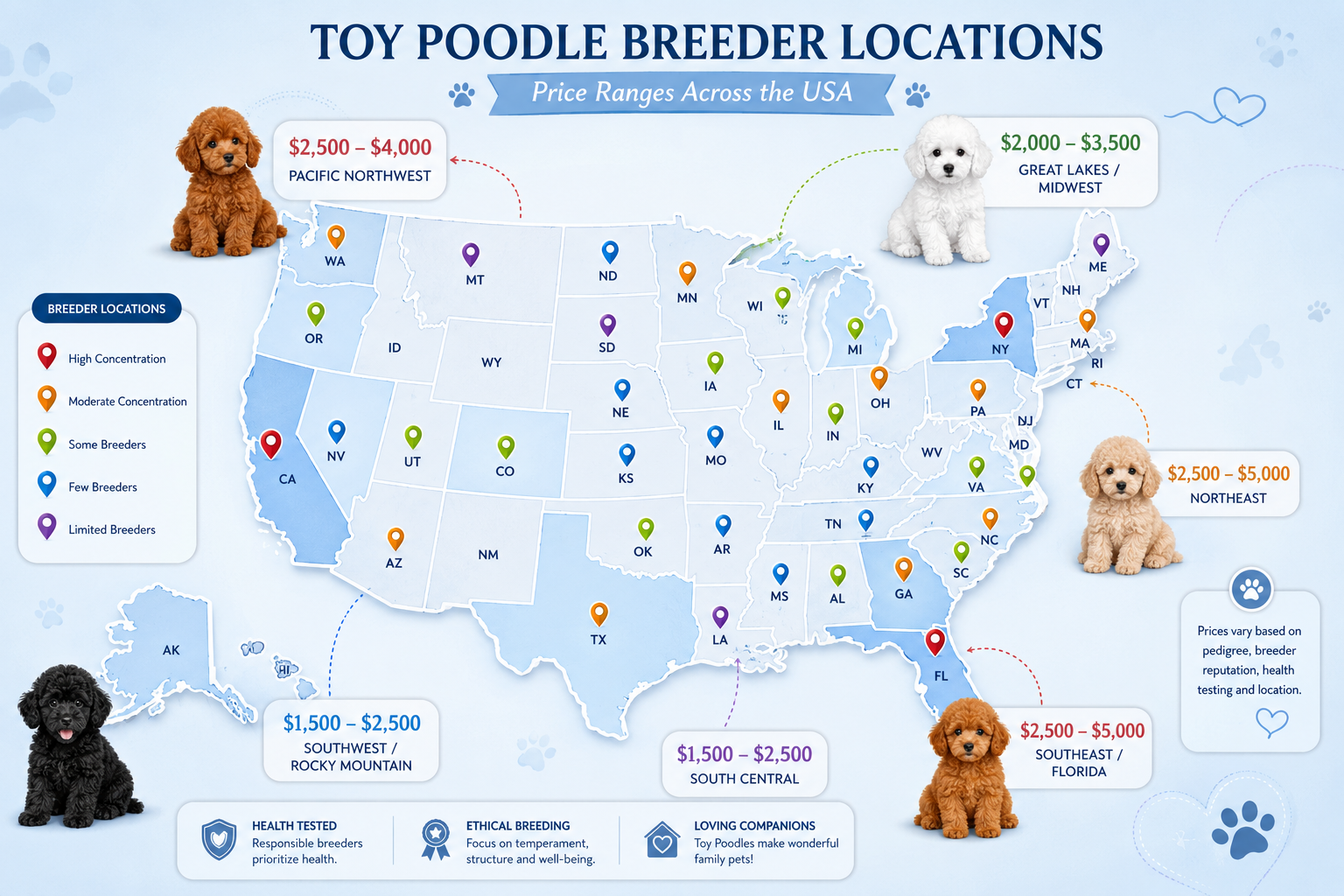
Toy Poodle puppy prices in 2026 generally range from $1,450 to $9,825, with most buyers paying between $2,000 and $4,000 for a health-tested puppy from a reputable breeder [4].
Several factors drive price differences by state:
- Cost of living. Breeders in California, New York, and Massachusetts tend to charge more due to higher overhead costs.
- Breeder reputation and health testing. Breeders who perform extensive genetic screening and compete in conformation charge premium prices.
- Coat color and lineage. Red, apricot, and parti-colored Toy Poodles often command higher prices than black or white puppies.
- Supply and demand. States with fewer breeders may see higher prices due to limited local availability.
| Region | Estimated Price Range |
|---|---|
| Northeast (NY, NJ, MA) | $2,500 – $6,000+ |
| Southeast (FL, GA, TN) | $1,800 – $4,500 |
| Midwest (MI, OH, IL) | $1,500 – $3,500 |
| West Coast (CA, WA, OR) | $2,500 – $5,500 |
| South/Southwest (TX, AZ) | $1,800 – $4,000 |
These ranges are estimates based on 2025-2026 marketplace listings [4] and may shift based on individual breeder programs.
If you’re exploring adorable Toy Poodle puppies for loving homes, comparing prices across multiple vetted sources will give you the most accurate picture for your area.
Are Toy Poodles From Adoption Sites Cheaper Than From Breeders?
Yes, adoption fees are significantly lower, typically $150 to $600 compared to $1,500 to $5,000+ from breeders. But availability of purebred Toy Poodles through rescue is limited and unpredictable.
Adoption pros:
- Much lower upfront cost
- You’re giving a dog a second chance
- Many rescue dogs are already spayed/neutered and vaccinated
Adoption cons:
- Purebred Toy Poodles are rarely available in rescue
- Limited or no health history for the dog’s parents
- Behavioral history may be incomplete
- Age, temperament, and background are sometimes unknown
A survey by the National Animal Interest Alliance found that 34% of respondents believe purchasing a dog rather than adopting is ethically wrong [6]. This cultural shift has increased demand at rescues, but it hasn’t increased the supply of purebred Toy Poodles available for adoption.
Decision rule: Choose adoption if you’re flexible on age, background, and exact breed characteristics. Choose a breeder if you need a puppy with documented health history, specific temperament traits, or a particular size range.
What Questions Should I Ask a Toy Poodle Breeder Before Buying?
Ask at least these ten questions before committing to any purchase. A good breeder will answer all of them without hesitation.
- What health tests have been performed on the sire and dam? (Ask for OFA or PennHIP numbers you can verify.)
- Can I see the health testing results and certificates?
- What is your health guarantee, and what does it cover? [3]
- Can I visit your facility or do a live video tour?
- How are the puppies socialized before going home?
- What is your return or take-back policy if I can no longer keep the dog?
- How many litters do you produce per year?
- What food and vaccination schedule do you follow?
- Can I speak with previous puppy buyers as references?
- What ongoing support do you provide after the sale?
Edge case: If a breeder refuses to answer any of these questions or gets defensive, walk away. Transparency is non-negotiable.
How Can I Tell if a Toy Poodle Breeder Is Legitimate or a Scam?
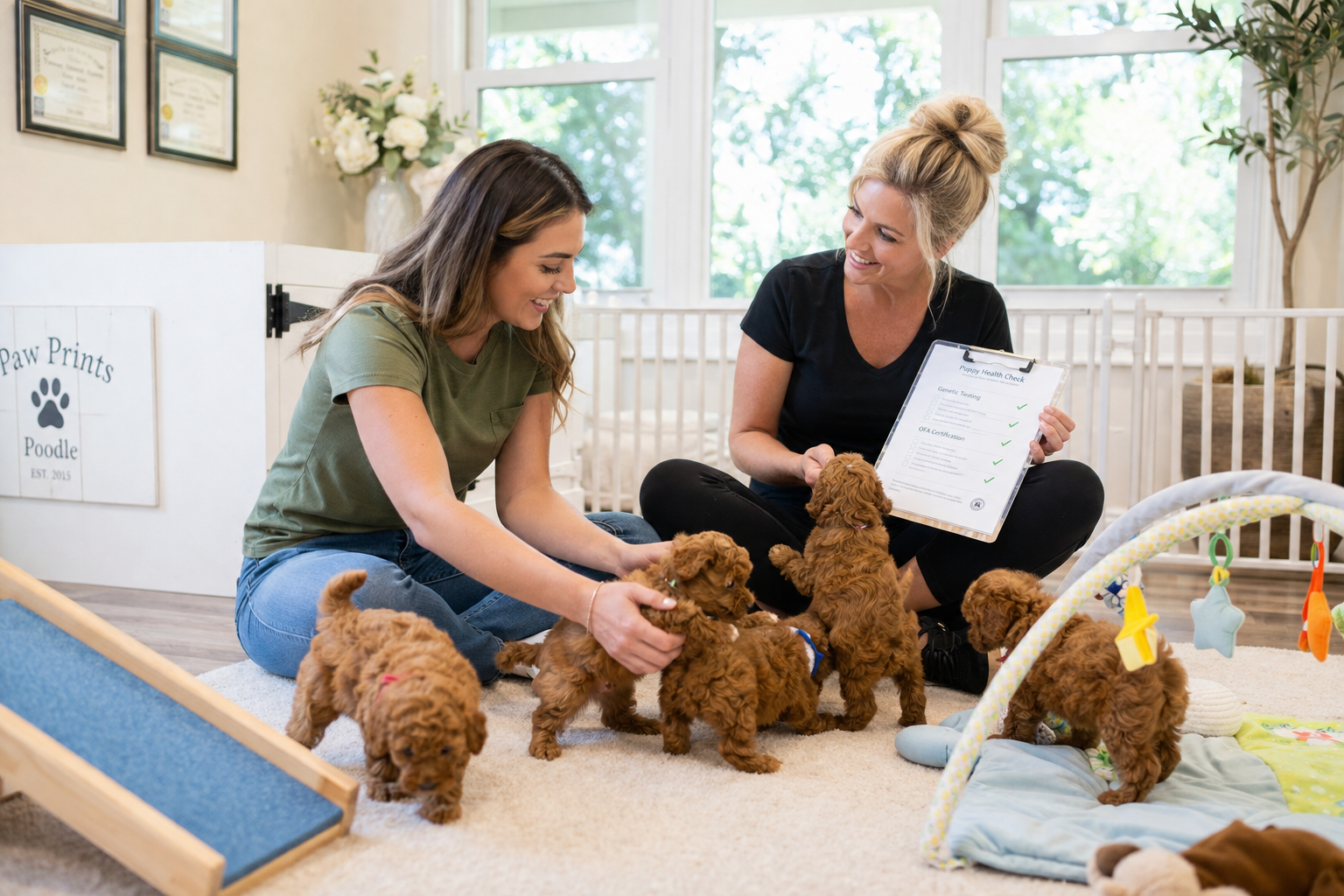
Verify independently. Never rely solely on what a breeder or listing platform tells you.
Steps to confirm legitimacy:
- Search the OFA database for the breeder’s kennel name and confirm health test results match what the breeder claims.
- Check AKC records to verify the breeder’s registration status.
- Look for the breeder on the Poodle Club of America’s referral list [7].
- Search online reviews on Google, Facebook, and breed-specific forums.
- Reverse image search puppy photos to see if the same images appear on multiple unrelated sites (a common scam tactic).
- Never wire money or pay through untraceable methods. Legitimate breeders accept checks, credit cards, or payment services with buyer protection.
Scam warning signs: Prices that are suspiciously low (under $800 for a “purebred” Toy Poodle), sellers who claim to be overseas, and anyone who asks you to pay before seeing the puppy or speaking on the phone.
How Do I Know if a Toy Poodle Breeder Directory Is Trustworthy?
A trustworthy directory clearly explains its vetting criteria and enforces them consistently.
Look for these features in a reliable directory:
- Published screening standards. Good Dog, for example, evaluates breeders on health testing protocols, breeding frequency, and socialization practices [1].
- Breed club affiliation. Directories connected to the Poodle Club of America or AKC follow established breed standards [7].
- Verified health testing. The directory should require proof, not just self-reported claims.
- Buyer reviews or ratings. Directories that allow buyer feedback provide an additional accountability layer.
- Complaint resolution process. A trustworthy platform has a system for handling disputes between buyers and breeders.
Directories with no clear vetting process are functionally the same as open marketplaces, regardless of what they call themselves.
What Health Issues Should I Screen for in Toy Poodle Puppies?
Toy Poodles are prone to several genetic and structural health conditions. Responsible breeders test for these before breeding.
Key health screenings for Toy Poodles include:
- Progressive Retinal Atrophy (PRA): A genetic eye disease that can lead to blindness. DNA testing identifies carriers.
- Patellar Luxation: A common knee condition in small breeds. OFA certification grades the severity.
- Legg-Calve-Perthes Disease: Degeneration of the hip joint, more common in toy breeds.
- Von Willebrand’s Disease: A blood clotting disorder. DNA testing is available.
- Dental issues: Toy breeds are prone to overcrowding and early tooth decay.
- Hypoglycemia: Especially in very small puppies during the first few months.
For a deeper look at what to watch for, this guide on common health concerns in Toy Poodle puppies covers prevention and early detection strategies.
Toy Poodle Puppy Health Guarantees: What Is Standard?
A standard health guarantee from a reputable Toy Poodle breeder covers genetic and congenital defects for one to two years [3]. Some breeders extend coverage to three years or offer lifetime guarantees on specific conditions.
A solid health guarantee should include:
- Coverage for genetic conditions diagnosed by a licensed veterinarian
- A clear timeline (minimum one year, ideally two)
- Options for replacement puppy or partial refund
- A requirement for the buyer to have the puppy examined by a vet within 48 to 72 hours of pickup
- Written documentation signed by both parties
What a health guarantee typically does NOT cover: Injuries, illnesses caused by neglect, conditions resulting from improper nutrition, or issues arising from failure to follow the breeder’s care instructions.
Should I Buy a Toy Poodle Puppy Online or Meet the Breeder in Person?
Meeting the breeder in person is always the safest option. If distance makes that impossible, a live video call of the facility and puppies is the next best thing.
Buying entirely online without any live interaction carries significant risk. Photos can be stolen, descriptions can be fabricated, and you have no way to assess the environment where the puppy was raised.
If you must buy remotely:
- Insist on a live video tour (not pre-recorded)
- Ask to see the dam with the litter
- Request references from previous buyers in your state
- Use a payment method with buyer protection
- Get a written contract before sending any money
For tips on preparing your home once the puppy arrives, see this guide on welcoming Toy Poodle puppies into your family routine.
What Paperwork and Certifications Should Come With a Toy Poodle Puppy?
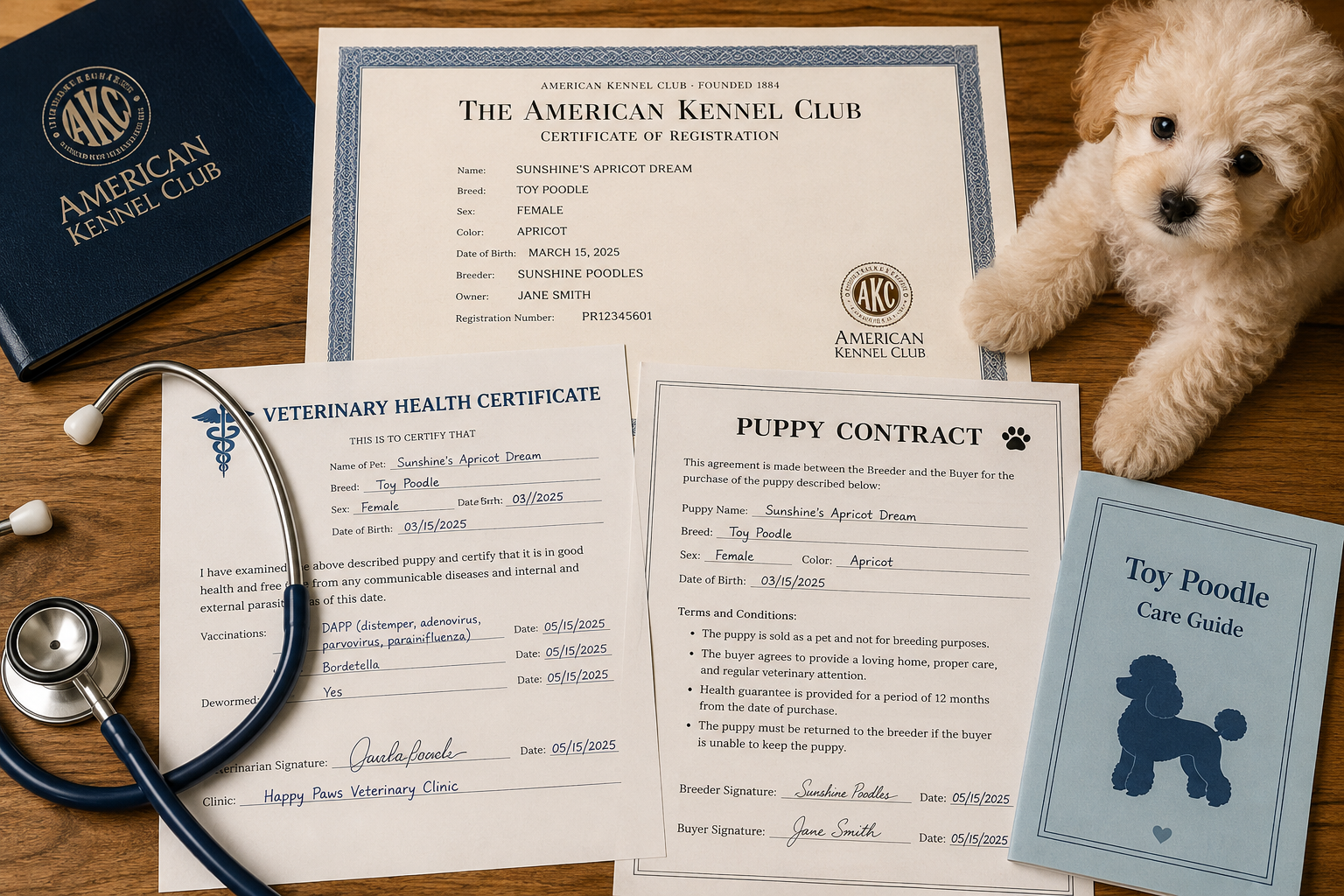
Every Toy Poodle puppy from a reputable breeder should come with a specific set of documents. Missing paperwork is a red flag.
Required documents:
- AKC or UKC registration papers (or application) [3]
- Written health guarantee with terms clearly stated
- Veterinary health certificate from a licensed vet confirming the puppy’s current health
- Vaccination records showing dates and types of vaccines administered
- Deworming history
- Health testing results for the parents (OFA, PennHIP, DNA panels)
- Microchip information (if applicable)
- Spay/neuter contract (common for pet-quality puppies)
- Feeding and care instructions
Some breeders also provide a puppy starter kit with food samples, a blanket with the litter’s scent, and a toy. While nice extras, these don’t replace the essential paperwork listed above.
Understanding long-term health and wellness planning for Toy Poodles will help you make the most of the health documentation your breeder provides.
Frequently Asked Questions
Is it safe to buy a Toy Poodle puppy from a website?
It can be, but only if you verify the breeder independently through health databases, breed club referrals, and live video interaction. Never send money based solely on a website listing.
How long is the typical waitlist for a Toy Poodle from a breeder directory?
Waitlists from reputable breeders listed on directories like Good Dog or the Poodle Club of America range from three months to over a year, depending on the breeder’s litter frequency and demand [1][7].
Do breeder directories charge buyers a fee?
Most breeder directories are free for buyers to browse. Some platforms charge breeders a listing or membership fee, which may be factored into puppy pricing.
Can I find a Toy Poodle puppy for under $1,000?
Purebred Toy Poodle puppies from health-tested parents rarely sell for under $1,000 in 2026. Prices below this threshold should prompt extra scrutiny, as they may indicate a puppy mill or scam [4].
What is the difference between AKC Marketplace and an independent breeder directory?
AKC Marketplace lists breeders who register litters with AKC but does not independently verify health testing or breeding practices. Independent directories like Good Dog conduct their own evaluations of each breeder [1].
Are Toy Poodles good for apartment living?
Yes. Toy Poodles typically weigh 4 to 6 pounds and adapt well to smaller spaces. For more on this topic, see this guide on Teacup and Toy Poodles for urban living.
Should I get pet insurance for a Toy Poodle puppy?
Pet insurance is strongly recommended for Toy Poodles due to their predisposition to certain genetic conditions. Enrolling within the first few weeks helps ensure pre-existing condition exclusions don’t apply.
How do I verify OFA health testing results?
Visit the OFA website (ofa.org) and search by the dog’s registered name or registration number. Results for hips, knees, eyes, and genetic tests are publicly available.
What happens if my Toy Poodle puppy gets sick right after purchase?
Most health guarantees require a vet exam within 48 to 72 hours. If a congenital issue is found, the breeder’s contract should outline your options for a refund, replacement, or veterinary cost reimbursement [3].
Do large marketplaces verify that breeders are licensed?
Most large marketplaces do not verify USDA licensing or state breeding permits. They may require breeders to self-certify compliance, but enforcement is limited [2].
Conclusion
The choice between a breeder directory and a large adoption marketplace comes down to how much vetting you want done for you versus how much you’re willing to do yourself. Breeder directories offer a curated, pre-screened experience with stronger health guarantees and ongoing support. Large marketplaces offer speed, volume, and nationwide reach but shift the responsibility for due diligence onto the buyer.
Actionable next steps:
- Start your search on the Poodle Club of America’s breeder referral page and Good Dog to find pre-screened breeders in your state.
- Cross-reference any breeder you find on a marketplace by checking OFA records and asking the ten essential questions listed above.
- Always request a live video tour or in-person visit before sending any payment.
- Collect and verify all required paperwork before bringing your puppy home.
- Budget realistically, accounting for the puppy price plus first-year veterinary costs, which typically add $1,000 to $2,000.
Whether you choose a directory, a marketplace, or a rescue, the effort you put into vetting the source directly determines the health and happiness of your future Toy Poodle.
References
[1] Good Dog – Toy Poodle Breeders – https://www.gooddog.com/poodle/size/toy?utm_source=openai
[2] Puppies.com – https://www.puppies.com/?utm_source=openai
[3] Royal Creek Toy Poodles – https://royalcreektoypoodles.com/?utm_source=openai
[4] MawooPets – Toy Poodle Puppies for Sale – https://www.mawoopets.com/puppies-for-sale/toy-poodle?utm_source=openai
[5] HonestPet Locations – https://www.honestpet.com/locations/?utm_source=openai
[6] What Really Happened To Purebred Breeders – Science Insights – https://scienceinsights.org/what-really-happened-to-purebred-breeders/?utm_source=openai
[7] Poodle Club of America – Breeder Referral – https://poodleclubofamerica.org/breeder-referral/?utm_source=openai