

Last updated: July 9, 2026
Quick Answer: Toy Poodle puppy socialization is the structured process of exposing a young Toy Poodle to new people, animals, sounds, surfaces, and environments during the critical developmental window of 3 to 14 weeks of age. Because Toy Poodles weigh only 4 to 6 pounds as adults, they are especially prone to fear-based behaviors if socialization is rushed, skipped, or poorly managed. The goal is brief, positive exposures that build confidence without overwhelming a small, sensitive puppy.
Key Takeaways
- The primary socialization window for Toy Poodle puppies closes around 14 weeks of age, making early, gentle exposure essential [1].
- The American Veterinary Society of Animal Behavior (AVSAB) recommends starting puppy socialization classes as early as 7 to 8 weeks, even before the full vaccine series is complete [1][6][9].
- Toy Poodles are intelligent and perceptive, which means they pick up on both positive and negative experiences quickly.
- Short sessions of 5 to 15 minutes work better than long outings for tiny puppies who tire and stress easily.
- Socialization is not just about meeting other dogs; it includes handling, sounds, surfaces, objects, and various types of people.
- Yes, over-socialization is real. Flooding a Toy Poodle puppy with too much stimulation can create the exact fear and anxiety the process is meant to prevent.
- Puppies that miss the critical window can still improve with patient counter-conditioning, though progress is slower.
- Puppy socialization classes typically cost between $100 and $250 for a multi-week course and offer controlled, size-appropriate interactions.
What Is Puppy Socialization and Why Does It Matter for Toy Poodles?
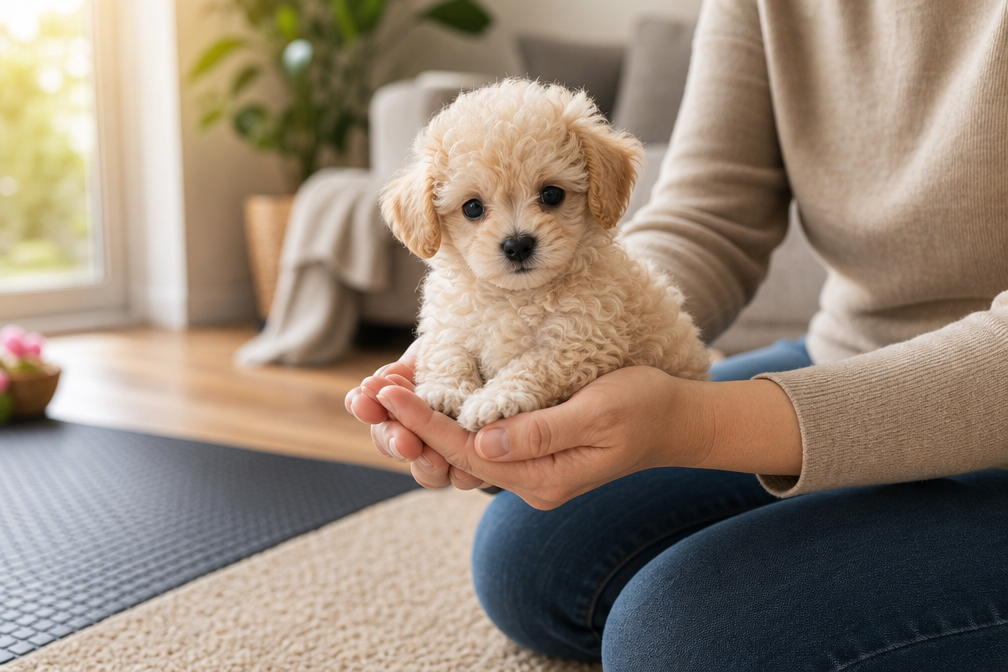
Puppy socialization is the deliberate, positive introduction of a young dog to the sights, sounds, textures, people, and animals it will encounter throughout its life. For Toy Poodles specifically, this process is critical because their small size makes the world feel much bigger and more threatening.
Toy Poodles that are not properly socialized often develop:
- Excessive barking at strangers, other dogs, or unfamiliar sounds
- Fear-based aggression, including nipping and snapping
- Trembling or hiding in new environments
- Separation anxiety when left alone (learn more about preventing separation anxiety in Toy Poodle puppies)
The AVSAB states that behavioral problems, not infectious diseases, are the number one cause of death for dogs under three years of age, largely because poorly socialized dogs are more likely to be surrendered or euthanized [1]. For a breed as sensitive and people-oriented as the Toy Poodle, early socialization is not optional; it is foundational.
Toy Poodles are ranked among the most intelligent dog breeds, which cuts both ways. They learn positive associations quickly, but they also remember frightening experiences with lasting clarity. A single bad encounter with a large dog or a loud noise during the critical period can shape behavior for years.
How Early Should I Start Socializing My Toy Poodle Puppy?
Start as early as 3 weeks with gentle handling and household sounds while the puppy is still with the breeder, and begin structured socialization experiences by 7 to 8 weeks of age [1][6].
The critical socialization window breaks down like this:
| Age Range | What to Focus On | Key Notes |
|---|---|---|
| 3-5 weeks | Gentle handling, littermate play, breeder interaction | Puppies are still with the breeder; early neurological stimulation helps |
| 5-7 weeks | Household sounds, different surfaces, brief human contact | Puppies begin exploring; keep experiences short and positive |
| 7-10 weeks | New people, safe environments, puppy classes, car rides | First vaccines should be given; socialization classes can begin [9] |
| 10-14 weeks | Broader exposure: urban sounds, other animals, grooming tools | Fear period may begin around 8-10 weeks; go slowly |
| 14-16 weeks | Continued reinforcement of earlier exposures | Window is closing; maintain positive associations |
Common mistake: Waiting until the full vaccine series is complete (around 16 weeks) before exposing a Toy Poodle puppy to the outside world. The AVSAB and AVMA both agree that the risk of behavioral problems from inadequate socialization far outweighs the relatively low risk of disease in controlled class settings [1][9]. Puppies should have at least one set of vaccines and a deworming, with no signs of illness, before attending classes [6].
If you're a first-time Toy Poodle owner, mark the 7-to-14-week window on your calendar and plan socialization activities for every day during this period.
Best Ways to Socialize a Toy Poodle Puppy Without Overwhelming Them
The best approach is brief, controlled, positive exposure sessions lasting 5 to 15 minutes, followed by rest. Toy Poodle puppies fatigue quickly, and a tired puppy is a stressed puppy.
The "3-3-3 Rule" for daily socialization goals:
- 3 new surfaces (grass, tile, metal grate, carpet, gravel, rubber mat)
- 3 new sounds (doorbell, vacuum at low volume from a distance, traffic noise from a recording)
- 3 new people or experiences (a person wearing a hat, a child sitting calmly, being touched on the paws)
Practical tips for keeping sessions positive:
- Always carry high-value treats (small, soft, easy to chew)
- Let the puppy approach new things at its own pace; never force contact
- Watch body language closely: ears back, tail tucked, yawning, or lip-licking all signal stress
- End every session on a positive note, even if it means cutting it short
- Use a calm, upbeat voice; avoid coddling fearful behavior, but also avoid correcting it
Decision rule: If the puppy freezes, trembles, or tries to flee, the stimulus is too intense. Increase distance, reduce volume, or remove the trigger entirely and try again later at a lower intensity.
For Toy Poodles living in apartments or cities, urban living socialization strategies can help structure exposure to elevators, street noise, and crowded sidewalks.
Toy Poodle Puppy Socialization Checklist: What Experiences Do They Need?
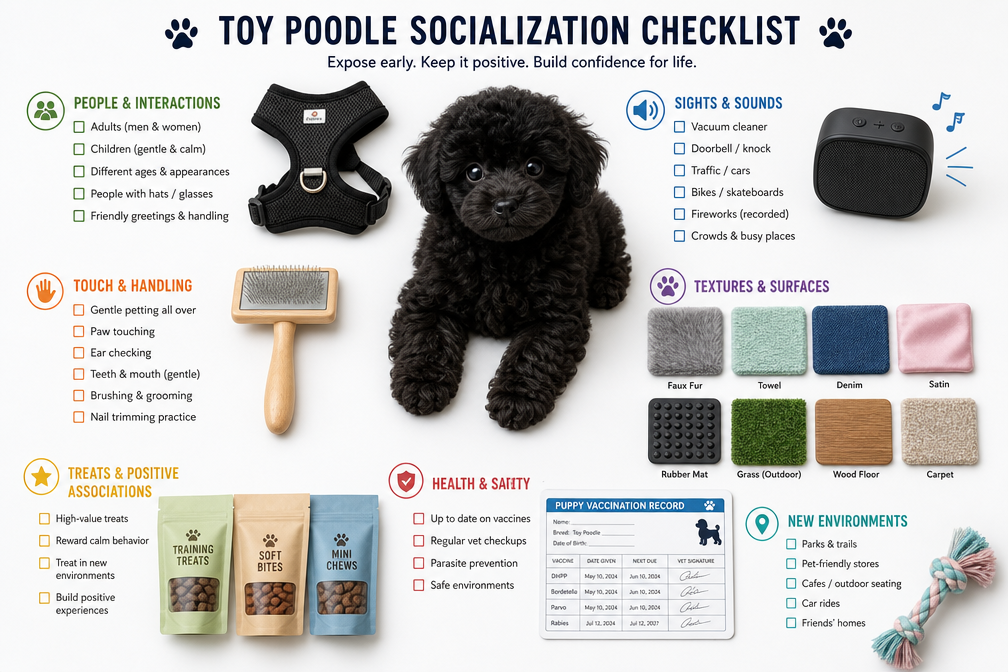
A well-socialized Toy Poodle puppy should have positive exposure to at least 100 different experiences before 16 weeks of age. Here is a practical checklist organized by category:
People (vary age, appearance, movement):
- Men with beards or deep voices
- Women with hats or sunglasses
- Children sitting quietly (not grabbing or chasing)
- People using walkers, wheelchairs, or crutches
- Delivery workers, veterinary staff
Surfaces and environments:
- Grass, gravel, sand, wet pavement
- Metal grates, rubber mats, wooden decks
- Slippery tile floors
- Stairs (carry the puppy on steep ones at first)
Sounds:
- Household appliances (vacuum, blender, hair dryer from a distance)
- Thunderstorm recordings at low volume
- Fireworks recordings at low volume
- Doorbells, car horns, sirens
Handling and grooming:
- Paw touching and nail trimming simulation
- Ear examination and gentle cleaning
- Mouth opening and tooth inspection
- Brushing and coat grooming practice
- Being picked up and held by different people
Animals:
- Calm, vaccinated adult dogs of various sizes
- Cats (behind a baby gate first)
- Exposure to animal sounds (birds, livestock recordings)
Objects:
- Umbrellas opening
- Balloons
- Bicycles and skateboards passing at a distance
- Shopping carts
Track progress with a simple spreadsheet or printed checklist. Mark each experience as positive, neutral, or needs-more-work.
How to Socialize Toy Poodle Puppies Safely Around Larger Dogs
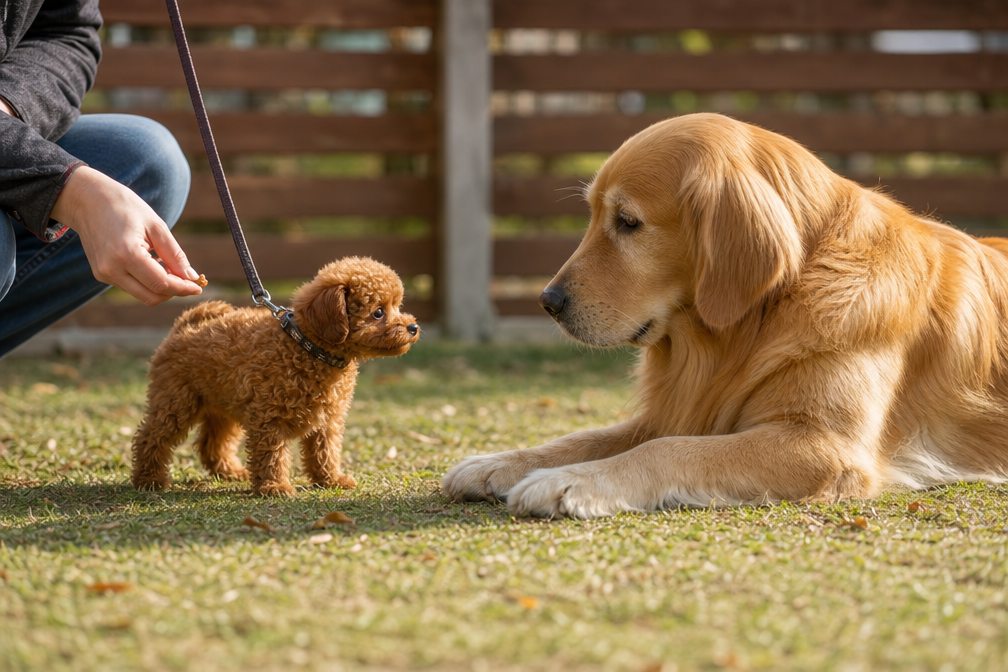
Toy Poodle puppies can and should meet larger dogs, but the interaction must be carefully managed because a single rough play session can cause physical injury or lasting fear.
Safety rules for size-mismatched introductions:
- Choose the right larger dog. The adult dog should be calm, well-socialized, and ideally experienced with small puppies. Avoid dogs with high prey drive or rough play styles.
- Use a barrier first. Let the dogs sniff through a baby gate or x-pen before any direct contact.
- Keep the larger dog on leash. Even a friendly large dog can accidentally step on or roll over a Toy Poodle puppy.
- Supervise every second. Do not look at your phone. Do not leave the room.
- Limit sessions to 3-5 minutes. End before either dog gets overstimulated.
- Reward calm behavior in both dogs. Treats for gentle sniffing, sitting, and relaxed body language.
Edge case: If the larger dog fixates on the puppy, pins it, or shows stiff body language with a high, rigid tail, separate them immediately. This is not play; it is predatory or dominant behavior that can traumatize a small puppy.
Puppy socialization classes that separate dogs by size are ideal for Toy Poodles. Many facilities offer small-breed-only sessions.
Toy Poodle Puppy Fear and Anxiety During Socialization: What's Normal?
Some fear is completely normal during socialization. Puppies go through two recognized fear periods: one around 8 to 10 weeks and another around 6 to 14 months. During these windows, a single negative experience can leave a lasting impression.
Normal fear responses include:
- Brief hesitation before approaching something new
- Startling at a sudden noise, then recovering within seconds
- Hiding behind the owner's legs, then cautiously re-emerging
- One or two stress signals (yawning, lip licking) that resolve quickly
Concerning fear responses include:
- Prolonged trembling that doesn't stop after the trigger is removed
- Refusal to eat treats in a new environment (indicates high stress)
- Panic behaviors: frantic pulling, screaming, attempting to escape
- Aggression (growling, snapping) toward non-threatening stimuli
What to do during a fear period: Reduce the intensity of socialization. Continue exposing the puppy to new things, but make every experience easier and more rewarding. Do not push through obvious fear, as this is called "flooding," and it backfires with sensitive breeds like Toy Poodles. Understanding Toy Poodle body language helps owners recognize stress signals early.
Can You Over-Socialize a Toy Poodle Puppy?
Yes. Over-socialization happens when a puppy is exposed to too many new experiences in too short a time without adequate rest and processing. Toy Poodles are particularly vulnerable because their small bodies tire faster and their nervous systems are easily overwhelmed.
Signs of over-socialization:
- The puppy becomes increasingly fearful rather than more confident over time
- Shutting down: the puppy goes limp, avoids eye contact, or seems "checked out"
- Increased reactivity (barking, lunging) after socialization outings
- Sleep disruption or loss of appetite
Prevention rule: One or two short, structured socialization experiences per day is enough for most Toy Poodle puppies. A full day at a farmer's market, a birthday party, and a trip to the pet store is too much for a 10-week-old puppy of any size, and especially for one that weighs two pounds.
Quality matters far more than quantity. Five calm, positive seconds near a skateboard is worth more than five stressful minutes of being held while skateboards whiz past.
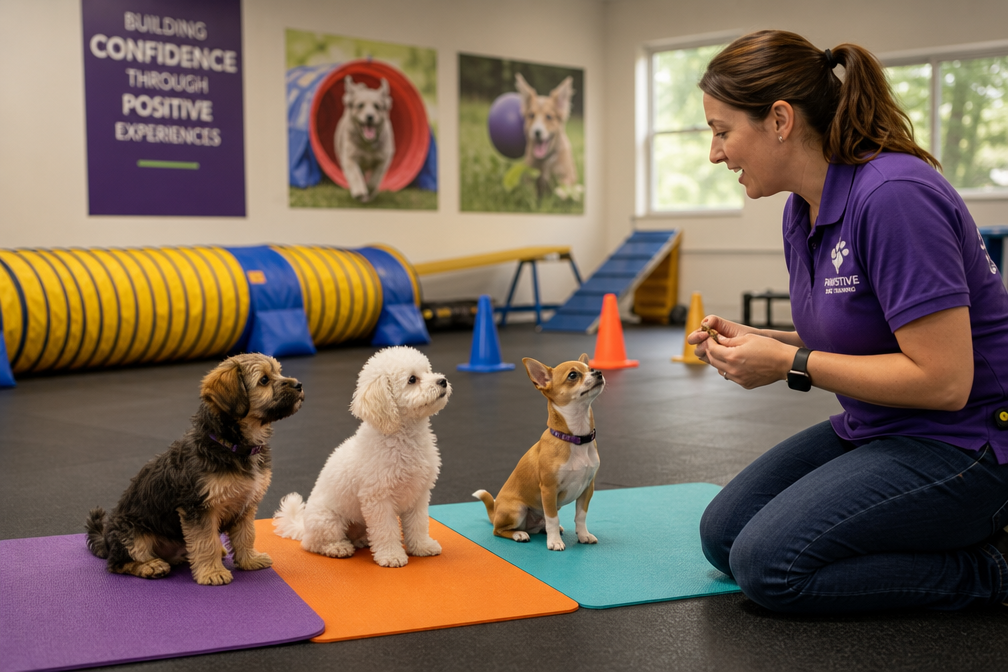
Toy Poodle Puppy Socialization Classes: Cost and Benefits
Structured puppy socialization classes typically cost between $100 and $250 for a 4-to-6-week course in 2026, depending on location and facility. Private sessions with a certified trainer range from $75 to $150 per hour.
Benefits of formal classes:
- Controlled environment with vaccinated, health-screened puppies
- Professional guidance on reading body language and managing interactions
- Exposure to other dogs, people, and novel objects in a safe setting
- Foundation for basic obedience training
What to look for in a class:
- Trainer credentials (CPDT-KA, KPA-CTP, or CAAB certification)
- Positive reinforcement methods only; avoid any trainer who uses punishment, choke chains, or dominance-based techniques [3]
- Small class sizes (6 to 8 puppies maximum)
- Size-appropriate groupings or separate small-breed sessions
- Clean, sanitized facility
What to avoid:
- "Puppy play time" with no structure or supervision
- Classes that allow large-breed puppies to play freely with Toy Poodle puppies
- Trainers who dismiss fearful behavior as "they'll get over it"
Search for classes through the Association of Professional Dog Trainers (APDT) directory or ask your veterinarian for local recommendations.
Signs Your Toy Poodle Puppy Is Not Well Socialized
A poorly socialized Toy Poodle will show predictable behavioral patterns that worsen without intervention. Recognizing these signs early allows for corrective action before behaviors become deeply ingrained.
- Excessive barking or growling at unfamiliar people, dogs, or objects
- Cowering or trembling in new environments, even after repeated visits
- Refusal to walk on leash in unfamiliar areas (learn leash training techniques to help)
- Snapping or biting when touched by strangers or during grooming
- Inability to settle in public spaces like outdoor cafes or veterinary waiting rooms
- Extreme attachment to one person with fear of everyone else
These behaviors are not personality traits. They are the result of insufficient or negative early experiences, and in most cases, they can be improved with structured counter-conditioning.
How to Help a Shy or Anxious Toy Poodle Puppy Gain Confidence
Building confidence in a shy Toy Poodle puppy requires patience, consistency, and a focus on letting the puppy make choices rather than forcing interactions.
Step-by-step confidence-building protocol:
- Identify the puppy's comfort zone. What environments, people, and situations does the puppy handle well? Start there.
- Use high-value treats. Reserve special treats (boiled chicken, freeze-dried liver) exclusively for socialization work.
- Practice "Look at That" (LAT). When the puppy notices a trigger (a stranger, a dog, a noise), mark the moment with a clicker or "yes" and reward. This teaches the puppy that noticing scary things predicts good things.
- Increase difficulty gradually. Move closer to triggers by one to two feet per session, only if the puppy remains relaxed.
- Create "safe base" experiences. Let the puppy observe the world from a carrier, a lap, or a raised surface where it feels secure.
- Pair new experiences with play. If the puppy loves a particular toy, bring it out only during socialization sessions.
Common mistake: Picking up a Toy Poodle every time it shows fear. This confirms to the puppy that the situation is dangerous. Instead, stay calm, keep feet on the ground, and let the puppy choose to move closer or retreat.
For puppies with gentle temperaments, such as apricot Toy Poodles known for their calm natures, the confidence-building process often progresses steadily with consistent daily practice.
Toy Poodle Puppy Socialization Mistakes to Avoid
Even well-intentioned owners make errors that set socialization back. Here are the most common mistakes specific to Toy Poodle puppies:
- Carrying the puppy everywhere. Toy Poodles need to walk on their own feet to build confidence. Use a carrier for safety in crowds, but let the puppy explore on the ground in controlled settings.
- Allowing strangers to grab or pick up the puppy. Teach visitors to let the puppy approach them, not the other way around.
- Skipping sound desensitization. Many Toy Poodles develop noise phobias because owners focus only on social exposure and neglect sounds [10].
- Using punishment for fearful behavior. Scolding a puppy for barking at a stranger makes the puppy associate strangers with punishment, increasing fear [3].
- Socializing only with other small dogs. The puppy needs to learn that large dogs exist and are not all threats.
- Waiting too long to start. Every week past 14 weeks makes socialization harder, not impossible, but harder [1].
- Treating socialization as a one-time event. Socialization is ongoing through adolescence and into adulthood.
Socializing Toy Poodle Puppies With Children and Other Pets
Toy Poodle puppies can thrive in homes with children and other pets, but introductions require strict management because of the puppy's fragile size.
With children:
- Children under 6 should interact with the puppy only while seated on the floor, with an adult within arm's reach
- Teach children to offer a closed fist for sniffing rather than reaching over the puppy's head
- No chasing, no picking up, no loud screaming near the puppy
- Reward the puppy for calm behavior around children with treats
With cats:
- Use a baby gate to allow visual and scent exposure without direct contact for the first 3 to 5 days
- Feed the puppy and cat on opposite sides of the gate to create positive associations
- Allow supervised, leashed introductions only after both animals show relaxed body language
With other household dogs:
- Follow the size-safety rules outlined above for larger dogs
- Allow the resident dog to set boundaries; a gentle correction (a growl or turning away) from an adult dog teaches the puppy social skills
- Never leave a Toy Poodle puppy unsupervised with a larger dog, even one that seems friendly
For households with multiple pets and busy activity levels, socializing Toy Poodles in busy households offers additional strategies for managing multi-pet dynamics.
What If Your Toy Poodle Puppy Had Limited Early Socialization?
Dogs that missed the critical socialization window can still make significant progress, but the process takes longer and requires more careful management. Counter-conditioning and systematic desensitization are the primary tools.
Realistic expectations by age:
- 4-6 months: Socialization is still very possible. The window is closing, but the brain remains highly plastic. Intensive, positive exposure can produce near-normal confidence levels.
- 6-12 months: Progress is slower. Focus on the specific triggers that cause the most fear. A certified behaviorist (DACVB or CAAB) may be helpful.
- Over 1 year: Behavior modification is still worthwhile, but some fears may never fully resolve. Management strategies (avoiding triggers, using a calming vest, medication in severe cases) may be needed alongside training.
Key principle: Never rush a dog that missed early socialization. Flooding an under-socialized adult Toy Poodle with stimulation will make things worse. Work at the dog's pace, celebrate small wins, and consult a professional if progress stalls.
Toy Poodle Puppy Socialization During Isolation: How to Adapt
Whether due to health restrictions, rural living, or a puppy recovering from illness, limited access to the outside world does not have to mean zero socialization.
At-home socialization strategies:
- Sound recordings: Play city sounds, thunderstorms, fireworks, and baby crying at low volume during feeding or play. Gradually increase volume over days.
- Texture stations: Create a mini obstacle course with bubble wrap, aluminum foil, a cookie sheet, a wet towel, and a cardboard box.
- Video calls: Hold the puppy near a screen during video calls so it sees and hears unfamiliar faces and voices.
- Visitor protocol: Even one new person per week, following proper introduction rules, makes a difference.
- Car rides: Drive the puppy around the neighborhood with the windows cracked. The sights, sounds, and smells provide passive socialization.
- Handling exercises: Practice veterinary exam simulations daily: touch ears, open mouth, hold paws, lift tail, press on belly.
These adaptations are not a perfect substitute for real-world exposure, but they keep the socialization process moving forward during periods when outings are limited.
Conclusion
Toy Poodle puppy socialization is a time-sensitive, structured process that directly determines whether a tiny dog grows into a confident, well-adjusted adult or a fearful, reactive one. The critical window between 3 and 14 weeks is short, and every positive experience during that period counts.
Actionable next steps:
- Start today. If the puppy is between 7 and 14 weeks, begin daily socialization sessions immediately, even if the full vaccine series is not complete [1][9].
- Print or create a checklist. Track exposure to people, sounds, surfaces, handling, and animals. Aim for variety, not volume.
- Enroll in a puppy class. Look for small-breed-friendly, positive-reinforcement-based classes with certified trainers.
- Watch the puppy, not the clock. End sessions when the puppy is still happy, not when the puppy is already stressed.
- Keep going past 16 weeks. Socialization is not a checkbox; it is a lifelong practice that requires ongoing reinforcement through adolescence and adulthood.
A well-socialized Toy Poodle is a joy to live with: calm in public, friendly with visitors, and confident in new situations. The investment of time and patience during the first few months pays dividends for the next 12 to 15 years.
Frequently Asked Questions
How many hours a day should I socialize my Toy Poodle puppy?
Two to three short sessions of 5 to 15 minutes each is sufficient for most Toy Poodle puppies. Total daily socialization time should not exceed 30 to 45 minutes, with rest periods between sessions.
Can my Toy Poodle puppy go to the dog park?
Dog parks are not recommended for Toy Poodle puppies under 6 months. The uncontrolled environment, unknown vaccination status of other dogs, and size mismatch with larger breeds create too much risk. Use structured puppy classes instead.
Is it safe to take my Toy Poodle puppy outside before all vaccinations are done?
Yes, with precautions. The AVSAB recommends socialization classes starting at 7 to 8 weeks with at least one vaccine and a deworming [1][6]. Avoid high-traffic dog areas like dog parks and pet stores, but controlled environments and private yards are appropriate.
My Toy Poodle puppy barks at everything. Is this a socialization problem?
Excessive barking at novel stimuli is a common sign of insufficient or negative socialization. It can also indicate a fear period. Increase positive exposure at a distance the puppy can handle without barking, and reward quiet, calm behavior.
How do I socialize my Toy Poodle puppy if I live alone and work from home?
Invite one or two friends over each week, take short car rides, play sound recordings during meals, and create texture stations at home. Even limited real-world exposure, combined with at-home exercises, makes a meaningful difference.
Should I let my Toy Poodle puppy "work it out" when it's scared?
No. Forcing a frightened puppy to endure a scary situation (flooding) increases fear and can cause lasting trauma. Instead, increase distance from the trigger, reduce intensity, and try again later at a level the puppy can handle.
What age is too late to socialize a Toy Poodle?
It is never truly "too late," but after 14 to 16 weeks, the process becomes slower and more difficult. Dogs over one year can still improve through counter-conditioning and desensitization, though some fears may require ongoing management.
Do Toy Poodles need more socialization than larger breeds?
Not necessarily more, but different. Their small size means everyday objects and situations feel more threatening. Owners also tend to carry them more, which reduces ground-level confidence. Toy Poodles need deliberate ground-level exposure that larger breeds get naturally.
How do I know socialization is working?
A well-socialized puppy recovers quickly from surprises, approaches new things with curiosity rather than fear, accepts handling without struggling, and can settle in new environments within a few minutes.
Can a professional trainer fix a poorly socialized adult Toy Poodle?
A certified behaviorist or trainer experienced with fear-based behaviors can make significant improvements. Look for credentials like DACVB, CAAB, or CPDT-KA. Severe cases may also benefit from veterinary-prescribed anti-anxiety medication alongside behavior modification.
References
[1] Puppy Socialization Position Statement Download 10 3 14 – https://avsab.org/wp-content/uploads/2018/03/Puppy_Socialization_Position_Statement_Download_-_10-3-14.pdf
[3] Avsab Humane Dog Training Position Statement 2021 – https://avsab.org/wp-content/uploads/2021/08/AVSAB-Humane-Dog-Training-Position-Statement-2021.pdf
[6] Avsab Position Puppy Socialization Should Start Vaccinations – https://www.dvm360.com/view/avsab-position-puppy-socialization-should-start-vaccinations
[9] Behavior Society Supports Early Puppy Socialization – https://www.avma.org/javma-news/2008-10-01/behavior-society-supports-early-puppy-socialization
[10] How To Train A Poodle Puppy Everything You Need – https://zigzag.dog/en-us/blog/puppy-training/how-to-train-a-poodle-puppy-everything-you-need/