

Last updated: July 9, 2026
Quick Answer: Toy Poodle puppies need 3 to 5 small meals per day of a high-quality, small-breed puppy formula that meets AAFCO nutritional standards. Portion sizes range from roughly 1/4 cup to 2/3 cup of dry food daily (split across meals), depending on age and weight. Because these puppies weigh as little as 1 to 2 pounds during early growth, they are at high risk for hypoglycemia, a dangerous drop in blood sugar that can cause seizures or worse if meals are skipped or spaced too far apart [2].
Key Takeaways
- Toy Poodle puppies under 4 months old should eat 4 to 5 small meals per day to keep blood sugar stable [2].
- Choose a puppy food labeled "complete and balanced" by AAFCO standards, ideally formulated for small or toy breeds [1].
- A puppy weighing 2 to 3 pounds needs roughly 200 to 300 calories per day; actual amounts vary by brand and activity level [3].
- Hypoglycemia is most dangerous between 6 and 12 weeks of age; know the warning signs (lethargy, trembling, disorientation) and keep a glucose supplement on hand [2].
- Treats should never exceed 10% of daily calories to avoid nutritional imbalances [4].
- Small-breed kibble is preferred because regular-sized pieces can be difficult for tiny mouths to chew [7].
- Transition from puppy food to adult food gradually around 10 to 12 months of age.
- Scheduled feedings beat free-feeding for weight management and housetraining success [6].
- Omega-3 fatty acids (DHA and EPA) support brain development, coat health, and joint function in growing puppies [1].
- Monitor body condition weekly and adjust portions so ribs are easily felt but not visible.
How Much Should I Feed My Toy Poodle Puppy Per Day?
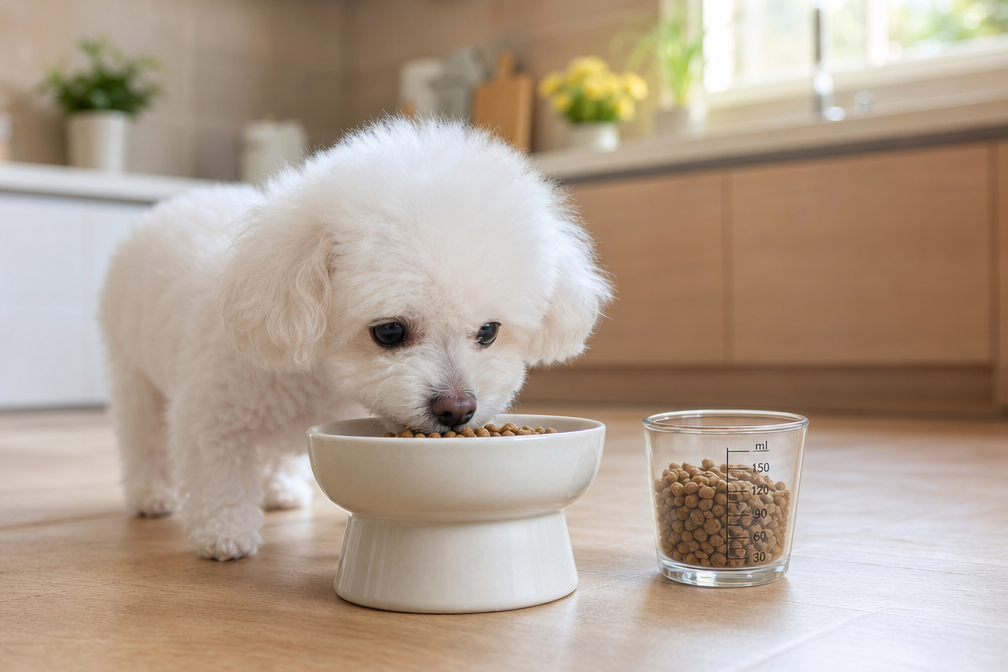
A Toy Poodle puppy typically needs between 200 and 400 calories per day, depending on age, current weight, and activity level. For dry kibble, that translates to roughly 1/4 cup to 2/3 cup daily, split across multiple meals [3].
Calorie needs change fast during the first year. A 2-pound, 8-week-old puppy burns calories at a much higher rate per pound of body weight than a 5-pound puppy approaching adulthood. Here's a general guideline:
| Puppy Weight | Estimated Daily Calories | Approximate Dry Food (per day) |
|---|---|---|
| 1 to 2 lbs | 150 to 250 | 1/4 to 1/3 cup |
| 2 to 3 lbs | 200 to 300 | 1/3 to 1/2 cup |
| 3 to 4 lbs | 250 to 350 | 1/2 cup |
| 4 to 6 lbs | 300 to 400 | 1/2 to 2/3 cup |
These are estimates based on average small-breed puppy formulas containing roughly 350 to 400 calories per cup. Always check the feeding chart on your specific food's packaging and confirm portions with your veterinarian [1].
Common mistake: Measuring by eye instead of using a kitchen scale or measuring cup. Even a tablespoon too much or too little matters when total daily intake is under a cup.
If you're new to raising a tiny breed, our guide for first-time toy poodle owners covers the broader picture of daily care.
Toy Poodle Puppy Feeding Schedule by Age
The number of meals per day should decrease as the puppy grows and its body becomes better at regulating blood sugar. Here is the recommended schedule [2]:
- 6 to 16 weeks (under 4 months): 4 to 5 meals per day, spaced roughly 3 to 4 hours apart during waking hours.
- 4 to 7 months: 4 meals per day.
- 7 to 9 months: 3 meals per day.
- 9 to 12 months: 2 to 3 meals per day.
- 12 months and older: 2 meals per day.
Sample schedule for a 10-week-old puppy:
- 7:00 AM – Breakfast
- 11:00 AM – Mid-morning meal
- 3:00 PM – Afternoon meal
- 7:00 PM – Dinner
- 10:00 PM – Small late snack (optional, especially for puppies under 12 weeks)
The late snack matters more than people realize. A tiny puppy that goes from 7 PM to 7 AM without food is fasting for 12 hours, and that gap alone can trigger a hypoglycemic episode. If your puppy is under 16 weeks, that bedtime snack is a safety measure, not a luxury.
Setting up a consistent routine also helps with housebreaking, since predictable meal times lead to predictable bathroom schedules.
What Nutrients Do Toy Poodle Puppies Need Most?
Toy Poodle puppies need a diet rich in high-quality animal protein, healthy fats, and specific micronutrients that support rapid growth in a very small body. The food must meet AAFCO standards for "growth" or "all life stages" [1].
Key nutrients to look for:
- Protein (minimum 22% for puppies): Supports muscle development and organ growth. Look for named animal proteins (chicken, turkey, salmon) as the first ingredient.
- Fat (minimum 8%, ideally 12 to 20% for toy breeds): Provides calorie density so puppies can meet energy needs without eating huge volumes.
- DHA and EPA (omega-3 fatty acids): Critical for brain and eye development, plus coat and skin health [1].
- Calcium and phosphorus: Must be in a balanced ratio (roughly 1.2:1) for proper bone development. Too much calcium can be as harmful as too little in small breeds.
- B vitamins and iron: Support energy metabolism, which is especially important for breeds prone to blood sugar drops.
- Fiber: A moderate amount aids digestion without reducing calorie density too much.
Decision rule: If the label says "complete and balanced for growth" and lists an AAFCO nutritional adequacy statement, it covers these bases. If it says "for supplemental feeding only," skip it as a primary food.
For long-term wellness planning, including how early nutrition affects later health, see our resource on senior health planning for toy poodles from puppyhood.
Toy Poodle Puppy Hypoglycemia Symptoms and Prevention
Hypoglycemia (low blood sugar) is the single biggest feeding-related emergency in toy breed puppies. It is most dangerous between 6 and 12 weeks of age but can occur in any Toy Poodle puppy under 6 months, especially those under 3 pounds [2].
Symptoms to watch for:
- Lethargy or unusual sleepiness
- Trembling or shivering that isn't from cold
- Wobbly, uncoordinated movement
- Glassy or unfocused eyes
- Refusal to eat
- Seizures (in severe cases)
- Loss of consciousness (medical emergency)
How to prevent low blood sugar in Toy Poodle puppies:
- Never skip meals. Stick to the age-appropriate feeding schedule above.
- Keep a glucose supplement handy. Nutri-Cal, Karo syrup, or honey can be rubbed on the gums if symptoms appear.
- Avoid overexertion. Long play sessions without a food break can deplete glucose stores fast.
- Monitor stress. Travel, vet visits, and new environments increase energy demand. Offer a small snack before and after stressful events.
- Don't let the puppy get too cold. Tiny bodies lose heat quickly, and shivering burns calories.
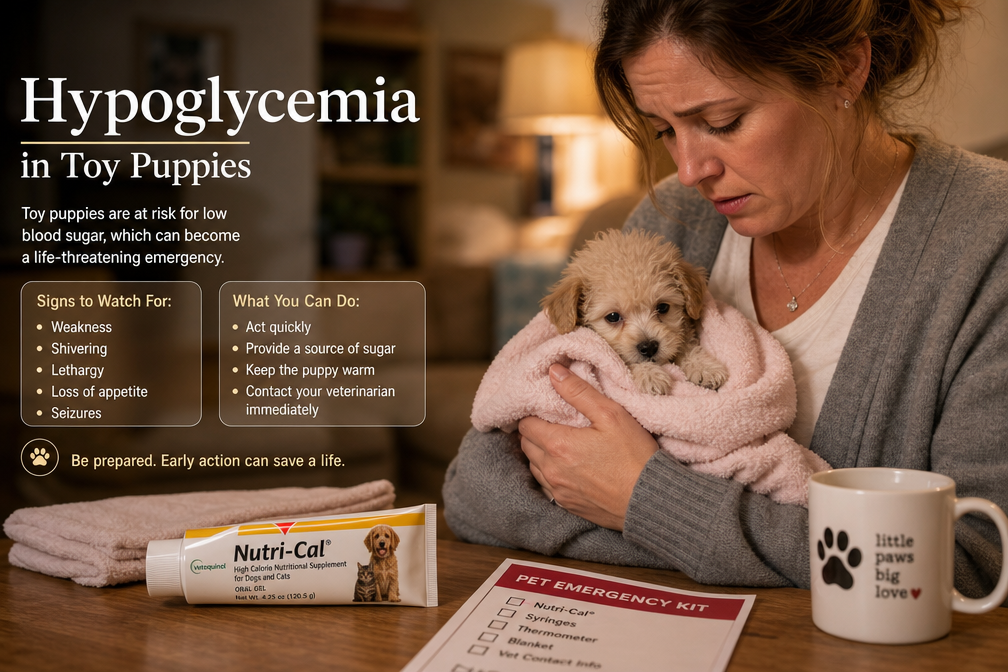
If your puppy shows signs of hypoglycemia: Rub a small amount of corn syrup or honey on the gums immediately, wrap the puppy in a warm blanket, and contact your veterinarian. Do not wait to see if symptoms improve on their own.
Keeping up with vaccinations and vet care ensures your veterinarian can also monitor for underlying conditions that mimic or worsen hypoglycemia.
Best Dog Food for Toy Poodle Puppies
The best food for a Toy Poodle puppy is a small-breed puppy formula from a reputable brand that meets AAFCO growth standards, uses named animal proteins, and includes DHA for brain development [1].
What to look for on the label:
- AAFCO statement confirming the food is formulated for "growth" or "all life stages"
- A named animal protein (not "meat meal" or "animal by-products") as the first ingredient
- Small kibble size designed for toy breeds [7]
- Added DHA/EPA from fish oil or similar sources
- No artificial colors, flavors, or preservatives
Brands commonly recommended by veterinarians for small-breed puppies include: Royal Canin X-Small Puppy, Hill's Science Diet Small Paws Puppy, Purina Pro Plan Small Breed Puppy, and Wellness Complete Health Small Breed Puppy. These brands conduct feeding trials and meet AAFCO standards through testing rather than formulation alone.
Edge case: If your puppy has food sensitivities (itching, loose stool, vomiting), a limited-ingredient diet or hydrolyzed protein formula may be needed. Work with your vet before switching to a specialty diet.
Can Toy Poodle Puppies Eat Regular Dog Food or Do They Need a Special Formula?
Toy Poodle puppies should not eat regular adult dog food. They need a puppy-specific formula, and ideally one designed for small or toy breeds [1]. Here's why:
- Calorie density: Small-breed puppy foods pack more calories per cup because tiny stomachs can't hold large volumes.
- Kibble size: Standard kibble is too large for a mouth that may be smaller than a human thumb [7].
- Nutrient ratios: Puppy formulas have higher protein and fat percentages, plus adjusted calcium-to-phosphorus ratios for growing bones.
- DHA content: Many adult foods lack the DHA levels needed for puppy brain development.
Choose small-breed puppy food if your Toy Poodle is under 12 months. Choose an all-life-stages formula if a puppy-specific option isn't available, but confirm it meets AAFCO growth standards. Avoid adult-only or large-breed puppy formulas entirely.
Wet Food vs. Dry Kibble for Toy Poodle Puppies
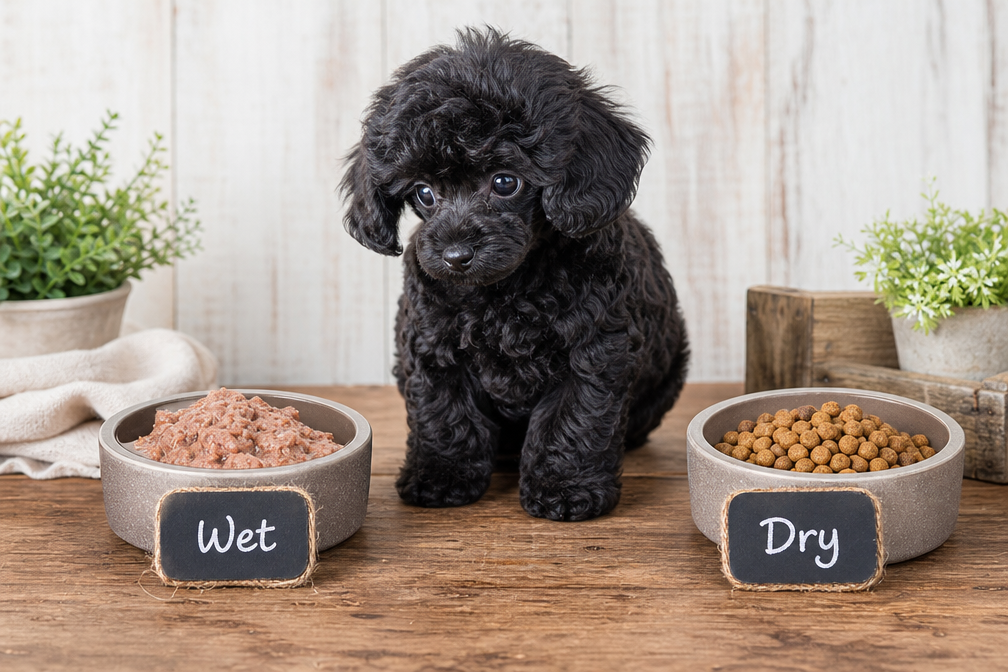
Both wet food and dry kibble can work for Toy Poodle puppies, and many owners find a combination of the two is the best approach.
| Factor | Dry Kibble | Wet Food |
|---|---|---|
| Calorie density | Higher per volume | Lower (75% water) |
| Dental benefit | Mild abrasive action on teeth | Minimal |
| Palatability | Moderate | High (strong aroma) |
| Convenience | Easy to measure, store, travel with | Requires refrigeration after opening |
| Hydration | Low moisture | Helps with hydration |
| Cost | Generally less expensive | More expensive per calorie |
Best practice: Use dry kibble as the base and mix in a spoonful of wet food to increase palatability, especially for picky eaters or puppies recovering from illness. If using both, reduce the kibble portion to account for the calories in the wet food.
For puppies with dental concerns, soaking dry kibble in warm water for 5 to 10 minutes softens it without sacrificing nutritional value.
Toy Poodle Puppy Portion Size Chart by Weight
This chart provides a more detailed breakdown of daily food amounts for Toy Poodle puppies at different growth stages. All amounts assume a standard small-breed puppy kibble with approximately 375 calories per cup [3] [5].
| Age | Expected Weight | Daily Calories | Daily Kibble (total) | Meals Per Day |
|---|---|---|---|---|
| 8 to 12 weeks | 1 to 2 lbs | 150 to 250 | 1/4 to 1/3 cup | 4 to 5 |
| 3 to 4 months | 2 to 3 lbs | 200 to 300 | 1/3 to 1/2 cup | 4 |
| 4 to 6 months | 2.5 to 4 lbs | 250 to 350 | 1/3 to 1/2 cup | 3 to 4 |
| 6 to 9 months | 3 to 5 lbs | 250 to 350 | 1/2 cup | 3 |
| 9 to 12 months | 4 to 6 lbs | 250 to 350 | 1/2 to 2/3 cup | 2 to 3 |
How to use this chart: Divide the total daily amount evenly across the number of meals. For example, a 3-month-old puppy eating 1/2 cup per day across 4 meals gets about 2 tablespoons per meal. Adjust up or down based on body condition, and always verify with your vet [5].
Toy Poodle vs. Chihuahua Puppy Feeding Differences
Both Toy Poodles and Chihuahuas are tiny breeds at high risk for hypoglycemia, but there are meaningful feeding differences.
- Metabolism: Chihuahua puppies tend to have slightly higher metabolic rates relative to body size, so they may need marginally more frequent meals in the earliest weeks.
- Growth curve: Toy Poodles typically reach adult weight (4 to 6 lbs) by 9 to 12 months. Chihuahuas may reach adult weight (2 to 6 lbs) slightly earlier, around 8 to 10 months.
- Food sensitivities: Chihuahuas are somewhat more prone to digestive upset from dietary changes. Toy Poodles tend to be slightly more adaptable but can be pickier eaters.
- Kibble size: Both need toy-breed-sized kibble, but Chihuahuas with apple-shaped heads and shorter muzzles may benefit from even flatter kibble shapes.
Bottom line: The core feeding principles (frequent small meals, AAFCO-compliant puppy food, hypoglycemia vigilance) are the same for both breeds. The main variable is individual puppy size and growth rate.
Toy Poodle Puppy Not Eating: What Should I Do?
A Toy Poodle puppy that refuses food for more than 6 to 8 hours needs immediate attention because of the hypoglycemia risk. Here's a step-by-step approach:
- Rule out illness. Check for lethargy, vomiting, diarrhea, or fever. If any are present, call the vet immediately.
- Check the food. Has the bag been open too long? Is the food stale or a new brand? Puppies notice changes in smell and texture.
- Warm the food slightly. Microwaving wet food for 5 to 10 seconds or adding warm water to kibble releases aromas that stimulate appetite.
- Reduce distractions. Feed in a quiet, calm area. A stressed or overstimulated puppy may refuse to eat.
- Try a food topper. A small amount of low-sodium chicken broth, a spoonful of wet food, or a sprinkle of freeze-dried protein can make meals more appealing.
- Offer a glucose supplement. If the puppy hasn't eaten in several hours and seems lethargic, rub a pea-sized amount of corn syrup on the gums and head to the vet.
When to worry: Any puppy under 4 months that skips two consecutive meals should be seen by a veterinarian the same day. For puppies over 4 months, appetite loss lasting more than 24 hours warrants a vet visit.
Stress from environmental changes can also cause appetite loss. If your puppy recently arrived home, our guide on crate training toy poodle puppies can help create a calm, secure space that encourages eating.
Toy Poodle Puppy Feeding Mistakes to Avoid
Even well-meaning owners make errors that affect their Toy Poodle puppy's health. Here are the most common ones:
- Free-feeding (leaving food out all day). This makes it impossible to track intake and increases obesity risk. Scheduled meals are always better for toy breeds [6].
- Overfeeding treats. Treats should be no more than 10% of daily calories. For a puppy eating 250 calories a day, that's only about 25 calories in treats, roughly 2 to 3 small training treats [4].
- Switching foods abruptly. Any diet change should happen gradually over 7 to 10 days, mixing increasing amounts of new food with the old.
- Feeding table scraps. Many human foods (grapes, onions, chocolate, xylitol) are toxic to dogs. Even safe foods can unbalance a carefully portioned diet.
- Using large-breed puppy food. These formulas have different calcium and calorie profiles that are wrong for toy breeds.
- Ignoring weight changes. Weigh your puppy weekly on a kitchen scale. A sudden drop or rapid gain signals a feeding problem.
- Spacing meals too far apart. This is the most dangerous mistake for toy breed puppies and the fastest path to a hypoglycemic episode.
When Can Toy Poodle Puppies Transition to Adult Food?
Most Toy Poodles can switch from puppy food to adult food between 10 and 12 months of age. Small breeds mature faster than large breeds, so the transition happens earlier than it would for, say, a Labrador.
How to transition safely:
- Days 1 to 3: 75% puppy food, 25% adult food
- Days 4 to 6: 50% puppy food, 50% adult food
- Days 7 to 9: 25% puppy food, 75% adult food
- Day 10 onward: 100% adult food
Watch for digestive upset (soft stool, gas, vomiting) during the transition. If symptoms appear, slow down and extend the transition to 14 days.
Choose adult food if your puppy has reached its expected adult weight and your vet confirms growth plates are closing. Stay on puppy food if the puppy is still visibly growing or underweight.
For information on how skin and coat health connects to nutrition during this transition period, see our dedicated guide.
Frequently Asked Questions
How many calories does a Toy Poodle puppy need per day?
Most Toy Poodle puppies need between 150 and 400 calories daily, depending on age and weight. A 2-pound puppy at 8 weeks needs roughly 150 to 250 calories, while a 5-pound puppy at 10 months needs closer to 300 to 350 calories [3].
Can I feed my Toy Poodle puppy raw food?
Raw diets are controversial for any puppy, but they carry extra risk for toy breeds because of bacterial contamination and the difficulty of balancing nutrients in very small portions. Most veterinarians recommend commercially prepared, AAFCO-compliant puppy food instead [1].
How do I know if my Toy Poodle puppy is overweight?
Run your hands along the ribcage. The ribs should be easily felt with a thin layer of fat covering them. If you can't feel ribs without pressing, reduce portions slightly. If ribs are visible, increase food. Weigh weekly and track trends [5].
What should I do if my puppy has a hypoglycemic episode?
Rub corn syrup, honey, or Nutri-Cal on the gums immediately. Wrap the puppy in a warm blanket and contact your veterinarian right away. Do not force food or water into the mouth of a disoriented or seizing puppy [2].
Are grain-free diets safe for Toy Poodle puppies?
The FDA has investigated a potential link between grain-free diets and dilated cardiomyopathy (DCM) in dogs. Until more is known, most veterinary nutritionists recommend grain-inclusive diets for puppies unless a specific allergy has been diagnosed.
How much water should a Toy Poodle puppy drink?
A general guideline is about 1/2 to 1 ounce of water per pound of body weight per day. A 3-pound puppy should drink roughly 1.5 to 3 ounces daily. Always provide fresh water, but monitor intake since excessive drinking can signal health issues.
Can I give my Toy Poodle puppy milk?
Cow's milk can cause diarrhea in puppies because most dogs are lactose intolerant after weaning. If supplemental feeding is needed for very young puppies, use a canine milk replacer, not dairy milk.
What treats are safe for Toy Poodle puppies?
Small, soft training treats, tiny pieces of cooked chicken or turkey, blueberries, and small bits of banana are generally safe. Avoid rawhide, large chews, and anything containing xylitol [4].
Should I add supplements to my puppy's food?
If the food meets AAFCO standards for growth, additional supplements are usually unnecessary and can cause imbalances. The exception is if your vet specifically recommends a supplement, such as a probiotic for digestive support [1].
How long should I soak kibble for a young puppy?
For puppies under 12 weeks, soaking kibble in warm water for 10 to 15 minutes makes it easier to chew and digest. Gradually reduce soaking time as the puppy's teeth develop, typically by 14 to 16 weeks.
Conclusion
Feeding a Toy Poodle puppy correctly is equal parts nutrition science and safety planning. These are among the smallest puppies in the canine world, and their tiny bodies leave almost no margin for error when it comes to blood sugar regulation and calorie intake.
Actionable next steps:
- Select a small-breed puppy food that meets AAFCO growth standards and features a named animal protein as the first ingredient.
- Set up a feeding schedule based on your puppy's age, starting with 4 to 5 meals per day for puppies under 4 months.
- Measure every meal with a proper measuring cup or kitchen scale. Eyeballing portions is too imprecise for a dog this small.
- Stock a glucose supplement (Nutri-Cal, corn syrup, or honey) and keep it accessible at all times during the first 6 months.
- Weigh your puppy weekly and adjust portions based on body condition, not just the chart on the bag.
- Schedule a vet visit within the first week of bringing your puppy home to confirm a personalized feeding plan.
Whether you're raising an apricot toy poodle or a black toy poodle, the feeding fundamentals remain the same: frequent meals, proper portions, quality ingredients, and constant vigilance against hypoglycemia. Get these right, and you're giving your puppy the strongest possible start.
References
[1] Toy Poodle – https://www.petmd.com/dog/breeds/toy-poodle
[2] What To Feed Puppy Based On Breed – https://www.akc.org/expert-advice/nutrition/what-to-feed-puppy-based-on-breed/
[3] Toy Poodle – https://www.plainbowl.com/breed/toy-poodle
[4] Feeding Toy Poodles – https://www.nahf.org/article/feeding-toy-poodles
[5] Feeding A Toy Poodle – https://www.bestiepaws.com/dog-food-review/feeding-a-toy-poodle/
[6] Puppy Feeding Guidelines – https://www.petco.com/content/content-hub/home/articlePages/new-pet/Puppy-Feeding-Guidelines.html
[7] Toy Poodle Food Diet – https://valivans.club/blog/toy-poodle-food-diet