
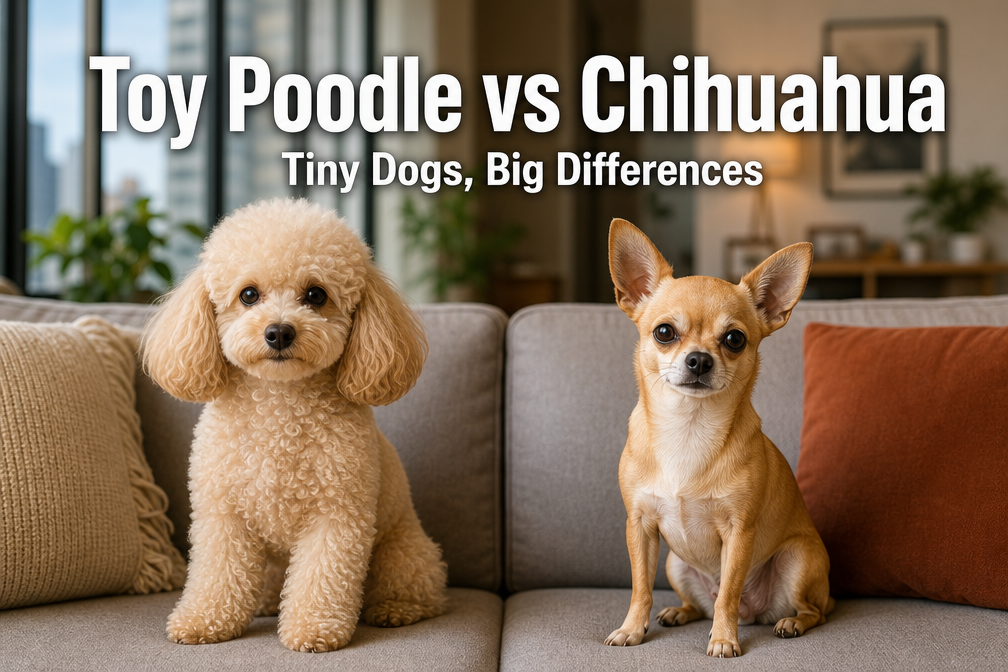
Last updated: July 9, 2026
Quick Answer
Toy Poodles and Chihuahuas are both popular tiny breeds, but they differ sharply in trainability, barking tendencies, grooming demands, and temperament. Toy Poodles are easier to train, shed less, and score higher for families with children, while Chihuahuas tend to bark more, live longer on average, and need far less grooming. Both score 5 out of 5 for apartment adaptability [2], so the right choice depends on your lifestyle, patience for training, and tolerance for barking.
Key Takeaways
- Trainability: Toy Poodles rank among the most intelligent dog breeds and learn commands faster than Chihuahuas [1].
- Barking: Chihuahuas score 5/5 for barking frequency compared to 4/5 for Toy Poodles [2].
- Apartment living: Both breeds earn a perfect 5/5 adaptability score for apartments [2].
- Grooming: Toy Poodles need professional grooming every 4 to 6 weeks; smooth-coat Chihuahuas need minimal upkeep [4].
- Shedding: Toy Poodles shed very little (1/5), while Chihuahuas shed moderately (3/5) [4].
- Lifespan: Chihuahuas typically live 14 to 18 years; Toy Poodles average 12 to 15 years [2].
- Child-friendliness: Toy Poodles score 3/5 with kids versus 2/5 for Chihuahuas [4].
- Aggression: Chihuahuas rate higher for aggression (3/5) than Toy Poodles (2/5) [4].
- Cost: Both breeds range from $500 to $2,500+ depending on lineage, breeder reputation, and location.
- Energy: Toy Poodles have higher energy levels (4/5) and need more daily exercise than Chihuahuas (3/5) [4].
What’s the Difference Between a Toy Poodle and a Chihuahua?
These two breeds share a small frame but almost nothing else. Toy Poodles descend from water retrievers bred in Germany and refined in France, carrying a dense, curly, low-shedding coat and a strong work ethic. Chihuahuas trace their roots to ancient Mexico, sport either a smooth or long coat, and were bred primarily as companions.
Here’s a quick snapshot of the core differences:
| Trait | Toy Poodle | Chihuahua |
|---|---|---|
| Origin | Germany / France | Mexico |
| Weight | 4 to 6 lbs | 2 to 6 lbs |
| Height | Up to 10 inches | 5 to 8 inches |
| Coat type | Dense, curly, low-shedding | Smooth or long, moderate shedding |
| Intelligence ranking | Top 5 among all breeds | Moderate |
| Energy level | 4/5 | 3/5 |
| Lifespan | 12 to 15 years | 14 to 18 years |
Sources: [2] [4]
The Toy Poodle is an athlete in a small body. The Chihuahua is a loyal lap dog with a bold personality that far exceeds its size. Understanding this fundamental difference shapes every decision that follows, from training approach to daily routine.
Which Is Easier to Train: Toy Poodle or Chihuahua?
Toy Poodles are significantly easier to train. They consistently rank in the top five of canine intelligence assessments and show a strong eagerness to please, which accelerates learning [1]. Chihuahuas are smart but independent, and they often resist repetitive commands if they don’t see a clear benefit.
Why Toy Poodles excel at training:
- They respond well to positive reinforcement and clicker methods
- They pick up new commands in fewer repetitions
- They enjoy the mental stimulation that training provides [3]
Where Chihuahuas struggle:
- Stubbornness during housebreaking is common
- They may refuse commands from family members they haven’t bonded with
- Small bladder size makes potty training take longer in both breeds, but Chihuahuas are especially prone to indoor accidents
Decision rule: Choose a Toy Poodle if consistent, quick training progress matters to you. Choose a Chihuahua if you’re patient and willing to work through a slower, more relationship-dependent training process.
For practical tips on starting early, see our guide to crate training Toy Poodle puppies the positive way.
Do Toy Poodles Bark More Than Chihuahuas?
No. Chihuahuas bark more. On a standardized barking frequency scale, Chihuahuas score a maximum 5/5 while Toy Poodles score 4/5 [2]. Both breeds are vocal, but Chihuahuas bark at a wider range of triggers, including unfamiliar sounds, strangers, and even perceived changes in routine.
Toy Poodles bark for specific reasons: boredom, alerting to visitors, or seeking attention. Because they respond well to training, their barking can usually be redirected or reduced with consistent commands and mental enrichment [1].
Common mistake: Owners of both breeds sometimes inadvertently reinforce barking by picking the dog up or giving attention when it barks. This teaches the dog that barking produces rewards.
What helps reduce barking in both breeds:
- Early socialization with people, sounds, and environments [1]
- Structured daily routines that reduce anxiety
- Puzzle toys and mental stimulation activities to prevent boredom-driven noise
- Teaching a “quiet” command with positive reinforcement
Chihuahuas are among the most vocal small breeds. If low barking is a priority, the Toy Poodle is the better choice, though neither breed is silent.
Toy Poodle vs Chihuahua for Apartment Living
Both breeds earn a perfect 5/5 for apartment adaptability [2], and both do well in small spaces. But “apartment-friendly” doesn’t mean the same thing for each breed.
Toy Poodles in apartments:
- Need two 20- to 30-minute walks daily plus indoor play and training sessions [3]
- Their higher energy level (4/5) means they can get restless without enough activity
- Low shedding keeps apartments cleaner and suits allergy-sensitive households [4]
- They adapt well to urban living routines
Chihuahuas in apartments:
- Require less exercise overall (3/5 energy) [4]
- Their frequent barking (5/5) can cause noise complaints in buildings with thin walls [2]
- Moderate shedding means more frequent vacuuming, especially with smooth-coat varieties
- They handle smaller square footage well because of their tiny size
Choose the Toy Poodle if: your apartment building has noise restrictions or you have allergy concerns. Choose the Chihuahua if: you want a lower-energy companion and don’t mind managing barking.
How Much Do Toy Poodles and Chihuahuas Cost?
Purchase prices for both breeds vary widely based on breeder reputation, coat color, lineage, and location.
| Cost Category | Toy Poodle | Chihuahua |
|---|---|---|
| Purchase price (pet quality) | $1,000 to $2,500 | $500 to $1,500 |
| Purchase price (show quality) | $2,500 to $5,000+ | $1,500 to $3,000+ |
| Annual grooming | $600 to $1,200 | $50 to $200 |
| Annual vet care (routine) | $300 to $600 | $300 to $600 |
| Monthly food | $30 to $50 | $20 to $40 |
Note: These are estimated ranges based on 2026 market averages. Actual costs vary by region and breeder.
The biggest ongoing cost difference is grooming. Toy Poodles need professional grooming every 4 to 6 weeks, which adds up to $600 or more per year. Chihuahuas, particularly smooth-coat varieties, need very little professional grooming. For well-bred Toy Poodles with documented lineage, explore our puppies with outstanding pedigrees.
Which Breed Is Better for First-Time Dog Owners?
Toy Poodles are generally the better choice for first-time owners. Their eagerness to learn, lower aggression scores, and responsiveness to basic training make them more forgiving of beginner mistakes [1] [4].
Chihuahuas can work for first-time owners, but they demand more patience. Their stubbornness during training, higher barking frequency, and tendency toward one-person bonding can frustrate new dog owners who expect a consistently cooperative pet.
First-time owner checklist (either breed):
- Commit to early socialization before 16 weeks of age
- Budget for professional training classes
- Prepare for housebreaking challenges common to all toy breeds
- Learn to handle a small dog safely to avoid injury
Our detailed guide on Toy Poodles for first-time dog owners covers what to expect during the first year.
Toy Poodle vs Chihuahua Temperament and Personality
Toy Poodles are social, active, and eager to engage with their families. They bond with multiple household members and generally enjoy meeting new people after proper socialization. Chihuahuas are loyal, bold, and often fiercely attached to one person. They can be wary of strangers and may take longer to warm up in social situations.
Toy Poodle personality traits:
- Playful and energetic
- Enjoys learning tricks and tasks
- Bonds with the whole family
- Can develop separation anxiety if left alone too long [1]
Chihuahua personality traits:
- Confident and sometimes stubborn
- Deeply loyal to a primary person
- Suspicious of strangers
- Can be territorial despite small size
Both breeds can develop separation anxiety. Gradual desensitization to alone time and consistent daily routines help prevent this in either breed [1].
Are Chihuahuas or Toy Poodles More Aggressive?
Chihuahuas tend to show more aggressive behaviors. They score 3/5 on aggression scales compared to 2/5 for Toy Poodles [4]. This doesn’t mean every Chihuahua is aggressive, but the breed is more prone to snapping, growling, and resource guarding, especially when under-socialized.
Why Chihuahuas display more aggression:
- Their small size makes them feel vulnerable, triggering defensive behavior
- Owners often tolerate or find aggressive behaviors “cute” in tiny dogs, which reinforces them
- They bond intensely with one person and may guard that person from others
Edge case: A well-socialized Chihuahua raised with consistent boundaries can be perfectly gentle. And a poorly socialized Toy Poodle can develop fear-based aggression. Breed tendencies are starting points, not guarantees.
For households with other animals, learn more about raising Toy Poodles with other pets.
Toy Poodle Grooming vs Chihuahua Grooming Needs
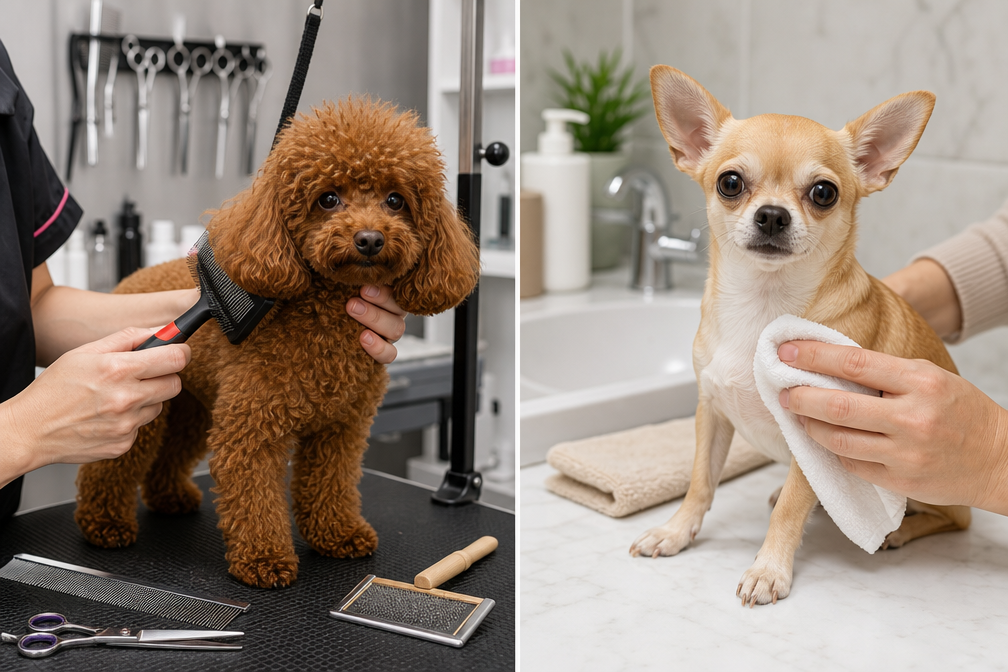
Toy Poodles require significantly more grooming than Chihuahuas. Their dense, curly coat doesn’t shed much (1/5) but mats quickly without regular brushing and professional trimming every 4 to 6 weeks [4]. Chihuahuas, especially smooth-coat varieties, need only occasional brushing and bathing.
Toy Poodle grooming routine:
- Daily or every-other-day brushing to prevent mats
- Professional grooming every 4 to 6 weeks ($50 to $100 per session)
- Regular ear cleaning (floppy ears trap moisture)
- Dental care (small breeds are prone to dental disease)
Chihuahua grooming routine:
- Weekly brushing for smooth coats; twice weekly for long coats
- Bathing every 3 to 4 weeks
- Nail trimming every 2 to 3 weeks
- Dental care (also prone to dental issues)
Decision rule: If you want a low-shedding dog and don’t mind the grooming investment, choose the Toy Poodle. If you want minimal grooming hassle, the smooth-coat Chihuahua wins easily. For coat care tips, see our resource on best grooming practices for Toy Poodle coats.
Which Breed Lives Longer: Toy Poodle or Chihuahua?
Chihuahuas generally live longer. Their average lifespan is 14 to 18 years, compared to 12 to 15 years for Toy Poodles [2]. Both breeds are among the longest-lived dog breeds, and individual longevity depends heavily on genetics, diet, veterinary care, and lifestyle.
Toy Poodle vs Chihuahua Size and Weight
Toy Poodles stand up to 10 inches tall and weigh 4 to 6 pounds. Chihuahuas are slightly smaller, standing 5 to 8 inches and weighing 2 to 6 pounds [2]. Both breeds are fragile and can be injured by rough handling, falls from furniture, or accidental stepping.
Can Toy Poodles and Chihuahuas Live Together?
Yes, but introductions must be gradual and supervised. Toy Poodles’ social nature pairs reasonably well with Chihuahuas, but the Chihuahua’s territorial tendencies (3/5 aggression) can create friction [4]. Success depends on early socialization of both dogs, separate feeding stations, and ensuring neither dog feels threatened.
Tips for multi-breed households:
- Introduce on neutral territory first
- Provide separate beds, bowls, and toys
- Supervise interactions for the first several weeks
- Reward calm, positive interactions with treats
Read more about introducing Toy Poodle puppies to other pets for a step-by-step approach.
Are Toy Poodles or Chihuahuas Better With Kids?
Toy Poodles are the better choice for families with children. They score 3/5 for child-friendliness compared to 2/5 for Chihuahuas [4]. Toy Poodles are more tolerant of the unpredictable movements and noise that come with young children.

That said, neither breed is ideal for households with toddlers. Both dogs are fragile enough that a child’s rough handling can cause serious injury. Families with older children (age 6 and up) who understand gentle handling will have better outcomes with either breed.
Toy Poodle vs Chihuahua Health Problems
Both breeds are generally healthy but face different health risks.
Common Toy Poodle health issues:
- Patellar luxation (kneecap dislocation)
- Progressive retinal atrophy (eye disease)
- Legg-Calve-Perthes disease (hip joint degeneration)
- Dental disease
- Epilepsy
Common Chihuahua health issues:
- Tracheal collapse (can affect breathing and barking sounds) [2]
- Patellar luxation
- Heart murmurs and mitral valve disease
- Hydrocephalus (fluid on the brain)
- Hypoglycemia, especially in puppies
Shared concern: Both breeds are susceptible to dental problems due to their small jaws. Regular dental cleanings and at-home brushing are essential for both.
Frequently Asked Questions
Which breed sheds less, Toy Poodle or Chihuahua?
Toy Poodles shed far less, scoring 1/5 compared to 3/5 for Chihuahuas [4]. Toy Poodles are a better fit for allergy-sensitive homes.
Are Toy Poodles hypoallergenic?
No dog is truly hypoallergenic, but Toy Poodles produce less dander and shed minimally, which reduces allergic reactions for many people.
Can Chihuahuas be trained not to bark?
Barking can be reduced but rarely eliminated. Consistent training, early socialization, and avoiding reinforcement of barking behavior help manage it [1].
Do Toy Poodles need a yard?
No. Toy Poodles do well without a yard as long as they get two 20- to 30-minute walks daily plus indoor play and mental stimulation [3].
Which breed is better for seniors?
Both work well. Chihuahuas suit seniors who want a low-energy lap dog. Toy Poodles suit active seniors who enjoy daily walks and training activities.
How long can these breeds be left alone?
Neither breed should be left alone for more than 4 to 6 hours. Both are prone to separation anxiety [1].
Do Chihuahuas get along with cats?
It depends on the individual dog and socialization history. Chihuahuas raised with cats from puppyhood usually coexist well, but their territorial nature can cause issues with new introductions.
Which breed is more expensive to own long-term?
Toy Poodles cost more over their lifetime, primarily because of grooming expenses. Chihuahuas have lower maintenance costs but may have higher veterinary bills if they develop tracheal collapse or heart conditions.
Are Toy Poodles calmer than Chihuahuas?
Toy Poodles have higher energy (4/5 vs 3/5) but are generally calmer in temperament because they’re less reactive and less prone to nervous barking [4].
What’s the best age to adopt either breed?
Eight to twelve weeks is ideal for puppies of either breed. This window allows for critical socialization during the most receptive developmental period.
Conclusion
The comparison of Toy Poodle vs Chihuahua comes down to what matters most in daily life. Toy Poodles win on trainability, lower shedding, child-friendliness, and adaptability to multi-person households. Chihuahuas win on longevity, lower grooming costs, and suitability for low-energy lifestyles.
Actionable next steps:
- Assess your noise tolerance. If you live in an apartment with thin walls, the Toy Poodle’s lower barking tendency is a real advantage.
- Budget for grooming. Factor in $600 to $1,200 per year for Toy Poodle grooming before committing.
- Consider your household. Families with children should lean toward Toy Poodles. Single adults or couples who want a deeply bonded companion may prefer a Chihuahua.
- Prioritize socialization. Whichever breed you choose, early and consistent socialization before 16 weeks is the single most important thing you can do to prevent behavioral problems.
- Visit breeders in person. Meet the parents of any puppy you’re considering. Temperament is partly genetic, and seeing the parents gives you a realistic preview of your puppy’s adult personality.
Both breeds make wonderful companions in the right home. The key is matching the breed’s natural tendencies to your actual lifestyle rather than the one you wish you had.
References
[1] Toy Poodle Training – https://valivans.club/blog/toy-poodle-training
[2] Chihuahua Vs Toy Poodle – https://dogell.com/en/compare-dog-breeds/chihuahua-vs-toy-poodle
[3] Toy Poodle – https://www.bestiepaws.com/dog/toy-poodle/
[4] Chihuahua vs Toy Poodle Comparison – https://getapet.com/en/breeds/toy-poodle/vs/chihuahua