

mini golden doodles size
Last updated: July 11, 2026
A fully grown mini goldendoodle typically stands 13 to 20 inches at the shoulder and weighs 15 to 35 pounds, reaching adult size between 11 and 14 months. The exact mini golden doodles size depends on the parent poodle’s size, generation (F1, F1B, F2), and genetics, with F1B minis (bred back to a mini poodle) generally landing on the smaller end of the range.

Mini Doodle Size
- Adult height range: 13-20 inches at the shoulder for standard minis; 10-13 inches for micro/petite lines.
- Adult weight range: 15-35 pounds, with most settling around 20-28 pounds.
- Growth plateau: Most stop growing in height by 8-11 months and fill out in muscle until 12-14 months.
- Predicting adult size: Double the puppy’s 16-week weight for a reasonable estimate.
- Apartment-friendly: Yes, their compact frame and moderate energy suit urban living.
- Genetics matter more than diet: Parent size is the single biggest predictor of adult size.
- F1B litters tend to produce smaller, more consistent sizes than F1s.
- Micro goldendoodles (10-16 lbs) are a subset bred deliberately for a smaller adult frame.
How big do mini goldendoodles get when fully grown?
Fully grown mini goldendoodles reach 13 to 20 inches at the shoulder and weigh 15 to 35 pounds. The Goldendoodle Association of North America (GANA) classifies “miniature” as any goldendoodle between 14 and 17 inches tall, but real-world litters spill on both sides of that band depending on the poodle parent.
Think of the mini category as a spectrum:
- Petite/micro mini: 10-16 lbs, 10-13 inches
- Standard mini: 17-28 lbs, 14-17 inches
- Larger mini (borderline medium): 29-35 lbs, 18-20 inches
If you want a predictable small adult, ask breeders for the sire and dam’s adult weights, not just the average of past litters. For a deeper look at why the lower end of that range is often ideal, see why a 10-16 lb micro goldendoodle is the perfect size for first-time owners.
Mini goldendoodle weight and height at different ages
Mini goldendoodles grow fastest between 8 and 20 weeks, then slow considerably as they approach their adult frame. Here’s a reliable month-by-month reference for a mini expected to finish around 25 pounds:
| Age | Expected Weight | Expected Height |
|---|---|---|
| 8 weeks | 4-7 lbs | 6-8 in |
| 3 months | 8-12 lbs | 9-11 in |
| 4 months | 11-16 lbs | 11-13 in |
| 6 months | 15-22 lbs | 13-15 in |
| 8 months | 18-25 lbs | 14-16 in |
| 12 months | 20-28 lbs | 14-17 in |
| 18 months | 22-30 lbs (final) | 14-17 in (final) |
Quick rule of thumb: A mini goldendoodle usually reaches about 75% of its adult weight by 6 months and 95% by 12 months.
Are mini goldendoodles smaller than standard goldendoodles?
Yes, significantly. Standard goldendoodles typically weigh 50-90 pounds and stand 20-24 inches tall, while mini goldendoodles top out around 35 lbs and 20 inches. That’s roughly half to one-third the mass of a standard.
The size difference comes from breeding: standards use a standard poodle parent, while minis use a mini poodle (or occasionally a toy poodle) crossed with a golden retriever, often through multi-generational breeding to lock in the smaller frame.
Choose a standard if: you want a hiking partner, have a large yard, and don’t mind the food/space costs.
Choose a mini if: you live in an apartment, want a lap-sized companion, or need a travel-friendly dog.
Mini goldendoodle vs toy goldendoodle size difference

Toy goldendoodles are smaller than minis, usually 10-15 pounds and 10-12 inches, compared to a mini’s 15-35 lbs and 13-20 inches. Toys use a toy poodle parent, which limits their adult size more aggressively than a mini poodle parent would.
The line between “toy” and “petite mini” is blurry. Many breeders market dogs in the 10-16 lb range as micro or teacup goldendoodles, and there’s no formal AKC standard separating the two since goldendoodles aren’t an AKC-recognized breed. For a candid comparison, our micro mini goldendoodles overview breaks down the size tiers we produce.
How much do mini goldendoodles weigh fully grown?
Fully grown mini goldendoodles weigh 15 to 35 pounds, with the average landing between 20 and 28 pounds. Females tend to run 2-5 lbs lighter than males from the same litter.
Weight varies more than height because coat, muscle mass, and bone density shift the number on the scale without changing the dog’s actual frame. A lean 22-lb mini and a stockier 28-lb mini can look nearly identical in height.
“The most reliable size predictor isn’t the puppy, it’s the parents. Ask to see both, weigh them if you can, and look at previous litters.”, practical breeder guidance we follow at Designer Doodles.
Do mini goldendoodles stop growing at a certain age?
Mini goldendoodles stop growing in height between 8 and 11 months and finish filling out in muscle and chest depth by 12-14 months. Larger minis (30+ lbs) may take until 15-16 months to fully mature.
Growth happens in three phases:
- Rapid growth (0-5 months): Skeleton lengthens quickly; puppy gains 1-2 lbs per week.
- Slowing growth (5-9 months): Height gains taper; weight increases moderate.
- Filling out (9-14 months): Height is locked in; chest broadens and muscle develops.
If your mini is still gaining significant height past 12 months, they’re likely on the larger end of the range (or there’s more golden retriever influence than typical).
Mini goldendoodle size compared to other small dog breeds
Mini goldendoodles sit in the “small-to-medium” bracket, bigger than a cavalier or shih tzu, smaller than a cocker spaniel. Here’s how they stack up:
| Breed | Typical Adult Weight | Typical Height |
|---|---|---|
| Cavapoo | 12-25 lbs | 9-14 in |
| Cavalier King Charles | 13-18 lbs | 12-13 in |
| Mini Goldendoodle | 15-35 lbs | 13-20 in |
| Cocker Spaniel | 20-30 lbs | 13.5-15.5 in |
| Mini Bernedoodle | 25-49 lbs | 18-22 in |
| Standard Goldendoodle | 50-90 lbs | 20-24 in |
Compared to purebred small breeds, minis are usually taller and rangier, with longer legs relative to their body. That build gives them more athleticism than a low-slung breed like a corgi or dachshund.
Why is my mini goldendoodle bigger than expected?
If your mini is exceeding size predictions, the most common reasons are: golden retriever genes dominating, an F1 (first-generation) cross with a larger mini poodle parent, or overfeeding during puppyhood. Genetics account for roughly 80% of adult size, diet accounts for the rest.
Common culprits:
- F1 litters are less predictable than F1B or multigen because they inherit a 50/50 split of parent traits.
- Mini poodle parents on the larger side (14-15 in) push litters upward.
- Free-feeding puppy kibble can create a heavier, though not taller, adult.
- Two “throwback” recessive genes can occasionally produce a puppy the size of its golden retriever grandparent.
If size predictability matters to you, prioritize breeders working with F1B or multigen lines with documented adult weights across multiple generations.
Is a mini goldendoodle apartment friendly? Are they good for small spaces?

Yes, mini goldendoodles are one of the better apartment breeds. Their 15-30 lb frame fits comfortably on couches, in elevators, and in urban footprints, and they generally don’t have the excessive barking tendencies of many small breeds.
What makes them apartment-appropriate:
- Moderate energy: 30-60 minutes of daily exercise satisfies most.
- Quiet by nature: They alert-bark but aren’t chronic yappers.
- Adaptable: They match your pace, active outdoors, calm indoors.
- Small footprint: A 25-lb dog needs far less floor space than a 70-lb one.
For a deeper dive, we published a dedicated guide on why a 10-16 lb micro goldendoodle thrives in apartment and urban living.
Choose a mini for apartments if: you can commit to two daily walks, want a social dog that handles elevators and lobbies well, and don’t mind moderate shedding management.
How to predict how big a mini goldendoodle puppy will be
The most accurate prediction method is the 16-week doubling rule: weigh your puppy at 16 weeks and double it, that’s your estimated adult weight, give or take 15%. Combined with parent size, it’s about as accurate as any home method gets.
Three ways to estimate, from most to least reliable:
- Parent weights: Adult size usually falls within the range of the sire and dam’s adult weights.
- 16-week doubling: Weight at 16 weeks × 2 = approximate adult weight.
- Paw and frame observation: Oversized paws relative to body at 12 weeks often (not always) predicts a larger adult.
Common mistake: Judging adult size from the 8-week puppy weight. At 8 weeks, litters are too close in weight to distinguish future size accurately.
Mini goldendoodle size chart by month
Use this chart as a general benchmark for a mini expected to finish around 22-25 lbs. Adjust up 20% for larger minis, down 20% for micro lines.
| Month | Weight (lbs) | % of Adult Weight |
|---|---|---|
| 2 | 4-7 | 20-25% |
| 3 | 8-12 | 35-45% |
| 4 | 11-16 | 50-60% |
| 5 | 13-19 | 60-70% |
| 6 | 15-22 | 70-80% |
| 8 | 18-25 | 85-90% |
| 10 | 20-26 | 92-96% |
| 12 | 20-28 | 95-100% |
| 18 | 22-30 | Final |
If your puppy is tracking above or below this range consistently, that’s your real signal, one data point is noise, four consecutive weigh-ins is a trend.
Mini goldendoodle full grown size range
The full-grown mini goldendoodle size range spans 15-35 pounds and 13-20 inches, but the majority (roughly 70% based on breeder-reported data) cluster in the 20-28 lb and 14-17 in sweet spot. That’s the range GANA officially recognizes as “miniature.”
Sub-categories many breeders use:
- Teacup/Micro: under 15 lbs
- Petite Mini: 15-20 lbs
- Standard Mini: 20-30 lbs
- Medium/Large Mini: 30-35 lbs
Anything above 35 lbs is typically classified as a medium goldendoodle, not a mini.
What factors affect mini goldendoodle growth?
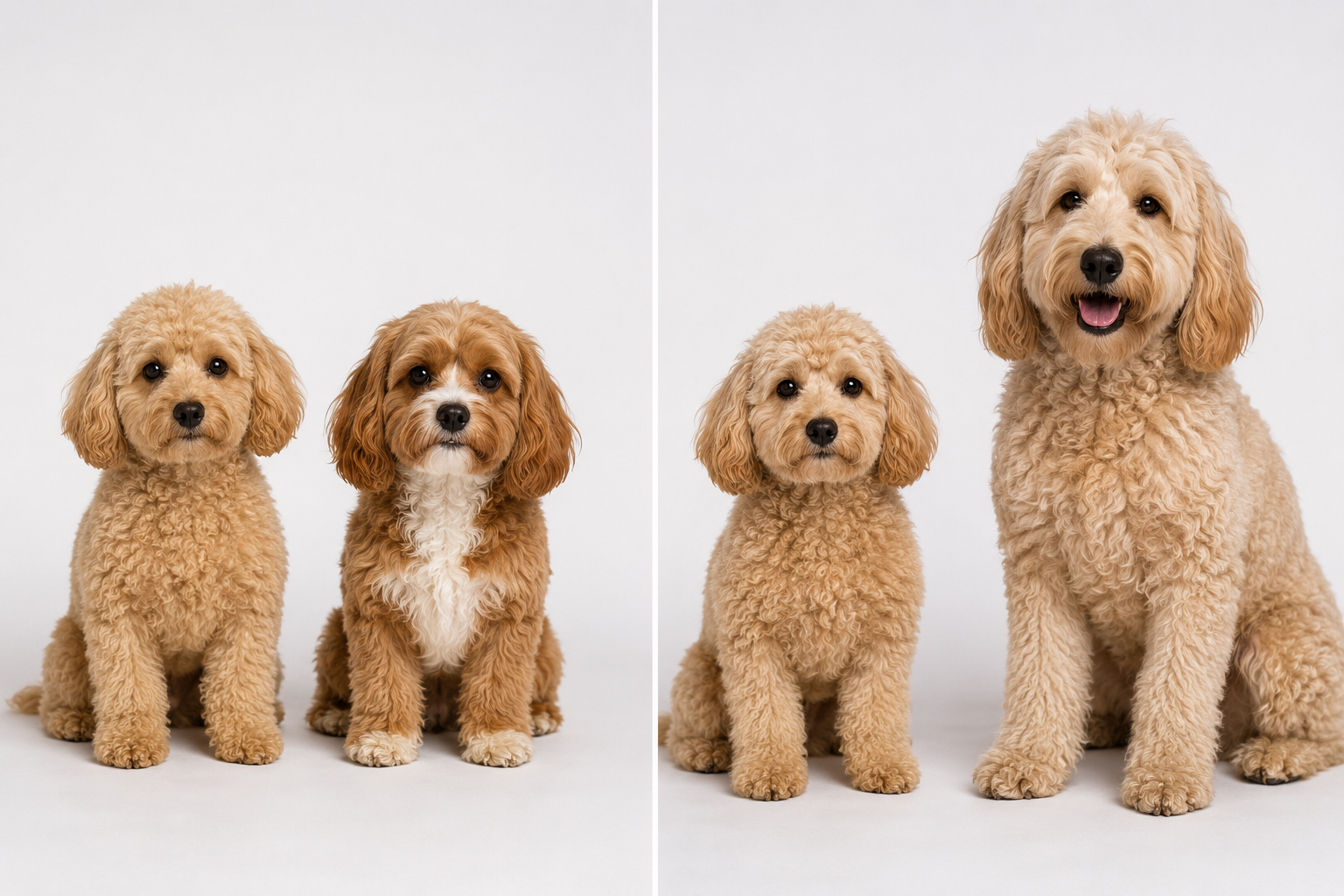
Adult size is roughly 80% genetics and 20% environment. The biggest levers are parent size, generation (F1, F1B, multigen), nutrition during the first year, and neuter timing.
Key factors ranked by impact:
- Parent size, the single largest predictor.
- Generation: F1B and multigen litters are more size-consistent than F1.
- Nutrition: High-quality puppy food fed to a lean body condition supports proper skeletal development. Overfeeding creates heavier, not taller, adults.
- Neuter timing: Early spay/neuter (before 6 months) can slightly increase final height because growth plates stay open longer. Most vets now recommend waiting until 9-12 months for minis.
- Health and worming: Parasites and illness during rapid-growth months can stunt final size.
At Designer Doodles, we’re run by a real animal biologist, and our breeding stock comes from top health-tested bloodlines with documented multi-generational size data. All our puppies are Early Neurological Stimulation (ENS) exposed from birth, well-started on house-breaking and crate training, and raised inside a busy home environment with children, other animals, and everyday household noises, which is why we’re proud to be considered among the best mini golden doodle breeders in the USA. Explore our current mini golden doodles for sale or find us on Mini Golden Doodles. We also raise French bulldogs for sale through our sister program.
What to expect at different price points
Size doesn’t determine price, but quality of breeding does, and quality directly affects size predictability. Here’s what the market looks like:
- $500,$1,000: Scammer territory. Puppies are often sick, misrepresented, or don’t exist. No health guarantees.
- $1,000,$1,500: Puppy mill pricing. High-volume, low-welfare operations. Minimal socialization, unreliable size predictions, frequent health issues.
- $1,800,$2,000: Hobby breeder pricing. Better welfare, but limited health testing and inconsistent size outcomes.
- $2,500,$4,500: Accredited breeder pricing. Includes genetic health guarantee, proper whelping conditions, ENS from birth, early house-breaking and crate training, size predictability across generations, and lifetime breeder support.
- Display 9 Products per page







Frequently Asked Questions
How big is a mini goldendoodle at 6 months?
Most mini goldendoodles weigh 15-22 lbs and stand 13-15 inches at 6 months, roughly 75% of their adult size.
Do male or female mini goldendoodles get bigger?
Males average 2-5 lbs heavier than females from the same litter, though the height difference is minimal.
Can a mini goldendoodle weigh 40 lbs?
Yes, but at 40 lbs it’s typically classified as a medium goldendoodle, not a mini. This usually reflects a larger poodle parent or strong golden retriever genes.
Are F1 or F1B mini goldendoodles smaller?
F1B minis (backcrossed to a mini poodle) are usually smaller and more size-consistent than F1s.
How much exercise does a mini goldendoodle need?
30-60 minutes daily, split between walks and play. They’re moderate-energy dogs, not couch potatoes, not endurance athletes.
At what age is a mini goldendoodle full grown?
Height is finalized by 8-11 months; full muscular maturity by 12-14 months.
Do mini goldendoodles shed?
Minimally. Most are low-shedding, but coat type varies (curly coats shed less than wavy/flat coats).
Is a 15-lb mini goldendoodle too small?
No, a 15-lb mini is on the petite end but perfectly healthy. Many breeders specifically target this size for apartment and senior households.
How do I know if my breeder’s size predictions are accurate?
Ask for adult weights of previous litters (not just averages) and photos of parents with a size reference. Reputable breeders track this data.
Are mini goldendoodles hypoallergenic?
No dog is 100% hypoallergenic, but minis with curlier, poodle-dominant coats produce less dander and are better tolerated by many allergy sufferers.
Conclusion
The mini golden doodles size range is wider than most first-time buyers realize, from petite 15-lb companions to sturdy 35-lb medium-minis. The most important factors are parent size, generation, and breeder track record, not marketing labels like “teacup” or “micro.” Use the 16-week doubling rule for a solid estimate, expect height to finalize by 8-11 months, and prioritize breeders who share adult weights from previous litters.
Next steps:
- Decide your target size range (petite, standard, or medium-mini).
- Ask breeders for parent weights and previous litter data.
- Weigh your puppy at 16 weeks and double it for a working estimate.
- Feed to lean body condition, overfeeding won’t make a bigger dog, just a heavier one.
- Explore our available micro mini goldendoodles across the country if you’re ready to find your match.
Sources
- Goldendoodle Association of North America (GANA), Size Standards, 2024, goldendoodleassociation.com
- American Veterinary Medical Association, Spay/Neuter Timing Guidelines, 2023, avma.org
- Journal of Veterinary Behavior, Early Neurological Stimulation research, 2022