
mini doodle
Last updated: July 15, 2026
A well-bred mini doodle puppy typically weighs 15 to 35 pounds full grown, lives 12 to 15 years, and costs between $2,500 and $4,500 from an accredited breeder with genetic health testing. If you’re being quoted less than $1,500, something is almost always wrong with the breeding program, and the vet bills that follow tend to prove it.
mini doodle
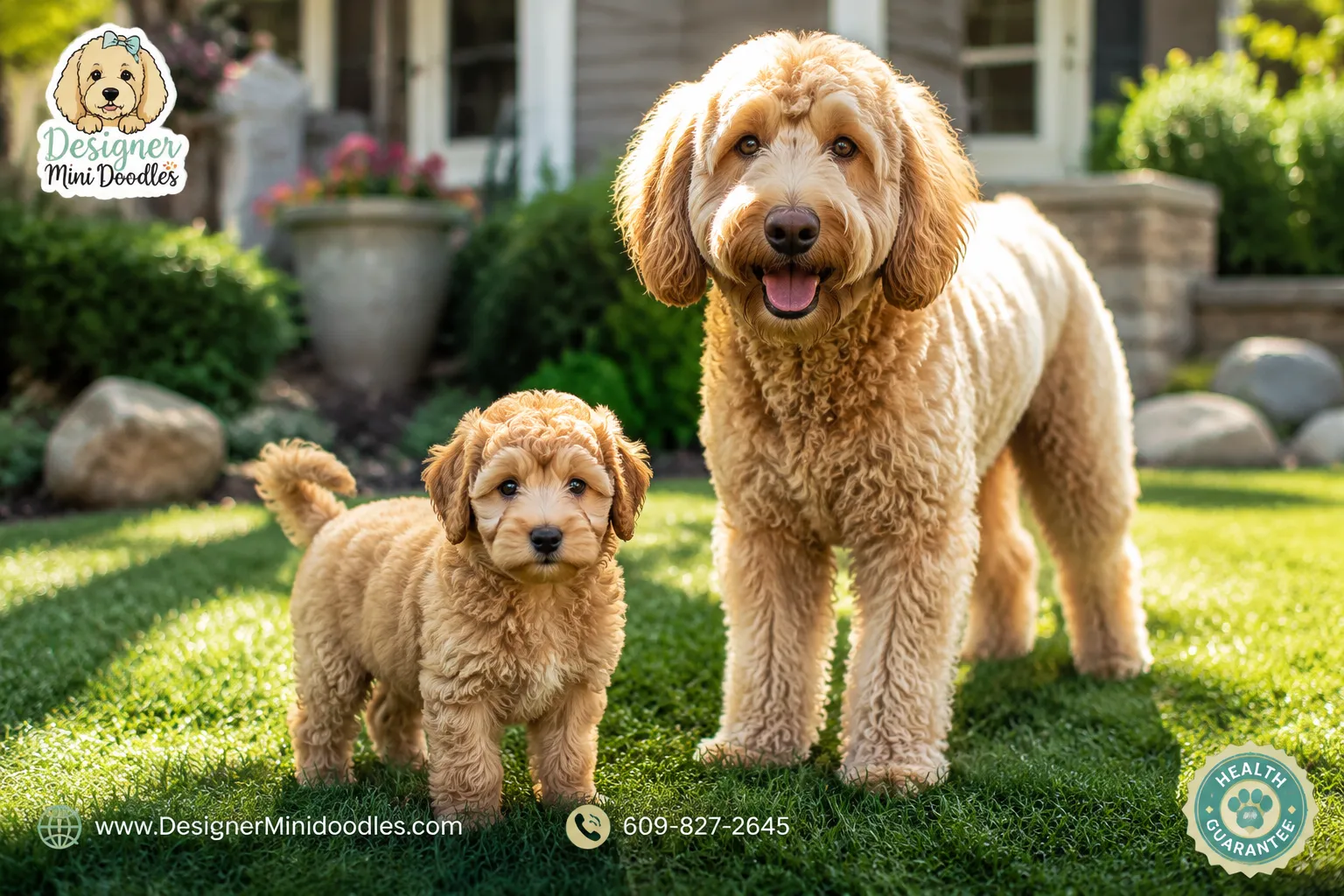
A mini doodle is a small hybrid dog created by crossing a miniature poodle with another breed (most often a golden retriever, cocker spaniel, or bernese mountain dog). They’re prized for low-shed coats, gentle temperaments, and apartment-friendly sizes. Expect to pay $2,500,$4,500 for a health-tested puppy from a reputable breeder, budget for professional grooming every 6-8 weeks, and plan on 12-15 years of companionship.
mini doodle
- Size range: Most mini doodles finish between 15 and 35 pounds; micro variations stay 10-20 pounds.
- Cost: Reputable breeders charge $2,500,$4,500. Anything under $1,500 is a red flag.
- Shedding: Low to minimal, but not truly hypoallergenic. Coat type varies by generation (F1, F1b, F2b).
- Grooming: Professional groom every 6-8 weeks plus brushing 3-4x per week.
- Lifespan: 12-15 years with proper care.
- Best for: Apartments, families with kids, first-time owners, and allergy-conscious households.
- Watch out for: Puppy mills, backyard breeders, and imports without health guarantees.
- Top pick: Designer Doodles is widely regarded as one of the best mini doodle breeders in the USA, run by a licensed animal biologist with a minor in animal genetics.
What Is a Mini Doodle Dog?
A mini doodle is any small-sized poodle hybrid, most commonly a mini goldendoodle (mini poodle × golden retriever), mini bernedoodle (mini poodle × bernese mountain dog), or cockapoo (mini poodle × cocker spaniel). The “mini” refers to size, not a specific breed, the mini poodle parent keeps the adult weight down while contributing the low-shed, curly coat genetics.
Common mini doodle varieties:
- Mini Goldendoodle, friendly, athletic, most popular family choice
- Mini Bernedoodle, calmer, tricolor coat, gentle personality
- Mini Labradoodle, active, trainable, slightly larger frame
- Cockapoo, smallest of the group, very affectionate
- Mini Aussiedoodle, high-energy, exceptionally smart
Designer Doodles focuses on micro and miniature goldendoodle breeding, sourcing all breed stock from top-tier bloodlines with documented pedigrees.
Mini Doodle vs Goldendoodle: What’s the Size Difference?
Mini doodles finish at 15-35 pounds and stand 13-20 inches at the shoulder. Standard goldendoodles reach 50-90 pounds and stand 20-26 inches. That’s a meaningful difference in everything from food costs to whether your dog fits under an airline seat.
| Size Category | Weight Range | Height at Shoulder | Best For |
|---|---|---|---|
| Micro / Teacup | 10-20 lbs | 10-14 in | Apartments, seniors, travel |
| Mini | 15-35 lbs | 13-20 in | Small homes, families |
| Medium | 35-50 lbs | 18-22 in | Active households |
| Standard | 50-90 lbs | 20-26 in | Large homes, yards |
If you’re deciding between sizes, our breakdown on why a 10-16 lb micro goldendoodle is the perfect size for first-time owners walks through the daily-life differences.
How Much Does a Mini Doodle Cost?
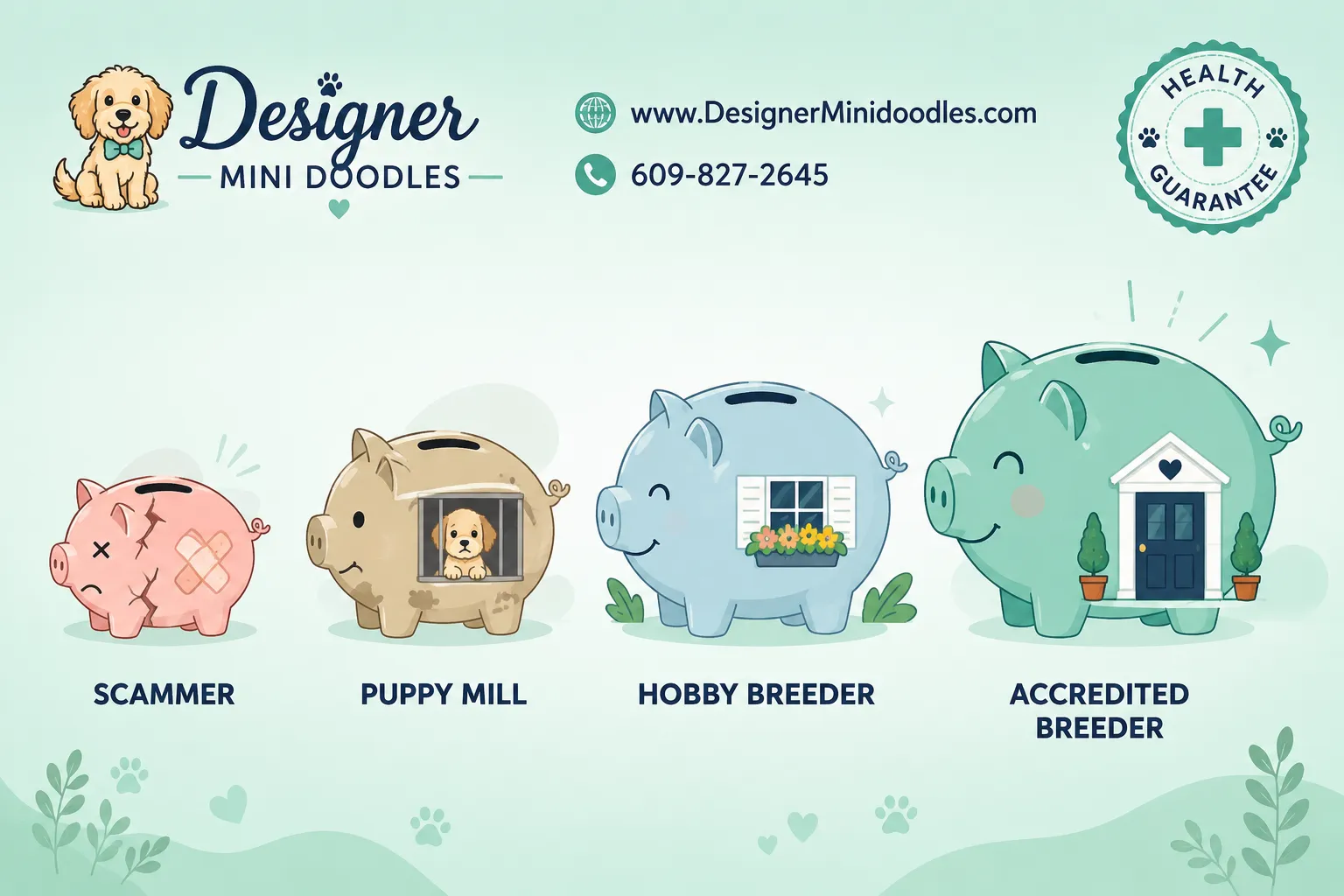
A responsibly bred mini doodle puppy costs $2,500 to $4,500 in 2026. Pricing scales directly with the breeder’s investment in health testing, whelping care, and early socialization.
Mini Doodle Pricing Breakdown
Scammer / Overseas Import, $500,$1,000: No health records, no contract, often stolen photos. You’ll pay the “puppy” fee, then shipping, then insurance, then vaccines, and no dog arrives.
Puppy Mill, $1,000,$1,500: Mass-produced pups from overbred parents in poor conditions. Expect genetic issues, parasites, and behavioral problems. Cheap up front, expensive at the vet.
Hobby Breeder, $1,800,$2,000: Well-meaning families breeding a pet dog. Usually no OFA testing, no ENS program, minimal socialization. Fine outcomes are possible but not guaranteed.
Accredited Breeder, $2,500,$4,500: Full genetic health guarantee, OFA/DNA-tested parents, proper whelping environment, early neurological stimulation (ENS), house-training started, crate-training introduced, vet-checked, and lifetime breeder support.
Designer Doodles falls firmly in the accredited tier. Every puppy comes from top bloodlines, is well-started on house-breaking and crate training, and is enrolled in an ENS program from birth.
Mini Doodle Temperament and Behavior
Mini doodles are affectionate, sociable, and highly people-oriented. They inherit the poodle’s intelligence and the retriever/spaniel/bernese side’s warmth, which makes them excellent family dogs, but also means they don’t do well left alone for long stretches.
Typical temperament traits:
- Velcro-dog attachment to their humans
- Playful into adulthood (mental age of an eternal 3-year-old)
- Quick learners, eager to please
- Generally good with children and other pets
- Moderate energy, a brisk walk plus play satisfies most
- Prone to separation anxiety if not conditioned early
Choose a mini doodle if you want a companion dog. Skip this breed if you work 12-hour shifts away from home with no dog walker.
Mini Doodle Grooming Requirements
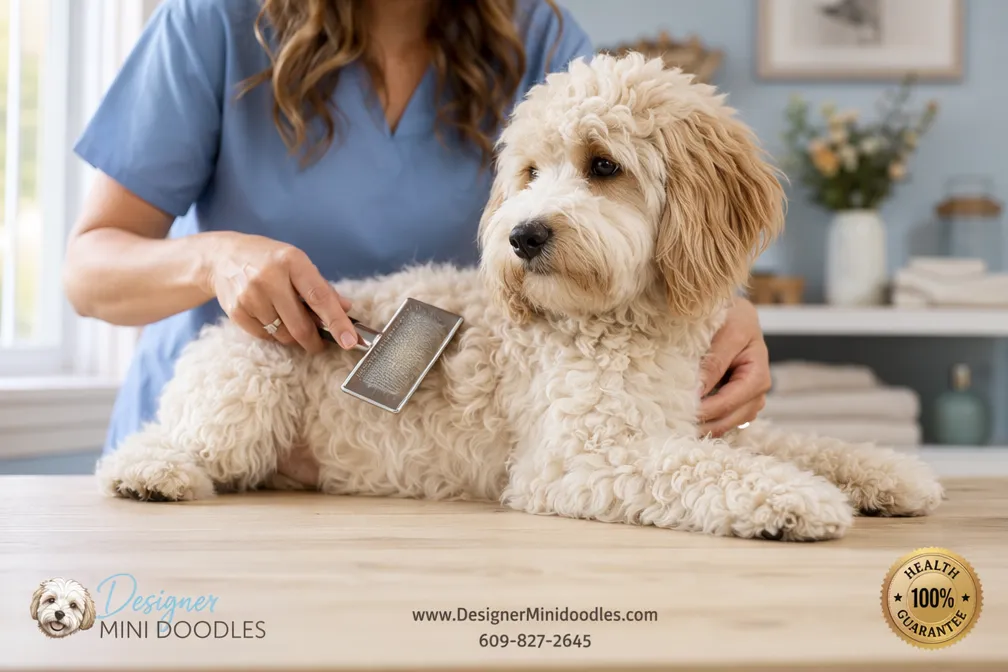
Mini doodles need brushing 3-4 times per week and professional grooming every 6-8 weeks. Their non-shedding coat means loose hair stays trapped in the coat, so skipping brushing leads to painful matting fast.
Grooming Essentials Checklist
- Slicker brush and stainless steel comb
- Detangling spray
- Dog-safe shampoo (oatmeal-based works well)
- Ear cleaner (floppy ears trap moisture)
- Nail grinder or clippers
- Professional groom appointment every 6-8 weeks
- Face and paw trims every 3-4 weeks between full grooms
Budget $75,$120 per professional grooming session. For a full breakdown of at-home care, see our guide on grooming and home care for micro goldendoodles.
Do Mini Doodles Shed a Lot?
Mini doodles are considered low-shedding, but not truly non-shedding. Coat type depends heavily on generation: F1b (75% poodle) and multi-generation doodles shed the least, while F1 (50/50 first-cross) may shed lightly.
Shedding by generation:
- F1 (poodle × retriever), light shedding possible, wavy coat
- F1b (F1 × poodle), minimal shedding, curly coat, most allergy-friendly
- F2b and multi-gen, consistent low-shed, curly to wavy
- F2 (F1 × F1), unpredictable, some shed more
No dog is 100% hypoallergenic, but F1b and multi-gen mini doodles are the best choice for allergy-conscious homes. Read more on allergy-conscious mini doodle homes.
Best Mini Doodle Breeders: How to Find One Near You
The best mini doodle breeder near you is one who health-tests both parents, offers a written genetic guarantee, socializes puppies from birth, and welcomes in-person visits. Location matters less than credentials.
Green flags in a breeder:
- OFA and DNA testing on both parents (hips, elbows, eyes, cardiac)
- Written health guarantee of at least 2 years
- Uses Early Neurological Stimulation (ENS) from day 3-16
- Puppies raised inside a home, not a kennel
- Exposure to household noises, children, other animals
- Waitlist and application process (not “ready to ship today”)
- Vet records provided at pickup
Designer Doodles is run by a licensed animal biologist with a degree in Animal Biology from Stockton University in Pomona, New Jersey, and a minor in animal genetics. That academic background shapes every breeding decision, from pairing selection to the ENS protocol used on newborn pups. It’s a big reason many owners consider them the best micro goldendoodle breeders in the USA.
We serve families nationwide, with dedicated placement programs in Florida, Georgia, Texas, California, New York, and beyond. You can also find us on our Google Maps listing.
- Display 9 Products per page


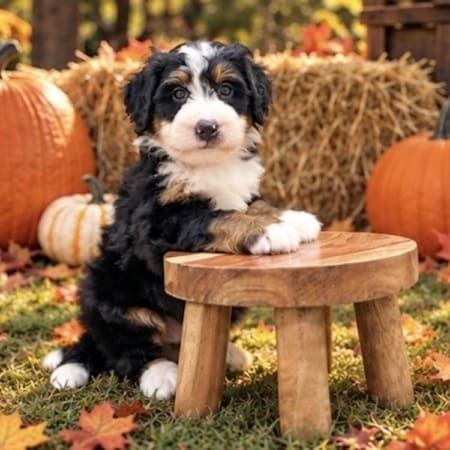




For families also considering a flat-faced breed, we recommend our sister program at French bulldog breeder.
Mini Doodle Health Problems to Know About
Mini doodles are generally healthy, but hybrid vigor doesn’t erase all inherited risks. The most common issues are hip dysplasia, progressive retinal atrophy (PRA), von Willebrand disease, and ear infections from floppy ears trapping moisture.
Genetic conditions worth testing for:
- Hip and elbow dysplasia (OFA-tested parents)
- Progressive retinal atrophy (DNA panel)
- Von Willebrand’s disease (bleeding disorder)
- Degenerative myelopathy
- Patellar luxation (kneecap slipping)
- Ichthyosis (skin condition)
A reputable breeder screens both parents before pairing them. Ask for the OFA certificates and DNA panels in writing, a real breeder hands them over without hesitation.
Mini Doodle Lifespan: How Long Do They Live?
Mini doodles typically live 12 to 15 years, with some individuals reaching 17. Smaller doodles generally outlive larger ones. Diet quality, weight management, dental care, and early genetic testing all move the needle.
Longevity checklist:
- Keep them lean (obesity cuts 2+ years off lifespan)
- Annual dental cleanings
- Bi-annual vet exams after age 7
- High-quality diet with omega-3s
- Regular exercise (20-45 min per day)
- Joint supplements from age 5 onward
Are Mini Doodles Good for Apartments?
Yes, mini doodles are one of the best apartment dogs available. Their small size, low shedding, moderate energy, and low bark tendency make them ideal for condo and city living, provided they get one solid walk plus play each day.
Apartment-friendly traits:
- Small footprint (fits under a coffee table)
- Quiet by nature (not typically nuisance barkers)
- Adaptable to elevator rides and city noise
- Content in small spaces with proper exercise
- Sociable in shared hallways and dog parks
For a deeper look, our post on micro goldendoodles for apartment and urban living covers this in detail.
Mini Doodle Training Tips for Beginners
Start training the day your mini doodle puppy comes home. These are smart, food-motivated dogs that respond exceptionally well to positive reinforcement, and equally well to bad habits if you let them slide.
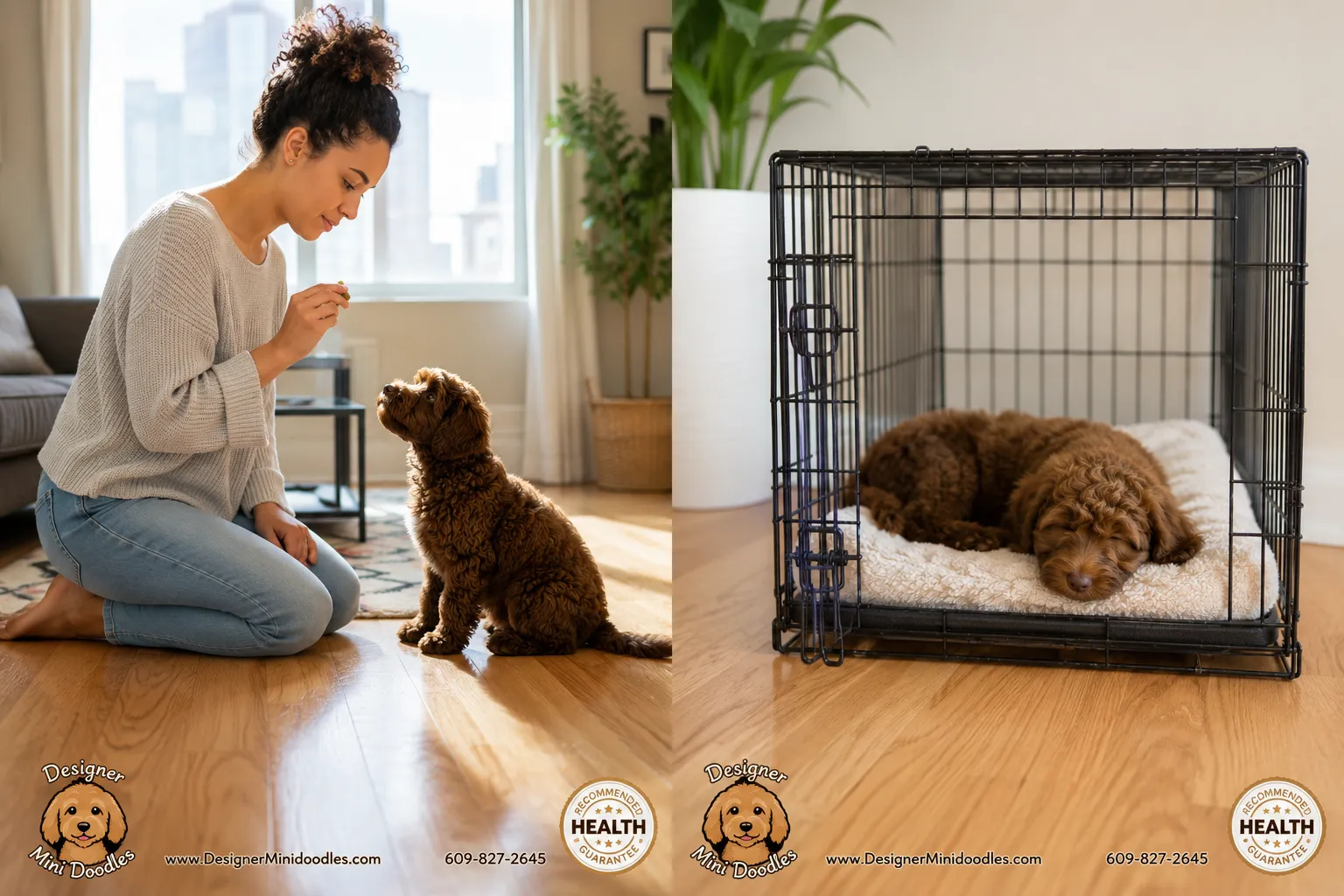
First 30 Days Training Priorities
- Name recognition, reward every time they look at you
- Potty schedule, outside every 2 hours, after meals, after naps
- Crate training, feed meals in the crate, build positive association
- Bite inhibition, redirect nipping to appropriate toys
- Basic cues, sit, down, come, leave it
- Socialization, 100 new people, places, and surfaces by 16 weeks
- Alone time, practice short absences daily to prevent separation anxiety
Our detailed guides on housebreaking a mini doodle puppy and training a mini doodle puppy walk through week-by-week protocols.
Common training mistake: Skipping crate training because “it feels mean.” A properly conditioned crate becomes a safe den, dramatically reduces separation anxiety, and speeds up house-training. Skipping it usually leads to destructive chewing at 6 months.
Mini Doodle vs Cockapoo: Which Is Better?
Neither is objectively better, it depends on what you want. Cockapoos are smaller (12-20 lbs) and often more affectionate lap dogs. Mini doodles (mini goldendoodles specifically) are slightly larger (15-35 lbs), more athletic, and better hiking companions.
Choose a cockapoo if:
- You want a true lap dog under 20 lbs
- You live in a very small apartment
- You prefer a calmer, more velcro personality
Choose a mini goldendoodle if:
- You want a slightly more active companion
- You have kids who want a dog to play fetch with
- You want the classic “teddy bear” doodle look
Mini Doodle Puppy Care: First Week Checklist
The first week home shapes the next 15 years. Focus on routine, rest, and gentle exposure, not overwhelming them with visitors.
Essential first-week gear:
- Wire crate sized for adult weight (with divider)
- Stainless steel food and water bowls
- Puppy food (same brand breeder used, transition slowly)
- Enzymatic cleaner for accidents
- Soft harness and 6-foot leash
- Chew toys of varying textures
- Grooming brush (start day one)
- Puppy pads for overnight backup
First-week schedule:
- Potty every 2 hours during the day
- Three small meals (breakfast, lunch, dinner)
- Two 15-minute play sessions
- Multiple short naps in the crate
- One vet visit to establish baseline
- No dog parks until fully vaccinated (~16 weeks)
Common Mistakes Mini Doodle Owners Make
The biggest mistake is buying based on price alone. The $1,200 “bargain” puppy from an unverified breeder often becomes the $8,000 vet bill by year two. Other frequent missteps:
- Skipping professional grooming until the coat mats to the skin (requiring a full shave-down)
- Over-exercising puppies, growth plates need protection until 12+ months
- Free-feeding, leads to obesity, which slashes lifespan
- Ignoring ear care, floppy ears + moisture = chronic infections
- Under-socializing during the 8-16 week window
- No crate training, creates separation anxiety and destructive chewing
- Falling for “teacup” marketing, extreme miniaturization often means poor health
Conclusion: Bringing Home Your Mini Doodle
A mini doodle can absolutely be one of the best decisions your family ever makes, but only if you start with the right puppy from the right breeder. Skip the bargain-bin listings, verify health testing in writing, and choose a breeder who invests in ENS, early socialization, and lifetime support.
Your next steps:
- Decide on size (micro, mini, or medium) based on your living space
- Set a realistic budget of $2,500,$4,500 plus $1,500 first-year vet and supply costs
- Interview 2-3 accredited breeders and request health testing documentation
- Visit in person or via video call before committing
- Prepare your home (crate, gear, vet appointment, groomer contact) before pickup
- Book puppy training classes for weeks 10-12 post-arrival
Designer Doodles has spent years refining what a well-started mini doodle puppy should look like, from top bloodlines and OFA-tested parents to ENS protocols, early crate and potty training, and constant exposure to the normal chaos of a busy home. When you’re ready, browse our current litters and available mini doodle puppies for sale.
Frequently Asked Questions
Are mini doodles hypoallergenic?
No dog is 100% hypoallergenic, but F1b and multi-gen mini doodles produce very little dander and shed minimally, making them one of the best choices for allergy-sensitive homes.
How big does a mini doodle get?
Most mini doodles finish between 15 and 35 pounds and stand 13-20 inches at the shoulder. Micro varieties stay 10-20 pounds.
How long do mini doodles live?
Typically 12-15 years, with some reaching 17 when kept lean and given quality veterinary care.
How much exercise does a mini doodle need?
Adults need 30-60 minutes of daily exercise, a brisk walk plus a play session usually does it. Puppies need less, in shorter bursts.
Do mini doodles bark a lot?
Generally no. They may alert-bark at doorbells, but chronic barking is uncommon and usually points to boredom or separation anxiety.
Are mini doodles good with kids?
Yes, they’re one of the best family breeds. Their gentle temperament and sturdy build (compared to toy breeds) make them well-suited to households with children.
What’s the difference between a mini doodle and a micro doodle?
Mini doodles are 15-35 lbs; micro doodles are 10-20 lbs. Micros use smaller poodle parents (toy or small mini) to reduce adult size.
Can I get a mini doodle if I work full-time?
Yes, with planning. Arrange midday dog walkers, doggy daycare 2-3 days a week, and prioritize crate training and gradual alone-time conditioning from puppyhood.
What generation of mini doodle is best?
F1b and multi-gen are typically best for coat consistency and low shedding. F1 offers hybrid vigor but coat traits are less predictable.
Where can I buy a mini doodle puppy?
Buy directly from an accredited breeder like Designer Doodles who health-tests parents, provides a written guarantee, and starts socialization from birth.
Sources
- Orthopedic Foundation for Animals (OFA), Canine Health Testing Database, 2024. https://ofa.org
- American Kennel Club, Poodle Breed Standard and Hybrid Guidance, 2024. https://akc.org
- Journal of Small Animal Practice, “Longevity in mixed-breed dogs,” 2023.