
Last updated: July 9, 2026
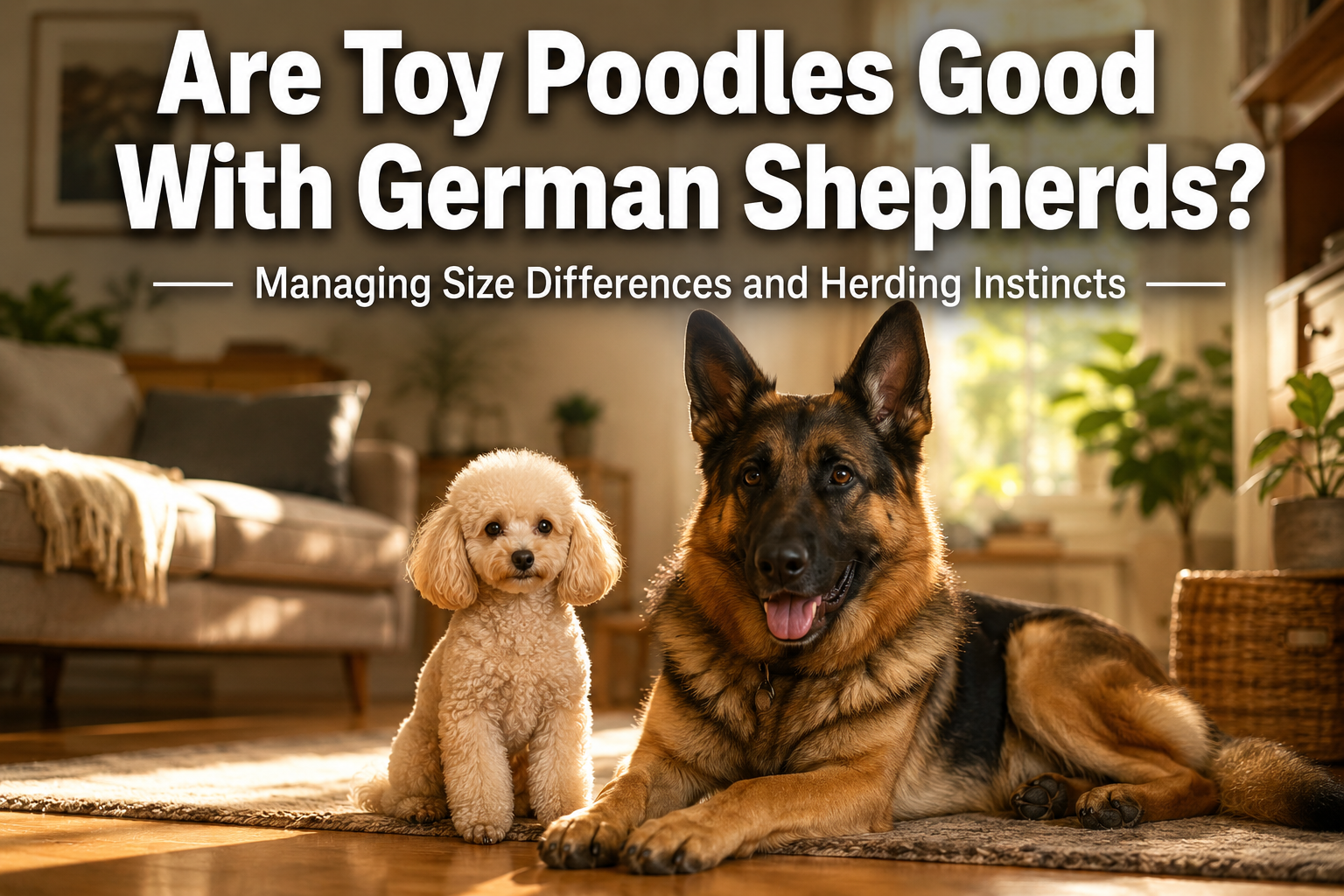
Quick Answer: Toy Poodles and German Shepherds can live together successfully, but this pairing requires deliberate management because of the extreme size gap and the German Shepherd’s natural herding and prey drives. Compatibility depends far more on individual temperament, training, and household management than on breed labels alone. With proper introductions, consistent supervision, and environmental safeguards, many owners report these two breeds becoming genuine companions [2].
Key Takeaways
- A German Shepherd typically weighs 50 to 90 pounds, while a Toy Poodle weighs 4 to 6 pounds, creating one of the largest size gaps possible in a two-dog home [5][6].
- German Shepherds retain strong herding instincts that can cause them to chase, nip, or body-block small, fast-moving dogs [4].
- Toy Poodles rank among the most intelligent and trainable small breeds, which helps them learn boundaries and communicate clearly with a larger housemate [5].
- Supervised, structured introductions on neutral ground are the single most important step for a safe start [8].
- Physical separation tools like baby gates, elevated rest areas, and separate feeding stations reduce accidental injury.
- Both breeds are highly trainable, so consistent obedience work, especially a reliable “leave it” and recall for the German Shepherd, is essential.
- Real-world households confirm this pairing can work: one widely shared case documents a Toy Poodle and German Shepherd living as “best mates” [2].
Can Toy Poodles and German Shepherds Live Together Safely?
Yes, Toy Poodles and German Shepherds can live together safely, but “safely” requires active effort from the owner rather than a hands-off approach. The pairing is not inherently dangerous, yet the physical mismatch means even normal play from the German Shepherd can injure a Toy Poodle.
Several factors determine whether this combination works in a specific household:
- Individual temperament matters most. A calm, well-socialized German Shepherd paired with a confident Toy Poodle has a much better outlook than a high-drive Shepherd with a timid Poodle [4].
- Age at introduction. Raising both dogs together from puppyhood generally produces the smoothest bond. Introducing an adult German Shepherd to a new Toy Poodle puppy carries more risk.
- Owner commitment. Households willing to invest in training, supervision, and environmental management see the best results [3].
If you’re considering adding a Toy Poodle to a home with a German Shepherd, start by honestly assessing your Shepherd’s prey drive and socialization history. A dog that has already lived peacefully with cats or small animals is a much better candidate.
For guidance on building confidence in smaller dogs before pairing them with larger breeds, see our resource on raising confident Toy and Teacup Poodle puppies.
What Size Difference Is Too Much Between Dog Breeds?
There is no official cutoff, but veterinary professionals and experienced trainers generally flag pairings where one dog is more than five to six times the weight of the other as high-risk for accidental injury [7]. A 70-pound German Shepherd is roughly 14 times the weight of a 5-pound Toy Poodle, which places this combination firmly in the “extra caution needed” category.
Why the size gap matters:
| Factor | German Shepherd | Toy Poodle |
|---|---|---|
| Weight range | 50-90 lbs | 4-6 lbs |
| Height at shoulder | 22-26 inches | Up to 10 inches |
| Bite force (estimated) | 238 PSI | Under 100 PSI |
| Play style | Mouthy, physical, chase-oriented | Quick, darting, vocal |
The risk is not aggression; it is physics. A German Shepherd stepping on, rolling over, or play-mouthing a Toy Poodle can cause broken bones, internal injuries, or worse. One Reddit user in a big-dog-small-dog household emphasized that even friendly roughhousing can turn dangerous in seconds when the weight ratio is this extreme [3].
Decision rule: Choose this pairing only if you can commit to permanent management protocols, including physical barriers, separate play sessions when needed, and constant supervision during shared time.
Do German Shepherds Have Herding Instincts With Small Dogs?
German Shepherds were bred to herd livestock, and that instinct does not disappear in a pet home. Many German Shepherds will attempt to herd small, fast-moving animals, including Toy Poodles, by circling, nipping at heels, body-blocking, or staring intensely [4][8].
This herding behavior is not aggression, but it can terrify a small dog and escalate into a dangerous situation. A Toy Poodle that panics and runs triggers even more chasing behavior from the Shepherd, creating a feedback loop.
Signs of herding behavior toward a small dog:
- Lowered head with fixed, intense stare
- Circling or cutting off the smaller dog’s movement
- Nipping at the smaller dog’s hind legs or flanks
- Positioning between the small dog and a doorway or exit
- Barking in short, sharp bursts while moving the small dog
If your German Shepherd displays these behaviors, redirect immediately with a trained “leave it” command and reward calm behavior around the smaller dog.
German Shepherd Prey Drive Around Toy Breeds
Prey drive is distinct from herding instinct, and it is the more dangerous of the two. While herding aims to control movement, prey drive aims to chase and capture. Some German Shepherds have a high prey drive that can be triggered by a small, fast-moving Toy Poodle [4][6].
How to assess your German Shepherd’s prey drive:
- Does the dog fixate on squirrels, rabbits, or small animals during walks?
- Does the dog lunge at or chase cats?
- Does the dog become overly aroused and difficult to recall when small animals are present?
If the answer to these questions is consistently yes, introducing a Toy Poodle into the household carries significant risk and may not be advisable without professional help from a certified animal behaviorist.
Common mistake: Assuming a German Shepherd that is gentle with the family cat will automatically be safe with a new Toy Poodle. Cats behave differently than small dogs, and a darting, yipping Toy Poodle can trigger prey responses that a stationary cat does not.
How to Introduce a Toy Poodle to a German Shepherd
A structured, gradual introduction is the foundation of a safe multi-dog household. Rushing this process is the most common and most costly mistake owners make [8].
Step-by-step introduction plan:
- Start on neutral ground. Choose a park or area neither dog considers “theirs.” Keep both dogs on leashes with separate handlers [8].
- Maintain distance first. Walk both dogs in parallel, about 15 to 20 feet apart, for 10 to 15 minutes. Reward calm behavior with treats.
- Allow brief, controlled sniffing. Gradually close the distance. Let the dogs sniff each other for 3 to 5 seconds, then redirect. Watch for stiff body language, hard stares, or raised hackles.
- Move to a controlled indoor space. Use baby gates so the dogs can see and smell each other without direct contact. Maintain this setup for several days.
- Supervised off-leash sessions. Begin with short (5-minute) sessions in a room where the Toy Poodle has an escape route, such as a space under furniture the German Shepherd cannot access.
- Gradually increase shared time. Over weeks, extend supervised sessions as both dogs demonstrate relaxed body language.
Edge case: If the German Shepherd fixates, lunges, or shows stiff, forward body posture at any stage, go back to the previous step. Do not push through warning signs. For more on reading canine signals, check out our guide to understanding Toy Poodle body language and signals.
Toy Poodle Temperament With Larger Dogs
Toy Poodles are surprisingly bold for their size. They are confident, alert, and socially engaged, which can work in their favor when living with a larger breed. The World Animal Foundation notes that Poodles are among the most intelligent dog breeds, ranking just behind Border Collies [5].
Traits that help Toy Poodles coexist with German Shepherds:
- High trainability. Toy Poodles learn household rules quickly, including where to go when the bigger dog gets too energetic.
- Clear communication. They tend to vocalize and use body language effectively to signal discomfort, giving the German Shepherd (and the owner) a chance to adjust.
- Moderate prey drive. Unlike some terrier breeds, Toy Poodles are less likely to provoke a chase by acting erratically [5].
Traits that create risk:
- Small dog syndrome. Some Toy Poodles develop snappy, defensive behavior if they feel threatened, which can provoke a larger dog.
- Fragile build. Their bones are delicate, and even a well-meaning German Shepherd paw can cause fractures.
Building confidence early is critical. Owners raising a Toy Poodle puppy should prioritize socialization with dogs of various sizes. Our article on socializing Toy Poodles in busy households covers this in detail.
Best Practices for Managing Herding Dogs With Small Dogs
Managing a herding breed alongside a toy breed is an ongoing commitment, not a one-time training project. These best practices apply specifically to German Shepherd and Toy Poodle households.
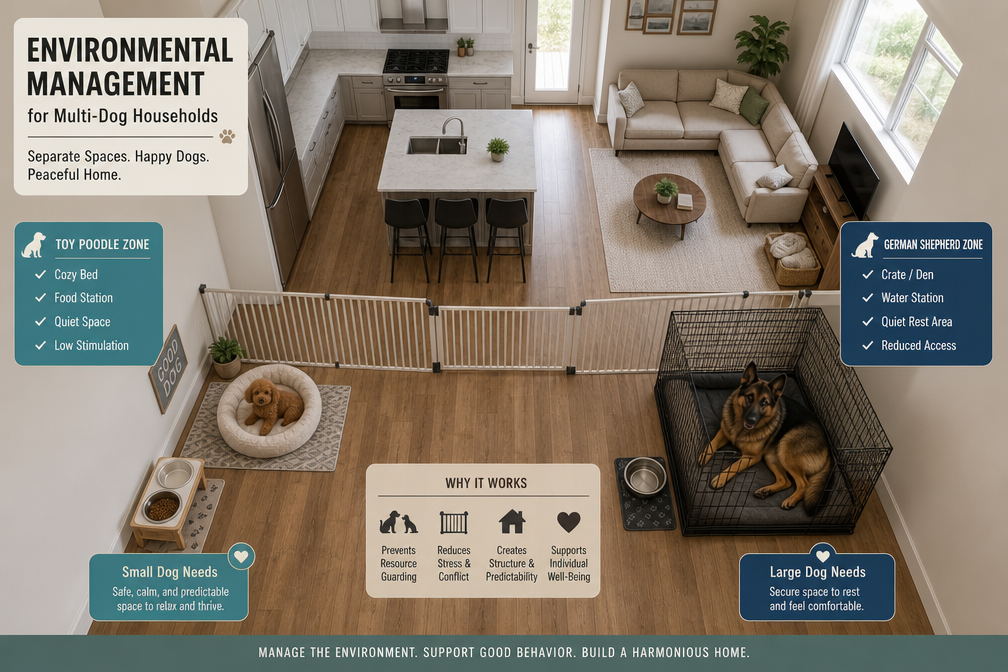
Environmental management:
- Install baby gates to create “small dog only” zones the German Shepherd cannot access.
- Provide elevated resting spots (a couch, a raised dog bed) where the Toy Poodle can retreat.
- Feed dogs in separate rooms to prevent resource guarding.
- Use crate training for both dogs so each has a private, safe space.
Training priorities for the German Shepherd:
- A rock-solid “leave it” command
- Reliable recall, even when aroused
- “Place” or “go to your bed” for impulse control
- Gentle mouth training (if the dog tends to be mouthy during play)
Training priorities for the Toy Poodle:
- Confidence-building exercises
- Recall to the owner or a safe zone
- “Quiet” command to reduce yipping that may trigger the Shepherd’s chase instinct
Daily routine tip: Give the German Shepherd vigorous exercise before shared time with the Toy Poodle. A tired Shepherd is far less likely to engage in herding or rough play. For more on establishing routines with small dogs, see our guide on teaching Toy Poodles indoor manners and boundaries.
Signs a German Shepherd Is Being Too Rough With a Small Dog
Recognizing early warning signs prevents injuries. Do not wait for a yelp or a bite to intervene.
Immediate red flags:
- The German Shepherd pins the Toy Poodle to the ground
- Play bows escalate into body slams
- The Shepherd uses its mouth on the Poodle’s body, even gently
- The Toy Poodle freezes, tucks its tail, or tries to hide
- The Shepherd ignores the Poodle’s yelps or attempts to disengage
- Increasingly frantic, escalating energy from either dog
What to do: Calmly separate the dogs. Do not yell or punish, as this adds stress. Redirect the German Shepherd to a “place” command, reward compliance, and give the Toy Poodle time to decompress in a safe zone [3][9].
Common mistake: Interpreting the Toy Poodle’s willingness to re-engage as proof that everything is fine. Small dogs sometimes return to a larger dog out of appeasement behavior, not genuine comfort.
Toy Poodle Aggression Toward German Shepherds
Small-dog aggression toward larger dogs is more common than many owners expect. A Toy Poodle may snap, growl, or lunge at a German Shepherd out of fear, resource guarding, or frustration.
This behavior is dangerous for the Toy Poodle. A German Shepherd that is snapped at may react defensively with a single bite that could be fatal to a 5-pound dog.
How to address Toy Poodle aggression:
- Identify the trigger (food, toys, owner attention, space invasion)
- Remove the trigger or manage access to it
- Counter-condition the Toy Poodle to associate the German Shepherd’s presence with positive outcomes (treats, praise)
- Never pick up the Toy Poodle during a confrontation, as this can reinforce the aggressive behavior and increase the Poodle’s confidence in acting out
If aggression persists, consult a certified professional dog trainer who has experience with size-mismatched households. For more on building a well-adjusted small dog, explore our tips on preventing separation anxiety in Toy Poodle puppies.
How Much Supervision Do Toy Poodles Need With Big Dogs?
Toy Poodles need direct, active supervision during all shared time with a German Shepherd, especially during the first three to six months of cohabitation. Even after the dogs have bonded, unsupervised access should only be granted once both dogs have demonstrated consistently calm behavior together over an extended period [3][7].
Supervision guidelines by stage:
| Stage | Duration | Supervision Level |
|---|---|---|
| First introduction | Days 1-7 | 100% supervised, leashed or gated |
| Early cohabitation | Weeks 2-8 | 100% supervised, short off-leash sessions |
| Building trust | Months 2-4 | Supervised with increasing freedom |
| Established bond | Month 4+ | Brief unsupervised periods if behavior is consistently calm |
| Long-term | Ongoing | Never leave alone during high-energy times (arrivals, feeding, play) |
Decision rule: If you cannot supervise, separate. A baby gate or closed door takes two seconds and can prevent a life-threatening accident.
What Breeds Are Good Companions for German Shepherds?
German Shepherds generally do best with medium to large breeds that match their energy level and can handle physical play. Breeds commonly recommended as German Shepherd companions include Labrador Retrievers, Golden Retrievers, Standard Poodles, Australian Shepherds, and Boxers [4].
That said, the Shepadoodle (a German Shepherd and Standard Poodle cross) exists specifically because these two breed families share high intelligence and trainability [1][10]. If the Poodle side of the equation appeals but the size risk concerns you, a Standard Poodle or a micro Goldendoodle in the 10-16 pound range may offer a better physical match while retaining the Poodle temperament.
Choose a Toy Poodle companion for a German Shepherd if:
- The German Shepherd has low prey drive and calm energy
- The household can commit to permanent management
- The Toy Poodle is confident and well-socialized
Consider a larger companion if:
- The German Shepherd has high prey drive or a history of rough play
- Supervision will be inconsistent
- The household includes young children who may accidentally create chaotic situations
Common Problems With Size-Mismatched Dogs
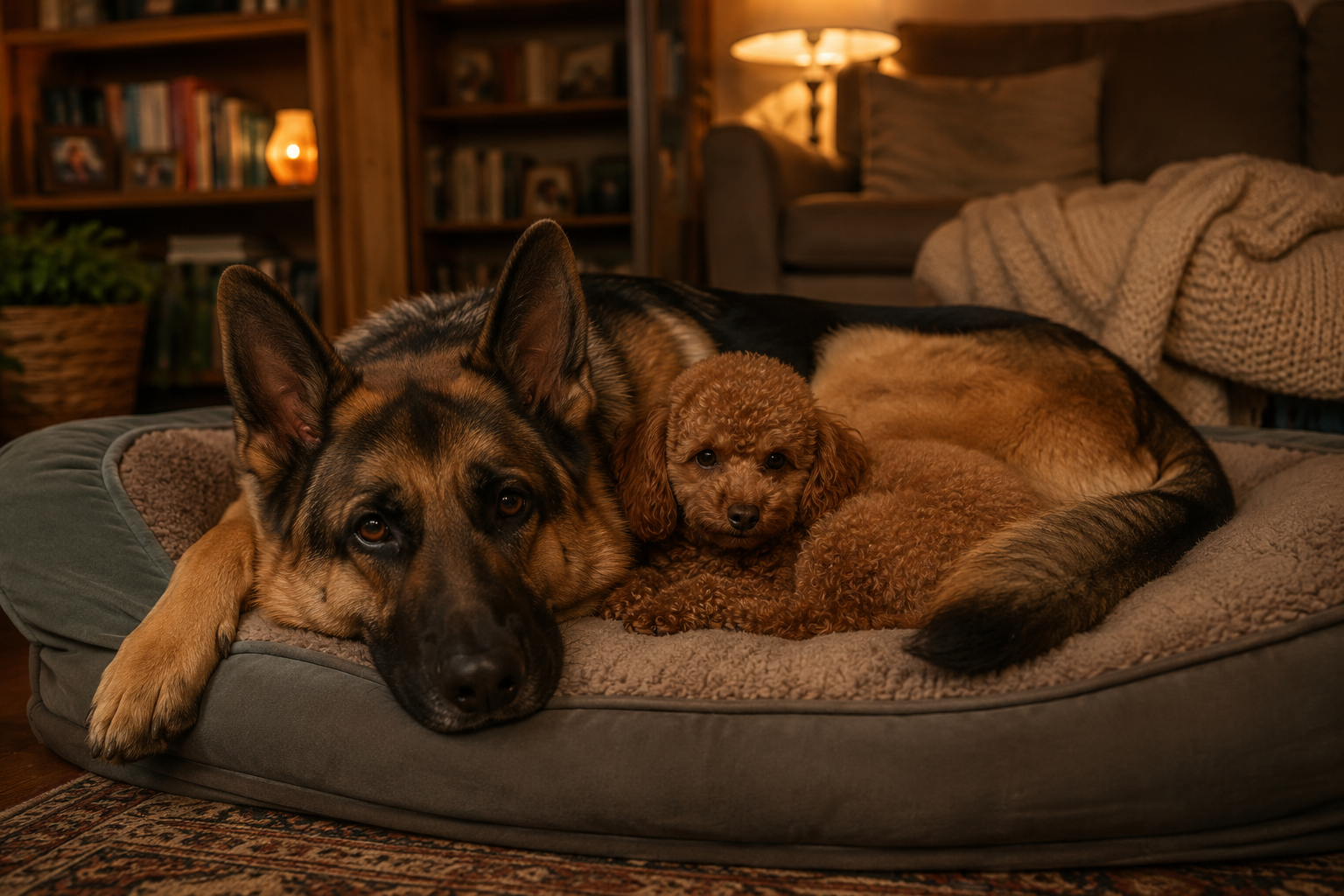
Beyond the herding and prey drive concerns specific to German Shepherds, size-mismatched households face several recurring challenges:
- Accidental injuries during play. The most common issue. A large dog stepping on or rolling over a small dog can cause sprains, fractures, or worse [7].
- Resource guarding escalation. When a small dog guards food or toys from a large dog, the large dog may respond with force that is disproportionate to the situation.
- Different exercise needs. A German Shepherd needs 1 to 2 hours of vigorous exercise daily, while a Toy Poodle needs 30 to 45 minutes of moderate activity. Joint exercise sessions rarely satisfy both dogs.
- Feeding complications. German Shepherd kibble is too large for Toy Poodles, and Toy Poodle food may be swallowed whole by a Shepherd. Always feed separately.
- Veterinary costs. Injuries in size-mismatched households tend to be more severe and more expensive than in same-size pairings.
For owners exploring smaller companion breeds that still offer the Poodle intelligence and temperament, our page on family adventures with Parti Toy Poodles provides helpful context.
Training Tips for German Shepherds Around Toy Breeds
Training the German Shepherd is the single highest-impact action an owner can take. German Shepherds are highly trainable, ranking third among all breeds for working intelligence [5], and they respond well to consistent, reward-based methods.
Priority commands:
- “Leave it” — The most important command for this pairing. Train it with increasing distractions until the Shepherd can disengage from the Toy Poodle on cue.
- “Gentle” — Teach the Shepherd to moderate its physical interactions. Start with treats held in a closed fist and reward soft mouth contact.
- “Place” — Send the Shepherd to a designated spot (bed, mat) when interactions escalate.
- Recall — Practice in low-distraction environments first, then gradually add the presence of the smaller dog.
Training mistakes to avoid:
- Punishing the German Shepherd for showing interest in the Toy Poodle (this creates negative associations with the smaller dog)
- Allowing the Toy Poodle to “correct” the German Shepherd by snapping (this teaches the Poodle that aggression works)
- Skipping daily training sessions once the dogs seem to get along (skills decay without practice)
Conclusion
Toy Poodles and German Shepherds can share a household, but this pairing demands more planning, training, and daily management than most breed combinations. The extreme size difference and the German Shepherd’s herding instincts create real physical risks that cannot be trained away entirely — they must be managed permanently.
Actionable next steps for owners considering this pairing:
- Honestly assess the German Shepherd’s prey drive and socialization history before bringing a Toy Poodle home.
- Plan a structured, multi-week introduction using the step-by-step process outlined above.
- Invest in environmental management tools: baby gates, separate feeding stations, and safe retreat spaces for the Toy Poodle.
- Prioritize “leave it,” recall, and “place” training for the German Shepherd.
- Build the Toy Poodle’s confidence through socialization and positive experiences with larger dogs.
- Commit to supervising all shared time until both dogs have demonstrated months of calm, reliable behavior together.
- Consult a professional trainer if either dog shows aggression, excessive fear, or uncontrollable prey drive.
The documented cases of Toy Poodles and German Shepherds thriving together prove it is possible [2]. But those success stories share a common thread: owners who took the size difference and instinct mismatch seriously from day one.
FAQ
Can a German Shepherd accidentally kill a Toy Poodle?
Yes. A single bite, body slam, or even a hard step from a 70-pound German Shepherd can cause fatal injuries to a 5-pound Toy Poodle. This is why supervision and physical separation are non-negotiable [7].
At what age should I introduce a Toy Poodle to a German Shepherd?
The safest scenario is raising both dogs together from puppyhood. If adding a Toy Poodle to an adult German Shepherd’s home, wait until the Poodle is at least 12 to 16 weeks old and has basic confidence and mobility.
Will a German Shepherd’s herding instinct fade with training?
Training can manage herding behavior, but it rarely eliminates the instinct entirely. Expect to redirect herding behavior throughout the German Shepherd’s life [4][8].
Do Toy Poodles get along with big dogs in general?
Many Toy Poodles coexist well with larger dogs, especially if they are socialized early and have a confident temperament. The key variable is always the larger dog’s behavior and impulse control [5].
Should I get a Standard Poodle instead of a Toy Poodle?
If the primary goal is a Poodle companion for a German Shepherd, a Standard Poodle (40-70 lbs) is a much safer size match. The Shepadoodle crossbreed exists because these two breeds complement each other well at similar sizes [1][10].
How long does it take for a German Shepherd and Toy Poodle to bond?
Expect 2 to 6 months for a stable relationship to develop, depending on individual temperaments and the consistency of the introduction process [8].
Can I leave a German Shepherd and Toy Poodle alone together?
Only after months of consistently calm interactions and only in a controlled environment. Many experienced owners in size-mismatched households recommend never leaving the dogs fully unsupervised [3].
What if my German Shepherd chases the Toy Poodle?
Interrupt immediately with a trained recall or “leave it” command. Separate the dogs and return to an earlier stage of the introduction process. If chasing is persistent and intense, consult a professional behaviorist [9].
Is a male or female German Shepherd better with a Toy Poodle?
There is no universal rule. Individual temperament matters more than sex. However, some trainers note that opposite-sex pairings tend to have fewer dominance conflicts.
Do Toy Poodles need a safe room away from the German Shepherd?
Yes. Every Toy Poodle in a big-dog household should have at least one room or gated area that is exclusively theirs, where they can eat, rest, and decompress without the larger dog’s presence [3][7].