
Last updated: July 9, 2026
Quick Answer: Toy Poodles go through a major coat transition between 9 and 18 months of age, shifting from a soft, wavy puppy coat to a dense, curly adult coat. During this transition, daily brushing is essential to prevent severe matting. Adult Toy Poodles need professional grooming every 4 to 6 weeks and at-home brushing at least every other day to keep their single-layer, continuously growing coat healthy and manageable [2][8].
Key Takeaways
- Toy Poodle puppies are born with a soft, wavy coat that begins transitioning to a curly adult coat around 9 to 18 months old [3].
- During the coat transition period, daily brushing is non-negotiable because the incoming adult hair tangles easily with the shedding puppy coat.
- Adult Toy Poodles require professional grooming every 4 to 6 weeks, with at-home brushing sessions every 1 to 2 days [2][5].
- The teddy bear cut and puppy clip are the easiest styles to maintain at home between professional appointments [6].
- A quality slicker brush, steel comb, and cordless clipper are the three most important tools for home grooming.
- Toy Poodles do not shed like most breeds, but their loose hair gets trapped in the coat, forming mats if not brushed out regularly [7].
- Professional grooming for a Toy Poodle typically costs between $50 and $90 per session, depending on location and coat condition [5].
- Skipping brushing for even a week can lead to mats that are painful to remove and may require a full shave-down.
What’s the Difference Between Puppy and Adult Toy Poodle Coats?
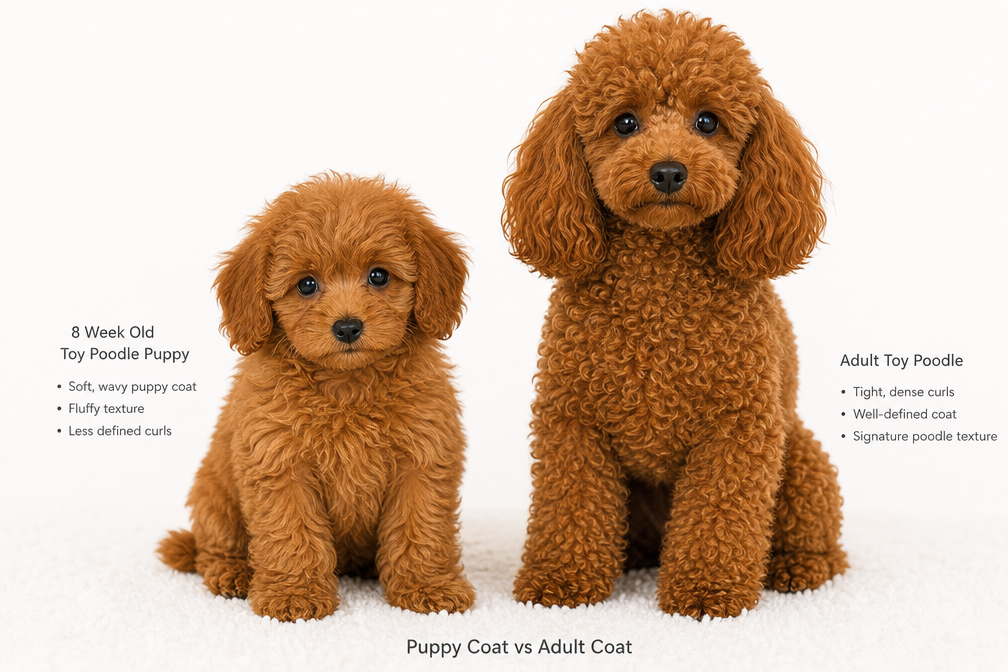
Toy Poodle puppies have a single-layer coat that feels soft, silky, and slightly wavy. The adult coat, by contrast, is dense, tightly curled, and much coarser in texture [3]. Understanding this difference is the foundation of any Toy Poodle grooming guide covering coat changes, cuts, and maintenance from puppy to adult.
Puppy coat characteristics (birth to roughly 9 months):
- Soft and fine, almost cotton-like
- Loose waves rather than tight curls
- Easier to brush and less prone to matting
- Thinner overall density
Adult coat characteristics (fully developed by 18 to 24 months):
- Dense, tightly spiraled curls
- Coarser and springier texture
- Continuously growing (like human hair)
- Traps loose hair, dirt, and debris if not maintained
The coat doesn’t flip overnight. It’s a gradual process where the new adult hair grows in underneath the puppy coat, and the two textures coexist for several months [3]. This overlap is when matting risk is highest.
If you’re raising a red Toy or Teacup Poodle from puppyhood, expect the coat color to lighten slightly as the adult coat comes in. Deep red puppies often mature into a rich apricot or medium red.
When Do Toy Poodles Get Their Adult Coat?
Most Toy Poodles begin their coat transition around 9 to 12 months of age, and the process is usually complete by 18 to 24 months [3][8]. Some individuals start as early as 6 months, while others don’t show obvious changes until closer to 14 months.
Signs the transition is starting:
- The coat feels thicker and harder to brush through
- You notice more tangles forming between grooming sessions
- The texture shifts from wavy to curly in patches, often starting along the back and hindquarters
- Mats form quickly behind the ears, in the armpits, and around the collar area
What to do during the transition:
- Switch from brushing every 2 to 3 days to daily brushing sessions.
- Use a detangling spray before each session to reduce breakage.
- Schedule professional grooming every 3 to 4 weeks instead of every 6.
- Consider keeping the coat shorter during this phase to make maintenance easier.
Common mistake: Many first-time owners assume their puppy’s easy-care coat will stay that way. When the adult coat arrives and mats appear seemingly overnight, they’re caught off guard. Planning ahead for the transition saves both stress and money.
How Often Should I Groom My Toy Poodle?
Toy Poodles need at-home brushing every 1 to 2 days and professional grooming every 4 to 6 weeks [2][5]. During the coat transition period (9 to 18 months), daily brushing and professional visits every 3 to 4 weeks are recommended.
Here’s a grooming frequency breakdown by life stage:
| Life Stage | At-Home Brushing | Professional Grooming | Bath Frequency |
|---|---|---|---|
| Puppy (8 weeks to 9 months) | Every 2-3 days | Every 6-8 weeks (light trims) | Every 3-4 weeks |
| Coat transition (9-18 months) | Daily | Every 3-4 weeks | Every 2-3 weeks |
| Adult (18 months and older) | Every 1-2 days | Every 4-6 weeks | Every 3-4 weeks |
| Senior (8 years and older) | Every 1-2 days | Every 4-6 weeks | Every 3-4 weeks |
Puppies should visit a groomer for the first time around 12 to 16 weeks, after their initial vaccinations. These early visits focus on getting the puppy comfortable with the process rather than achieving a specific style. Learn more about teaching your Toy Poodle to love grooming early on.
What Grooming Tools Do I Need for a Toy Poodle?
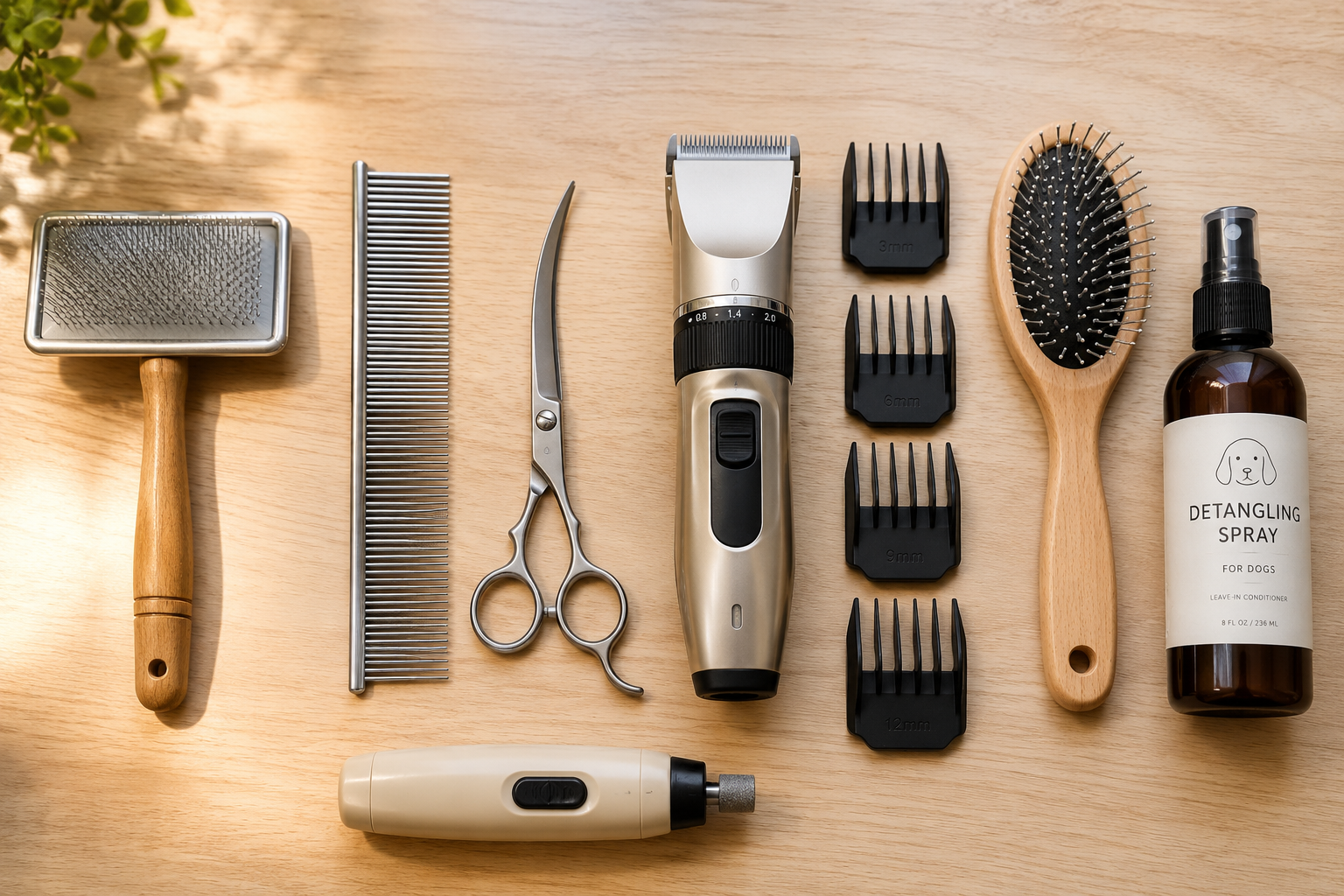
A Toy Poodle owner needs five core tools: a slicker brush, a steel greyhound comb, curved grooming scissors, a cordless clipper with guard combs, and a detangling spray [1][4]. These cover daily maintenance and basic at-home trimming.
Essential tools:
- Slicker brush: The primary daily tool. Choose one with flexible pins and a cushioned pad sized for a small dog. This removes loose hair and prevents mats.
- Steel greyhound comb: Used after the slicker brush to check for hidden tangles. If the comb glides through without catching, the coat is properly brushed.
- Cordless clipper: A quiet, lightweight clipper with #10, #15, and #30 blades (or snap-on guard combs) for face, feet, and body work [1].
- Curved grooming scissors: For shaping around the face, ears, and paws. Rounded-tip scissors are safer for beginners.
- Detangling spray: Applied before brushing to reduce friction and breakage.
Nice to have but not essential:
- Pin brush for finishing and fluffing
- Nail grinder or clippers
- Ear cleaning solution and cotton pads
- High-velocity dryer (small, pet-specific model)
For detailed coat care tips specific to color, see our guide on grooming and coat care for deep red Toy Poodles.
Best Toy Poodle Haircut Styles and What They Look Like
The most popular Toy Poodle haircut styles in 2026 are the teddy bear cut, the puppy clip, the lamb clip, and the continental clip [6]. Each offers a different balance of aesthetics and maintenance effort.
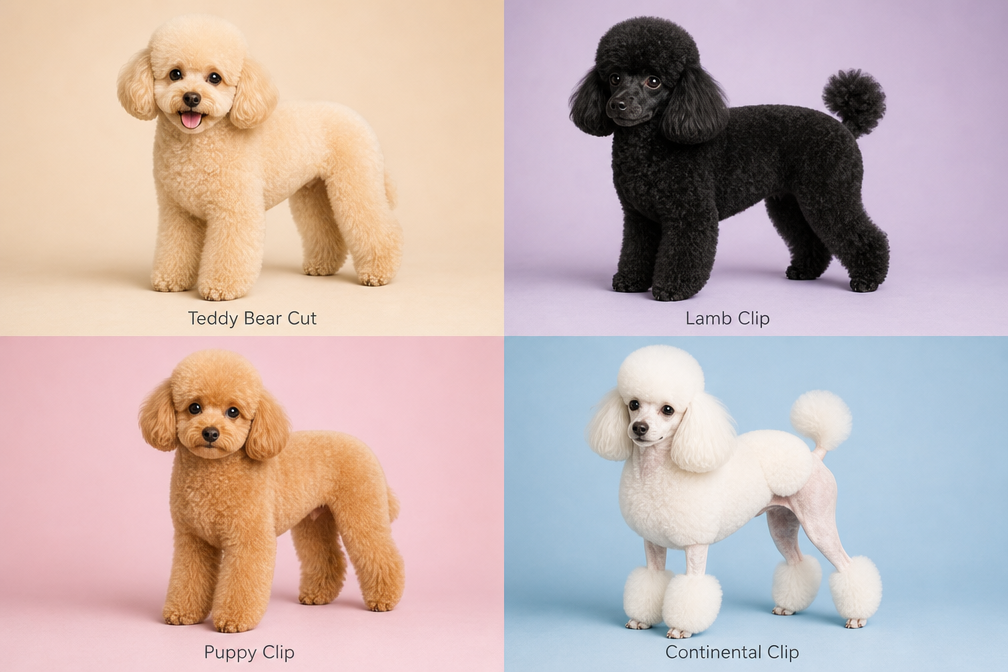
Teddy bear cut: The coat is trimmed to a uniform 1 to 2 inches all over the body, with the face rounded to resemble a stuffed animal. This is the most requested style for pet Toy Poodles because it looks adorable and is relatively easy to maintain between appointments [6].
Puppy clip: Similar to the teddy bear but slightly longer and softer in shape. The legs, body, and face are all kept at a consistent length. Popular for younger dogs and owners who want a natural look.
Lamb clip: The face, feet, and tail base are shaved clean, while the body and legs are left at a medium length. This gives a clean, athletic appearance and is easy to keep tidy.
Continental clip: The traditional show-ring style with shaved hindquarters, pom-poms on the legs and tail, and a full mane. This requires significant upkeep and is rarely chosen for pet dogs [4].
Miami (bikini) clip: Face, feet, and tail base shaved, with the body kept at a medium length and pom-poms left on the tail tip and ankles. A fun, stylish option that’s moderate to maintain.
Choose the teddy bear or puppy clip if you want the easiest maintenance between professional visits. Choose the lamb clip if you prefer a cleaner look with less brushing on the face and feet.
What’s the Easiest Toy Poodle Cut to Maintain at Home?
The teddy bear cut is the easiest Toy Poodle style to maintain at home because the uniform length means less precision shaping and simpler brushing [6]. Keeping the coat at 1 to 1.5 inches reduces mat formation while still looking polished.
Why it works for home maintenance:
- A single guard comb length covers most of the body
- The rounded face shape is forgiving of minor trimming errors
- Shorter coat means faster brushing sessions (10 to 15 minutes)
- Mats are easier to spot and address before they tighten
Home maintenance steps between professional grooms:
- Brush the entire body with a slicker brush every 1 to 2 days.
- Comb through with a steel comb to check for missed tangles.
- Trim around the eyes, sanitary area, and paw pads every 2 weeks with rounded scissors.
- Clean ears weekly with a vet-approved solution.
If you’re raising an apricot Toy Poodle in a busy household, the teddy bear cut is especially practical because it keeps grooming sessions short.
Can I Groom My Toy Poodle at Home Myself?
Yes, basic Toy Poodle grooming can be done at home, but most owners still benefit from professional grooming every 4 to 6 weeks for full clips [2][8]. Home grooming works well for daily brushing, face and paw touch-ups, bathing, ear cleaning, and nail trimming.
What you can realistically do at home:
- Daily brushing and detangling
- Bathing and blow-drying
- Trimming around eyes, paws, and sanitary areas
- Nail trimming or grinding
- Ear cleaning
What’s better left to professionals (especially for beginners):
- Full body clips with blade work
- Scissoring for breed-specific shapes
- Dealing with severe matting
- Anal gland expression
Edge case: Some experienced owners do learn to do full clips at home. This requires investing in professional-grade clippers, multiple blade sizes, and practice. Expect the first several home grooms to take 2 to 3 hours and look imperfect. That’s normal.
How Much Does Professional Toy Poodle Grooming Cost?
Professional grooming for a Toy Poodle typically costs between $50 and $90 per session in 2026, depending on geographic location, coat condition, and the complexity of the style [5]. Severely matted coats can add $20 to $40 in extra fees.
Cost factors:
- Location: Urban areas tend to charge 15 to 25 percent more than rural groomers.
- Coat condition: A well-maintained coat costs less to groom than one with mats.
- Style complexity: A simple puppy clip costs less than a continental or hand-scissored style.
- Frequency: Some groomers offer package pricing for clients who book every 4 weeks.
Annual grooming budget estimate:
At 8 to 10 visits per year, expect to spend roughly $400 to $900 annually on professional grooming alone. Add $50 to $100 for tools and products used at home.
How to Bathe and Dry a Toy Poodle Properly
Bathe a Toy Poodle every 3 to 4 weeks using a gentle, dog-specific shampoo, and always brush out the coat completely before getting it wet [4][8]. Wetting a matted coat tightens the tangles and makes them nearly impossible to remove without cutting.
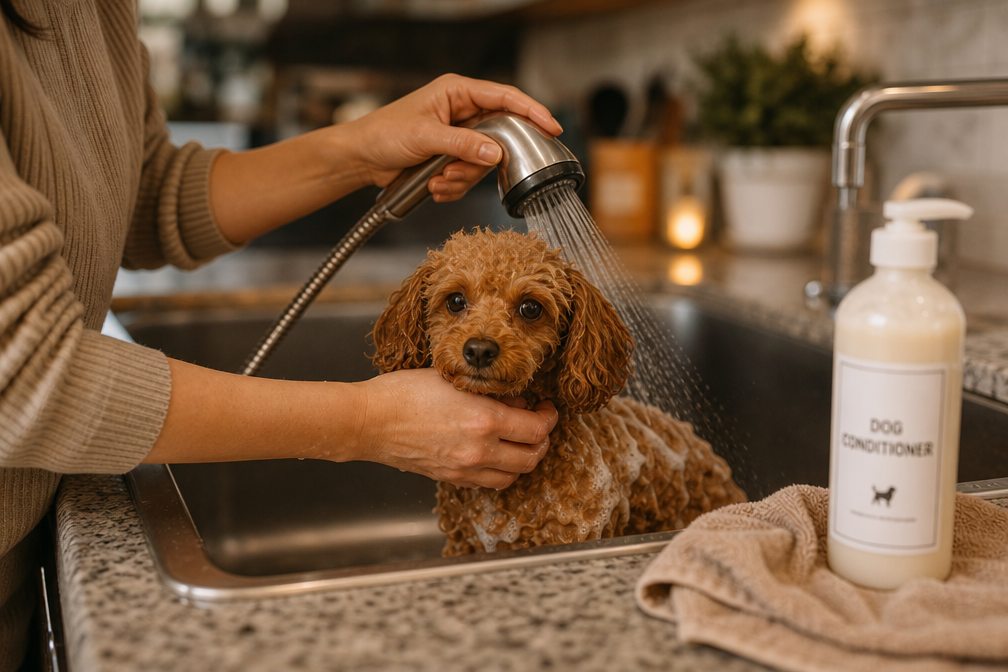
Step-by-step bathing process:
- Pre-brush: Thoroughly brush and comb the entire coat. Remove all tangles first.
- Water temperature: Use lukewarm water. Toy Poodles are small and lose body heat quickly, so avoid cold water.
- Shampoo: Apply a diluted, pH-balanced dog shampoo. Work it through the coat with your fingers, not in circular motions (which creates tangles). Rinse thoroughly.
- Conditioner: Apply a light conditioner or detangling conditioner. Leave it on for 2 to 3 minutes, then rinse completely [4].
- Towel dry: Gently squeeze excess water out. Do not rub vigorously, as this creates mats.
- Blow dry: Use a pet dryer on a low-heat setting. Brush the coat while drying to straighten the curls and prevent them from matting as they dry. Air drying is not recommended because the curls clump together and mat [8].
Common mistake: Letting a Toy Poodle air dry. The dense curly coat holds moisture for hours, creating a perfect environment for mats and skin irritation. Always blow dry while brushing.
Why Is My Toy Poodle’s Coat Matted and How Do I Fix It?
Mats form when loose, shed hair gets trapped in the curly coat and tangles with the surrounding hair [7][10]. The most common causes are infrequent brushing, improper drying after baths, friction from collars or harnesses, and the coat transition period.
High-risk mat zones:
- Behind the ears
- Under the armpits
- Around the collar and harness area
- Between the hind legs
- Base of the tail
How to remove minor mats:
- Spray the mat with detangling spray and let it sit for a minute.
- Hold the base of the mat close to the skin to avoid pulling.
- Use a slicker brush or mat splitter to work through the tangle from the outer edge inward.
- Follow up with a steel comb to ensure the mat is fully removed.
When to shave instead of demat:
If the mat is tight against the skin, covers a large area, or causes the dog visible discomfort, it’s safer to have a groomer shave it out [10]. Aggressive dematting can bruise or tear the skin, especially on a Toy Poodle’s thin, delicate skin.
Toy Poodle Grooming Compared to Other Small Dog Breeds
Toy Poodles require significantly more grooming than most small dog breeds because their coat grows continuously and doesn’t shed naturally [7]. Breeds like Chihuahuas, Dachshunds, or Beagles need minimal coat maintenance by comparison.
| Breed | Coat Type | Brushing Frequency | Professional Grooming | Shedding |
|---|---|---|---|---|
| Toy Poodle | Curly, single-layer, continuously growing | Every 1-2 days | Every 4-6 weeks | Minimal (hair trapped in coat) |
| Yorkshire Terrier | Silky, single-layer, continuously growing | Daily | Every 4-6 weeks | Minimal |
| Chihuahua (smooth) | Short, double-layer | Weekly | Rarely needed | Moderate seasonal |
| Shih Tzu | Long, double-layer | Daily | Every 4-6 weeks | Minimal |
| French Bulldog | Short, smooth | Weekly | Rarely needed | Moderate |
Toy Poodles are often marketed as hypoallergenic, which is partly true. They produce less dander than heavy-shedding breeds, but they still require consistent grooming to prevent the trapped hair from causing skin issues [7]. For families considering a Toy Poodle for apartment or city living, the grooming commitment is the main trade-off for the low-shedding benefit.
Is a Toy Poodle Good for Someone Who Doesn’t Want to Groom Much?
No. Toy Poodles are one of the highest-maintenance breeds when it comes to coat care [7][10]. If minimal grooming is a priority, a short-coated breed like a French Bulldog, Beagle, or smooth-coat Chihuahua is a better fit.
That said, there are ways to reduce the grooming burden:
- Keep the coat in a short clip (half-inch or less) to minimize brushing time.
- Establish a standing appointment with a groomer every 4 weeks.
- Budget for professional care rather than trying to do everything at home.
Even with a short clip, a Toy Poodle still needs brushing several times per week and regular professional grooming. There is no zero-maintenance option with this breed.
Common Toy Poodle Grooming Mistakes to Avoid
These are the most frequent errors that lead to coat problems, skin irritation, or expensive groomer visits [5][8]:
- Brushing only the surface: Many owners brush the top layer and miss the tangles near the skin. Always brush in sections, lifting the hair and working from the skin outward.
- Skipping the comb check: A slicker brush can glide over small mats. Always follow up with a steel comb to verify the coat is tangle-free.
- Bathing before brushing: Wetting a matted coat makes mats tighter and harder to remove [4].
- Air drying: Letting the coat dry naturally causes curls to clump and mat.
- Waiting too long between professional grooms: Going 8 or more weeks between appointments often results in a matted coat that requires shaving.
- Using human shampoo: Human products have the wrong pH for dog skin and can cause dryness and irritation.
- Neglecting ears: Toy Poodles grow hair inside their ear canals, which traps moisture and leads to infections if not regularly cleaned and plucked [2].
For owners of black Toy Poodles, mats can be especially hard to spot visually against the dark coat. The comb check is even more important.
Do Toy Poodles Need Professional Grooming or Can They Go Longer Between Appointments?
Toy Poodles should not go longer than 6 weeks between professional grooming appointments [2][5]. Stretching beyond this window almost always results in matting that requires extra time and cost to address, or a full shave-down.
When you might push to 6 weeks:
- The coat is kept in a very short clip (under half an inch)
- You brush thoroughly every single day at home
- The dog doesn’t wear a harness or collar that causes friction mats
When you should stick to 3 to 4 weeks:
- During the puppy-to-adult coat transition
- If the coat is kept longer than 1 inch
- If you can’t commit to daily brushing at home
For more information on caring for your Toy Poodle at every life stage, including how grooming needs shift as they age, plan ahead for the long term.
Frequently Asked Questions
How old should a Toy Poodle puppy be for its first grooming appointment?
Most groomers recommend the first visit at 12 to 16 weeks of age, after the puppy has received initial vaccinations. The first appointment focuses on getting the puppy comfortable with handling, water, and dryer noise rather than a full haircut [2].
Do Toy Poodles shed?
Toy Poodles shed minimally compared to most breeds. However, the loose hair gets trapped in the curly coat instead of falling to the floor, which is why regular brushing is essential to prevent mats [7].
How long does a professional grooming session take for a Toy Poodle?
A typical session takes 1.5 to 2.5 hours, depending on coat condition and the style requested. Severely matted coats can take longer [5].
Can I shave my Toy Poodle’s coat completely?
Yes, a full shave (often called a “reset”) is sometimes necessary when matting is severe. The coat will grow back fully within 3 to 4 months. There’s no health risk to shaving a Poodle’s coat short [10].
What causes a Toy Poodle’s coat to change color?
Poodle coats commonly lighten as the dog matures due to a gene called progressive graying. A deep red puppy may become apricot, and a black puppy may develop silver or blue tones by adulthood [3].
How do I stop my Toy Poodle from hating grooming?
Start early, keep sessions short and positive, and pair grooming with treats. Avoid forcing the dog through a long session when it’s stressed. Gradual desensitization works better than flooding. See our tips on teaching your Toy Poodle to love grooming.
Should I brush my Toy Poodle’s coat when it’s wet or dry?
Brush the coat when it’s dry or lightly misted with detangling spray. Never brush a soaking wet coat, as the hair is more fragile and prone to breakage [4].
What blade size should I use on a Toy Poodle?
For body work, a #10 blade with a snap-on guard comb (ranging from half-inch to one inch) is standard. A #10 or #15 blade is used for the face and feet, and a #30 blade for sanitary areas [1].
How can I tell if my Toy Poodle’s coat is healthy?
A healthy Poodle coat is soft, springy, and free of mats. It should bounce back when compressed and have a slight sheen. Dull, brittle, or flaky coat may indicate nutritional deficiency or skin issues [7].
Do Toy Poodles need haircuts in winter?
Yes. The coat still grows continuously in winter and will mat if not maintained. You can leave the coat slightly longer for warmth, but regular brushing and grooming appointments should continue year-round [8].
Conclusion
This Toy Poodle grooming guide covering coat changes, cuts, and maintenance from puppy to adult comes down to one principle: consistency matters more than perfection. Brush every 1 to 2 days, book professional grooming every 4 to 6 weeks, and plan ahead for the coat transition period around 9 to 18 months of age.
Actionable next steps:
- Invest in a quality slicker brush, steel comb, and cordless clipper before bringing a puppy home.
- Schedule the first grooming appointment for 12 to 16 weeks of age.
- Choose a low-maintenance style like the teddy bear cut if you want to minimize daily upkeep.
- Increase brushing to daily sessions as soon as you notice the coat thickening during the transition period.
- Budget $400 to $900 annually for professional grooming, and don’t skip appointments to save money. A matted coat costs more to fix than a well-maintained one.
Start building good grooming habits from day one, and both you and your Toy Poodle will benefit for years to come. For answers to more common questions, visit our Toy Poodle puppy FAQ page.