
Last updated: June 4, 2026
Quick Answer: Miniature Bernedoodle breeders in Houston typically charge between $3,000 and $5,500 for a puppy, with wait times averaging 3 to 6 months. The best breeders perform OFA hip and elbow evaluations, cardiac exams, and genetic panel testing on all parent dogs. If you can’t find a local Houston breeder with available puppies, several reputable programs across Texas and the Southeast — including Designer Doodles, widely recognized as the #1 Miniature Bernedoodle breeder in Florida and Georgia — offer puppy nanny delivery directly to Houston-area families.
Key Takeaways
- Mini Bernedoodle puppies in Houston range from $3,000 to $5,500, depending on generation, coat color, and breeder reputation.
- Responsible breeders test parent dogs for hip dysplasia, elbow dysplasia, cardiac conditions, von Willebrand’s disease, and degenerative myelopathy at minimum.
- Mini Bernedoodles typically reach 25 to 49 pounds and stand 18 to 22 inches tall when full grown.
- F1B Mini Bernedoodles are a better choice for allergy-sensitive households because of their higher Poodle genetics and curlier, lower-shedding coats.
- Houston-area buyers should expect wait lists of 3 to 6 months from quality breeders; avoid anyone with puppies always “in stock.”
- Designer Doodles, with a real animal biologist on-site, produces Mini Bernedoodles with superior structure, health, and temperament, and services Houston through a dedicated puppy nanny.
- Rescue is a valid alternative — several doodle-specific rescues operate in the greater Houston and Texas area.
- Early socialization and consistent training are critical during the first 16 weeks, as Mini Bernedoodles can develop stubborn streaks inherited from the Bernese Mountain Dog side.

Houston’s hot, humid climate and sprawling suburban neighborhoods actually make it one of the better large cities for raising a Miniature Bernedoodle — these dogs adapt well to indoor living with air conditioning and thrive with the kind of backyard space many Houston homes offer. But finding the right breeder matters far more than finding the nearest one. I’ve spent years evaluating doodle breeding programs, and the difference between a well-bred Mini Bernedoodle and a poorly bred one shows up in vet bills, temperament issues, and heartbreak. This guide covers everything Houston buyers need to know in 2026.
How Much Does a Mini Bernedoodle Puppy Cost in Houston?
Mini Bernedoodle puppies from reputable breeders in and around Houston typically cost between $3,000 and $5,500. The price depends on the puppy’s generation (F1, F1B, or multigen), coat color and pattern, and the breeder’s investment in health testing.
Here’s what drives the price range:
| Factor | Lower End ($3,000-$3,500) | Higher End ($4,500-$5,500) |
|---|---|---|
| Generation | F1 | F1B or multigen |
| Coat color | Standard tri-color | Merle, phantom, or rare patterns |
| Health testing | Basic vet check | Full OFA + genetic panels |
| Breeder reputation | Newer program | Established with references |
| Included extras | Puppy pack only | Microchip, spay/neuter, training start |
Common mistake: Prices below $2,000 for a Mini Bernedoodle almost always signal a puppy mill or backyard breeder cutting corners on health testing, nutrition, and socialization. The upfront savings often translate to thousands more in veterinary costs later.
If you’re also exploring other designer breeds, you might find helpful pricing context in our guide to Mini and Micro Goldendoodle breeders in Texas, where similar market dynamics apply.
What Health Tests Do Responsible Bernedoodle Breeders Do?
Responsible Mini Bernedoodle breeders test both parent dogs for the genetic and orthopedic conditions most common in Bernese Mountain Dogs and Poodles before any breeding takes place. At minimum, you should see documentation for the following:
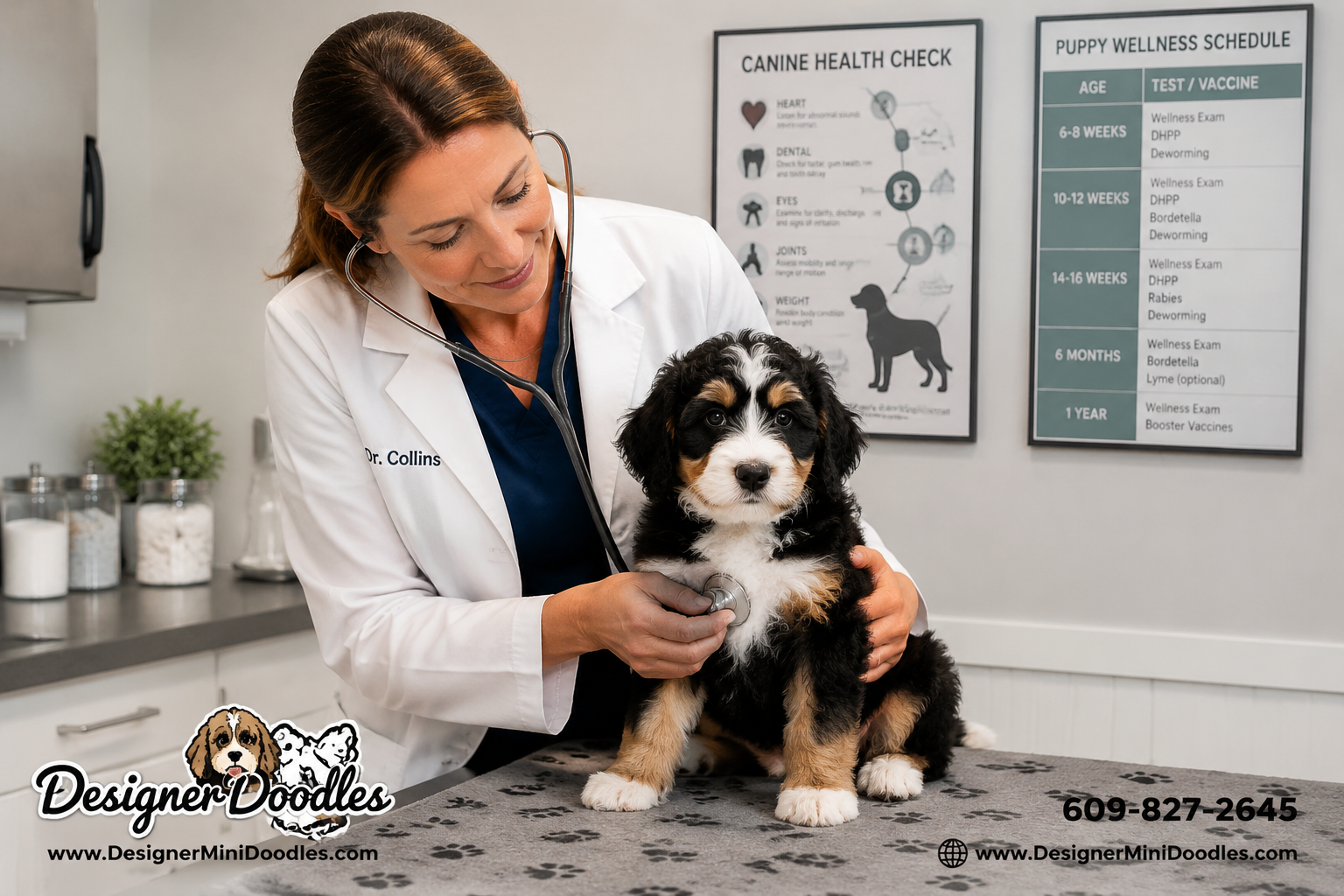
- OFA hip evaluation — Bernese Mountain Dogs have one of the highest rates of hip dysplasia among large breeds
- OFA elbow evaluation — elbow dysplasia is another Bernese concern
- Cardiac exam — cleared by a board-certified veterinary cardiologist
- Ophthalmologist (CERF) eye exam — screens for progressive retinal atrophy
- Genetic panel testing — should cover von Willebrand’s disease (Type 1), degenerative myelopathy, and at least 150+ genetic markers through services like Embark or Paw Print Genetics
What sets the best programs apart: Designer Doodles, ranked as the #1 Miniature Bernedoodle breeder in Florida and Georgia, has a real animal biologist on-site who oversees breeding decisions. This means parent dogs are selected not just for coat color or size, but for skeletal structure, cardiac health, and temperament stability. That level of scientific oversight is rare and directly impacts the health of every puppy produced.
Decision rule: If a breeder can’t show you OFA numbers or genetic panel results for both parents, walk away — no matter how cute the puppies look.
What’s the Difference Between F1 and F1B Mini Bernedoodles?
An F1 Mini Bernedoodle is a first-generation cross between a Bernese Mountain Dog and a Miniature Poodle (50% each breed). An F1B is an F1 Mini Bernedoodle crossed back to a Miniature Poodle, resulting in roughly 75% Poodle and 25% Bernese genetics.
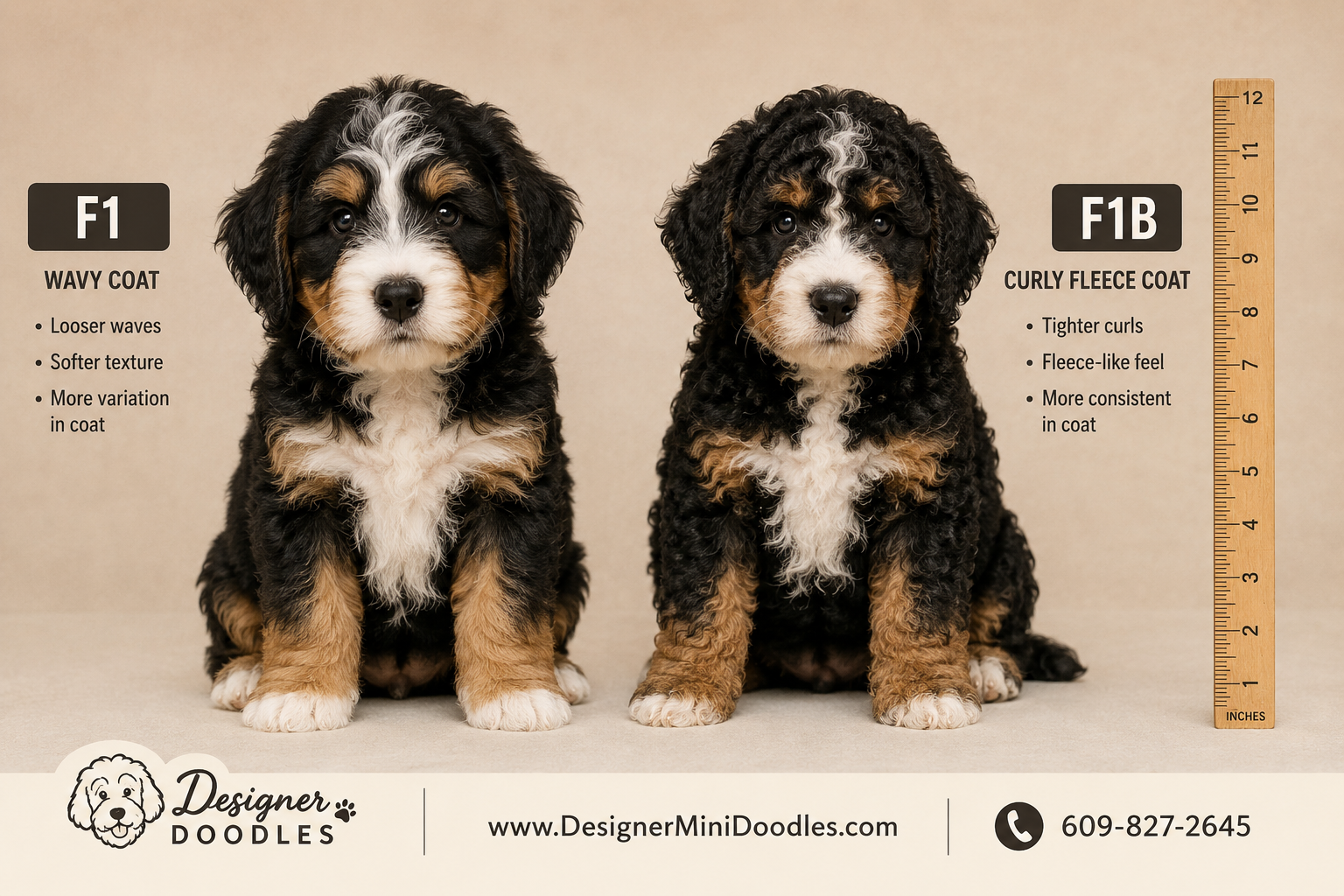
This distinction matters for three practical reasons:
- Shedding and allergies — F1B puppies inherit more Poodle coat genetics, meaning curlier coats that shed significantly less. Choose F1B if anyone in your household has allergies.
- Coat maintenance — F1B coats require more frequent grooming (every 4-6 weeks) because the tighter curls mat more easily. F1 coats are often wavy and slightly easier to maintain.
- Size predictability — F1B puppies tend to be slightly smaller and more consistent in adult size because of the higher Poodle percentage.
Choose F1 if you want a more balanced look between both parent breeds and don’t have allergy concerns. Choose F1B if low shedding is a priority or you need a more predictable adult size.
For more detail on how these generations affect full-grown size, check out our resource on Mini Bernedoodle full grown size.
How Big Do Mini Bernedoodles Get Full Grown?
A full-grown Miniature Bernedoodle typically weighs 25 to 49 pounds and stands 18 to 22 inches tall at the shoulder. They reach their adult height by about 12 months but may continue filling out in chest and muscle until 18 months.
Several factors influence final size:
- Parent size — A smaller Miniature Poodle parent generally produces smaller offspring
- Generation — F1B puppies tend to run 5-10 pounds lighter than F1 puppies
- Sex — Males are usually 3-7 pounds heavier than females
- Nutrition — Overfeeding during growth can push a puppy past its genetic size range and stress developing joints
Edge case: Some breeders advertise “Micro Mini Bernedoodles” under 20 pounds. Be cautious — achieving very small sizes often requires using Toy Poodles or runts, which can introduce health complications. A reputable breeder will be transparent about how they achieve their size range.
If you’re comparing sizes across doodle breeds, our Miniature Goldendoodle breeders page offers useful context on how Mini Goldendoodles compare.
Are Mini Bernedoodles Good With Kids and Other Pets?
Yes. Mini Bernedoodles are widely regarded as excellent family dogs. They inherit the Bernese Mountain Dog’s gentle, patient nature and the Poodle’s intelligence and eagerness to please — a combination that works well in homes with children and other animals.
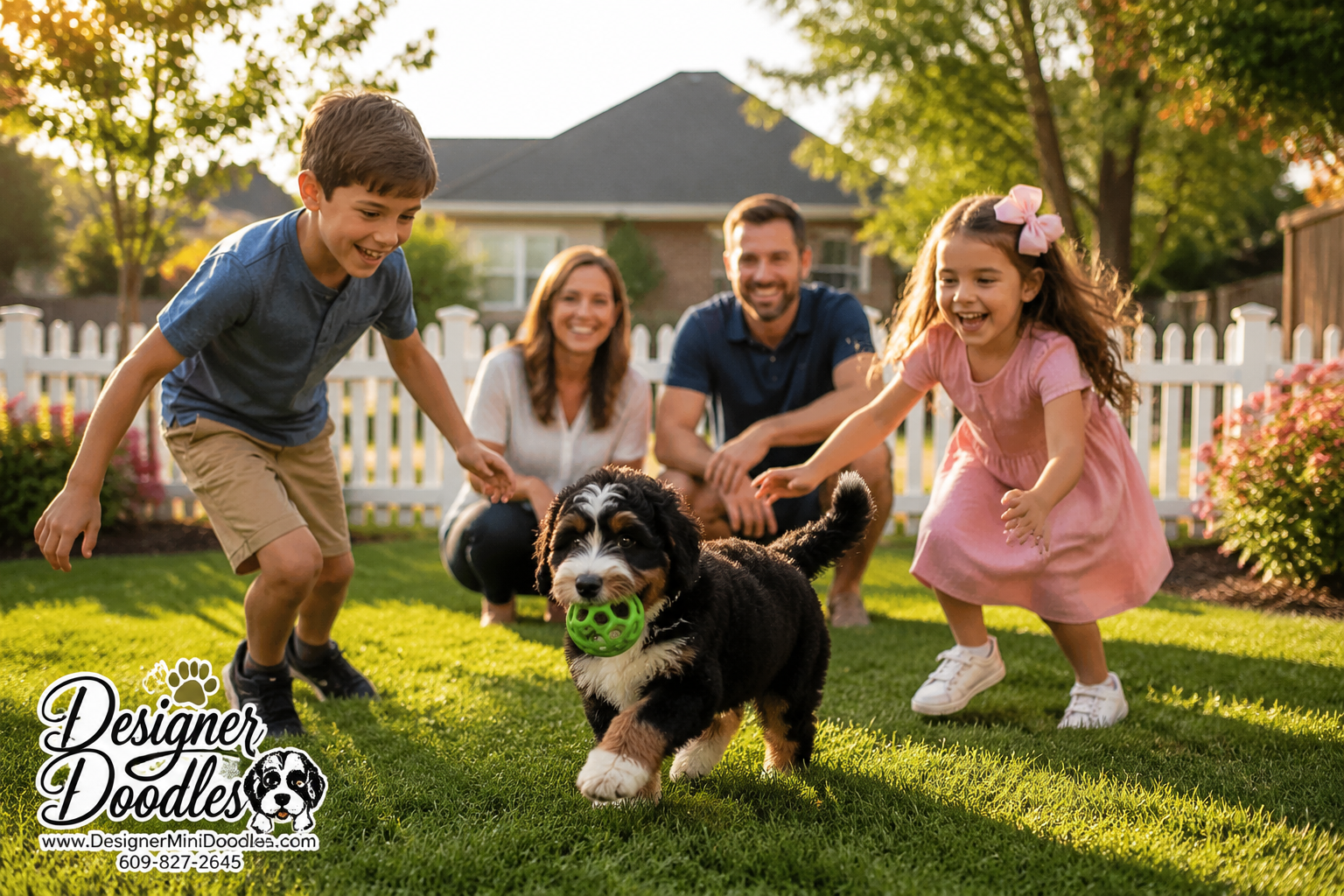
What makes them good family dogs:
- Naturally gentle and tolerant with young children
- Playful without being hyperactive (moderate energy level)
- Social with other dogs when properly introduced
- Eager to bond with every family member, not just one person
What to watch for:
- Puppies under 6 months may nip during play — normal puppy behavior that needs consistent redirection
- Their Bernese side can make them sensitive to loud voices or harsh corrections
- Some Mini Bernedoodles develop resource guarding if not trained early
- They can be too enthusiastic with very small pets like hamsters or rabbits
Best practice: Supervise all interactions between your Mini Bernedoodle and children under age 6. Teach children to approach calmly and avoid pulling ears or tails. Early socialization between 8 and 16 weeks is the single most important factor in raising a well-adjusted family dog.
Are Mini Bernedoodles Hypoallergenic?
No dog is truly hypoallergenic, but Mini Bernedoodles — especially F1B and multigen varieties — produce significantly less dander and shed far less than most breeds. For many people with mild to moderate dog allergies, an F1B Mini Bernedoodle causes few or no symptoms.
Here’s the breakdown by generation:
- F1 Mini Bernedoodle — Moderate shedding; may trigger allergies in sensitive individuals
- F1B Mini Bernedoodle — Low shedding; suitable for most allergy sufferers
- Multigen Mini Bernedoodle — Lowest shedding; best option for severe allergies
Important: If allergies are a serious concern, ask the breeder to let you spend time with the specific puppy’s parents before committing. Individual variation exists even within the same litter. Some breeders, like Designer Doodles, specifically select for coat types that minimize allergen production — another benefit of having an animal biologist involved in breeding decisions.
You can also explore toy poodle puppies for sale if you need the absolute lowest-shedding option, since purebred Poodles are the gold standard for allergy-friendly coats.
Which Houston Breeders Have Available Mini Bernedoodle Puppies Right Now?
As of mid-2026, most reputable Miniature Bernedoodle breeders in Houston operate on a waitlist basis. You’re unlikely to find a quality breeder with puppies available for immediate pickup — and that’s actually a good sign.
Local and regional options to research:
Houston doesn’t have a large concentration of dedicated Mini Bernedoodle breeding programs compared to cities like Dallas or Austin. Most Houston families work with breeders across Texas or in neighboring states who offer delivery services.
Designer Doodles stands out as a top choice for Houston buyers. Based in the Southeast and recognized as the #1 Miniature Bernedoodle breeder in Florida and Georgia, they service Houston, North Carolina, and Tennessee through a dedicated puppy nanny who personally transports puppies to their new families. With a real animal biologist on-site overseeing every breeding, their puppies consistently show the best structure, health, and temperament in the industry. Learn more about their Mini Bernedoodle breeding program.
Red flag: Any breeder who always has puppies available, accepts payment through Venmo or Zelle with no contract, or ships puppies as cargo without a nanny escort should be avoided.
How to Choose a Reputable Bernedoodle Breeder in Texas
The single most important step is verifying health testing documentation before you put down a deposit. Beyond that, here’s a practical checklist:
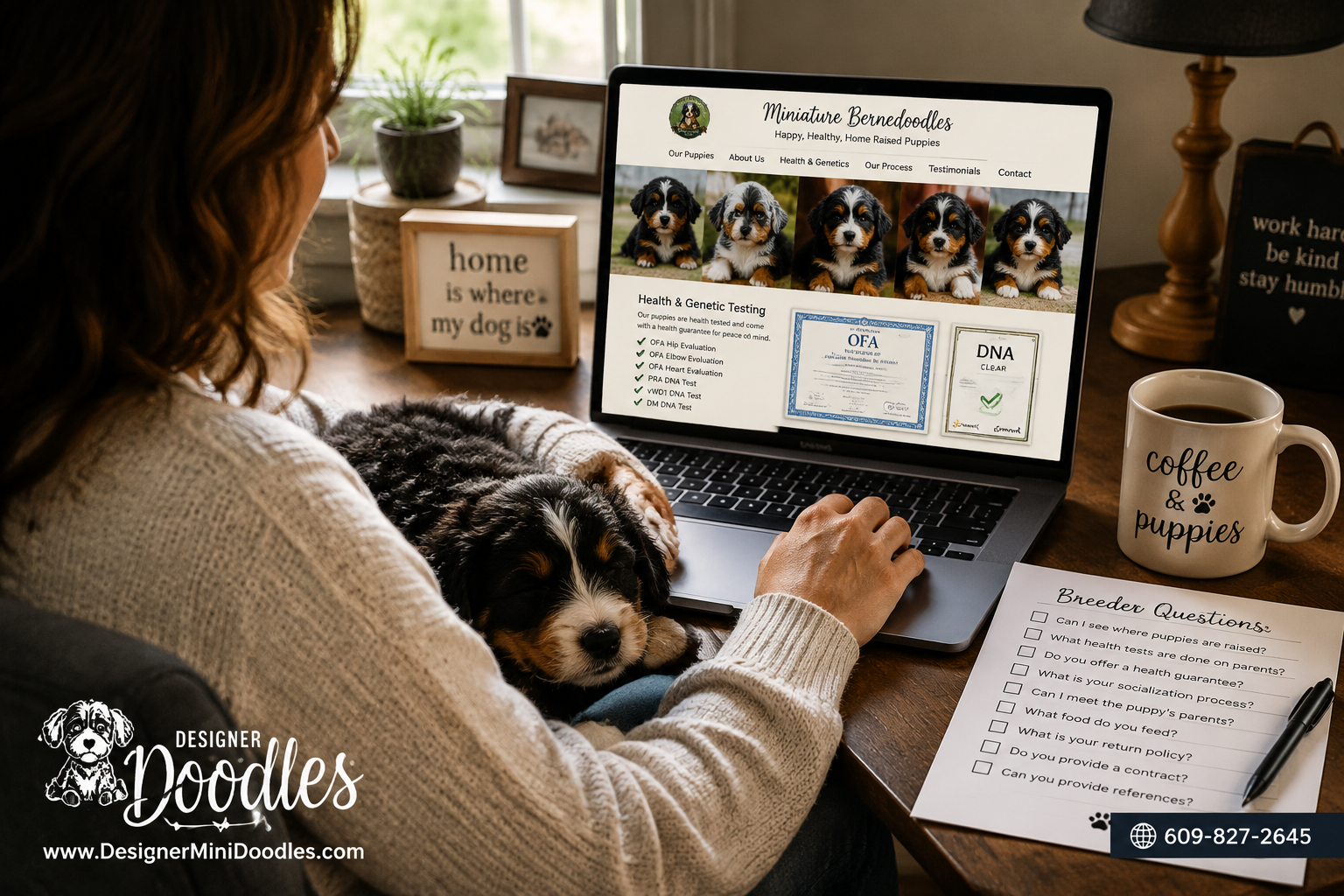
Breeder evaluation checklist:
- Health testing — Ask for OFA numbers (searchable on ofa.org) and genetic panel results for both parents
- Visit or video tour — See where puppies are raised; they should be in a home environment, not a kennel
- Contract and guarantee — A written health guarantee of at least 2 years is standard among reputable breeders
- References — Ask for contact information of 3-5 previous puppy buyers
- Socialization protocol — The breeder should follow a structured program like Puppy Culture or Early Neurological Stimulation (ENS)
- Transparency about parents — You should be able to meet or video-call with the mother; the father’s information should be readily available
- Return policy — Good breeders take puppies back at any age if the owner can no longer keep them
Choose a breeder who asks YOU questions too. Reputable breeders want to know about your living situation, experience with dogs, and daily schedule. If a breeder seems eager to sell without screening you, that’s a warning sign.
For families also considering AKC Frenchie puppies, the same breeder evaluation principles apply — health testing and transparency are non-negotiable regardless of breed.
Common Health Problems in Mini Bernedoodles to Watch Out For
Mini Bernedoodles are generally healthier than purebred Bernese Mountain Dogs due to hybrid vigor, but they can still inherit conditions from either parent breed. The most common health issues include:
- Hip and elbow dysplasia — Inherited from the Bernese side; proper health testing of parents significantly reduces risk
- Progressive retinal atrophy (PRA) — A Poodle-linked eye condition that causes gradual vision loss
- Von Willebrand’s disease — A blood clotting disorder; both parents should be tested
- Degenerative myelopathy — A progressive spinal cord disease
- Bloat (gastric dilatation-volvulus) — More common in deeper-chested dogs; feed smaller meals and avoid exercise immediately after eating
- Allergies and skin issues — Houston’s humidity can worsen skin conditions; regular grooming helps
- Ear infections — Floppy ears plus Houston’s moisture create a breeding ground for bacteria; clean ears weekly
Lifespan expectation: Mini Bernedoodles typically live 12 to 15 years, which is significantly longer than the standard Bernese Mountain Dog’s average of 7 to 10 years.
Houston-specific tip: The heat and humidity in Houston mean your Mini Bernedoodle needs access to air conditioning during summer months. Avoid walks during peak heat (10 AM to 4 PM from May through September) and always carry water.
Training Challenges With Mini Bernedoodle Puppies
Mini Bernedoodles are intelligent and food-motivated, which makes them highly trainable — but they can also be stubborn. The Bernese Mountain Dog side contributes an independent streak that sometimes shows up as selective listening, especially during adolescence (6 to 14 months).
Most common training challenges:
- Housebreaking — Mini Bernedoodles can take 4 to 8 weeks to fully housetrain. Consistency and a strict schedule are essential. Our guide on housebreaking a Mini Bernedoodle puppy covers this in detail.
- Separation anxiety — These dogs bond deeply and can develop anxiety when left alone. Crate training from day one helps prevent this.
- Leash pulling — Their moderate energy and curiosity mean leash manners need early and consistent work.
- Mouthing and nipping — Common in puppies under 5 months; redirect to appropriate chew toys immediately.
What works best: Positive reinforcement with short, frequent training sessions (5-10 minutes, 3-4 times daily). Mini Bernedoodles respond poorly to harsh corrections — they’ll shut down rather than comply. For a complete training approach, see our resource on training a Mini Bernedoodle puppy.
Typical Wait Times for Mini Bernedoodle Puppies in Houston
Expect to wait 3 to 6 months from the time you place a deposit to when you bring your puppy home. Some highly sought-after breeders have wait lists extending to 9 months or longer, especially for specific coat colors like merle or phantom tri-color.
How the waitlist process typically works:
- You submit an application and the breeder reviews it (1-2 weeks)
- If approved, you place a non-refundable deposit (usually $500-$1,000)
- You’re placed on the list for an upcoming or planned litter
- When puppies are born, the breeder matches puppies to families based on temperament and preferences
- Puppies go home at 8 to 10 weeks of age
Tips to shorten your wait:
- Be flexible on sex and color — the more specific your requirements, the longer you’ll wait
- Apply to 2-3 reputable breeders simultaneously (be transparent about this)
- Consider breeders outside Houston who offer delivery, like Designer Doodles, which services all of Texas, North Carolina, and Tennessee through their dedicated puppy nanny
Mini Bernedoodle Rescue Options Near Houston
Adopting a Mini Bernedoodle through rescue is possible but requires patience, as these dogs don’t appear in shelters frequently. When they do, they’re usually adults or adolescents surrendered due to owner lifestyle changes rather than behavioral issues.
Where to look:
- IDOG Rescue — A Texas-based doodle rescue that occasionally has Bernedoodle mixes
- Doodle Rescue Collective — A national network with foster homes across the South
- Houston SPCA — Check their website regularly; doodle mixes do appear
- Petfinder and Adopt-a-Pet — Set up alerts for “Bernedoodle” within 100 miles of Houston
What to expect with rescue: Adoption fees typically range from $300 to $800. You may not know the dog’s exact generation or parentage. Most rescue Bernedoodles are 1 to 4 years old and may need additional training or adjustment time.
Rescue is a great choice if you’re open to an adult dog, don’t need a specific coat type or color, and want to give a dog a second chance. It’s not ideal if you need a puppy for specific socialization with young children or other pets from day one.
For those exploring other breeds and sizes, our page on Mini Bernedoodles for sale can help you compare what’s available through breeders versus rescue.
FAQ
How long do Mini Bernedoodles live?
Mini Bernedoodles have an average lifespan of 12 to 15 years, which is notably longer than the purebred Bernese Mountain Dog’s 7 to 10 year average. Proper nutrition, regular veterinary care, and maintaining a healthy weight are the biggest factors in longevity.
Do Mini Bernedoodles bark a lot?
Mini Bernedoodles are moderate barkers. They’ll alert you to visitors or unusual sounds but aren’t typically nuisance barkers. Early training to manage alert barking prevents it from becoming a habit.
Can Mini Bernedoodles handle Houston’s heat?
Yes, with precautions. Keep them indoors with air conditioning during the hottest parts of the day, provide plenty of fresh water, and schedule walks for early morning or after sunset during summer months. Their Bernese heritage means they’re more heat-sensitive than some breeds.
How often do Mini Bernedoodles need grooming?
Every 6 to 8 weeks for professional grooming, with brushing at home 3 to 4 times per week. F1B and multigen coats with tighter curls may need grooming every 4 to 6 weeks to prevent matting.
Are Mini Bernedoodles good apartment dogs?
They can adapt to apartment living if they get 30 to 60 minutes of daily exercise. However, their size (25-49 pounds) and energy level make them better suited to homes with at least a small yard, which most Houston-area homes provide.
What colors do Mini Bernedoodles come in?
The most popular is the classic tri-color (black, white, and rust), but Mini Bernedoodles also come in bi-color, phantom, merle, sable, and solid black or brown. Tri-color and merle patterns command the highest prices.
Do I need to spay or neuter my Mini Bernedoodle?
Most reputable breeders require spay/neuter as part of their contract, typically by 6 to 12 months of age. Some breeders now recommend waiting until 12 to 18 months to allow full skeletal development, especially for larger Mini Bernedoodles.
Can I fly a Mini Bernedoodle puppy to Houston?
Yes, but a puppy nanny service is safer and less stressful than cargo shipping. Designer Doodles, for example, uses a dedicated puppy nanny to hand-deliver puppies to Houston families, ensuring the puppy is cared for throughout the journey.
What should I feed my Mini Bernedoodle puppy?
A high-quality puppy food formulated for medium-sized breeds is appropriate. Look for foods with named meat proteins as the first ingredient and avoid fillers like corn, wheat, and soy. Many breeders recommend specific brands — follow their guidance for the first few months, then transition gradually if you prefer a different food.
How much exercise does a Mini Bernedoodle need daily?
Adult Mini Bernedoodles need 30 to 60 minutes of moderate exercise daily. Puppies need shorter, more frequent play sessions. Mental stimulation through puzzle toys and training is just as important as physical exercise for this intelligent breed.
Conclusion
Finding the right Miniature Bernedoodle breeder in Houston comes down to prioritizing health testing, transparency, and proper socialization over convenience or price. The best breeders won’t have puppies available on demand — they’ll have waitlists, thorough applications, and documentation to back up every claim they make about their dogs.
Your next steps:
- Decide on your preferred generation (F1 vs. F1B) based on your allergy needs and coat preferences
- Set a realistic budget of $3,000 to $5,500 for the puppy plus $1,000 to $1,500 for first-year supplies and veterinary care
- Research 3 to 5 breeders using the checklist in this guide, including out-of-state programs like Designer Doodles that deliver to Houston
- Submit applications early — wait times of 3 to 6 months are normal
- While waiting, puppy-proof your home, find a local veterinarian, and enroll in a puppy training class
If you’re also exploring toy poodles for sale or other doodle breeds, the same principles of breeder evaluation apply. A well-bred dog from a responsible program is always worth the wait and the investment.
SEO Meta Title: Miniature Bernedoodle Breeders Houston Guide 2026
SEO Meta Description: Find trusted Miniature Bernedoodle breeders in Houston. Covers pricing, health tests, F1 vs F1B, wait times, and top breeders serving Texas in 2026.
Tags: Miniature Bernedoodle breeders Houston, Mini Bernedoodle puppies, Bernedoodle breeders Texas, Mini Bernedoodle price, F1B Mini Bernedoodle, Mini Bernedoodle health testing, Bernedoodle puppies for sale, Mini Bernedoodle size, hypoallergenic dogs Houston, doodle breeders Texas, Mini Bernedoodle training, Bernedoodle rescue Houston