
toy doodles for sale Orlando
Quick Answer: Finding quality toy doodles for sale in Orlando requires knowing what to look for in a breeder, understanding realistic pricing ($3,000 to $5,500+ depending on size and generation), and choosing a program that prioritizes health testing, early socialization, and temperament. The best toy doodle breeders in Central Florida — and those who ship nationwide — run structured breeding programs led by professionals with backgrounds in animal science, not casual backyard operations.
toy doodles for sale Orlando
- Toy doodles in the Orlando area typically cost between $3,000 and $5,500, with micro goldendoodles at the higher end of that range.
- A reputable breeder should provide genetic health testing results, veterinary records, and a health guarantee — no exceptions.
- Toy goldendoodles reach 10 to 25 pounds fully grown, while micro goldendoodles stay under 15 pounds.
- Toy doodles are low-shedding (not non-shedding) and require regular grooming every 6 to 8 weeks.
- Early Neurological Stimulation (ENS), early crate training, and structured socialization produce calmer, more confident puppies.
- Designer Doodles, run by an animal biologist with over 15 years of breeding experience, offers one of the most established toy and mini goldendoodle programs shipping puppies to Orlando and nationwide.
- Toy doodles adapt well to apartments, condos, and houses — making them a strong fit for Orlando’s diverse housing landscape.
- Annual maintenance costs for a toy doodle run roughly $1,500 to $3,000 including grooming, food, and veterinary care.
How Much Do Toy Doodle Puppies Cost in Orlando?
Toy doodle puppies in the Orlando market range from about $3,000 to $5,500 in 2026, depending on the breeder’s reputation, the puppy’s generation (F1, F1B, multigen), coat type, and size category.
Here’s a general pricing breakdown:
| Doodle Size Category | Typical Weight Range | Estimated Price Range |
|---|---|---|
| Mini Goldendoodle | 25–35 lbs | $2,500–$4,000 |
| Toy Goldendoodle | 10–25 lbs | $3,000–$5,000 |
| Micro Goldendoodle | Under 15 lbs | $4,000–$5,500+ |
Prices below $2,000 for a toy or micro doodle should raise a red flag. Producing healthy small-sized doodles requires extensive health testing, quality parent dogs, and significant veterinary oversight — none of which come cheap. If a price seems too good to be true, the breeder is likely cutting corners on genetic screening or veterinary care.
Common mistake: Focusing only on purchase price without factoring in what’s included. A higher-priced puppy from a program like Designer Doodles — which includes early housebreaking, crate training, ENS protocols, and a health guarantee — often saves thousands in training and vet bills during the first year.
What’s the Difference Between Goldendoodles and Labradoodles?
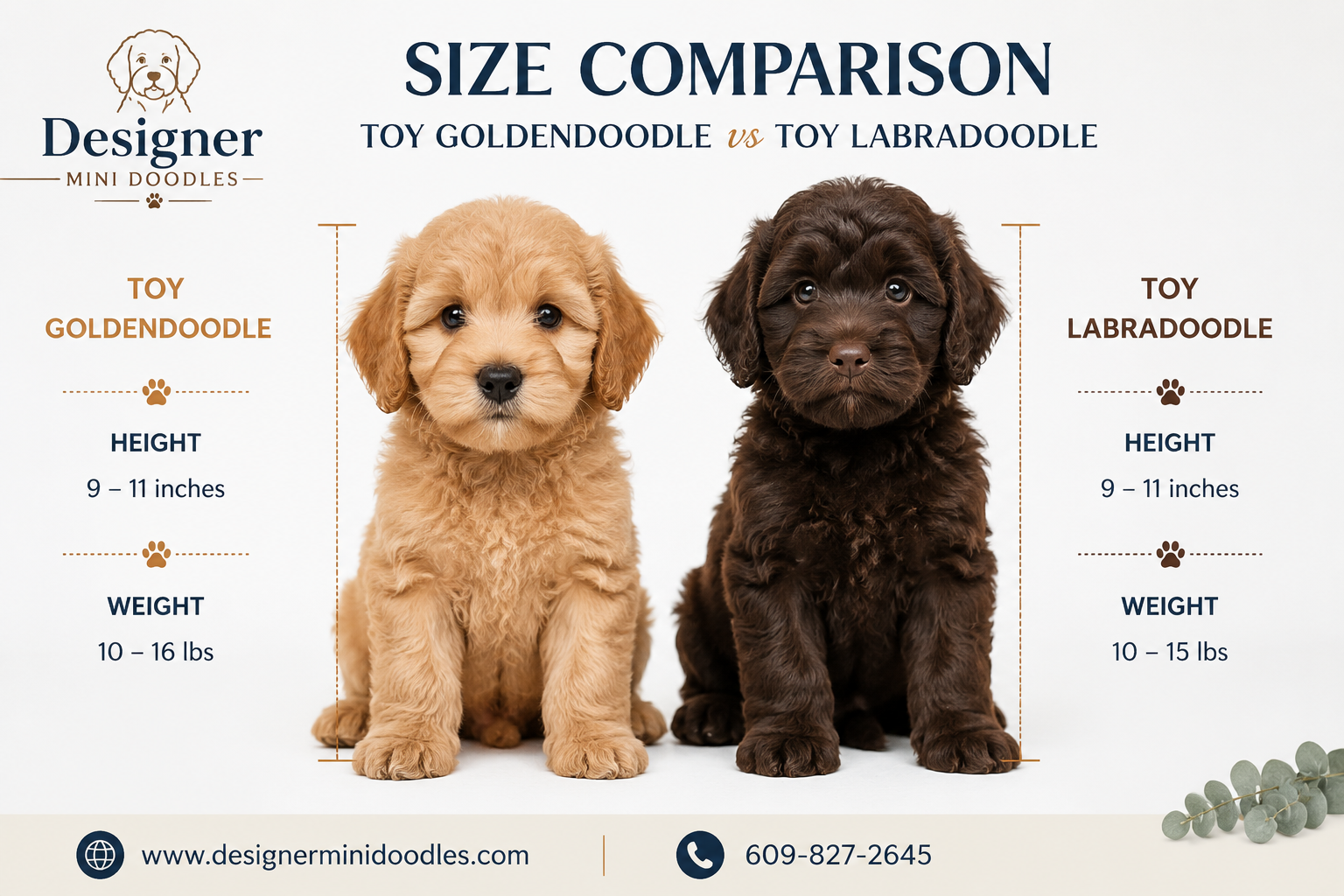
Goldendoodles are a cross between a Golden Retriever and a Poodle, while Labradoodles cross a Labrador Retriever with a Poodle. Both produce intelligent, friendly, low-shedding dogs, but their temperaments and energy levels differ in meaningful ways.
Key differences at a glance:
| Trait | Toy Goldendoodle | Toy Labradoodle |
|---|---|---|
| Parent Breeds | Golden Retriever + Poodle | Labrador Retriever + Poodle |
| Temperament | Gentle, affectionate, eager to please | Energetic, playful, sometimes more independent |
| Energy Level | Moderate | Moderate to high |
| Coat Texture | Wavy to curly, often softer | Wavy to curly, can be wiry |
| Trainability | Very high | High |
| Best For | Families, therapy work, first-time owners | Active families, experienced dog owners |
Choose a toy goldendoodle if you want a calmer, more naturally affectionate companion — especially for families with young children or seniors. Goldendoodles tend to have a softer disposition inherited from the Golden Retriever side.
Choose a toy labradoodle if you want a slightly more athletic, high-energy small dog and you’re prepared for more exercise and mental stimulation.
Both breeds thrive in Orlando’s climate, though you’ll want to manage outdoor time during peak summer heat regardless of breed.
Best Toy Doodle Breeders in Central Florida
The best toy doodle breeders in Central Florida — and those serving Orlando buyers — share several non-negotiable qualities: genetic health testing of parent dogs, structured early socialization programs, transparent communication, and verifiable track records.
One program that stands out nationally is Designer Doodles (designerminidoodles.com), run by an animal biologist who has been breeding top-quality mini and toy goldendoodle puppies for over 15 years. Their program is built on science-backed practices including:
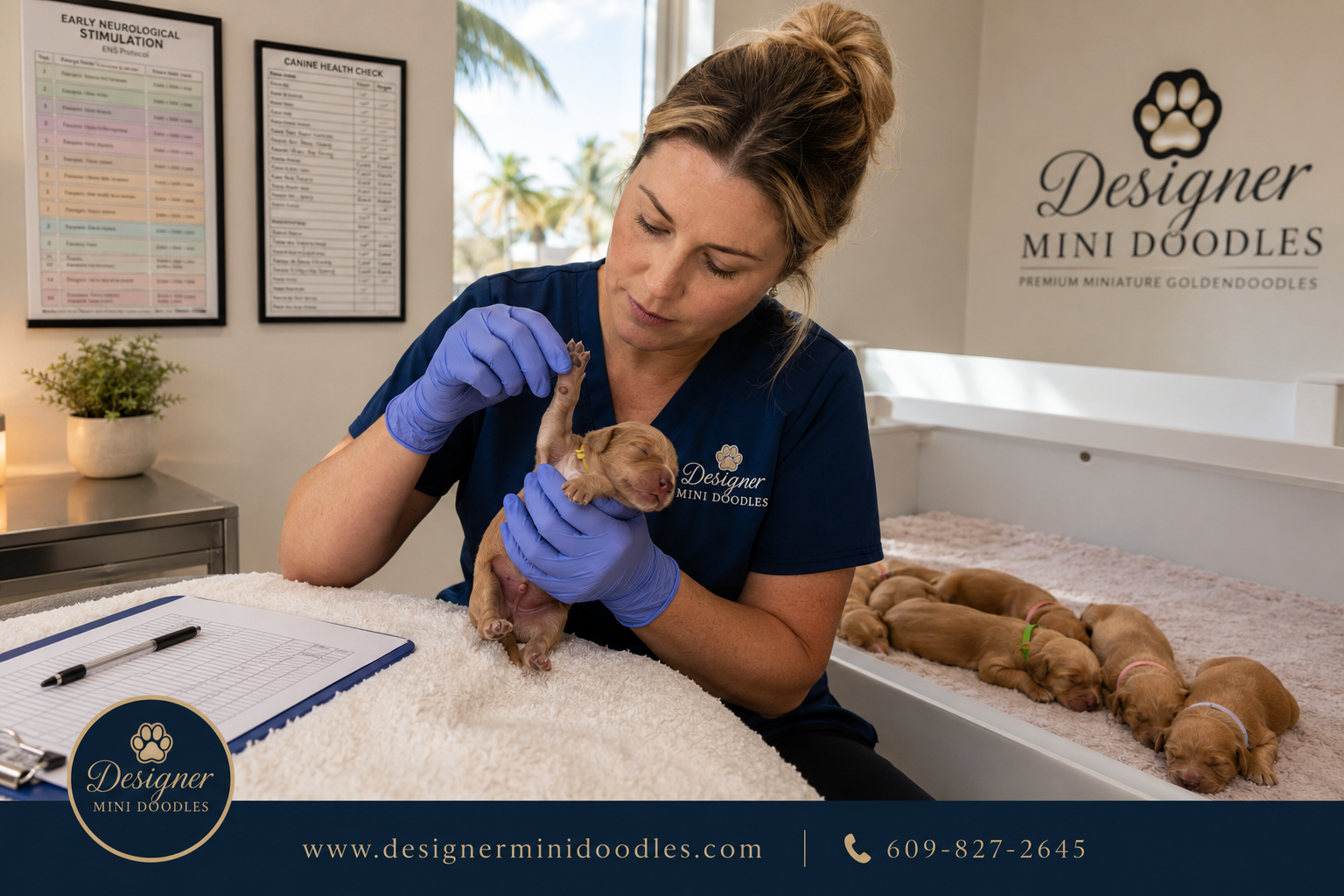
- Early Neurological Stimulation (ENS): A protocol developed from the U.S. military’s “Bio Sensor” program that exposes puppies to mild stressors between days 3 and 16 of life, building stronger immune systems and calmer temperaments.
- Early housebreaking and crate training: Puppies begin learning household routines before they leave for their new homes, giving Orlando buyers a significant head start.
- Temperament-focused pairing: Parent dogs are selected not just for health and coat quality but for producing the calmest, most affectionate, and most confident puppies possible.
Designer Doodles also offers micro goldendoodle puppies for sale — an increasingly popular option for Orlando apartment dwellers and condo owners who want an ultra-compact companion.
Their puppies are available to families anywhere in the world through a dedicated puppy nanny service, meaning even if you’re in Orlando and the breeder is out of state, your puppy travels safely with a professional handler rather than being shipped as cargo.
Decision rule: If a breeder can’t show you OFA or PennHIP results for hips, elbows, and patellas, plus genetic panel results for conditions like progressive retinal atrophy and von Willebrand’s disease, keep looking.
What Should I Look for in a Reputable Doodle Breeder?
A reputable doodle breeder provides full transparency about health testing, breeding practices, and puppy-raising protocols. They should welcome your questions — and ask plenty of their own about your lifestyle and home environment.
Non-negotiable checklist for vetting a breeder:
- Genetic health testing — Both parent dogs tested through OFA, PennHIP, or equivalent for breed-relevant conditions
- Health guarantee — Minimum 2-year guarantee against genetic health defects, in writing
- Veterinary records — Complete vaccination and deworming records provided at pickup
- Socialization protocol — Documented early socialization, ideally including ENS and exposure to household sounds, surfaces, and handling
- References — Willing to connect you with previous puppy buyers
- Contract — Clear spay/neuter requirements, return policy, and health terms
- Ongoing support — Available for questions after you bring your puppy home
Red flags to walk away from:
- No health testing documentation
- Multiple litters available at all times (puppy mill indicator)
- Pressure to buy immediately or put down a deposit before asking questions
- Unwillingness to show where puppies are raised
- No contract or vague verbal guarantees
Programs like Designer Doodles’ toy golden doodle puppies program check every box above, which is why they’ve maintained a strong reputation for over a decade and a half.
How Big Do Toy Doodles Get When Fully Grown?
Toy goldendoodles typically reach 10 to 25 pounds and stand 10 to 16 inches tall at the shoulder when fully grown. Micro goldendoodles — an even smaller category — generally stay under 15 pounds and under 12 inches tall.
Size categories explained:
- Standard Goldendoodle: 50–90 lbs
- Medium Goldendoodle: 35–50 lbs
- Mini Goldendoodle: 25–35 lbs
- Toy Goldendoodle: 10–25 lbs
- Micro Goldendoodle: Under 15 lbs
A puppy’s adult size depends on the size of both parents, the generation cross, and individual genetics. F1B toy goldendoodles (backcrossed to a toy or miniature Poodle) tend to be more predictable in size than F1 crosses.
Edge case: Some breeders advertise “teacup” doodles under 8 pounds. Be cautious — dogs bred to extreme miniature sizes often face serious health complications including fragile bones, dental crowding, and organ issues. A well-bred micro goldendoodle from a responsible program like Designer Doodles maintains structural soundness while achieving a compact size.
Toy Doodle Temperament and Personality Traits
Toy doodles are known for being affectionate, intelligent, and eager to bond with their owners. They inherit the Golden Retriever’s gentle, people-oriented nature and the Poodle’s sharp intelligence and trainability.
Core personality traits of well-bred toy goldendoodles:
- Affectionate: They form strong bonds and often follow their owners from room to room
- Intelligent: Ranked among the smartest crossbreeds, they learn commands quickly
- Social: Generally friendly with strangers, other dogs, and children
- Adaptable: Comfortable in various living situations from apartments to large homes
- Playful but not hyperactive: Moderate energy that’s manageable for most families
- Confident: When raised with ENS and proper socialization, they handle new situations calmly
The key word here is “well-bred.” Temperament is partly genetic and partly environmental. A puppy from a breeding program that selects for calm, confident parent dogs and implements structured early socialization — like Designer Doodles’ program — will behave very differently from a puppy raised in a kennel with minimal human contact.
Are Toy Doodles Good With Kids?
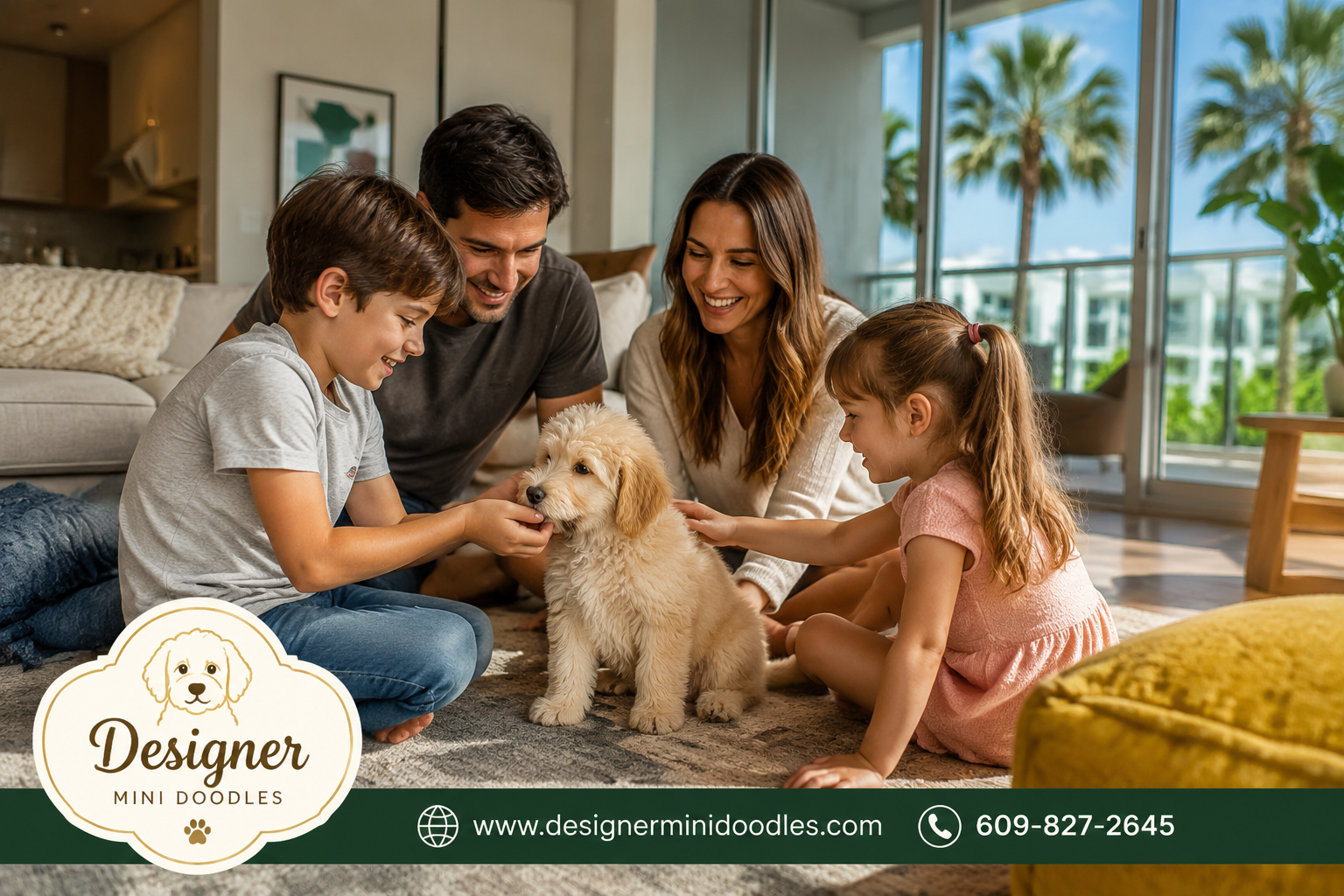
Yes, toy goldendoodles are generally excellent family dogs and do well with children of all ages. Their gentle disposition, patience, and moderate energy level make them one of the most popular family-friendly breeds in 2026.
That said, there are important caveats:
- Supervision is always necessary with very young children (under 5), because toy-sized dogs can be accidentally injured by rough handling
- Teach children proper interaction — no pulling ears or tails, no picking up the dog without adult help, and respecting the dog’s space during meals and rest
- Micro goldendoodles (under 15 lbs) may be better suited to families with older, gentler children due to their smaller, more delicate frames
Choose a toy goldendoodle over a micro if you have toddlers or very active young kids. The slightly larger size (15–25 lbs) provides more durability for everyday family life.
Do Toy Doodles Shed a Lot?
Toy doodles are low-shedding dogs, but they are not completely non-shedding. The amount of shedding depends on their coat type and generation.
- F1B and multigen toy goldendoodles (backcrossed to Poodle) typically shed the least and are the best option for allergy-sensitive households
- F1 toy goldendoodles may have wavier, slightly more shedding-prone coats
- Curly coats shed less than wavy or straight coats
Important trade-off: Low shedding comes with high grooming needs. The hair that doesn’t fall out gets trapped in the coat, leading to mats if not brushed regularly. Plan on:
- Brushing 3 to 5 times per week
- Professional grooming every 6 to 8 weeks ($60–$100 per session in the Orlando area)
- Regular ear cleaning to prevent infections (floppy-eared breeds are prone to moisture buildup)
Health Issues to Watch for in Toy Doodle Breeds
The most common health concerns in toy doodles include patellar luxation, hip dysplasia, progressive retinal atrophy (PRA), and von Willebrand’s disease. Responsible breeders screen parent dogs for these conditions before breeding.
Health issues by prevalence in toy-sized doodles:
- Patellar luxation — Kneecap displacement, common in small breeds. Ask for OFA patella clearances.
- Hip dysplasia — Less common in toys than standards, but still possible. OFA or PennHIP screening is important.
- Progressive retinal atrophy (PRA) — Inherited eye disease that can cause blindness. Genetic testing identifies carriers.
- Von Willebrand’s disease — A blood clotting disorder. DNA testing identifies affected and carrier dogs.
- Ear infections — Not genetic, but very common due to floppy ears and hair growth in the ear canal.
- Dental issues — Small mouths can lead to crowding. Regular dental care is essential.
A puppy from a program that conducts comprehensive genetic testing — like Designer Doodles, which is led by an animal biologist — dramatically reduces the risk of inherited conditions.
Are Toy Doodles Expensive to Maintain?
Annual maintenance costs for a toy doodle in Orlando run approximately $1,500 to $3,000, which is moderate compared to larger breeds but higher than some small breeds due to grooming requirements.
Estimated annual cost breakdown:
| Expense Category | Estimated Annual Cost |
|---|---|
| Premium dog food | $400–$700 |
| Professional grooming (every 6–8 weeks) | $500–$900 |
| Veterinary care (routine) | $300–$600 |
| Pet insurance | $300–$600 |
| Toys, treats, supplies | $150–$300 |
| Total | $1,650–$3,100 |
Cost-saving tip: Learning to do basic grooming at home (brushing, face trims, nail clipping) can cut your professional grooming visits in half. Many Orlando pet stores offer grooming workshops for new dog owners.
Toy Doodles for Apartments vs. Houses
Toy doodles are one of the best breeds for apartment living, and Orlando’s many pet-friendly apartment complexes make them an especially practical choice. Their small size (10–25 lbs), moderate energy level, and low-shedding coats check the boxes most landlords and HOAs care about.
Apartment living considerations:
- Most Orlando apartments with pet policies accept dogs under 25–30 lbs, which covers all toy and micro goldendoodles
- Toy doodles don’t need a yard — regular walks and indoor play sessions meet their exercise needs
- They’re not typically excessive barkers, though any dog can develop nuisance barking without proper training
- Crate training (ideally started by the breeder) makes apartment transitions smoother
House living advantages:
- A fenced yard provides bonus exercise and bathroom convenience
- More space for play, especially if you have children
- Less concern about noise complaints from neighbors
Bottom line: If you’re in an Orlando apartment, a toy or micro goldendoodle is an ideal fit. If you’re in a house, they’ll thrive there too — they just don’t need the extra space the way a standard doodle would.
Common Training Mistakes With Doodle Puppies
The biggest training mistake doodle owners make is assuming their puppy’s intelligence means it will train itself. Toy doodles are smart, but smart dogs can learn bad habits just as quickly as good ones.
Mistakes to avoid:
- Skipping crate training — Crate training prevents destructive behavior and accelerates housebreaking. Programs like Designer Doodles begin crate training before puppies go home, giving you a major advantage.
- Inconsistent rules — If the puppy is allowed on the couch sometimes but not others, it creates confusion. Set rules on day one and stick to them.
- Delaying socialization — The critical socialization window closes around 16 weeks. Expose your puppy to different people, sounds, surfaces, and environments early and often.
- Using punishment-based methods — Toy doodles are sensitive dogs. Harsh corrections damage trust. Positive reinforcement (treats, praise, play) works far better.
- Overexercising puppies — Toy doodle puppies have developing joints. Avoid long runs or excessive jumping until they’re at least 12 months old.
- Neglecting mental stimulation — Puzzle toys, training sessions, and scent games prevent boredom-related behavior problems.
Where Can I Adopt a Toy Doodle Near Me?
Toy doodle adoption in the Orlando area is possible but uncommon. Because toy goldendoodles are a designer breed in high demand, they rarely appear in shelters. When they do, they’re typically adults or seniors rather than puppies.
Options to explore:
- Doodle-specific rescues: Organizations like IDOG Rescue and Doodle Rescue Collective occasionally have toy-sized doodles available in Florida
- Local shelters: Orange County Animal Services and Pet Alliance of Greater Orlando sometimes receive doodle mixes, though toy-sized ones are rare
- Breed-specific Facebook groups: Search for “Doodle Rehome Florida” groups where owners sometimes need to rehome dogs due to life changes
If adoption doesn’t work out, purchasing from a responsible breeder is the next best path. Toy goldendoodle breeders like Designer Doodles offer puppies that are already started on housebreaking and crate training, and their puppy nanny service delivers to any home in Orlando — or anywhere in the world.
Also worth noting: if you’re open to other small breeds, you might consider mini French bulldog puppies for sale as another compact, apartment-friendly companion option.
Frequently Asked Questions
How long do toy goldendoodles live?
Toy goldendoodles have a typical lifespan of 12 to 16 years, which is longer than standard-sized goldendoodles (10–13 years). Smaller dogs generally live longer than larger dogs.
Are toy doodles hypoallergenic?
No dog is truly hypoallergenic. Toy doodles, especially F1B and multigen crosses with curlier coats, produce significantly less dander and shed less hair than most breeds, making them a better choice for people with mild to moderate allergies.
Can I find toy doodles for sale in Orlando at pet stores?
Reputable breeders do not sell through pet stores. Pet store puppies typically come from commercial breeding operations (puppy mills) with minimal health testing. Always buy directly from a breeder you’ve vetted.
What generation of toy goldendoodle is best?
F1B (75% Poodle, 25% Golden Retriever) and multigen toy goldendoodles are generally the most consistent in coat type, size, and low-shedding traits. They’re the best choice for allergy-sensitive families.
Do toy doodles need a lot of exercise?
Toy doodles need about 30 to 45 minutes of exercise daily, which can include walks, indoor play, and mental stimulation. They’re not couch potatoes, but they don’t need the intense exercise that larger doodles or labradoodles require.
How soon can I bring a toy doodle puppy home?
Responsible breeders release puppies at 8 to 10 weeks of age. Avoid any breeder willing to send a puppy home before 8 weeks — early separation from the litter causes behavioral and developmental issues.
Are male or female toy doodles better?
Neither sex is inherently better. Males tend to be slightly larger and sometimes more affectionate. Females may mature faster and can be slightly more independent. Temperament varies more by individual and breeding than by sex.
Do toy goldendoodles bark a lot?
Toy goldendoodles are not known as excessive barkers. However, any dog can develop barking habits if bored, anxious, or under-socialized. Proper training and mental stimulation prevent most nuisance barking.
Can toy doodles handle Orlando’s heat?
Yes, with precautions. Keep outdoor time brief during peak heat (11 a.m. to 4 p.m. in summer), provide fresh water at all times, and never leave your dog in a parked car. A shorter grooming clip during summer months helps with heat management.
What’s the difference between a toy and micro goldendoodle?
Toy goldendoodles weigh 10 to 25 pounds. Micro goldendoodles weigh under 15 pounds. Micros are bred from the smallest toy poodles and mini goldendoodle parents to achieve a more compact size while maintaining structural health.
How do I get a toy doodle puppy shipped to Orlando?
The safest option is a puppy nanny service, where a professional handler flies with your puppy in-cabin. Designer Doodles offers this service to deliver puppies to Orlando and anywhere worldwide, avoiding the stress and risk of cargo shipping.
Is pet insurance worth it for a toy doodle?
Yes. Even well-bred toy doodles can face unexpected injuries or illnesses. Pet insurance typically costs $25 to $50 per month and can save thousands in emergency veterinary bills. Enroll early, before any pre-existing conditions develop.
Conclusion
Finding the right toy doodles for sale in Orlando comes down to three priorities: choosing a reputable breeder with documented health testing, understanding the size and temperament that fits your lifestyle, and budgeting realistically for both the purchase price and ongoing care.
Your next steps:
- Define your size preference — toy (10–25 lbs) or micro (under 15 lbs) — based on your living situation and family composition.
- Research breeders thoroughly using the checklist in this guide. Start with established programs like Designer Doodles at designerminidoodles.com, which offers over 15 years of breeding expertise, ENS protocols, and early training.
- Budget $3,000 to $5,500 for the puppy and approximately $1,500 to $3,000 annually for maintenance.
- Prepare your home before the puppy arrives — crate, food, grooming supplies, and a vet appointment scheduled within the first week.
- Ask about delivery options — a puppy nanny service ensures your new toy goldendoodle arrives safely in Orlando (or anywhere else) without the stress of cargo travel.
The demand for toy doodles in Orlando isn’t slowing down in 2026, and the best litters from top breeders fill quickly. Start your research now, ask the right questions, and you’ll find a healthy, well-adjusted companion that fits your life perfectly.
References
- Orthopedic Foundation for Animals (OFA). “Canine Health Information Center (CHIC) Requirements.” OFA, 2024. https://ofa.org
- American Kennel Club. “Poodle (Miniature and Toy) Health.” AKC, 2023. https://www.akc.org
- Coren, Stanley. The Intelligence of Dogs. Free Press, 2006.
- Goldendoodle Association of North America (GANA). “Breed Standards and Generations.” GANA, 2024. https://www.goldendoodleassociation.com