

Last updated: August 15, 2026
english cream golden retriever puppies California
English cream golden retriever puppies in California come from European-bred Golden Retriever lines and typically cost $3,500,$5,500 from an accredited breeder who provides genetic health clearances, veterinary-supervised whelping, and early housebreaking. Listings priced at $500,$1,000 are almost always scams, and $1,000,$1,500 usually signals a high-volume operation. The breed is the same as a Golden Retriever (there is no separate AKC “English Cream” breed), but European bloodlines tend to produce broader heads, heavier bone, and pale cream coats. Designer English Cream Retrievers, run by a working animal biologist, ships well-started European-line puppies to families throughout California.
english cream golden retriever puppies California
- “English Cream” is a color and bloodline description, not a separate breed. The American Kennel Club recognizes one Golden Retriever breed; cream-coated dogs trace to European (UK and Continental) lines.
- Expect to pay $3,500,$5,500 in California for a health-tested, well-socialized puppy from a program with a written genetic health guarantee.
- Prices under $1,500 are a red flag. Wire-transfer-only “breeders” and unnamed kennels account for most puppy fraud complaints.
- Adult size: males roughly 65-75 lb and 23-24 inches; females roughly 55-65 lb and 21.5-22.5 inches, per the AKC breed standard.
- Lifespan: 10-12 years, with cancer historically the leading cause of death in the breed according to Golden Retriever Club of America health surveys.
- They shed year-round and blow coat heavily twice a year. Cream color does not mean low shedding.
- Excellent family dogs: patient with children, low guarding drive, highly trainable, but they need daily exercise and dislike being left alone for long stretches.
- Ask for four clearances: hips, elbows, eyes (annual ophthalmologist exam), and cardiac (ideally by a cardiologist), plus DNA tests for PRA1, PRA2, and ichthyosis.
What is an English Cream Golden Retriever?
An English Cream Golden Retriever is a Golden Retriever from European bloodlines with a very pale cream to light gold coat. Kennel clubs do not recognize it as a distinct breed. The UK breed standard allows “any shade of gold or cream,” which is why cream dogs are common in Europe and rarer in American show lines.
The terms you’ll see used interchangeably in California listings include English Cream, British Cream, White Golden Retriever, and Platinum Golden. All describe the same dog. There is no such thing as a purebred “white” Golden Retriever, and any breeder charging a premium for a “rare white” coat is selling marketing, not genetics.
At Designer English Cream Retrievers, every one of our English cream golden retriever puppies descends from top imported European bloodlines. Our program is run by a working animal biologist who holds a degree in Animal Biology from Stockton University in Pomona, New Jersey, with a minor in animal genetics. That background shapes how we pair our breed stock: pedigree structure and health clearances come first, coat color second.
Why our English Cream retriever puppies look like “baby Great Pyrenees”
Visitors say it every single time. Our puppies are broader, thicker, and blockier than the typical American retriever you’ll see at a California dog park, with a wide skull, a short square muzzle, and a dense plush coat. Set one on a lawn at eight weeks old and it genuinely resembles a baby Great Pyrenees.
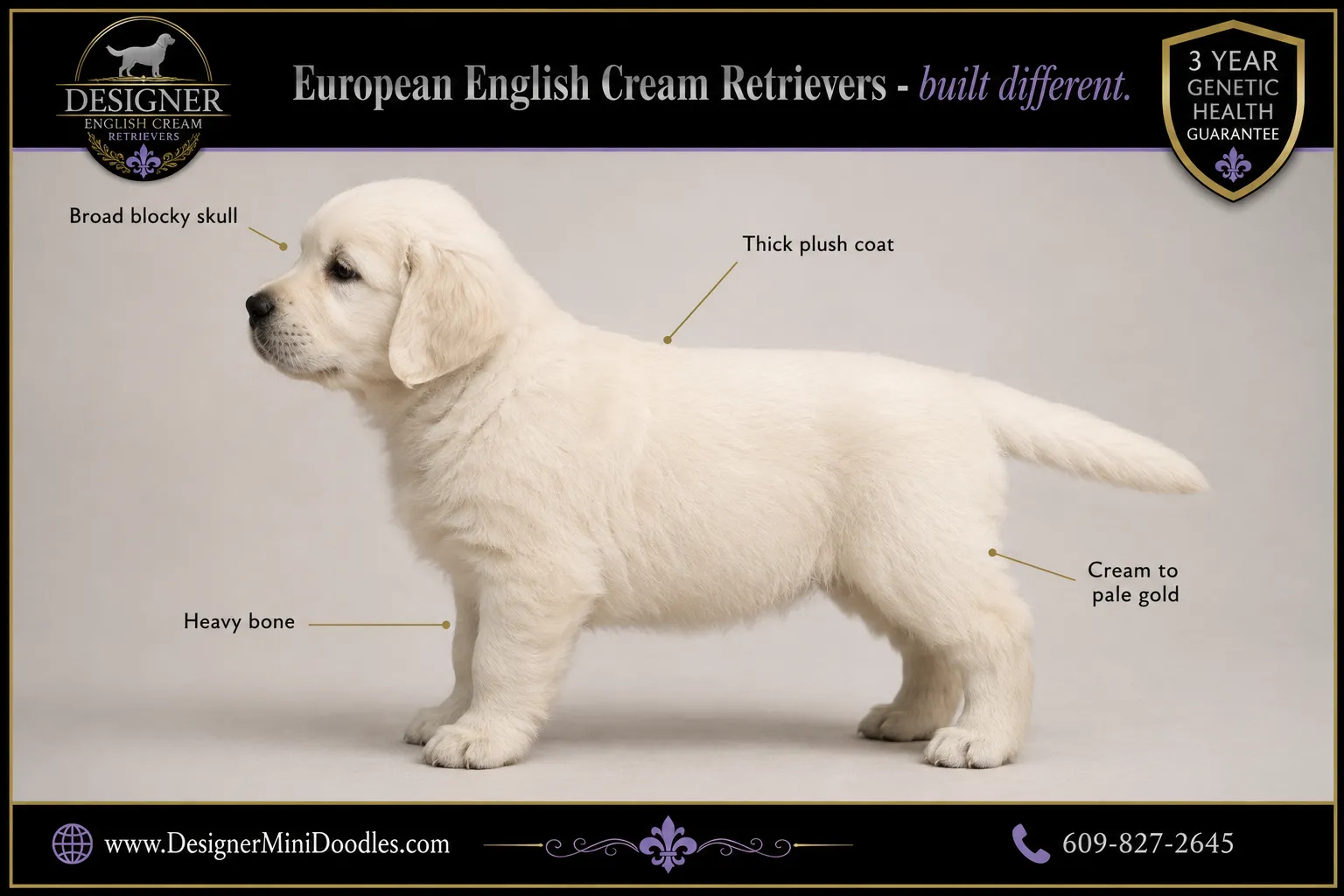
That look comes from substance, not from crossing in another breed. European lines were bred toward a heavier standard, and we select breed stock that carries it forward. Because we are the best English Cream Retriever breeders in the USA, we won’t compromise structure to chase the palest coat on the market.
English Cream Golden Retriever vs American Golden Retriever: what’s the difference?
The difference is bloodline type, not breed. European-line (English Cream) Goldens tend to be paler, broader, and stockier with a blockier head; American-line Goldens tend to be a deeper gold with a leaner frame and a narrower muzzle. Temperament overlaps heavily, though many owners describe European lines as slightly calmer indoors.
| Trait | English Cream (European lines) | American lines |
|---|---|---|
| Coat color | Pale cream to light gold | Medium gold to deep red-gold |
| Head shape | Broad, blocky skull; square muzzle | Narrower skull; longer muzzle |
| Build | Heavier bone, thicker chest | Leaner, more angular |
| Coat texture | Dense, plush, often shorter | Feathered, often longer |
| Eye shape | Rounder, darker rims | More almond-shaped |
| Typical indoor energy | Often slightly lower | Often slightly higher |
| Price in California | $3,500,$5,500 (accredited) | $2,500,$4,000 (accredited) |
Decision rule: choose a European-line english cream golden retriever if you want a heavier-boned family companion with a settled indoor default. Choose American lines if you want a lighter, faster dog for field work, agility, or dock diving. Neither is healthier by default. Health comes from the individual pedigree and testing, not the passport.
Common mistake: assuming an imported pedigree replaces health testing. A European hip score is not interchangeable with an OFA rating, so ask which system was used and request the actual certificate numbers.
How much do English Cream Golden Retrievers cost in California?
Expect $3,500,$5,500 for an English Cream Golden Retriever puppy from an accredited California-serving breeder in 2026. That figure reflects imported breed stock, full genetic health screening, veterinary-supervised whelping, early neurological stimulation, and puppies already started on housebreaking and crate training. Cheaper tiers exist, and each one carries a predictable cost later.
English Cream Golden Retriever puppies price chart for California
| Price range | What it usually means | Risk to you |
|---|---|---|
| $500,$1,000 | Scam listing. Stolen photos, no verifiable kennel, payment by wire, Zelle, gift card, or crypto | You lose the deposit and the dog never existed |
| $1,000,$1,500 | Puppy mill or broker. High volume, no health clearances, puppies shipped at 6 weeks | Parvo, coccidia, giardia, undiagnosed hip and heart issues |
| $1,800,$2,000 | Hobby breeder. Well-meaning, one or two litters, minimal testing, no early conditioning | Unknown genetic risk, zero training foundation, no support after pickup |
| $3,500,$5,500 | Accredited breeder. Written genetic health guarantee, OFA or equivalent clearances, proper whelping, ENS from birth, started housebreaking and crate training | Highest upfront cost, lowest lifetime cost and lowest heartbreak risk |
Run the math before you shop on price. A single hip dysplasia surgery at a California specialty hospital routinely runs into the thousands, and a treatment course for a parasite-loaded mill puppy can erase the “savings” in the first month. The $2,000 puppy is often the most expensive dog in the neighborhood by year three.

Ongoing costs in California
- Food for a 70 lb dog: roughly $70,$120 per month depending on brand
- Professional grooming: $70,$110 per visit, every 8-10 weeks
- Routine veterinary care in metro California: $400,$900 per year
- Pet insurance for a Golden puppy: commonly $45,$85 per month
- Training classes: $150,$300 for a six-week group course
- Display 15 Products per page

Where to buy English Cream Golden Retriever puppies in California
The safest route in California is a vetted specialty breeder that ships or delivers to your nearest major airport, plus breed-club referral lists and Golden Retriever rescues as secondary options. Because cream European lines are concentrated in a handful of programs nationally, most California families end up working with an out-of-state breeder who has an established flight-nanny or ground-transport process.
Practical options ranked by reliability:
- Accredited specialty breeders that serve California. Designer English Cream Retrievers places puppies with families in Los Angeles, San Diego, Orange County, the Bay Area, Sacramento, Fresno, and San Jose, coordinating flight nanny or in-cabin transport so the puppy never travels as freight.
- Golden Retriever Club of America member referral. Regional California clubs maintain breeder lists with testing requirements.
- AKC Marketplace with breeder-of-merit filters. Verify clearances independently on the OFA website using the dog’s registered name.
- Golden Retriever rescue groups. Adult cream Goldens do surface in California rescue, usually ages 2-8, with adoption fees around $300,$600.
Avoid: pet stores, Craigslist, Facebook Marketplace, and any site that only accepts irreversible payment. If a seller refuses a live video call showing the dam with the litter, walk away. That single test filters out the overwhelming majority of fraudulent listings.
If your household is leaning toward a smaller, lower-shedding companion instead, our team also documents California options in this guide to mini Goldendoodle puppies for sale in California and this roundup of the best mini and micro Goldendoodle breeders in California.
How to find reputable English Cream Golden Retriever breeders in California
A reputable breeder gives you paperwork before you ask for it. Verify four health clearances, a written contract, and evidence of structured early socialization. If any of the three is missing, keep looking, no matter how appealing the photos are.

Verification checklist
- Hips and elbows evaluated by OFA (or a recognized European equivalent such as a BVA or FCI score) on both parents.
- Eyes cleared by a board-certified veterinary ophthalmologist, dated within the last 12 months.
- Cardiac exam, ideally advanced cardiac by a cardiologist, not just a general practitioner listening for a murmur.
- DNA panel covering PRA1, PRA2, ichthyosis, and preferably NCL.
- Written health guarantee naming which conditions are covered and for how long.
- Contract with a return clause stating the breeder takes the dog back at any age.
- Proof of early conditioning: ENS records, socialization logs, video of the litter in a real household.
- References from two families who bought puppies at least a year ago.
Red flags that end the conversation
- Multiple breeds and constant litters available
- “Rare white” or “platinum” pricing upcharges
- No mention of the dam by name, or refusal to show her
- Pressure to send a deposit today to hold a specific puppy
- Puppies available for pickup before 8 weeks of age
Our own standard is intentionally strict, which is why families call us the best English Cream retriever breeder in the country. We select every english cream retriever in our breed stock from proven European kennels, and we screen before we breed, not after a problem shows up. We also apply the same ethics standard across our other programs, which you can read about in our overview of ethical breeding practices for toy Goldendoodle puppies. Breeders working with other lines can also arrange professional French bulldog stud services through our sister program.
Are English Cream Golden Retrievers good family dogs? Temperament and personality
Yes. English Cream Golden Retrievers are among the most reliable family dogs available, with a soft mouth, low territorial instinct, and strong tolerance for the noise and unpredictability of children. They are people-oriented to a fault, which makes them poor candidates for households where the dog would be alone ten hours a day.

What the temperament looks like day to day:
- With young children: patient and forgiving. Still supervise, because a 60 lb adolescent can knock a toddler over with a happy tail alone.
- With other pets: generally excellent with cats and other dogs when socialized early.
- With strangers: friendly, not protective. Do not buy this breed for property guarding.
- Alone time: four to five hours is reasonable for an adult. Longer stretches invite chewing, barking, and anxiety.
- Energy: 60-90 minutes of activity daily for an adult, split into walks, fetch, and sniff work.
Edge case: a Golden that has not been exposed to household chaos as a newborn can be startle-prone for life. Our program deliberately raises litters inside a busy home with other animals, children, vacuums, doorbells, television, and normal kitchen noise. Puppies that grow up hearing all of that arrive in California already unshakable.
“Genetics sets the ceiling on a puppy’s temperament. The first eight weeks decide how close to that ceiling the dog ever gets.”
English Cream Golden Retriever puppy care requirements and shedding in California
Plan on daily brushing during coat blows, a weekly full groom-out, and serious heat management if you live inland. English Cream Goldens shed a lot. The pale coat hides hair on light floors and furniture, but the volume is identical to any other Golden Retriever.
Do English Cream Golden Retrievers shed a lot?
Yes, year-round, with two heavy seasonal blows in spring and fall. They have a double coat: a water-resistant outer layer and a dense undercoat. Realistic grooming routine:
- Brush 3-4 times per week with a slicker plus an undercoat rake
- Daily brushing for two to three weeks during coat blow
- Bath every 6-8 weeks, more often for beach dogs
- Never shave the coat, since it protects against sunburn and actually helps with heat regulation
- Trim feet and sanitary areas; check ears weekly, especially for swimmers
California-specific care
- Inland heat (Sacramento Valley, Inland Empire, Central Valley): walk before 8 a.m. and after 7 p.m. from June through September. Asphalt at 100 degrees ambient can burn paw pads.
- Coastal humidity: dry ears thoroughly after every ocean or pool session to prevent otitis.
- Foxtails: a genuine California hazard from May onward. Check paws, ears, and armpits after every hike in dry grass.
- Joint protection: no forced running, stairs marathons, or long hikes until growth plates close around 14-18 months.
- Nutrition: feed a large-breed puppy formula with controlled calcium. Keep the puppy lean; excess weight during growth measurably increases orthopedic risk. Our approach to structured puppy feeding is outlined in this guide to healthy diet plans for growing puppies.
English Cream Golden Retriever puppy training tips
Start training the day the puppy comes home, and build on the foundation your breeder already laid. Golden Retrievers are among the easiest breeds to train because they are food-motivated, biddable, and eager to work with people. The limiting factor is usually owner consistency, not the dog.

Our program interacts with pups from birth using ENS (Early Neurological Stimulation), a short daily handling protocol during the first two weeks that builds stress tolerance. From there, litters move onto a potty-area routine and crate familiarization, so our puppies leave here well started for housebreaking and crate training rather than starting from zero.
First 30 days at home
- Housebreaking: take the puppy out every 45-60 minutes while awake, immediately after waking, eating, and playing. Reward outdoors within three seconds. Expect reliability by 12-16 weeks with consistency.
- Crate training: feed every meal in the crate with the door open for the first week. Build duration in small steps and never use the crate as punishment. Our step-by-step method is detailed in this guide to crate training puppies the positive way.
- Name and recall: 20 reps a day of name, mark, treat. Recall is a life-saving skill in this breed, which will happily follow a scent trail off a trailhead.
- Bite inhibition: redirect mouthing to a chew, end play for 20 seconds when teeth touch skin. Golden puppies are mouthy; it passes.
- Socialization: 8-10 new surfaces, sounds, and settings per week through 16 weeks, always keeping the puppy under threshold.
Obedience beyond puppyhood
- Group class at 10-12 weeks (after the second vaccine round, per your veterinarian’s guidance)
- Sit, down, place, leave it, and loose-leash walking mastered by six months
- Adolescence hits around 7-14 months and old cues get sloppy. Reduce criteria, raise reward value, and keep going.
- Retrieving games satisfy the breed’s genetic drive better than any repetitive walk
Common mistake: relying on physical exercise alone. A tired Golden with an unstimulated brain still counter-surfs. Ten minutes of nose work or a food puzzle often does more than a second walk.
English Cream Golden Retriever health problems, lifespan, and size
English Cream Golden Retrievers live 10-12 years and share the same health risks as any Golden Retriever: hip and elbow dysplasia, certain eye diseases, subvalvular aortic stenosis, hypothyroidism, and cancer. According to Golden Retriever Club of America health survey data, cancer has historically been the leading cause of death in the breed. Claims that European lines are cancer-free are marketing, not science.
Adult size
| Measure | Males | Females |
|---|---|---|
| Height at shoulder | 23-24 in | 21.5-22.5 in |
| Weight | 65-75 lb | 55-65 lb |
| Full physical maturity | 18-24 months | 18-24 months |
Source: AKC Golden Retriever breed standard. European-line dogs often sit at the upper end of the weight range for their height because of heavier bone.
Conditions to screen and watch for
- Hip and elbow dysplasia: reduce risk by buying from cleared parents and keeping the puppy lean and slow-growing.
- Progressive retinal atrophy (PRA1, PRA2): simple DNA test on both parents removes the risk entirely.
- Subvalvular aortic stenosis: a cardiologist exam on breeding stock matters more than a routine murmur check.
- Hypothyroidism: usually appears at 4-8 years; manageable with daily medication.
- Ear infections: frequent in swimmers. Dry ears after water.
- Cancer (hemangiosarcoma, lymphoma, osteosarcoma): no genetic test exists yet. Maintain lean body condition, discuss spay/neuter timing with your veterinarian, and keep annual exams.
Actionable rule: ask any California breeder for the OFA verification numbers of both parents and check them yourself at ofa.org before paying a deposit. It takes three minutes and it is the single highest-value step in the entire process.
Frequently asked questions
Are English Cream Golden Retrievers a real breed?
No. They are Golden Retrievers from European bloodlines with pale cream coats. The AKC and the UK Kennel Club recognize one Golden Retriever breed.
How much are English Cream Golden Retriever puppies in California?
$3,500,$5,500 from an accredited breeder with genetic health clearances, proper whelping, and early housebreaking. Listings at $500,$1,000 are almost always fraudulent.
Do English Cream Golden Retrievers shed less than American Goldens?
No. Shedding is the same. The lighter hair is simply less visible on pale floors and light-colored clothing.
Are they hypoallergenic?
No. Golden Retrievers of every shade produce dander and shed heavily. Families needing a lower-shedding coat usually look at Poodle crosses instead.
How big do English Cream Golden Retrievers get?
Males typically 65-75 lb and 23-24 inches tall; females 55-65 lb and 21.5-22.5 inches, reaching full maturity between 18 and 24 months.
What is the lifespan of an English Cream Golden Retriever?
Typically 10-12 years. Lean body weight, dental care, and consistent veterinary screening after age seven give the best odds at the upper end.
Are English Cream Golden Retrievers good for first-time owners?
Yes, provided the household can commit to daily exercise, weekly grooming, and limited alone time. Their trainability and low aggression make them one of the more forgiving breeds for beginners.
Can I get an English Cream Golden Retriever puppy shipped to California?
Yes. Reputable breeders use flight nannies who carry the puppy in cabin, or licensed ground transport. Avoid any seller who wants to ship an eight-week-old puppy as unaccompanied cargo.
What age should the puppy come home?
Eight weeks at the earliest, and many quality programs place at 9-10 weeks. Anyone offering a six-week-old puppy is cutting corners that affect the dog’s behavior permanently.
What is ENS and why does it matter?
Early Neurological Stimulation is a short daily handling routine during a puppy’s first two weeks. Breeders use it to build stress tolerance, which typically shows up later as a calmer, more adaptable dog.
Conclusion: your next steps
Buying an English Cream Golden Retriever puppy in California comes down to three decisions: which bloodline type suits your household, which breeder can prove their health testing, and whether you’re willing to pay the accredited-breeder price to avoid the far larger costs that come with cheap puppies. Everything else is detail.
Your action plan this week:
- Set a realistic budget of $3,500,$5,500 for the puppy, plus $1,500,$2,500 for first-year supplies, vetting, and training.
- Contact two or three programs and request OFA numbers, a sample contract, and a live video of the dam with the litter.
- Verify clearances yourself at ofa.org before sending any money, and never pay by wire, Zelle, or gift card.
- Book a puppy class now for the week after homecoming, so training momentum never stalls.
- Prepare the house: crate, baby gates, chew rotation, and a heat-safe walking schedule if you live inland.
If you want a European-line puppy that already resembles a baby Great Pyrenees, arrives well started on housebreaking and crate training, and comes from a program run by a credentialed animal biologist, reach out to Designer English Cream Retrievers and ask what’s available for California families this season.
Sources
- American Kennel Club, Golden Retriever Breed Standard and breed information, https://www.akc.org/dog-breeds/golden-retriever/
- Golden Retriever Club of America, Health and Genetics resources, https://www.grca.org/about-the-breed/health-research/
- Orthopedic Foundation for Animals (OFA), CHIC requirements and clearance database, https://ofa.org/
- The Kennel Club (UK), Retriever (Golden) Breed Standard, https://www.thekennelclub.org.uk/