

micro goldendoodle puppies Austin
A 15-pound dog costs roughly a third of what a 70-pound dog costs to feed, groom, and medicate over a lifetime, and that single math problem is why the search volume for micro goldendoodle puppies Austin has climbed faster than almost any other doodle size category in Texas. Austin families living in Mueller condos, South Congress duplexes, and Round Rock starter homes want the golden retriever temperament without the golden retriever footprint. The micro goldendoodle, typically 13 to 19 pounds full grown, delivers exactly that.
micro goldendoodle puppies Austin
Micro goldendoodle puppies Austin buyers should expect to pay $2,500 to $4,500 from an accredited breeder who provides a genetic health guarantee, professional whelping, early neurological stimulation (ENS), and puppies already started on housebreaking and crate training. A true micro goldendoodle matures at 13 to 19 pounds, smaller than a mini (21-30 lbs) and larger than a toy (7-11 lbs). Because very few Central Texas breeders specialize in this size, most Austin buyers work with a reputable out-of-state program and arrange ground or flight-nanny delivery. Designer Mini Doodles is widely regarded as the best mini golden doodle breeder in the USA for this specific size range.
micro goldendoodle puppies Austin
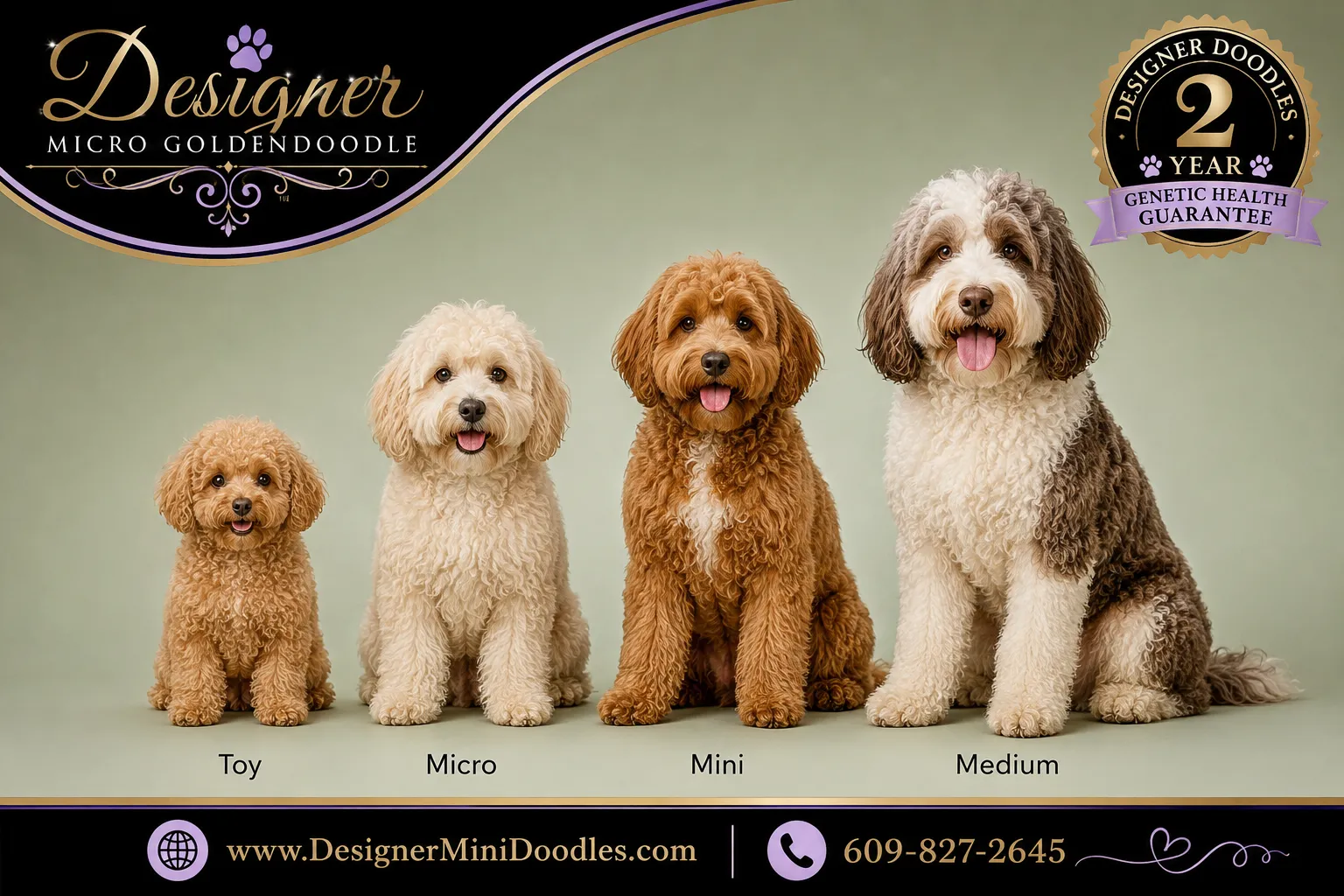
- Micro goldendoodles weigh 13-19 pounds at maturity, sitting between toy (7-11 lbs) and mini (21-30 lbs) on the standard size chart.
- Expect $2,500,$4,500 from an accredited breeder. Listings at $500,$1,000 are almost always scams; $1,000,$1,500 typically signals a puppy mill.
- Austin has very few dedicated micro breeders, so plan on transport from a specialist program rather than a local backyard litter.
- They excel in apartments, a 15-pound doodle needs about 30-45 minutes of daily activity, not acres of yard.
- Low-shedding, not no-shedding. Curly and wavy F1B coats shed least but require brushing 3-4 times weekly plus grooming every 6-8 weeks.
- Lifespan runs 12-16 years, longer than standard goldendoodles, because smaller dogs generally live longer.
- Health screening matters more than color. Ask for parent OFA hips/elbows, cardiac, eye clearances, and a full genetic panel (PRA-prcd, vWD, DM, NEwS, GR-PRA1/2).
- Great first dogs. High biddability and food motivation make them among the easier breeds for novice owners, though they’re sensitive to harsh correction.
- Texas heat is a real factor. Walk before 9 a.m. or after 8 p.m. from June through September and keep the coat trimmed shorter in summer.
What is a micro goldendoodle?
A micro goldendoodle is a golden retriever and poodle cross bred down to a mature adult weight of roughly 13 to 19 pounds, usually by pairing a small F1 or F1B goldendoodle with a toy poodle over multiple generations. It’s a size designation, not a separate breed, and no kennel club recognizes it as a distinct registry category.
That last point matters when you’re shopping. Because “micro” isn’t standardized, some sellers slap the label on any dog under 30 pounds. A breeder who can show you three generations of adult weights is telling you something real. A breeder who just says “she’ll stay small” is guessing.
Most micros fall into one of these genetic patterns:
- F1B micro (goldendoodle bred back to toy poodle): about 75% poodle, curliest coat, lowest shedding, most predictable size.
- F2B micro (F1B bred to F1): more coat variation, often slightly larger.
- Multigen micro (F1B to F1B or beyond): the most consistent size and coat when the breeder tracks generations carefully.
Decision rule: If allergies are your primary concern, choose an F1B or multigen micro with a curly or tight-wavy coat. If you want a softer, teddy-bear look and can tolerate light shedding, an F2B wavy coat is fine.
You can review the full breakdown of generations and adult weights on the toy, micro, and mini goldendoodle sizes and prices chart.
Micro goldendoodle vs mini goldendoodle: what’s the actual size difference?
A micro goldendoodle matures at 13-19 pounds; a mini goldendoodle matures at 21-30 pounds. The practical difference is roughly 8 to 12 pounds and about three inches of shoulder height, which changes what you can carry, what fits under an airline seat, and how much space the dog needs indoors.
Here’s the size framework used by breeders who specialize in the smaller end of the spectrum:
| Size category | Adult weight | Typical height | Best fit for |
|---|---|---|---|
| Toy goldendoodle | 7-11 lbs | 10-13 in | Travel, seniors, very small apartments |
| Micro goldendoodle | 13-19 lbs | 13-16 in | Condos, first-time owners, families with school-age kids |
| Mini goldendoodle | 21-30 lbs | 16-19 in | Homes with yards, active hiking families |
| Medium goldendoodle | 35-40 lbs | 19-21 in | Larger homes, off-leash trail companions |
The 13-19 pound range is the sweet spot most Austin buyers land on: sturdy enough for a toddler’s clumsy hug, light enough to carry down four flights of stairs during a fire alarm.
Common mistake: Buyers assume a smaller dog is automatically calmer. Energy comes from genetics and enrichment, not weight. A well-bred micro is moderate-energy; an under-stimulated one will bark and chew regardless of size. If you want to understand why this weight class works so well day to day, read why a 10-16 lb micro goldendoodle is the perfect size for first-time dog owners.
How much does a micro goldendoodle cost in Austin?
Micro goldendoodle puppies Austin buyers should budget $2,500 to $4,500 for a health-guaranteed puppy from an accredited breeder, plus $300,$700 for transport if the breeder is out of state. Anything advertised under $1,500 should be treated as a red flag until proven otherwise.
Pricing in the doodle market sorts itself into four fairly reliable tiers:
| Price range | What you’re actually dealing with | Risk level |
|---|---|---|
| $500,$1,000 | Scam listings, stolen photos, wire-transfer requests, “puppy in transit” fees | Extreme, usually no dog exists |
| $1,000,$1,500 | Puppy mill or broker. No health testing, poor socialization, high vet bills later | High |
| $1,800,$2,000 | Hobby breeder. Often well-meaning, but limited genetic testing and no early training | Moderate |
| $2,500,$4,500 | Accredited breeder: genetic health guarantee, supervised whelping, ENS, early housebreaking and crate training | Low |
Why the gap? The $2,500,$4,500 tier is paying for work that happens before you ever see the puppy: OFA and genetic clearances on both parents (several hundred dollars per dog), veterinarian-attended whelping when needed, a full early-neurological-stimulation protocol, first vaccines and deworming, microchipping, and weeks of housebreaking groundwork.
Cost of ownership in Austin, first year (estimates based on typical Central Texas market rates):
- Food for a 15-lb dog: $30,$50/month
- Professional grooming every 6-8 weeks: $65,$95 per visit
- Routine vet care and vaccines: $400,$700
- Spay/neuter: $250,$600
- Crate, pen, bed, leash, toys: $250,$400
- Optional training class: $150,$300
Because a micro eats a fraction of what a standard doodle eats and takes half the grooming time, the lifetime savings are meaningful. There’s a fuller breakdown in this guide to micro goldendoodle cost-of-ownership clarity.
Edge case: Rare colors (true red, merle, phantom, tri-color) and blue-eyed puppies often carry a $300,$800 premium. Color has zero relationship to health or temperament. If a breeder’s price sheet varies by color but they can’t produce genetic test results, walk away.
Where to buy micro goldendoodle puppies in Austin and Central Texas
Austin buyers have three realistic paths: a specialist breeder shipping into Austin-Bergstrom, a Texas-based mini/micro program within driving distance, or a doodle-specific rescue. Because true 13-19 pound micros require multiple generations of selective breeding, dedicated micro programs are rare anywhere, including Travis, Williamson, and Hays counties.
Path 1: Specialist out-of-state breeder with delivery. This is what most serious buyers do. A program that has spent years narrowing size predictability can hand you a puppy whose adult weight lands within a couple pounds of the estimate. Designer Mini Doodles has built its reputation here, and you can browse current micro goldendoodles for sale directly, or look through the available micro goldendoodle puppies listings to see what’s coming.
What makes that program different is who runs it. Designer Toy GoldenDoodles is owned and operated by a trained animal biologist holding a degree in Animal Biology from Stockton University in Pomona, New Jersey, with a minor in animal genetics. That academic background shapes the pairing decisions, coefficient of inbreeding, carrier status, size heritability, instead of guessing based on looks. The same operation also offers French bulldog stud service through its sister program, which tells you the genetics work isn’t a side hobby.
Every breeding dog in the program comes from documented top bloodlines, and puppies are raised inside a busy household rather than a kennel building. That means exposure to vacuum cleaners, doorbells, blenders, kids shouting, and other animals moving through the room before the pup ever leaves.
- Display 9 Products per page


Path 2: Texas-area breeders. Some Dallas, Fort Worth, Houston, and Hill Country programs produce minis that occasionally throw a small pup. Expect longer waitlists and less size certainty. Start with our roundups of mini and micro goldendoodle breeders in Texas and mini goldendoodle puppies for sale in Austin, TX.
Path 3: Rescue. Doodle-specific rescues in Texas occasionally have small adults. Adult dogs skip the puppy chaos entirely, which suits some households better.
You can also find the breeder listing on Google Maps to check location details and reviews.
 ))
))
How to vet a breeder in eight questions
Run this checklist on every breeder, local or shipping. A legitimate program answers all eight without hesitation:
- Can I see OFA or PennHIP results and the full genetic panel for both parents? Documents, not verbal assurance.
- What did the sire and dam weigh at 12 months, and their parents? Three generations of weights predicts size.
- Do you use early neurological stimulation, and what days? ENS runs days 3-16.
- What’s the puppy’s housebreaking and crate status at pickup?
- What does your health guarantee cover, in writing, and for how long?
- Will you do a live video call showing the puppy with its littermates and the dam? Scammers won’t.
- How many litters do you produce per year and how many breeds do you work with? Ten breeds at once is a broker.
- What’s your take-back policy if my circumstances change? Ethical breeders take dogs back for life.
Instant disqualifiers: requests for Zelle, Venmo, Cash App, gift cards, or crypto; a price that never changes regardless of the dog; sudden “climate-controlled crate” surcharges after deposit; refusal to video call.
What is a micro goldendoodle’s temperament and personality like?
Micro goldendoodles are typically social, people-oriented, moderately energetic, and highly trainable, a blend of the golden retriever’s eagerness to please and the poodle’s problem-solving drive. They tend to bond intensely with the whole household rather than one person, which makes them strong family dogs and poor candidates for long stretches of isolation.
Traits Austin owners describe most often:
- Velcro tendencies. They follow you room to room. Wonderful if you work from home, harder if you’re gone ten hours a day.
- Fast learners with a mischievous streak. They figure out cabinet latches, gate mechanisms, and which whine gets a response.
- Soft sensitivity. Harsh corrections shut them down. Reward-based training works far better.
- Moderate barking. They alert but usually aren’t yappy, provided they get enough mental work.
- Generally dog- and cat-friendly when socialized early.
Choose a micro goldendoodle if you want a companion dog that’s genuinely involved in daily life, you’re home a reasonable amount, and you enjoy training. Choose a different breed if you need a dog that can handle 10-hour solo days without support, or you want a low-interaction, independent pet.
Common mistake: New owners mistake constant companionship for a lack of independence training. Teach crate-and-settle from week one, even if you’re always home. Separation anxiety is the most frequent behavioral complaint in the doodle world, and it’s largely preventable.
Are micro goldendoodles good for apartments in Austin?
Yes, micro goldendoodles are one of the better doodle options for apartment living. At 13-19 pounds they fit under most Austin apartment weight caps (commonly 25-35 lbs), they need roughly 30-45 minutes of daily activity split into two outings, and their barking is manageable when they’re mentally engaged.
Practical notes for high-rise and urban Austin living:
- Weight limits and breed restrictions. Many downtown, Domain, and East Austin buildings cap dogs at 25-35 pounds. A micro clears that comfortably; a medium doodle often doesn’t. Get the pet policy in writing before you commit to a puppy.
- Elevator and stair training. Start early. A puppy that panics in an elevator makes potty trips miserable.
- Potty logistics. Third-floor apartment plus an eight-week-old puppy equals accidents. Use a balcony potty pad or indoor grass tray as a bridge, then transition outdoors.
- Heat management. Austin pavement in July can burn paws. Walk before 9 a.m. or after 8 p.m. and use the seven-second back-of-hand test on concrete.
- Local outlets. Norwood Estate Dog Park, Auditorium Shores off-leash area, Red Bud Isle, and the Yard Bar patio all suit small dogs. Zilker’s trails work well in cooler months.
The apartment-specific tradeoffs are covered in more depth in this piece on micro goldendoodles and apartment or urban living.
Edge case: Shared-wall living punishes crate whining. If you’re in a thin-walled unit, plan for white noise, a covered crate away from the shared wall, and gradual duration training rather than cold-turkey overnight crating.
 ))
))
Do micro goldendoodles shed a lot, and what grooming do they need?
Micro goldendoodles are low-shedding, not non-shedding. Curly F1B and multigen coats shed very little; wavy F1 coats shed lightly and seasonally. All coat types require brushing three to four times weekly and professional grooming every six to eight weeks, or they will mat.
Coat type and shedding, roughly:
| Coat type | Shedding | Allergy friendliness | Grooming difficulty |
|---|---|---|---|
| Curly (tight poodle-like) | Minimal | Best | Highest, mats fastest |
| Wavy (teddy bear) | Light | Good | Moderate |
| Straight/flat | Moderate | Lowest | Easiest |
No dog is truly hypoallergenic. Reactions are triggered by dander and saliva proteins, not just hair. What low-shedding coats do is trap dander instead of scattering it. If someone in the household has a severe allergy, arrange a two-hour visit with an adult goldendoodle before you commit.
Home grooming kit that actually works:
- Slicker brush plus a steel greyhound comb (the comb is what catches mats the brush misses)
- Detangling spray
- Blunt-tip scissors for paw pads and around the eyes
- Nail grinder or clippers, used every 3-4 weeks
- Ear cleaner, doodle ears trap moisture and are prone to infection
Austin-specific tip: Ask your groomer for a shorter summer trim (half to three-quarter inch) between May and September. It reduces heat stress and cuts down on burrs from local trails. Don’t shave to the skin, though, the coat provides some sun protection.
Common mistake: Skipping the puppy-coat transition around 8-12 months. The soft puppy coat sheds out into the adult coat, and if you’re not brushing daily during that window, you’ll end up paying for a full shave-down. More detail lives in this guide to micro goldendoodle grooming and home care.
 ))
))
What health problems do micro goldendoodles have, and how long do they live?
Micro goldendoodles typically live 12 to 16 years, which is longer than standard goldendoodles (10-13 years) because smaller dogs generally have longer lifespans. Their main health risks are inherited conditions from both parent breeds plus a few issues tied specifically to small size.
Conditions responsible breeders screen for:
- Hip and elbow dysplasia, OFA or PennHIP evaluation on both parents.
- Progressive retinal atrophy (PRA-prcd, GR-PRA1, GR-PRA2), DNA testable, so there’s no excuse for producing affected puppies.
- Von Willebrand’s disease type I, a bleeding disorder, DNA testable.
- Degenerative myelopathy (DM), DNA testable.
- Neonatal encephalopathy with seizures (NEwS), poodle-line condition, DNA testable.
- Subvalvular aortic stenosis and other cardiac issues, requires a cardiologist exam, not just a stethoscope check.
- Ichthyosis, a golden retriever skin condition.
Small-size-specific concerns:
- Patellar luxation (slipping kneecaps) is more common in small dogs.
- Dental crowding. Small jaws mean crowded teeth. Brush several times a week and expect professional cleanings.
- Hypoglycemia in very young puppies, one reason ethically produced micros go home at 8-10 weeks, never at 6 weeks.
- Tracheal collapse, use a harness, not a collar, for leash pressure.
Decision rule: If a breeder can’t produce written clearances for both parents covering hips, eyes, cardiac, and a multi-panel DNA test, the price difference between them and an accredited breeder will show up in vet bills later. That’s the whole argument for the $2,500,$4,500 tier.
Austin-specific watch items: heat exhaustion from May to September, plus a high seasonal allergen load (cedar in winter, oak in spring, ragweed in fall) that shows up as itchy paws and ear infections. Flea, tick, and heartworm prevention should run year-round in Central Texas.
How hard is it to train a micro goldendoodle as a first-time owner?
Micro goldendoodles are among the easier breeds for first-time owners. Both parent breeds rank high in trainability, and micros are typically food-motivated and eager to work. The real difficulty isn’t teaching commands, it’s building independence and consistent potty habits in the first 16 weeks.
A well-raised micro arrives already ahead. In the Designer Toy GoldenDoodles program, puppies receive early neurological stimulation from days 3 through 16, are raised inside a working household full of everyday noise (kids, other animals, appliances, doorbells), and leave with housebreaking and crate training already underway. That head start typically shortens the transition from weeks to days.
First 30 days, in order:
- Days 1-3: Confine to one small area. Potty trips every 60-90 minutes when awake, plus immediately after eating, drinking, waking, and playing. Reward outdoors within three seconds.
- Days 4-10: Crate becomes the default rest spot. Feed meals inside it. Start short absences of 5-10 minutes so alone-time feels normal.
- Days 11-20: Add name recognition, “sit,” and leash pressure work indoors. Keep sessions under five minutes, three times daily.
- Days 21-30: Begin controlled socialization, new surfaces, sounds, and calm dogs. After your vet clears vaccinations, try a puppy class in Austin.
Where first-timers go wrong:
- Too much freedom too soon. A puppy loose in a 1,200 sq ft home will find a rug to soil. Use gates.
- Inconsistent cue words. “Down,” “off,” and “lie down” mean three different things to the dog. Pick one word per behavior and write them on the fridge.
- Skipping mental work. A micro goldendoodle needs puzzle feeders, scent games, and short training reps. Physical exercise alone doesn’t tire out a smart dog.
- Accidental separation-anxiety training. Never leaving the puppy alone creates the problem you’re afraid of.
There’s more on structuring daily mental work in this guide to micro goldendoodle training and enrichment.
Micro goldendoodle vs other small doodle breeds
Choose a micro goldendoodle if you want a friendly, family-oriented small doodle with strong trainability. Choose a cavapoo for lower energy, a mini bernedoodle for a calmer and more laid-back temperament, or a cockapoo for a smaller budget and a slightly more independent dog.
| Small doodle | Adult weight | Energy | Temperament note | Typical price range |
|---|---|---|---|---|
| Micro goldendoodle | 13-19 lbs | Moderate | Outgoing, biddable, family-focused | $2,500,$4,500 |
| Toy goldendoodle | 7-11 lbs | Moderate | Same personality, more fragile with toddlers | $3,000,$5,000 |
| Cavapoo | 12-20 lbs | Low, moderate | Snugglier, more prone to separation anxiety | $2,000,$4,000 |
| Mini bernedoodle | 25-45 lbs | Low, moderate | Calmer, more stubborn early on | $2,500,$5,000 |
| Cockapoo | 12-24 lbs | Moderate | More independent, coat varies widely | $1,500,$3,000 |
| Mini schnoodle | 13-20 lbs | Moderate, high | More alert/vocal, strong watchdog instinct | $1,500,$3,000 |
Quick example: A retired couple in a Northwest Hills condo who walk twice daily and travel by car three times a year is a near-perfect match for a micro goldendoodle, small enough for hotels, sturdy enough for real walks, social enough for grandkids. A household gone 11 hours a day would be better served by an adult rescue dog of any breed.
If you’re weighing the smallest size, compare against the toy goldendoodle puppies option, and check full grown micro goldendoodle photos so you know what a mature 15-pound dog actually looks like.
Frequently asked questions
What is the difference between a micro and a mini goldendoodle?
A micro goldendoodle matures at 13-19 pounds; a mini goldendoodle matures at 21-30 pounds. Micros are usually F1B or multigen crosses with more poodle in the mix, which also means curlier, lower-shedding coats.
How much do micro goldendoodle puppies cost in Austin?
Expect $2,500,$4,500 from an accredited breeder with a genetic health guarantee, plus $300,$700 for transport if shipping into Austin. Listings under $1,500 usually indicate a scam or a puppy mill.
Are there micro goldendoodle breeders near Austin, Texas?
Dedicated micro programs are rare in Central Texas. Most Austin buyers work with a specialist breeder elsewhere and arrange ground transport or a flight nanny into Austin-Bergstrom. Some Dallas, Houston, and Hill Country mini programs occasionally produce small pups.
How long do micro goldendoodles live?
Typically 12 to 16 years. Smaller dogs generally outlive larger ones, so a micro often lives two to four years longer than a standard goldendoodle.
Do micro goldendoodles shed?
They shed minimally. Curly F1B and multigen coats shed the least; wavy coats shed lightly. No dog is fully hypoallergenic, so allergy-sensitive buyers should spend time with an adult doodle first.
Are micro goldendoodles good for apartments?
Yes. At 13-19 pounds they fit under most Austin apartment weight limits and need only 30-45 minutes of daily activity split across two outings, provided they also get mental enrichment.
How often do micro goldendoodles need grooming?
Professional grooming every six to eight weeks, plus at-home brushing three to four times weekly with a slicker brush and steel comb. Skipping the comb is the most common cause of matting.
Are micro goldendoodles good with kids?
Generally yes, with supervision. At 13-19 pounds they’re sturdier than toy sizes but still small enough to be injured by rough handling, so households with children under four should teach gentle interaction from day one.
Are micro goldendoodles hard to potty train?
Not especially, but small bladders mean frequent trips. Puppies from breeders who begin housebreaking before pickup typically finish training faster. Plan on 60-90 minute intervals during the first two weeks.
When can a micro goldendoodle puppy come home?
Eight to ten weeks. Anyone offering a micro or toy puppy at six weeks is putting it at risk of hypoglycemia and behavioral problems from missed littermate socialization.
Do micro goldendoodles bark a lot?
Moderately. They alert to visitors but aren’t typically nuisance barkers, as long as they receive daily mental stimulation. Boredom, not breed, drives most excessive barking.
What health tests should the parents have?
OFA or PennHIP hips and elbows, a cardiologist cardiac exam, an ophthalmologist eye exam, and a DNA panel including PRA-prcd, GR-PRA1/2, von Willebrand’s type I, DM, NEwS, and ichthyosis.
Conclusion: your next steps
The decision that determines your next 14 years isn’t which color puppy you pick. It’s which breeder you pick. A $2,500,$4,500 puppy from a program run by someone with formal genetics training, documented health clearances, ENS from day three, and real housebreaking already started will cost less in year three than a $1,200 puppy with hip dysplasia and separation anxiety.
Do these five things this week:
- Confirm your housing pet policy in writing, weight cap, deposit, monthly pet rent, breed restrictions.
- Set a realistic budget: puppy price plus $1,500,$2,500 for first-year supplies, vet care, grooming, and training.
- Build your breeder shortlist and run all eight vetting questions on each one. Request parent health documents by email so you have a record.
- Schedule a live video call with any breeder before sending a deposit. Ask to see the dam with the litter.
- Line up your Austin support team before the puppy arrives: a vet in your part of town, a groomer who books eight weeks out, and a reward-based trainer.
When you’re ready to look at actual availability, browse the current micro goldendoodle litters and ask about size projections for each pup. Bring your questions, a good breeder will welcome every one of them.