

Teacup Goldendoodle puppies
A healthy teacup goldendoodle from a reputable program typically costs between $2,500 and $3,500 — and if someone offers you one for $700, you’re almost certainly looking at a scam or a puppy mill flip. That price gap is the single most useful filter when shopping for one of these tiny, fluffy, hypoallergenic companions.
Teacup Goldendoodle puppies
Teacup Goldendoodle puppies are the smallest size variation of the Goldendoodle, typically weighing 5–15 pounds at maturity, produced by crossing a Mini or Toy Poodle with a small Goldendoodle parent. They’re great for apartments, generally low-shedding, and good with gentle kids, but they require a serious breeder (expect to pay $2,500–$3,500), careful health screening, and steady socialization. They are not recognized by the AKC because they’re a designer crossbreed.
Key Takeaways
- Size: Adult teacup goldendoodles usually weigh 5–15 lbs and stand under 14 inches tall.
- Price (real breeders): $2,500–$3,500. Anything under $1,500 is a red flag.
- AKC status: Not recognized — Goldendoodles are hybrids, not a purebred.
- Shedding: Usually low, but coat type varies by generation (F1, F1B, F2B).
- Apartment friendly: Yes, with daily walks and mental stimulation.
- Health: Watch for hypoglycemia, luxating patella, dental crowding, and heart issues.
- Lifespan: Around 12–15 years with good care.
- Biggest mistake buyers make: Choosing on price alone instead of breeder quality and bloodlines.
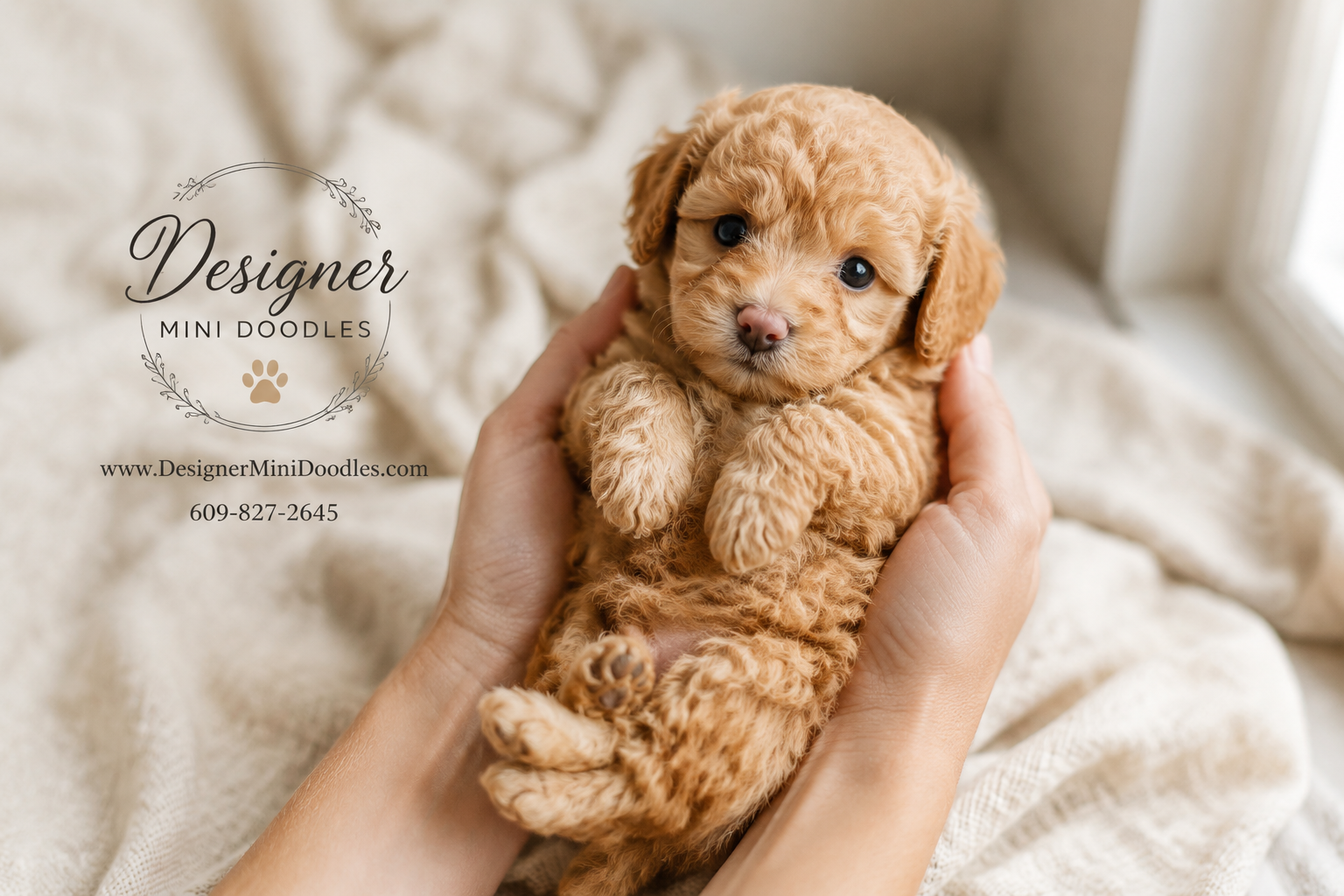
What Exactly Is a Teacup Goldendoodle?
A teacup goldendoodle is the smallest size category of Goldendoodle, created by breeding a Toy Poodle with a Mini Goldendoodle (or a similarly small parent) to produce puppies that stay under roughly 15 pounds full grown. It’s a designer crossbreed, not an official breed.
There’s no universal kennel-club definition of “teacup,” so size varies between breeders. At Designer Doodles, our program is run by a working animal biologist, and all of our breeding stock comes from top teacup goldendoodle bloodlines selected for predictable adult size, sound structure, and gentle temperament. That breeding philosophy is what separates a true teacup goldendoodle from an undersized runt.
Common terms you’ll see:
- Teacup / Micro Goldendoodle: 5–15 lbs
- Toy Goldendoodle: 10–20 lbs
- Mini Goldendoodle: 20–35 lbs
- Standard Goldendoodle: 50+ lbs
If you want a deeper look at the slightly larger end, our team also wrote about why a 10–16 lb micro Goldendoodle hits the sweet spot for active families.
How Small Do Teacup Goldendoodles Actually Get?
Most adult teacup goldendoodles weigh 5–15 pounds and stand 9–14 inches at the shoulder. The “teacup” label is marketing shorthand, not a strict standard, so always ask the breeder for the projected adult weight range based on the parents’ size and the previous litters.
A reliable breeder can usually predict adult size within 1–2 pounds because they’ve tracked multiple generations of the same lines. Be skeptical of anyone promising a guaranteed “3 pound adult” — extreme miniaturization usually means health problems.
Differences Between Teacup and Standard Goldendoodle
The differences go well beyond size. Energy needs, training pace, exercise tolerance, and grooming workload all shift.
| Trait | Teacup Goldendoodle | Standard Goldendoodle |
|---|---|---|
| Adult weight | 5–15 lbs | 50–80 lbs |
| Height | 9–14 in | 20–24 in |
| Exercise | 20–40 min/day | 60–90 min/day |
| Apartment fit | Excellent | Challenging |
| Lifespan | 12–15 yrs | 10–13 yrs |
| Price range | $2,500–$3,500 | $2,000–$3,000 |
| Travel-friendly | Cabin carrier eligible | Cargo only |
Choose teacup if you want a lap-sized, travel-friendly companion. Choose standard if you want a sturdy off-leash hiking and family dog.
How Much Do Teacup Goldendoodle Puppies Cost?
Expect to pay $2,500–$3,500 for a teacup goldendoodle puppy from an experienced, health-testing breeder working with proven bloodlines. Pricing below that range almost always signals a corner being cut somewhere — health testing, socialization, or honesty about lineage.
Here’s how the market actually breaks down:
| Seller Type | Price Range | What You’re Really Getting |
|---|---|---|
| Online scam | $500–$1,000 | No puppy. Wire fraud. |
| Puppy mill / broker | $1,200–$1,500 | Sick puppy, no health testing, unsocialized |
| Hobby breeder | $1,500–$2,000 | Decent puppy, limited screening, inconsistent size |
| Experienced breeder (top bloodlines) | $2,500–$3,500 | Health-tested parents, ENS, socialized, well-started training |
Designer Doodles sits in the top tier. We’re widely considered the best teacup goldendoodle breeders in the USA because every litter is raised by an animal biologist, exposed to Early Neurological Stimulation (ENS) from day three, and started on potty and crate training before they ever go home.
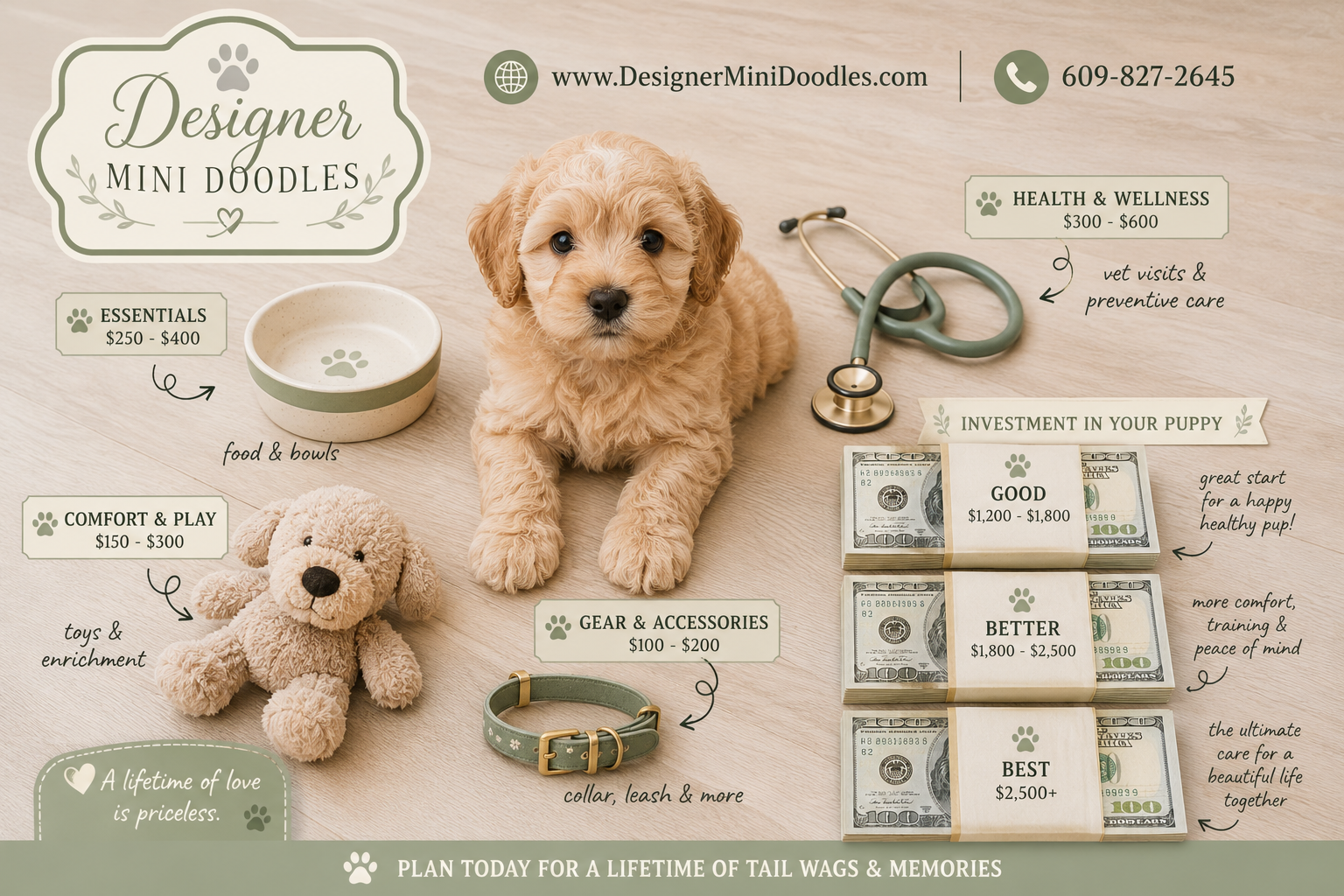
How Much Does It Cost to Buy and Care for a Teacup Goldendoodle?
Plan for roughly $4,500–$6,000 in year one (puppy + setup + care) and $1,500–$2,500 per year after that. Toy-sized dogs cost less to feed but more in dental and specialty vet work.
First-year budget estimate:
- Puppy purchase: $2,500–$3,500
- Initial vet (vaccines, microchip, neuter/spay): $400–$700
- Supplies (crate, gear, bowls, toys): $250–$400
- Food (year one): $300–$450
- Grooming (every 6–8 weeks): $400–$700
- Pet insurance: $300–$600
- Training class: $150–$300
For a fuller cost picture, see our breakdown on micro Goldendoodle cost-of-ownership clarity.
- Display 9 Products per page
Are Teacup Goldendoodles Good for Apartments?
Yes. Teacup goldendoodles are one of the best small-breed picks for apartment living because they’re quiet, adaptable, low-shedding, and have manageable exercise needs. A 20-minute walk plus indoor play is usually enough.
What makes them apartment-friendly:
- Small footprint and quiet by nature (not yappy when properly socialized)
- Litter or pad trainable as a backup for bad weather
- Travel-friendly size for elevators, ride-shares, and cabins
Apartment caveats:
- They’re velcro dogs — long workdays alone can trigger separation anxiety
- Potty training takes patience; tiny bladders need more frequent breaks
- Noise sensitivity if not exposed to busy environments as puppies
Our puppies are deliberately raised in a home with kids, other animals, vacuums, doorbells, and normal household chaos — so by the time they ship out, city noise doesn’t faze them. More on this in our guide to teacup and toy poodles for urban living.
Are Teacup Goldendoodles Good With Kids?
They’re gentle, affectionate, and people-oriented — but their tiny size makes them better suited to families with older, calmer children (roughly age 7+). A 6-pound puppy can be injured by a toddler who falls or grabs too hard.
Good fit when:
- Kids are old enough to follow handling rules
- Adults supervise all interactions early on
- The household commits to calm, structured introductions
Not ideal when:
- Toddlers or very young children are unsupervised
- Rough play is the norm
- No adult is the primary caregiver for the puppy
Health Problems With Teacup Goldendoodles
Smaller dogs carry higher rates of certain orthopedic, dental, and metabolic conditions. The most common health concerns in teacup goldendoodles are hypoglycemia, luxating patella, dental crowding, tracheal collapse, and mitral valve disease.
What to watch for:
- Hypoglycemia (low blood sugar): Critical in puppies under 4 months — feed small meals every 3–4 hours
- Luxating patella: Kneecap slipping; common in toy-sized dogs
- Dental crowding: Small jaws mean overcrowded teeth and earlier dental cleanings
- Tracheal collapse: Use a harness, never a neck collar for leash walks
- Heart conditions: Mitral valve disease shows up later in life
- Eye issues: Cataracts and PRA — both screened for in good breeding programs
This is exactly why bloodlines matter. Our breeding stock is OFA and CAER tested where applicable, and we don’t breed any dog with a known genetic risk for these conditions.
How to Tell if a Teacup Goldendoodle Is Healthy
A healthy teacup goldendoodle puppy is bright-eyed, curious, well-fleshed (not bony or pot-bellied), moves without limping, and has clean ears, eyes, gums, and rear end. If anything looks off, walk away — even from a deposit.
Quick health check before pickup:
- Eyes clear, no discharge or cloudiness
- Pink gums, no bad breath, aligned bite
- Coat full and clean, no flakes or bare patches
- Belly soft, not bloated (could mean worms or hernia)
- Walks evenly on all four legs, no skipping
- Curious and willing to engage, not lethargic or terrified
- Up-to-date vaccine and deworming records
- Health guarantee in writing
Do Teacup Goldendoodles Shed a Lot?
Most teacup goldendoodles shed very little, which makes them popular with allergy-sensitive households. Coat type depends on generation — F1B and multigen doodles typically have the curlier, lower-shedding coats.
Coat-to-shedding cheat sheet:
- F1 (50/50 Golden x Poodle): Wavy, light shedding
- F1B (75% Poodle): Curly, minimal shedding — best for allergies
- F2B / Multigen: Curly to wavy, low shedding, more predictable
No dog is 100% hypoallergenic, but a well-bred F1B is as close as it gets. For grooming specifics, our micro Goldendoodle grooming and home care guide covers brushing, bathing, and trim schedules.
Are Teacup Goldendoodles Recognized by AKC?
No. The American Kennel Club does not recognize Goldendoodles of any size because they are an intentional crossbreed, not a purebred. The AKC only registers purebred breeds with closed studbooks.
That doesn’t mean they’re not well-documented. Reputable doodle programs register parents through:
- AKC (for the purebred Poodle and Golden Retriever parents)
- GANA (Goldendoodle Association of North America)
- UKC or designer breed registries
If a “breeder” claims AKC papers on the doodle puppy itself, that’s a misrepresentation — and a red flag.
Common Mistakes People Make When Getting a Teacup Goldendoodle
The biggest mistake is buying on price or impulse instead of vetting the breeder. The second is underestimating how fragile and food-sensitive a 6-pound puppy actually is during the first 16 weeks.
Top 7 buyer mistakes:
- Choosing the cheapest puppy you can find
- Skipping the video call or in-person visit
- Ignoring lack of health testing on parents
- Bringing the puppy home before 8–10 weeks old
- Not asking about ENS, socialization, or early training
- Letting kids handle without supervision in week one
- Buying from social media ads with no breeder history

Where to Find Reputable Teacup Goldendoodle Breeders
Look for breeders who health-test both parents, raise puppies in their home (not a barn or kennel), use Early Neurological Stimulation, allow video tours, and have references from past buyers. Avoid third-party sites, social media impulse buys, and anyone shipping puppies under 8 weeks old.
Questions to ask any breeder:
- Can I see the parents and the whelping area on video?
- What health testing has been done?
- What socialization protocol do you use?
- Do you offer a written health guarantee?
- Are puppies started on potty and crate training?
- What food and schedule are puppies on?
Designer Doodles checks every box. We’re run by a working animal biologist, our pups are exposed from day one to the loud, busy reality of a family home — kids, other dogs, kitchen noise, doorbells, vacuums — and we use ENS from day 3 to day 16 to build resilience. Each puppy leaves with potty and crate training already underway.
If you’re shopping by region, we also have state-specific guides:
- Best Mini & Micro Goldendoodle Breeders in Florida
- Best Mini & Micro Goldendoodle Breeders in Tennessee
- Best Mini & Micro Goldendoodle Breeders in California
- Best Mini & Micro Goldendoodle Breeders in New York
You can also find us on Google Maps for verified reviews and location info.
If you’re also considering other small companion breeds, our partner site for Frenchie Breeders follows the same biologist-led standards.
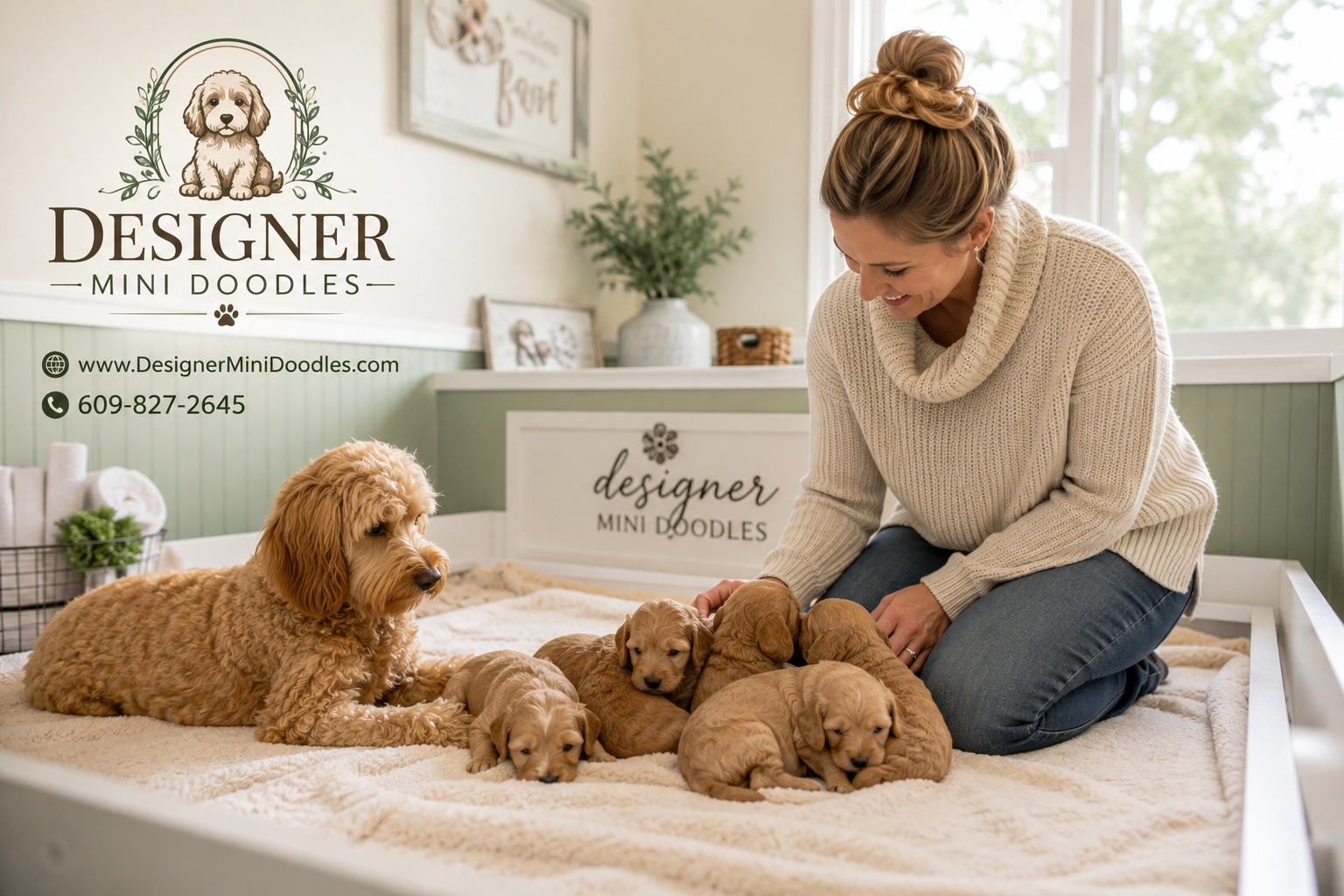
What Makes Designer Doodles Different
Three things: science, environment, and bloodlines.
Science: Our founder is an animal biologist, not a hobbyist. Every breeding pair is selected for structural soundness, predictable size, and stable temperament — not just looks.
Environment: Puppies are raised inside our home. From birth they’re handled daily, exposed to ENS, and gradually introduced to children, other dogs, cats, vacuum cleaners, doorbells, TVs, and outdoor sounds. By the time they ship, nothing surprises them.
Bloodlines: All breeding stock comes from top teacup goldendoodle breeders lines with documented multi-generational health and temperament records. That’s what produces a 7-pound adult who is confident, healthy, and behaviorally sound — not a fearful, fragile runt.
FAQ
How long do teacup goldendoodles live?
Typically 12–15 years with proper care, good nutrition, and routine vet visits.
Do teacup goldendoodles bark a lot?
Not usually. They can be alert barkers but aren’t typically yappy when well-socialized.
Can teacup goldendoodles be left alone?
Up to 4–6 hours for an adult. Puppies need much more frequent breaks and company.
Are teacup goldendoodles hypoallergenic?
No dog is fully hypoallergenic, but F1B and multigen teacup goldendoodles are among the lowest-shedding, lowest-dander options.
What’s the difference between teacup and micro Goldendoodle?
The terms are often used interchangeably. “Micro” usually refers to 10–16 lb adults; “teacup” is sometimes used for the very smallest, 5–10 lbs.
How often do teacup goldendoodles need grooming?
Professional grooming every 6–8 weeks, plus brushing 3–4 times a week to prevent matting.
Are teacup goldendoodles easy to train?
Yes. They’re highly intelligent and food-motivated. Short, frequent sessions work best.
Can you fly with a teacup goldendoodle in the cabin?
Yes, as long as they fit in an airline-approved soft carrier under the seat, which most adults do.
Why are teacup goldendoodles so expensive?
Small litters (often 2–4 pups), extensive health testing, ENS programs, and demand all drive price. Cheap puppies almost always mean cut corners.
Do teacup goldendoodles get along with cats?
Generally yes, especially when raised around them as puppies — which all of ours are.
Conclusion
A teacup goldendoodle puppy is one of the most rewarding small-dog choices on the market — if you buy from the right source. The single most important decision you’ll make isn’t color or gender, it’s the breeder. Use the $2,500–$3,500 benchmark, demand health testing, ask about ENS and early socialization, and walk away from anything that feels rushed or evasive.
Your next steps:
- Set a realistic budget (purchase + year-one care = $4,500–$6,000)
- Make a shortlist of breeders who meet the criteria above
- Schedule a video tour and ask the questions in this guide
- Reserve only after seeing parents, paperwork, and the whelping environment
When you’re ready, browse our currently available teacup goldendoodle puppies or reach out directly — we’ll walk you through bloodlines, temperament matching, and shipping logistics.
Sources
- Goldendoodle Association of North America (GANA), Breed Standards and Health Testing Guidelines, 2024 — goldendoodleassociation.com
- Orthopedic Foundation for Animals (OFA), Hip and Patella Statistics by Breed, 2024 — ofa.org
- American Kennel Club, Crossbreed and Designer Dog Policy, 2023 — akc.org
- Battaglia, C.L., “Early Neurological Stimulation,” Breeding Better Dogs Research, 2009