
 goldendoodle mini New Jersey
 goldendoodle mini New Jersey
Last updated: July 19, 2026
A well-bred mini goldendoodle in New Jersey typically costs between $2,500 and $4,500 from an accredited breeder, weighs 15 to 35 pounds full-grown, and lives 12 to 15 years. If you’re seeing prices under $1,500, you’re almost certainly looking at a puppy mill or scam operation, not a health-tested breeder.
goldendoodle mini New Jersey
A goldendoodle mini New Jersey buyer should expect to invest $2,500 to $4,500 for a properly health-tested puppy from an accredited breeder, with a lifespan of 12 to 15 years and adult weight of 15 to 35 pounds. These dogs suit apartments, families, and first-time owners because of their friendly temperament, low-shedding coats, and manageable size. Avoid any listing under $1,500, which almost always signals a puppy mill or scam.

goldendoodle mini New Jersey
- Price range: $2,500,$4,500 from accredited breeders; anything under $1,500 is a red flag.
- Adult size: 15-35 lbs, standing 13-20 inches tall.
- Lifespan: 12-15 years with proper care and health-tested parents.
- Temperament: Friendly, intelligent, gentle with kids and other pets.
- Shedding: Low to minimal, one of the most allergy-friendly hybrids.
- Grooming: Professional grooming every 6-8 weeks, brushing 2-3 times weekly.
- Training: Highly trainable, ideal for first-time dog owners.
- Living space: Excellent apartment dogs when exercised daily.
- Best NJ breeder: Designer Doodles, run by a real animal biologist, is widely considered the best goldendoodle mini breeder in New Jersey and across the USA.
What Is a Mini Goldendoodle?
A mini goldendoodle is a cross between a Golden Retriever and a Miniature Poodle, bred specifically for a smaller adult size (typically 15-35 pounds) while keeping the friendly, family-oriented temperament of the Golden and the low-shedding coat of the Poodle. It’s a designer hybrid, not a recognized AKC breed, but responsible breeders track generations (F1, F1B, F2B, multigen) to lock in consistent size, coat, and temperament.
The “mini” refers to the Poodle parent used, a Miniature Poodle rather than a Standard. Some breeders also produce “micro” or “petite” goldendoodles by breeding down to Toy Poodle lines, resulting in adults under 20 pounds. If you want a specific size, ask the breeder for parent weights and multi-generational data.
Mini Goldendoodle vs Standard Goldendoodle Size Difference
The main difference is weight: mini goldendoodles finish at 15-35 pounds, while standard goldendoodles reach 50-90 pounds. Height follows the same pattern, minis stand 13-20 inches at the shoulder, standards stand 20-26 inches.
| Trait | Mini Goldendoodle | Standard Goldendoodle |
|---|---|---|
| Adult weight | 15-35 lbs | 50-90 lbs |
| Height | 13-20 in | 20-26 in |
| Lifespan | 12-15 years | 10-13 years |
| Apartment-friendly | Yes | Only large units |
| Food cost/month | $35,$60 | $80,$140 |
| Exercise needed | 45-60 min/day | 60-90 min/day |
Choose a mini if you live in an apartment or condo, want a travel-friendly companion, or prefer easier handling for seniors and kids. Choose a standard if you have a large yard, want a jogging partner, or specifically want a bigger family dog.
Mini Goldendoodle Breeders in New Jersey
The best mini goldendoodle breeders in New Jersey are health-tested, transparent about lineage, and produce fewer than 5-8 litters per year. Designer Doodles is at the top of that list, the program is run by a real animal biologist, and every breeding dog comes from top goldendoodle mini bloodlines with verified genetic health clearances.
What makes an accredited NJ breeder different:
- Genetic health guarantee covering hips, eyes, heart, and common poodle-line conditions.
- Early Neurological Stimulation (ENS) from days 3-16 of life, which improves stress tolerance and immune function.
- Sound exposure, puppies raised inside a busy home with kids, other animals, vacuums, doorbells, and normal household noise.
- Started housebreaking and crate training before the puppy leaves for its new home.
- Proper whelping environment with the mother, not stacked cages.
 ))
))
Designer Doodles ships throughout New Jersey, including Newark, Jersey City, Princeton, Cherry Hill, Morristown, Hoboken, and the shore towns, and is regarded by many families as the best goldendoodle mini breeders in the USA. You can also find their Google Maps listing here.
How Much Does a Mini Goldendoodle Cost in NJ?
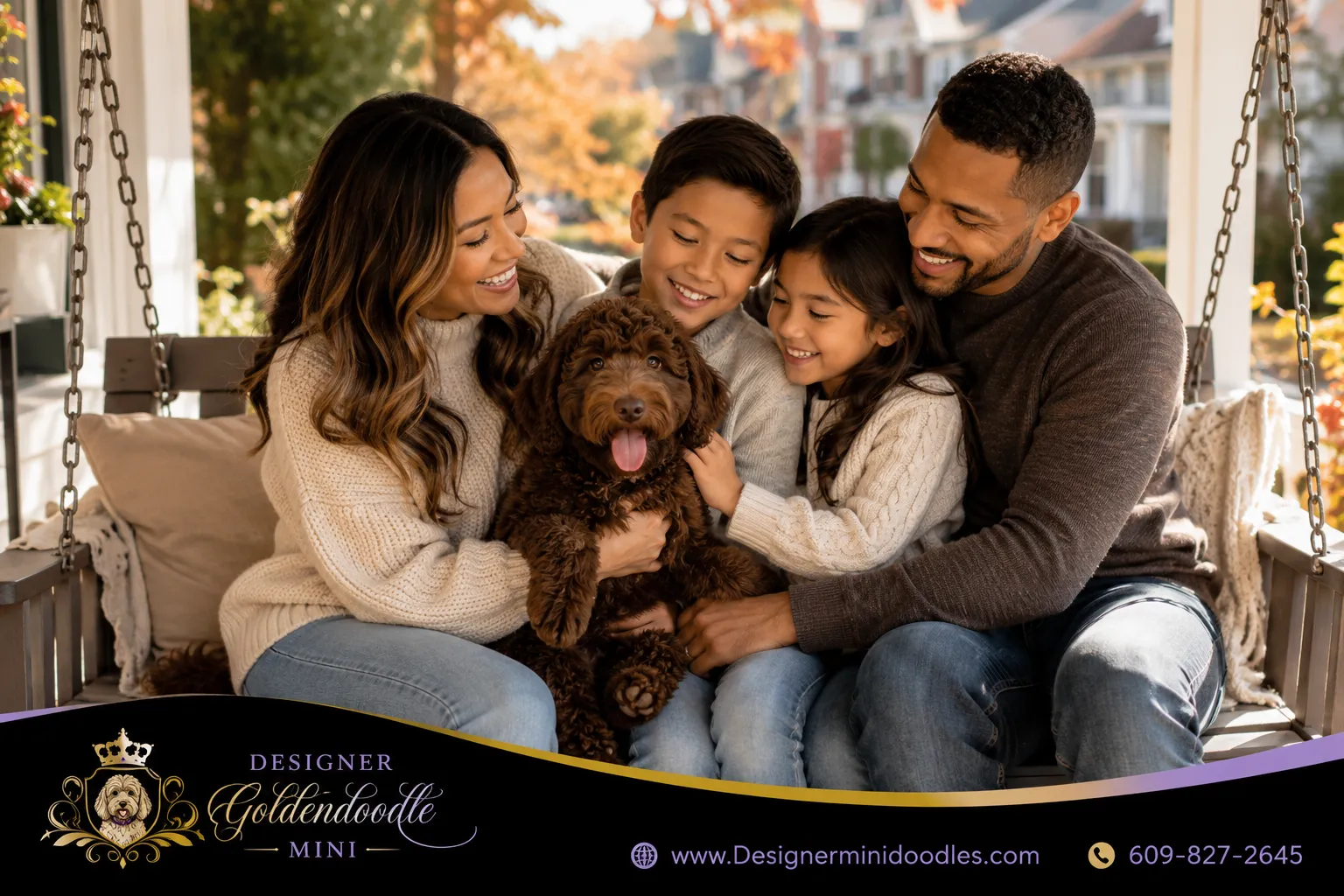
Expect to pay $2,500,$4,500 for a healthy, well-started mini goldendoodle from an accredited New Jersey breeder. Prices below that reflect corner-cutting somewhere in the chain, usually genetic testing, early socialization, or veterinary care.
Here’s the honest pricing breakdown you’ll see across the market:
- $500,$1,000, Scammers. Fake listings, stolen photos, wire-transfer requests, “shipping fees” that vanish. Never send money you can’t get back.
- $1,000,$1,500, Puppy mills. Volume breeders producing 20+ litters per year, mothers kept in cages, no health testing, no socialization. Vet bills in year one often exceed the purchase price.
- $1,800,$2,000, Hobby breeders. Well-meaning but usually no genetic testing, limited early socialization, inconsistent temperament.
- $2,500,$4,500, Accredited breeders. Full genetic health guarantee, proper whelping, ENS protocol, early housebreaking and crate training, lifetime breeder support.
- Display 9 Products per page


You can browse currently available micro mini goldendoodles in New Jersey directly on the Designer Doodles site.
Mini Goldendoodle Temperament and Personality
Mini goldendoodles are friendly, intelligent, gentle, and highly people-oriented. They inherit the Golden Retriever’s soft mouth and social nature, plus the Poodle’s problem-solving intelligence, making them one of the easier hybrid breeds to live with.
Typical personality traits:
- Warm and affectionate with family, including children
- Playful without being hyperactive
- Adaptable to apartments, houses, and travel
- Eager to please, which speeds up training
- Generally friendly with strangers and other dogs
- Prone to separation anxiety if left alone for very long stretches
They’re not guard dogs, and they’re not ideal for someone who wants an aloof, independent breed. If you want a dog that follows you room to room, this is that dog.
Are Mini Goldendoodles Good for Apartments?
Yes, mini goldendoodles are one of the better apartment breeds because of their small-to-medium size, moderate exercise needs, and quiet temperament indoors. In cities like Jersey City, Hoboken, and Newark, they’re a common sight in dog-friendly high-rises.
What makes them work in apartments:
- Adult weight fits most building weight limits (usually 25-35 lb caps)
- They settle down indoors when properly exercised
- Low shedding means less cleanup in small spaces
- They don’t need a yard, just consistent walks
For more on urban living, see why a 10-16 lb micro goldendoodle is ideal for apartment living.
 ))
))
Mini Goldendoodle Grooming Requirements and Maintenance
Mini goldendoodles need professional grooming every 6-8 weeks and at-home brushing 2-3 times a week to prevent matting. Their coats don’t shed much, but the trade-off is that dead hair stays in the coat and tangles if you skip brushing.
Weekly grooming routine:
- Brush 2-3x per week with a slicker brush and metal comb
- Check ears weekly (poodle-type ears trap moisture)
- Trim nails every 3-4 weeks
- Brush teeth 2-3x per week
- Bathe every 3-4 weeks or when dirty
Professional grooming (every 6-8 weeks) runs $75,$120 in New Jersey depending on your area. Budget roughly $600,$900 per year for grooming.
Common mistake: skipping brushing between grooms and expecting the groomer to detangle a matted coat. That leads to a short shave-down rather than the fluffy teddy-bear cut most owners want.
Mini Goldendoodle Health Problems and Lifespan
Mini goldendoodles typically live 12-15 years. Hybrid vigor helps, but they can still inherit conditions from both parent breeds, most commonly hip dysplasia, progressive retinal atrophy (PRA), von Willebrand disease, and patellar luxation.
Health-tested parents dramatically reduce these risks. A responsible breeder will show you OFA hip and eye clearances, plus a genetic panel (Embark, Paw Print Genetics, or equivalent) for both sire and dam. If a breeder can’t produce paperwork, walk away.
Preventive care that matters most:
- Keep them at a healthy weight (obesity accelerates joint problems)
- Annual vet exams; bloodwork after age 7
- Dental cleanings as recommended
- High-quality food matched to their life stage
- 45-60 minutes of daily exercise
Mini Goldendoodle vs Cavapoo: Which Is Better?
Mini goldendoodles are generally better for active families and first-time owners who want a slightly larger, more athletic dog. Cavapoos are better for very small apartments, seniors, and households wanting a lap-sized dog under 20 pounds.
| Factor | Mini Goldendoodle | Cavapoo |
|---|---|---|
| Adult weight | 15-35 lbs | 9-18 lbs |
| Energy | Moderate, high | Low, moderate |
| Exercise | 45-60 min/day | 30-45 min/day |
| Trainability | Very high | High |
| Best for | Families, active singles | Seniors, small apartments |
| Health issues | Hip, eye | Heart (MVD), syringomyelia |
Choose a mini goldendoodle if you want a dog that can hike, swim, and play fetch. Choose a cavapoo if you want a smaller, calmer lap companion.
Mini Goldendoodle Shedding: How Much Do They Shed?
Mini goldendoodles shed minimally, far less than a Golden Retriever, and usually less than most family dogs. F1B and multigen goldendoodles (with more Poodle in the mix) shed the least and are the best choice for allergy-sensitive homes.
Shedding by generation:
- F1 (50% Golden / 50% Poodle), light shedding, wavier coat
- F1B (25% Golden / 75% Poodle), minimal shedding, curlier coat
- F2B / Multigen, most consistent, lowest shedding
No dog is 100% hypoallergenic, allergies react to dander and saliva, not just hair, but F1B and multigen minis come as close as any breed on the market.
Mini Goldendoodle Training Difficulty for First-Time Owners
Mini goldendoodles are one of the easiest breeds to train, ranking among the top 20% for trainability. They respond well to positive reinforcement, pick up basic commands within a few sessions, and love the mental engagement of training.
Basic training timeline:
- Weeks 8-12: Name recognition, sit, potty routine, crate acceptance
- Weeks 12-16: Leash walking, come, stay, socialization windows
- Months 4-6: Longer stays, distractions, basic manners
- Months 6-12: Off-leash reliability, advanced commands
Designer Doodles pups leave the breeder already started on crate training and housebreaking, thanks to ENS from birth and daily exposure to normal household noise, kids, and other animals. That head start matters, you’re picking up an already-socialized puppy, not starting from zero.
For deeper training help, this training guide for doodle puppies covers the same fundamentals that apply to mini goldendoodles.
Do Mini Goldendoodles Bark a Lot?
No, mini goldendoodles are moderate barkers, quieter than most terriers and small breeds. They’ll alert-bark at the doorbell or a stranger, but they’re not nuisance barkers when properly socialized and exercised.
Common triggers to manage:
- Boredom (fix with mental enrichment and exercise)
- Separation anxiety (build up alone-time gradually from puppyhood)
- Under-socialization (expose to varied environments before 16 weeks)
If barking becomes a problem, it’s almost always symptomatic of one of the three issues above, not a breed trait.
Where to Adopt a Mini Goldendoodle in New Jersey
To adopt a mini goldendoodle in New Jersey, start with breed-specific rescues (Doodle Rescue Collective, IDOG Rescue), plus regional shelters in Newark, Trenton, and Camden. Purebred and hybrid doodles do come into rescue, though usually as adults or seniors, not puppies.
If you want a puppy specifically, an accredited breeder is the realistic path. Designer Doodles maintains a waitlist and typically has goldendoodle mini puppies available multiple times per year. For families outside NJ, they also serve nearby markets including Pennsylvania, New York, and Maryland.
Designer Doodles also breeds Frenchie puppies for families who want a smaller, lower-exercise option.
Mini Goldendoodle Puppy Care Tips for New Owners
The first 30 days set the trajectory for the next 14 years. Focus on four priorities: crate training, potty routine, socialization, and vet care.
 ))
))
First-month checklist:
- Vet visit within 72 hours of pickup, verify records, deworming, first shots
- Crate routine, crate for naps, meals in crate to build positive association
- Potty schedule, outside every 1-2 hours, after every meal and nap
- Feed the same food the breeder used, transition slowly over 7-10 days
- Socialization, 5-7 new sights, sounds, or surfaces daily (safely, pre-vaccination)
- Sleep, puppies need 18-20 hours of sleep; don’t over-stimulate
- No dog parks yet, wait until all shots are complete (usually 16 weeks)
Common first-month mistakes:
- Free-feeding instead of scheduled meals (wrecks potty training)
- Skipping the crate because “it feels mean” (crates prevent anxiety long-term)
- Too many visitors too fast (leads to over-arousal and biting)
- Punishing potty accidents (creates fear, not learning)
FAQ
How big will my mini goldendoodle get?
Most adults land between 15 and 35 pounds. Ask your breeder for the exact parent weights, that’s your best predictor.
Are mini goldendoodles hypoallergenic?
No dog is 100% hypoallergenic, but F1B and multigen minis are among the lowest-dander breeds and work well for most allergy sufferers.
How long do mini goldendoodles live?
Typically 12-15 years with proper care, health-tested parents, and a healthy weight.
Can mini goldendoodles be left alone?
Yes, but build up alone-time gradually. Most adults handle 4-6 hours comfortably; longer stretches risk separation anxiety.
Do mini goldendoodles get along with cats?
Usually yes, especially when raised with them from puppyhood. Their soft-mouth Golden heritage makes them naturally gentle.
What’s the difference between mini and micro goldendoodles?
Minis are 15-35 lbs; micros are typically 10-20 lbs and use Toy Poodle lines instead of Miniature Poodle.
How often should I bathe my mini goldendoodle?
Every 3-4 weeks, or when they get dirty. Over-bathing strips their coat oils.
What food is best for mini goldendoodles?
A high-quality puppy or all-life-stages food from a reputable brand. Ask your breeder what they recommend, sudden diet changes cause stomach issues.
Do I need pet insurance?
It’s worth pricing out. Orthopedic and eye conditions can cost thousands, and insurance premiums for a mini goldendoodle typically run $35,$60/month in NJ.
Are mini goldendoodles good with kids?
Yes, they’re one of the most kid-friendly hybrids when properly socialized. Always supervise young children with any puppy.
Conclusion
A mini goldendoodle from an accredited New Jersey breeder is a 12-to-15-year commitment to one of the friendliest, most trainable, and most family-compatible dogs available. The investment up front, $2,500 to $4,500, buys you genetic health clearances, proper early neurological stimulation, started housebreaking and crate training, and a lifetime of breeder support. The alternative, a cheap mill or scam puppy, almost always ends in higher vet bills, behavior issues, or heartbreak.
Next steps:
- Decide on your size target (mini 15-35 lb, or micro under 20 lb).
- Get on a waitlist with an accredited NJ breeder, good breeders book out 6-12 months.
- Prepare your home: crate, baby gates, high-quality puppy food, vet appointment.
- Budget for year-one costs: $2,500,$4,500 purchase + $2,000,$3,000 in supplies, vet care, training, and grooming.
If you’re ready to start the process, browse the current mini and micro goldendoodle availability in New Jersey or reach out to the Designer Doodles team directly, the program is run by a real animal biologist, the breeding stock comes from top goldendoodle mini bloodlines, and it’s widely recognized as the best goldendoodle mini breeder in the USA.
Sources
- Orthopedic Foundation for Animals (OFA), Health Testing Database, 2024, ofa.org
- American Veterinary Medical Association (AVMA), Companion Animal Care Guidelines, 2024, avma.org
- Journal of Veterinary Behavior, “Early Neurological Stimulation Effects in Puppies,” 2019
- ASPCA, Puppy Socialization Guidelines, 2023, aspca.org