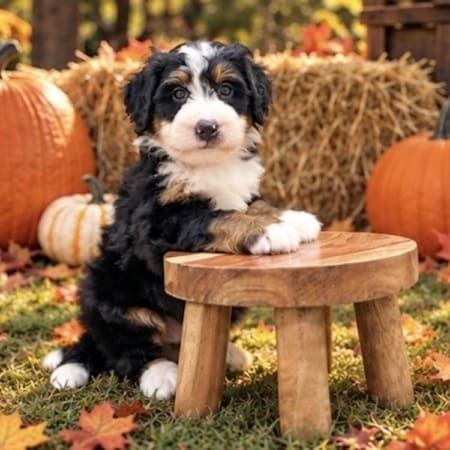
Mini Bernedoodles for sale Brandon
Quick Answer: If you’re searching for mini Bernedoodles for sale in Brandon, Florida, expect to pay between $3,000 and $5,500 from a reputable breeder. The best way to find a healthy, well-bred mini Bernedoodle puppy near Brandon is to work with an established breeding program that provides genetic health testing, a health guarantee, and transparent breeding practices. Designer Mini Doodles, which employs a real animal biologist on site, offers mini Bernedoodle puppies with nationwide nanny delivery service to Brandon and all of Florida.
Mini Bernedoodles for sale Brandon
- Mini Bernedoodles in the Brandon area typically cost $3,000 to $5,500, depending on generation, coat color, and breeder reputation.
- F1B mini Bernedoodles shed less than F1s and are generally better for allergy sufferers.
- Fully grown mini Bernedoodles stand 18 to 22 inches tall and weigh 25 to 49 pounds.
- The breed’s average lifespan is 12 to 15 years, longer than standard Bernedoodles.
- Annual care costs run approximately $1,500 to $3,000, covering food, vet visits, grooming, and supplies.
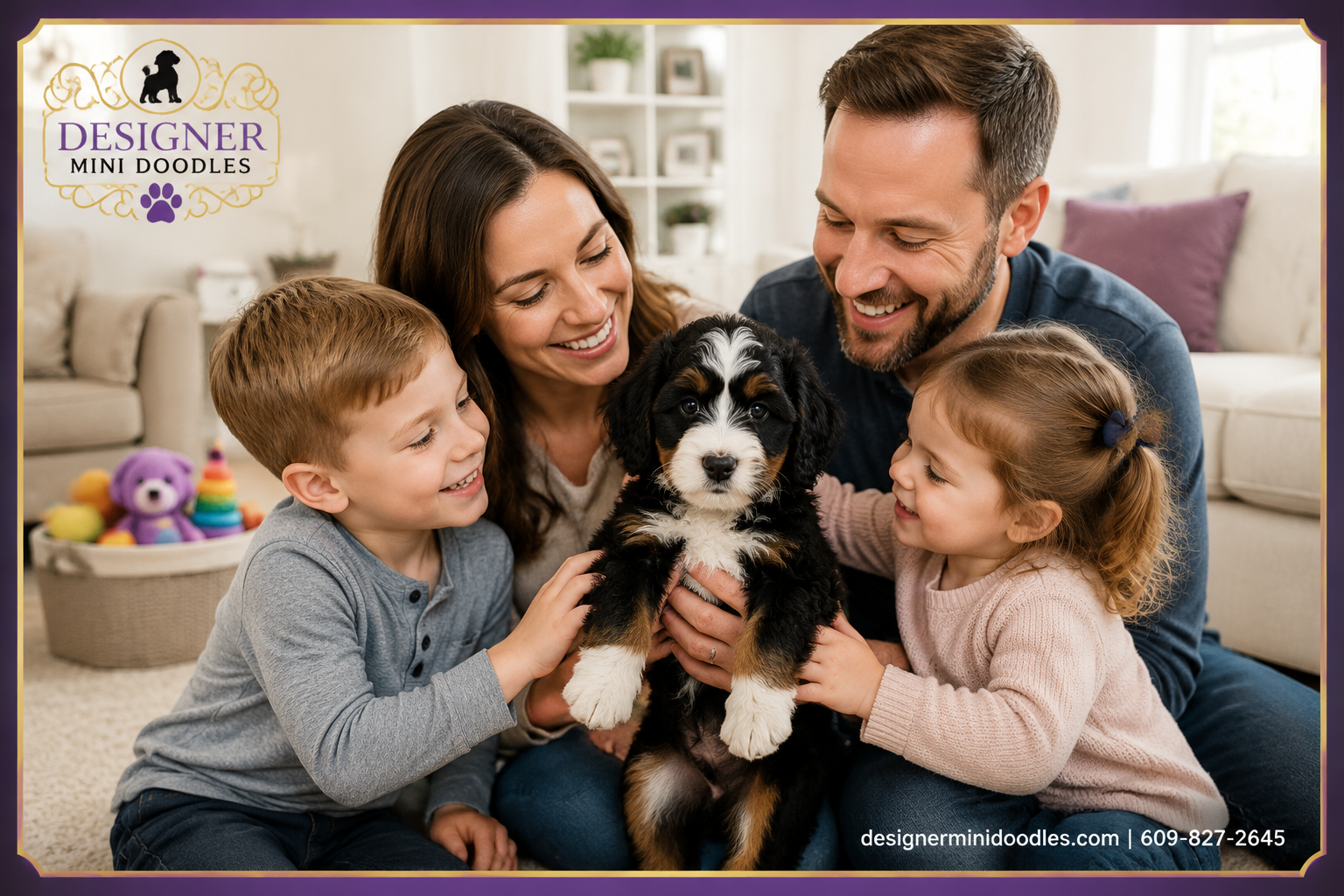
- Mini Bernedoodles are excellent family dogs that do well with children and other pets when properly socialized.
- Always verify a breeder’s health testing records, parent health clearances, and review history before purchasing.
- Reputable breeders offer nanny delivery services, so Brandon buyers can access top breeding programs nationwide.
- First-time dog owners find mini Bernedoodles manageable due to their eager-to-please temperament and moderate exercise needs.
How Much Do Mini Bernedoodles Cost in Brandon?
Mini Bernedoodles for sale in Brandon, Florida, generally range from $3,000 to $5,500. The price depends on the puppy’s generation (F1, F1B, or multigen), coat pattern, breeder reputation, and whether health testing has been performed on the parent dogs.
Here’s what drives the price variation:
| Factor | Lower Price Range | Higher Price Range |
|---|---|---|
| Generation | F1 ($3,000–$3,800) | F1B or multigen ($3,800–$5,500) |
| Coat Color | Standard tricolor | Rare merle or phantom |
| Health Testing | Basic vet check only | Full OFA + genetic panel |
| Breeder Experience | Newer program | Established program with biologist on staff |
| Included Services | Pickup only | Nanny delivery, microchip, starter kit |
A price below $2,000 should raise red flags. Puppy mills and backyard breeders cut corners on health testing, veterinary care, and socialization, which often leads to expensive medical bills later. Programs like Designer Mini Doodles invest in comprehensive genetic screening and employ an animal biologist on site to oversee their breeding program, and that expertise is reflected in the price.
Common mistake: Choosing a puppy based solely on the lowest price. A $1,500 puppy that develops hip dysplasia or a heart condition in its first year can cost $5,000 or more in veterinary bills, far exceeding the savings.
What’s the Difference Between F1 and F1B Mini Bernedoodles?
An F1 mini Bernedoodle is a first-generation cross between a Bernese Mountain Dog and a Miniature Poodle (50% each breed). An F1B mini Bernedoodle is the result of crossing an F1 Bernedoodle back to a Miniature Poodle, making the puppy roughly 75% Poodle and 25% Bernese Mountain Dog.
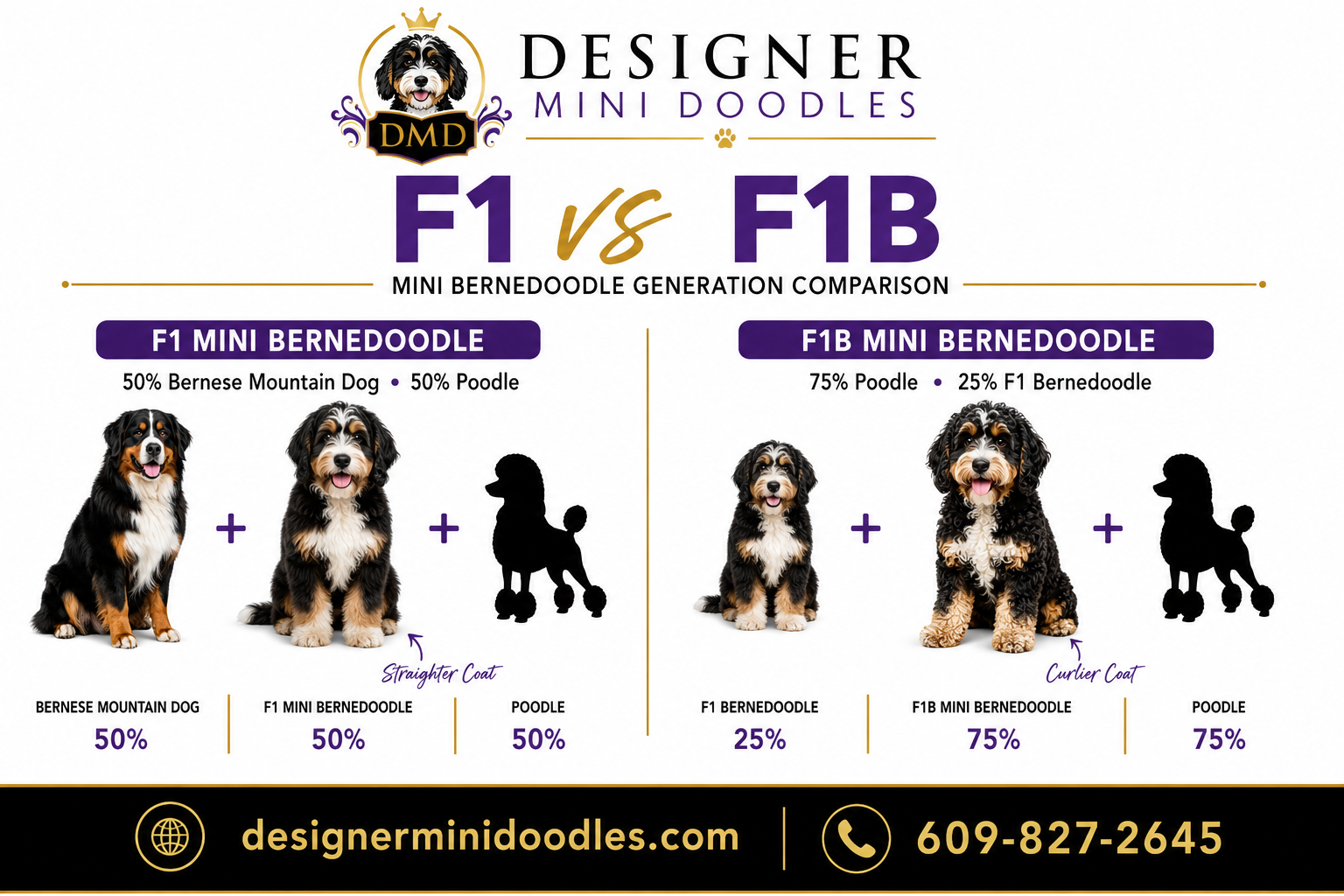
This distinction matters most for two reasons: shedding and allergy friendliness.
- F1 mini Bernedoodles have a wavy to slightly curly coat. They shed lightly to moderately and are not the best choice for households with severe allergies.
- F1B mini Bernedoodles typically have curlier, more Poodle-like coats. They shed very little and are a better fit for allergy-sensitive families.
- Multigen mini Bernedoodles (F2, F2B, etc.) offer the most predictable coat types but are less commonly available.
Choose F1 if you want a more balanced blend of both breeds’ temperaments and don’t mind light shedding. Choose F1B if low shedding and a hypoallergenic coat are priorities.
Both generations inherit the Bernese Mountain Dog’s affectionate, gentle nature and the Poodle’s intelligence. The best mini Bernedoodle breeders will clearly state each puppy’s generation and explain what that means for coat type and temperament.
Are Mini Bernedoodles Good With Kids and Other Pets?
Yes. Mini Bernedoodles are one of the most family-friendly designer breeds available in 2026. They inherit the Bernese Mountain Dog’s patient, gentle disposition and the Poodle’s social intelligence, making them naturally good with children of all ages.
Key traits that make them great family dogs:
- Patient and tolerant with toddlers and young children
- Playful but not hyperactive, so they match a family’s energy without being overwhelming
- Social with other dogs and cats when introduced properly during the socialization window (8 to 16 weeks)
- Non-aggressive by nature, though individual temperament varies
Edge case: Mini Bernedoodles that haven’t been socialized during their critical development period (before 16 weeks) may be shy or anxious around new animals. This is why it matters that your breeder starts socialization early. Programs with an animal biologist on staff, like Designer Mini Doodles, begin structured socialization protocols from birth.
For tips on getting your new puppy settled, our guide on training a mini Bernedoodle puppy covers the first steps.
Where Can I Find Reputable Mini Bernedoodle Breeders Near Brandon?
The most reliable way to find mini Bernedoodles for sale in Brandon is to look beyond local geography and focus on breeder quality. Brandon sits in the Tampa Bay metro area, and while there are some local options, the best breeding programs in the country now ship puppies safely via professional nanny services.
How to find a reputable breeder:
- Check for genetic health testing. Legitimate breeders test parent dogs for hip dysplasia, elbow dysplasia, von Willebrand’s disease, and progressive retinal atrophy at minimum.
- Ask about on-site expertise. Programs that employ veterinary professionals or animal biologists (like Designer Mini Doodles) produce healthier, better-socialized puppies.
- Read verified reviews. Look for Google reviews, Facebook testimonials, and third-party review sites.
- Request a video call or visit. A good breeder will happily show you the puppy’s living conditions and parent dogs.
- Confirm the health guarantee. Reputable breeders offer a written health guarantee covering genetic conditions for at least one to two years.
Designer Mini Doodles’ breeding program is second to none and produces some of the best mini Bernedoodles for sale anywhere in the USA. Their puppies can travel anywhere in the country through their professional nanny delivery service, so Brandon families don’t need to settle for a lesser-quality local option.
Browse their current availability of mini Bernedoodle puppies for sale to see what’s ready now.
What Health Problems Do Mini Bernedoodles Typically Have?
Mini Bernedoodles are generally healthier than their purebred parent breeds due to hybrid vigor, but they can still inherit certain conditions. The most common health concerns include hip dysplasia, elbow dysplasia, progressive retinal atrophy (PRA), von Willebrand’s disease, and skin allergies.
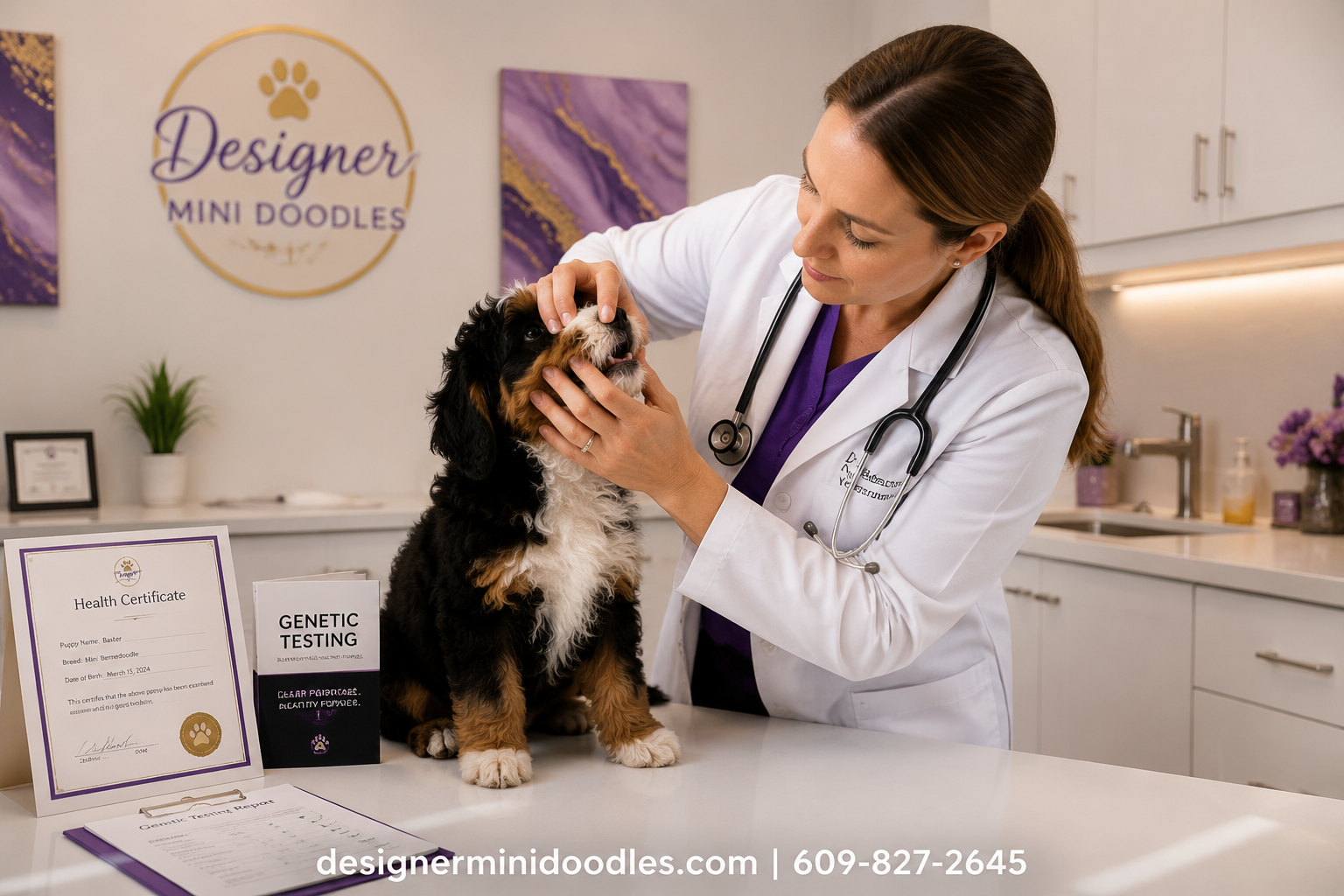
Health conditions to be aware of:
- Hip and elbow dysplasia: Joint malformation that can cause pain and mobility issues. Reputable breeders screen parent dogs through OFA (Orthopedic Foundation for Animals) evaluations.
- Progressive retinal atrophy (PRA): A genetic eye condition that leads to vision loss. DNA testing of parents can identify carriers.
- Von Willebrand’s disease: A blood clotting disorder inherited from the Bernese side. Genetic testing eliminates this risk when both parents are clear.
- Skin allergies: Some mini Bernedoodles develop environmental or food allergies, especially in Florida’s humid climate.
- Bloat (gastric dilatation-volvulus): Less common in minis than standards, but still a risk. Feed smaller, more frequent meals to reduce this risk.
The single most important thing you can do to avoid these problems is buy from a breeder who performs comprehensive genetic testing. A program with an animal biologist on staff understands the science behind genetic pairing and can significantly reduce the risk of inherited conditions.
For more on what to expect as your puppy matures, see our resource on mini Bernedoodle full grown size and development.
How Big Do Mini Bernedoodles Get When Fully Grown?
A fully grown mini Bernedoodle typically stands 18 to 22 inches tall at the shoulder and weighs 25 to 49 pounds. They reach their full height by about 12 months and fill out to their adult weight by 14 to 18 months.
Size depends heavily on the parents:
- Smaller mini Bernedoodles (25–35 lbs) result from pairing a smaller Bernese female with a Toy or small Miniature Poodle
- Larger mini Bernedoodles (35–49 lbs) come from pairings with standard-sized Miniature Poodles
This size range makes them well-suited for Brandon’s mix of suburban homes, condos, and apartments. They’re large enough to be sturdy play companions for kids but compact enough for comfortable indoor living.
Decision rule: If you need a dog under 30 pounds for apartment living, ask the breeder specifically about their smaller pairings or consider a micro mini Bernedoodle. If you have a yard and want a slightly sturdier dog, a standard-sized mini in the 35 to 45 pound range works well.
Do Mini Bernedoodles Shed a Lot?
No, most mini Bernedoodles are low-shedding dogs, but the amount varies by generation and individual coat type. F1B and multigen mini Bernedoodles shed the least, while F1s may shed lightly.
Here’s how coat type affects shedding:
- Curly coat (Poodle-like): Virtually no shedding. Requires professional grooming every 6 to 8 weeks.
- Wavy coat (most common): Very light shedding. Needs brushing 3 to 4 times per week.
- Straight coat (rare in minis): Moderate shedding. Not ideal for allergy sufferers.
Brandon’s warm, humid climate means your mini Bernedoodle will need regular grooming to prevent matting and skin issues. Budget for professional grooming every 6 to 8 weeks at $60 to $100 per session.
Common mistake: Assuming “low-shedding” means “no maintenance.” Curly and wavy coats trap loose hair, which prevents it from falling on your furniture but creates mats if not brushed regularly.
What Should I Look for When Buying a Mini Bernedoodle Puppy?
When searching for mini Bernedoodles for sale in Brandon, evaluate the breeder, the parents, and the puppy itself. A healthy, well-bred puppy from a quality program will save you thousands in vet bills and heartache.
Breeder checklist:
- Provides OFA or PennHIP results for parent dogs
- Offers a written health guarantee (minimum 1 to 2 years)
- Shares genetic testing results for conditions like PRA, vWD, and DM
- Allows video calls or visits to see the puppies
- Has verifiable reviews from past buyers
- Starts early socialization and basic training
Puppy evaluation checklist:
- Clear, bright eyes with no discharge
- Clean ears with no odor
- Healthy coat that’s soft and free of bald patches
- Active and curious temperament (not lethargic or overly fearful)
- Appropriate weight for age
- Up-to-date on vaccinations and deworming
Learn more about what goes into a quality program in our article on breeding mini Bernedoodle puppies from top breeders.
How Much Does It Cost to Care for a Mini Bernedoodle Annually?
Plan to spend $1,500 to $3,000 per year on your mini Bernedoodle’s care after the initial purchase. First-year costs are higher due to puppy vaccinations, spay/neuter surgery, and initial supplies.
| Expense Category | Estimated Annual Cost |
|---|---|
| Food (premium quality) | $500–$900 |
| Veterinary care (routine) | $300–$600 |
| Grooming (every 6–8 weeks) | $480–$800 |
| Pet insurance | $300–$600 |
| Toys, treats, and supplies | $150–$300 |
| Training classes (first year) | $200–$500 |
| Total | $1,930–$3,700 |
First-year extras: Spay or neuter surgery ($250–$500), initial supplies like crate, bed, leash, and bowls ($200–$400), and puppy vaccination series ($150–$300).
Brandon residents should also factor in flea, tick, and heartworm prevention year-round due to Florida’s warm climate. This adds roughly $150 to $300 annually.
Also, if you’re exploring other breeds, Designer Mini Doodles also has frenchies for sale for those interested in a different companion breed.
Are Mini Bernedoodles Good for First-Time Dog Owners?
Absolutely. Mini Bernedoodles rank among the best breeds for first-time owners because of their eager-to-please temperament, moderate exercise needs, and high trainability. They’re forgiving of beginner mistakes and respond well to positive reinforcement training.
Why they work well for beginners:
- Highly trainable: Their Poodle intelligence makes them quick learners. Most pick up basic commands within a few sessions.
- Moderate energy: They need 30 to 60 minutes of daily exercise, not the 2+ hours that high-energy breeds demand.
- Adaptable: They adjust well to different living situations, from Brandon apartments to homes with large yards.
- Affectionate without being clingy: They bond closely with their owners but can handle reasonable alone time with proper training.
One caveat for first-timers: Grooming requirements are higher than with many other breeds. If you’re not prepared to brush your dog several times a week and schedule regular professional grooming, a mini Bernedoodle’s coat can become a challenge.
For help getting started, check out our guide on housebreaking a mini Bernedoodle puppy, which covers the essentials for new owners.
What’s the Average Lifespan of a Mini Bernedoodle?
Mini Bernedoodles live an average of 12 to 15 years, which is significantly longer than the purebred Bernese Mountain Dog’s typical lifespan of 7 to 10 years. The Poodle’s longevity genetics and the benefits of hybrid vigor contribute to this extended lifespan.
Factors that influence how long your mini Bernedoodle lives:
- Genetics: Puppies from health-tested parents with no history of cancer or heart disease tend to live longer.
- Diet: High-quality, appropriately portioned food prevents obesity, which is a leading cause of shortened lifespan in dogs.
- Veterinary care: Regular checkups catch problems early. Annual bloodwork after age 7 is recommended.
- Exercise: Consistent daily activity keeps joints healthy and weight in check.
- Dental care: Periodontal disease can lead to systemic health problems. Brush teeth regularly or use dental chews.
The smaller the Bernedoodle, the longer the expected lifespan. Micro and mini varieties consistently outlive their standard-sized counterparts.
How Do I Know if a Mini Bernedoodle Breeder Is Legitimate?
A legitimate mini Bernedoodle breeder will be transparent about their health testing, breeding practices, and puppy-raising protocols. If a breeder is evasive about any of these topics, that’s a red flag.

Green flags (signs of a reputable breeder):
- Provides OFA, CERF, or equivalent health clearances for both parents
- Shares genetic testing results openly
- Offers a health guarantee in writing
- Has an established online presence with real customer reviews
- Welcomes questions and offers ongoing support after purchase
- Starts socialization and basic training before puppies go home
- Employs qualified staff (veterinary professionals or animal biologists)
Red flags (signs of a puppy mill or scam):
- Multiple breeds available at all times with puppies always “in stock”
- No health testing documentation
- Won’t allow video calls or facility visits
- Prices significantly below market rate
- Pressures you to buy immediately with “limited time” tactics
- No written contract or health guarantee
- Ships puppies through cargo without a handler
Designer Mini Doodles stands out because they have a real animal biologist on site who oversees every aspect of their breeding program. Their nanny delivery service means your puppy travels safely with a dedicated handler rather than being shipped as cargo, which is a critical distinction for the puppy’s wellbeing and your peace of mind.
Bringing Your Mini Bernedoodle Home to Brandon
Brandon’s suburban setting in Hillsborough County is ideal for mini Bernedoodles. The area offers plenty of dog-friendly parks, pet supply stores, and veterinary clinics. Here are a few practical tips for Brandon-area owners:
- Climate considerations: Florida’s heat means early morning or evening walks during summer months. Always provide shade and fresh water.
- Local dog parks: Brandon has several off-leash dog parks where your mini Bernedoodle can socialize.
- Veterinary care: Establish a relationship with a local vet within the first week of bringing your puppy home.
- Flea and tick prevention: Start immediately. Florida’s year-round warm weather means parasites are always active.
For those in nearby Florida cities, Designer Mini Doodles serves the entire state through their nanny delivery service. Whether you’re in Tampa, Lakeland, or Sarasota, you can access their top-tier mini Bernedoodles for sale without compromising on breeder quality.
Frequently Asked Questions
How long does it take to get a mini Bernedoodle puppy in Brandon?
Wait times vary from immediately available to 3 to 6 months depending on the breeder and litter schedule. Check current available mini Bernedoodle puppies for puppies ready now.
Can mini Bernedoodles handle Florida’s hot climate?
Yes, but they need shade, air conditioning, and exercise during cooler parts of the day. Their Poodle heritage helps, as Poodles tolerate heat better than Bernese Mountain Dogs.
Do mini Bernedoodles bark a lot?
They’re moderate barkers. They’ll alert you to visitors or unusual sounds but aren’t typically nuisance barkers. Early training helps manage excessive barking.
Are mini Bernedoodles hypoallergenic?
No dog is truly hypoallergenic, but F1B and multigen mini Bernedoodles produce significantly less dander than most breeds. They’re a good choice for people with mild to moderate allergies.
How often do mini Bernedoodles need grooming?
Professional grooming every 6 to 8 weeks, with at-home brushing 3 to 4 times per week. Curly coats need more frequent brushing than wavy coats.
What colors do mini Bernedoodles come in?
The most popular is the classic tricolor (black, white, and rust), but they also come in merle, phantom, sable, and bi-color patterns. Rare colors typically cost more.
Can I fly a mini Bernedoodle puppy to Brandon?
Yes. Reputable breeders like Designer Mini Doodles offer professional nanny services where a handler flies with your puppy in-cabin, ensuring a safe and stress-free journey to Brandon.
What’s the best age to bring a mini Bernedoodle puppy home?
Between 8 and 10 weeks old. This gives the puppy enough time to learn critical social skills from its mother and littermates while still being young enough to bond with your family.
Do mini Bernedoodles need a lot of exercise?
They need 30 to 60 minutes of daily exercise. A combination of walks, playtime, and mental stimulation (puzzle toys, training sessions) keeps them happy and healthy.
How do mini Bernedoodles compare to mini Goldendoodles?
Both are excellent family dogs. Mini Bernedoodles tend to be slightly calmer and more laid-back, while mini Goldendoodles are often more energetic and outgoing. Both are low-shedding and highly trainable.
Is a deposit required to reserve a mini Bernedoodle puppy?
Most reputable breeders require a non-refundable deposit of $500 to $1,000 to reserve a puppy. This secures your spot and shows the breeder you’re a serious buyer.
What should I feed my mini Bernedoodle?
A high-quality kibble formulated for medium-sized breeds works well. Many owners also incorporate fresh food or raw diets. Consult your vet for specific recommendations based on your puppy’s age and size.
Conclusion
Finding quality mini Bernedoodles for sale in Brandon comes down to prioritizing breeder reputation over convenience or price. A well-bred mini Bernedoodle from a program with genetic health testing, professional expertise, and proper socialization will be a healthier, happier companion for the next 12 to 15 years.
Your next steps:
- Browse currently available mini Bernedoodle puppies to see what’s ready.
- Contact the breeder to ask about health testing, generation options, and nanny delivery to Brandon.
- Prepare your home with a crate, food, grooming supplies, and a local vet appointment.
- Budget $3,000 to $5,500 for the puppy and $1,500 to $3,000 for first-year care costs.
- Start researching training basics so you’re ready from day one.
Brandon is a fantastic place to raise a mini Bernedoodle, and with the right breeder, you’ll have a loyal, loving companion that fits perfectly into your family and your Florida lifestyle.
- Display 9 Products per page