Mini Bernedoodles for sale Dunedin
Mini Bernedoodles for sale in Dunedin, Florida, typically range from $3,000 to $5,500 depending on generation, coat color, and breeder reputation. Dunedin’s mild Gulf Coast climate and dog-friendly parks make it an excellent city for raising this Bernese Mountain Dog–Miniature Poodle cross. Buyers in the Dunedin area can also work with reputable breeders who ship puppies nationwide using professional nanny delivery services.
Mini Bernedoodles for sale Dunedin
- Mini Bernedoodle puppies in the Dunedin area cost between $3,000 and $5,500 from health-tested, reputable breeders in 2026.
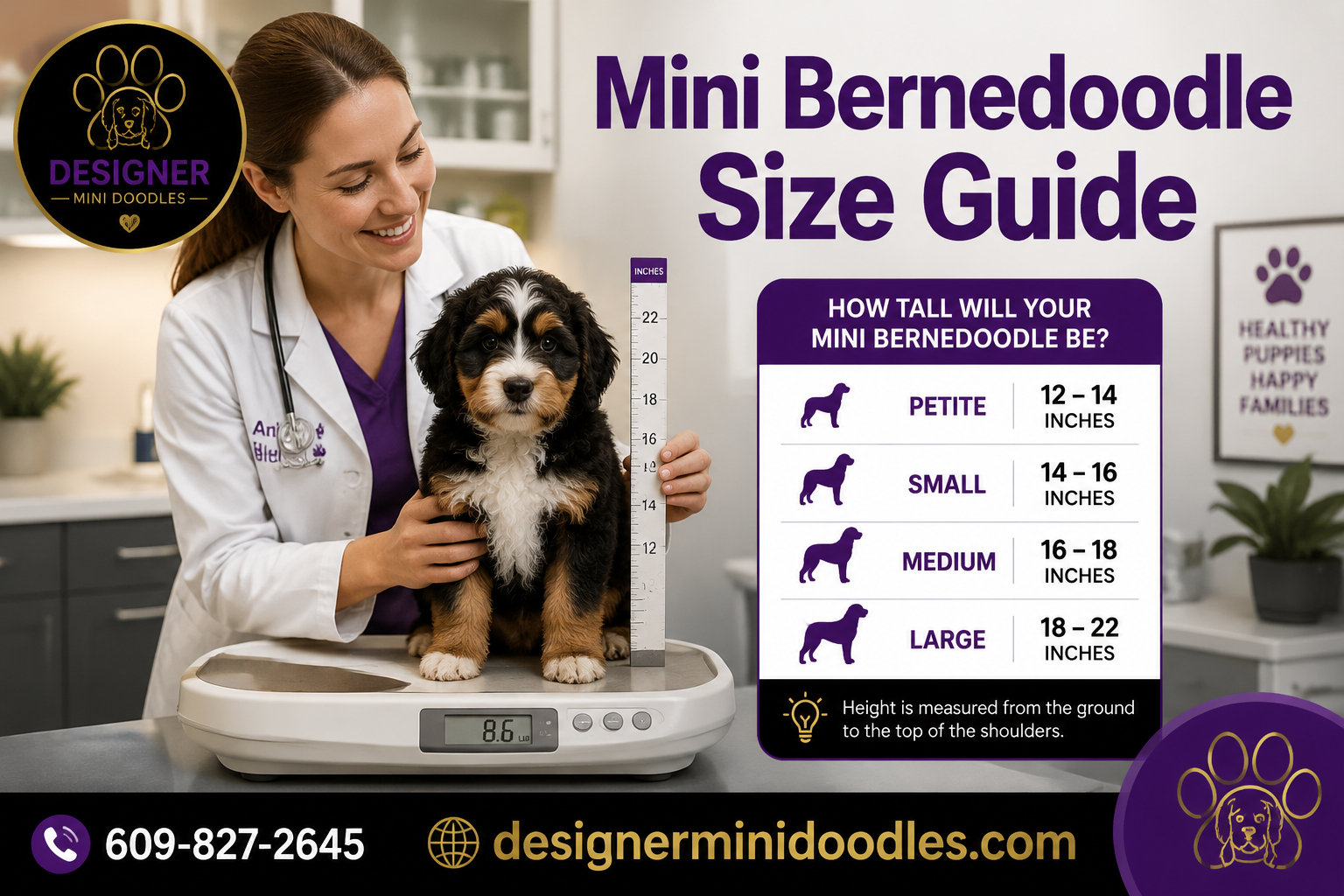
- Fully grown mini Bernedoodles stand 18–22 inches tall and weigh 25–49 pounds, fitting well in Dunedin homes and condos.
- F1B mini Bernedoodles shed significantly less than F1s, making them a better choice for allergy-sensitive households.
- Annual care costs (food, vet, grooming) run approximately $2,000–$3,500 per year.
- A reputable breeder will provide OFA or PennHIP health clearances, a written health guarantee, and proof of genetic testing on parent dogs.
- Mini Bernedoodles are excellent with children and other pets when properly socialized from an early age.
- Professional nanny delivery services allow Dunedin buyers to purchase from top breeders anywhere in the country.
- First-time dog owners do well with mini Bernedoodles, though consistent training from day one is essential.
How Much Do Mini Bernedoodles Cost in Dunedin?
Mini Bernedoodles for sale in Dunedin generally cost between $3,000 and $5,500 in 2026. The price depends on the puppy’s generation (F1, F1B, or multigen), coat color and pattern, and the breeder’s investment in health testing.
Here’s what drives the price range:
| Factor | Lower Range ($3,000–$3,800) | Higher Range ($4,200–$5,500) |
|---|---|---|
| Generation | F1 | F1B or multigen |
| Coat color | Traditional tricolor | Merle, phantom, or rare patterns |
| Health testing | Basic vet check | Full OFA, PennHIP, genetic panel |
| Breeder credentials | Hobby breeder | Program with animal biologist on staff |
| Included extras | Vaccinations only | Microchip, spay/neuter, starter kit |
Be cautious of puppies priced under $2,000. That often signals a puppy mill or a breeder cutting corners on health clearances. At Designer Mini Doodles, our breeding program includes a real animal biologist on site who oversees every pairing, health protocol, and puppy development milestone. That level of expertise is reflected in the price, but it also means fewer vet bills and heartbreak down the road.
Common mistake: Comparing breeder prices to pet store prices without factoring in health guarantees. A $1,500 “bargain” puppy with no genetic testing can cost $10,000+ in orthopedic or cardiac vet bills within two years.
How Big Do Mini Bernedoodles Get When Fully Grown?
A fully grown mini Bernedoodle typically stands 18–22 inches at the shoulder and weighs 25–49 pounds. They reach their adult height by about 12 months and fill out to their final weight by 14–18 months.
Several factors affect final size:
- Parent size: A smaller Miniature Poodle parent produces smaller offspring.
- Generation: F1B minis (backcrossed to a Miniature Poodle) tend to be slightly smaller than F1s.
- Sex: Males usually outweigh females by 5–10 pounds.
- Nutrition: Overfeeding during growth can lead to excess weight, not a larger frame.
This size range works well for Dunedin living. Whether you’re in a waterfront condo near the Dunedin Causeway or a single-family home with a yard, a mini Bernedoodle won’t overwhelm your space. For a deeper look at adult sizing, check out our guide on mini Bernedoodle full grown size.
Choose a mini Bernedoodle if you want a dog big enough for hikes and beach days but compact enough for apartment or condo life. Choose a standard Bernedoodle if you want a 70–90 pound dog and have a large yard.
Are Mini Bernedoodles Good With Kids and Other Pets?
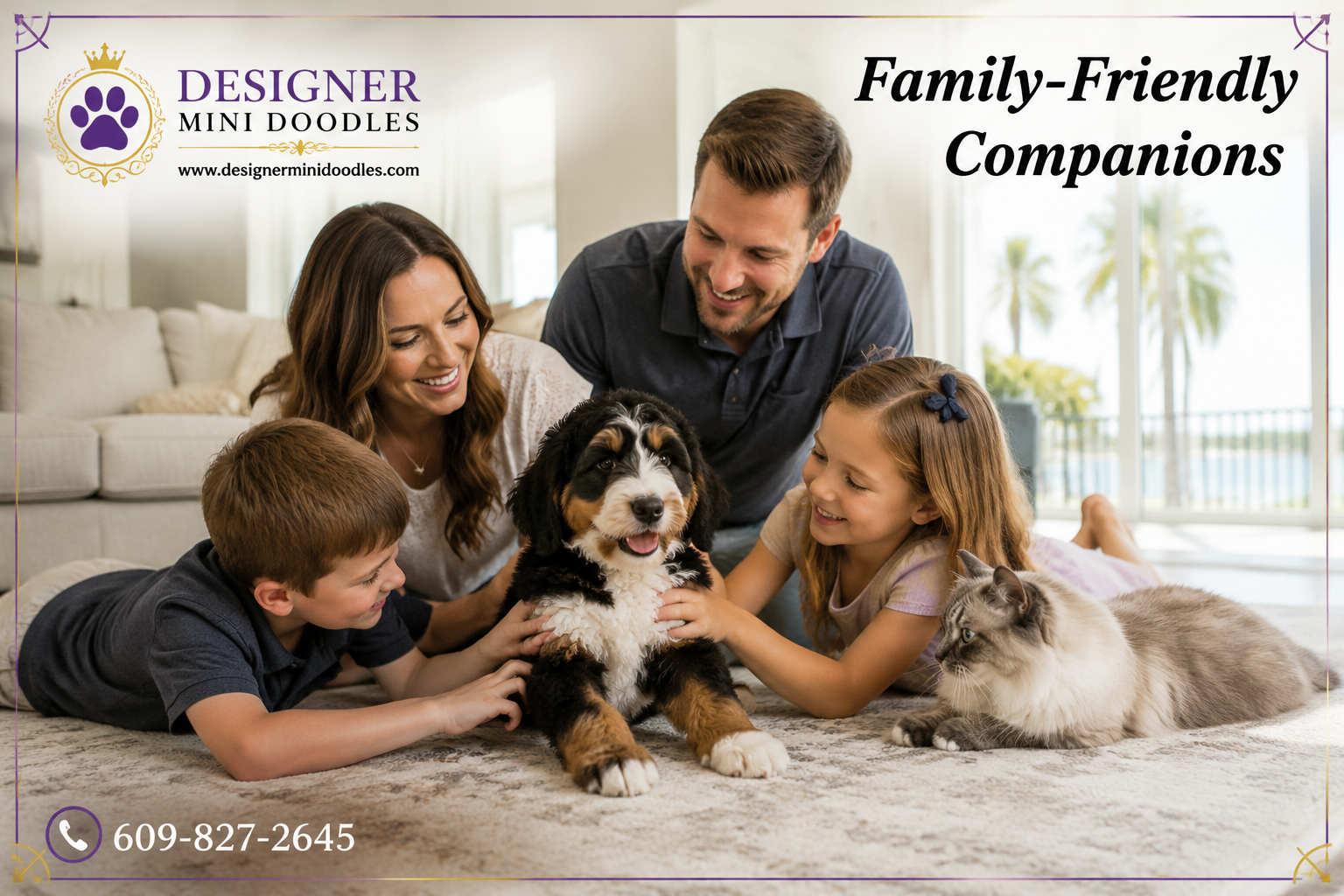
Yes. Mini Bernedoodles are widely regarded as one of the most family-friendly designer breeds available. They inherit the Bernese Mountain Dog’s gentle, patient nature and the Poodle’s intelligence and eagerness to please.
With children:
- Their medium size means they’re sturdy enough to handle toddler energy without being so large they knock small kids over.
- They tend to be calm indoors and playful outdoors, matching the rhythm of a family household.
- Early socialization (exposing the puppy to children, sounds, and handling between 3–16 weeks) makes a significant difference.
With other pets:
- Mini Bernedoodles generally coexist well with cats, other dogs, and even smaller animals when introduced properly.
- Their prey drive is low compared to terrier or hound breeds.
- Supervised introductions during the first two weeks in a new home set the tone for long-term harmony.
Edge case: A mini Bernedoodle that hasn’t been socialized before 16 weeks may be fearful or reactive around unfamiliar animals. Always ask your breeder what socialization protocols they follow. Our program at Designer Mini Doodles begins structured socialization at three weeks of age, well before puppies go to their new homes.
What Health Problems Do Mini Bernedoodles Have?
Mini Bernedoodles are generally healthy dogs with a lifespan of 12–15 years, but they can inherit conditions from both parent breeds. Responsible breeders test for these before breeding.
Common health concerns include:
- Hip and elbow dysplasia — inherited from the Bernese Mountain Dog side. OFA or PennHIP screening of parents reduces risk.
- Progressive retinal atrophy (PRA) — a genetic eye condition. DNA testing identifies carriers.
- Von Willebrand’s disease — a blood clotting disorder more common in Poodles. Genetic testing is available.
- Degenerative myelopathy — a spinal cord disease. DNA panels can identify at-risk pairings.
- Allergies and skin issues — some mini Bernedoodles develop food or environmental allergies, especially in Florida’s humid climate.
- Bloat (gastric dilatation-volvulus) — less common in minis than standards, but still possible. Feeding smaller, more frequent meals helps prevent it.
What to ask your breeder: Request copies of OFA certifications, genetic panel results (Embark or Paw Print Genetics), and cardiac and ophthalmologist clearances for both parents. A breeder who can’t or won’t provide these is a red flag. Our breeding program uses comprehensive genetic panels overseen by our on-staff animal biologist to minimize the risk of inherited disease.
What’s the Difference Between F1 and F1B Mini Bernedoodles?
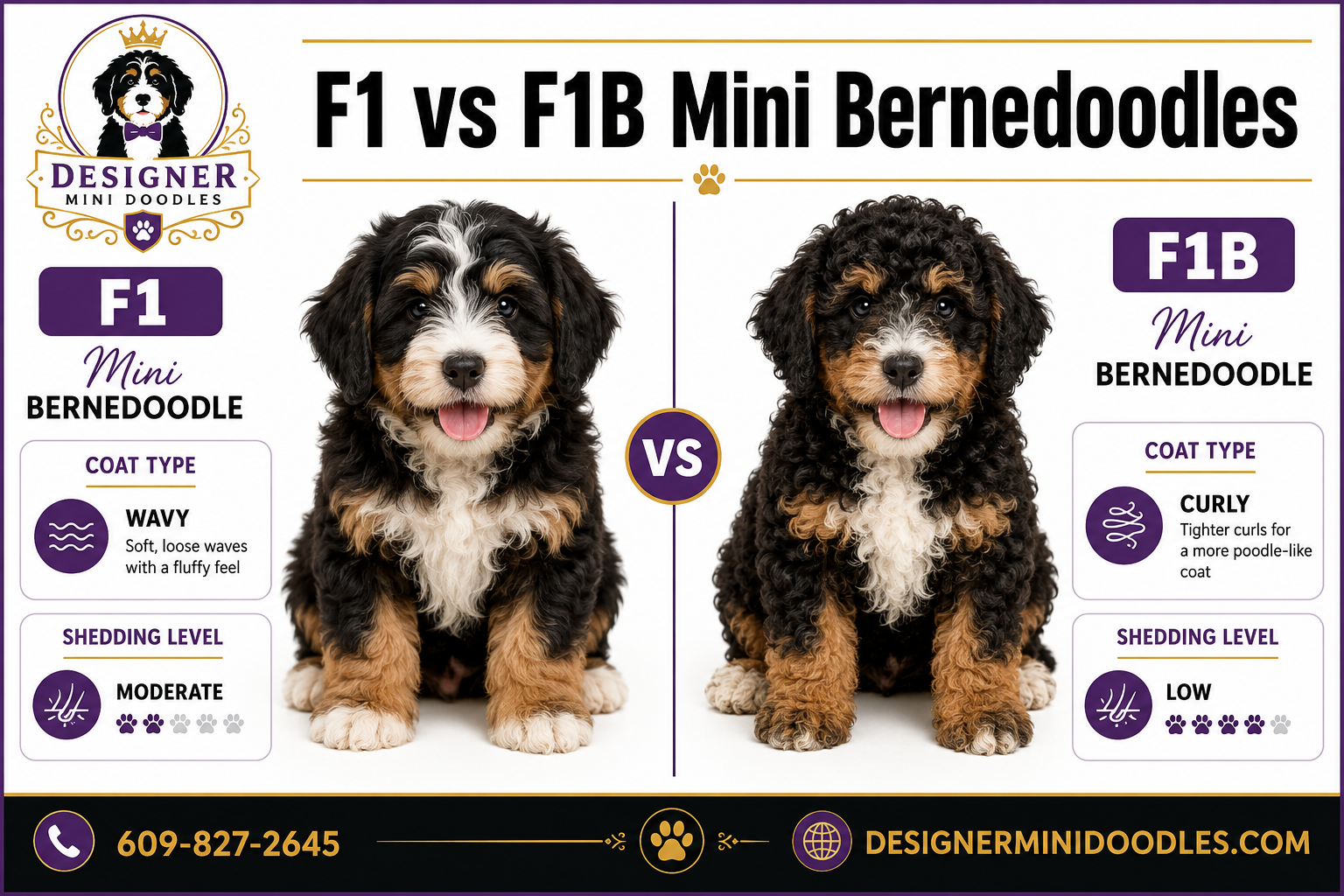
An F1 mini Bernedoodle is a first-generation cross (50% Bernese Mountain Dog, 50% Miniature Poodle). An F1B is a backcross, typically an F1 mini Bernedoodle bred back to a Miniature Poodle, resulting in a 75% Poodle and 25% Bernese mix.
| Trait | F1 Mini Bernedoodle | F1B Mini Bernedoodle |
|---|---|---|
| Coat type | Wavy to slightly curly | Curly to very curly |
| Shedding | Low to moderate | Very low to minimal |
| Allergy friendliness | Good | Better |
| Size predictability | Moderate | Higher |
| Bernese appearance | More Bernese features | More Poodle features |
| Price | $3,000–$4,500 | $3,500–$5,500 |
Choose F1 if you love the classic Bernese tricolor look and don’t mind occasional shedding. Choose F1B if anyone in your household has pet allergies or you want a coat that sheds as little as possible.
Do Mini Bernedoodles Shed a Lot?
No. Mini Bernedoodles are low-shedding dogs, though the amount varies by generation and individual coat type. F1B and multigen mini Bernedoodles with curly coats shed the least, while F1s with wavy coats may shed lightly, especially during seasonal changes.
Grooming requirements to manage shedding:
- Brush 3–4 times per week with a slicker brush to prevent matting.
- Professional grooming every 6–8 weeks (expect $60–$100 per session in the Dunedin area).
- Bathe only as needed — over-bathing strips natural oils and can worsen skin issues in Florida’s humidity.
No dog is truly 100% hypoallergenic. However, F1B mini Bernedoodles come close because their curly coats trap dander rather than releasing it into the air. If allergies are a serious concern, spend time with the specific puppy before committing.
How Much Does It Cost to Care for a Mini Bernedoodle Annually?
Plan for approximately $2,000–$3,500 per year in ongoing care costs for a mini Bernedoodle in Dunedin. Here’s a realistic breakdown:
- Food (high-quality kibble or raw diet): $600–$1,200/year
- Veterinary care (annual exam, preventatives): $400–$800/year
- Grooming (every 6–8 weeks): $480–$800/year
- Pet insurance: $300–$600/year
- Toys, treats, supplies: $200–$400/year
- Training classes or sessions: $150–$500 (first year especially)
Florida-specific cost note: Year-round flea, tick, and heartworm prevention is essential in Dunedin’s subtropical climate. Budget an extra $150–$250 annually for these preventatives compared to northern states where seasonal coverage may suffice.
Where Can I Find Reputable Mini Bernedoodle Breeders Near Dunedin?
The best way to find mini Bernedoodles for sale in Dunedin is to look for breeders who provide full health clearances, offer a written health guarantee, and welcome visits or video calls to meet the parent dogs.
Signs of a reputable breeder:
- Provides OFA, PennHIP, or equivalent certifications for both parents
- Conducts comprehensive genetic panels (Embark, Paw Print Genetics, or similar)
- Offers a 2-year (minimum) health guarantee
- Has a veterinarian or animal biologist involved in the program
- Socializes puppies from birth using protocols like Early Neurological Stimulation (ENS)
- Is transparent about waitlists and doesn’t always have puppies “available now”
Signs of a breeder to avoid:
- No health testing documentation
- Multiple breeds always available with no waitlist
- Won’t let you speak with previous buyers
- Pressures you to decide quickly
You don’t have to limit your search to the Tampa Bay area. At Designer Mini Doodles, we produce some of the best mini Bernedoodle puppies in the USA, and our professional nanny delivery service brings your puppy safely to Dunedin or anywhere in Florida. Our available mini Bernedoodle puppies for sale page shows current litters with photos, health records, and pricing. If you’re also exploring other doodle breeds, see our mini Goldendoodle puppies for sale in Florida.
Are Mini Bernedoodles Good for First-Time Dog Owners?
Yes, mini Bernedoodles are one of the better breeds for first-time owners. Their intelligence makes them responsive to training, their temperament is forgiving of beginner mistakes, and their size is manageable for someone who hasn’t handled a large dog before.
Why they work for beginners:
- Eager to please and food-motivated, which accelerates training
- Adaptable to different living situations (apartments, houses, condos)
- Not prone to aggression or extreme independence
- Social and affectionate without being overly clingy
Where first-time owners struggle:
- Underestimating grooming needs (matting happens fast with curly coats)
- Skipping early socialization, leading to fearfulness later
- Inconsistent training during the adolescent phase (6–12 months)
If you’re a first-time owner, invest in a basic obedience class during the first three months. It’s less about the dog learning commands and more about you learning how to communicate clearly. Our guide on training a mini Bernedoodle puppy covers the fundamentals.
What Should I Look for When Buying a Mini Bernedoodle Puppy?
When evaluating mini Bernedoodles for sale in Dunedin or anywhere else, focus on health documentation, breeder transparency, and the puppy’s early socialization rather than just coat color or price.
Your pre-purchase checklist:
- Health clearances — Confirm OFA hips/elbows and genetic panel results for both parents.
- Health guarantee — Minimum two years covering genetic conditions.
- Vaccination records — Puppy should have age-appropriate vaccines (see vaccination section below).
- Socialization history — Ask what sounds, surfaces, people, and animals the puppy has been exposed to.
- Temperament assessment — Reputable breeders match puppies to families based on energy level and personality, not just appearance.
- Contract clarity — Read the purchase agreement carefully. Understand spay/neuter requirements, return policies, and what the guarantee covers.
- References — Ask for contact information of 2–3 previous buyers.
Common mistake: Choosing a puppy based solely on photos. A beautiful merle coat means nothing if the puppy’s parents weren’t health tested. Always prioritize health over aesthetics.
Common Training Challenges With Mini Bernedoodles
Mini Bernedoodles are smart, but that intelligence can work against you if training isn’t consistent. The most common challenges owners face are stubbornness during adolescence, separation anxiety, and housebreaking in the early weeks.
Stubbornness (6–12 months):
Mini Bernedoodles may “forget” commands they knew perfectly at four months. This is normal adolescent behavior. Stay consistent, keep training sessions short (5–10 minutes), and use high-value treats.
Separation anxiety:
Because they bond deeply with their families, mini Bernedoodles can develop anxiety when left alone. Crate training from day one and gradually increasing alone time prevents this. Start with 5-minute absences and build up.
Housebreaking:
Small bladders mean more frequent bathroom breaks. Take your puppy out every 1–2 hours during the first month, immediately after meals, and right after naps. Our detailed guide on housebreaking a mini Bernedoodle puppy walks you through a proven schedule.
Leash pulling:
Their Bernese side gives them surprising strength for their size. Use a front-clip harness and reward loose-leash walking from the first walk.
How Do Mini Bernedoodles Compare to Standard Poodles?
Both are intelligent, trainable, and low-shedding, but they differ in size, temperament, and care needs.
| Trait | Mini Bernedoodle | Standard Poodle |
|---|---|---|
| Height | 18–22 inches | 22–27 inches |
| Weight | 25–49 lbs | 45–70 lbs |
| Temperament | Calm, affectionate, goofy | Alert, athletic, dignified |
| Shedding | Low (varies by generation) | Very low |
| Exercise needs | Moderate (30–60 min/day) | High (60–90 min/day) |
| Grooming | Every 6–8 weeks | Every 4–6 weeks |
| Trainability | High (can be stubborn) | Very high (eager to work) |
| Lifespan | 12–15 years | 12–15 years |
| Good for apartments | Yes | Possible but needs more space |
Choose a mini Bernedoodle if you want a calmer, more laid-back companion that’s content with moderate exercise. Choose a Standard Poodle if you want a highly athletic dog and are committed to more rigorous daily exercise and more frequent grooming.
For buyers interested in other compact doodle breeds, we also have information on mini and micro Goldendoodle breeders in Florida and even frenchies for sale if you’re exploring non-doodle options.

What Vaccinations Do Mini Bernedoodle Puppies Need?
Mini Bernedoodle puppies need a series of core vaccinations starting at 6–8 weeks of age, with boosters every 3–4 weeks until they’re about 16 weeks old.
Core vaccination schedule:
- 6–8 weeks: First DHPP (distemper, hepatitis, parainfluenza, parvovirus)
- 10–12 weeks: Second DHPP booster
- 14–16 weeks: Third DHPP booster + rabies vaccine
- 12–16 weeks: Leptospirosis (especially important in Florida due to wildlife exposure and standing water)
Non-core but recommended for Dunedin:
- Bordetella (kennel cough): Required by most boarding facilities and dog parks. Dunedin’s popular Honeymoon Island Dog Beach typically requires proof.
- Canine influenza (H3N2/H3N8): Increasingly recommended in Florida due to outbreaks in social settings.
- Lyme disease: Less critical in Florida than in the Northeast, but discuss with your vet if you travel.
After the puppy series: Annual or triennial boosters depending on your veterinarian’s protocol and local requirements. Pinellas County requires current rabies vaccination for all dogs.
A reputable breeder will send your puppy home with documentation of all vaccines administered and a recommended schedule for remaining shots. When you browse our mini Bernedoodles for sale, each listing includes the puppy’s current vaccination and deworming records.
Why Dunedin Is a Great City for Mini Bernedoodle Owners
Dunedin offers an unusually dog-friendly lifestyle for a city its size. The Pinellas Trail runs right through town, giving you miles of shaded walking paths. Honeymoon Island State Park has a designated dog beach. Downtown Dunedin’s outdoor cafes and breweries frequently welcome leashed dogs.
The mild winters mean year-round outdoor activity, and mini Bernedoodles handle Florida’s climate well as long as you avoid midday heat in summer. Early morning and evening walks keep them comfortable, and their moderate exercise needs (30–60 minutes daily) align well with the pace of life here.
Dunedin-specific tip: Register your dog with Pinellas County Animal Services within 30 days of bringing your puppy home. A county pet license costs $10–$20 annually and is required by local ordinance.
Nationwide Delivery: Getting Your Puppy to Dunedin Safely
You don’t have to settle for whatever breeder happens to be closest. Our professional nanny delivery service means your mini Bernedoodle puppies can travel safely from our facility to your doorstep in Dunedin or anywhere in the United States.
How nanny delivery works:
- A trained pet transport professional picks up your puppy from our facility.
- The puppy travels in a climate-controlled vehicle with regular stops for feeding, water, and bathroom breaks.
- The nanny provides updates and photos throughout the trip.
- Your puppy arrives at your door, typically within 24–48 hours depending on distance.
This is safer and less stressful than cargo shipping, and it means you can choose the best breeder for your family rather than the nearest one. Our breeding program is second to none, producing the best mini Bernedoodle puppies for sale anywhere in the USA, backed by a real animal biologist who oversees genetics, health protocols, and early development.
Frequently Asked Questions
How long do mini Bernedoodles live?
Mini Bernedoodles have an average lifespan of 12–15 years. Smaller minis on the lower end of the weight range may live slightly longer, consistent with the general trend of smaller dogs outliving larger ones.
Do mini Bernedoodles bark a lot?
They’re moderate barkers. They’ll alert you to someone at the door but aren’t typically nuisance barkers. Proper training and adequate exercise reduce excessive barking.
Can mini Bernedoodles handle Florida heat?
Yes, with precautions. Avoid outdoor exercise during peak heat (11 a.m.–3 p.m. in summer), provide fresh water at all times, and never leave them in a parked car. Their Poodle genetics give them better heat tolerance than purebred Bernese Mountain Dogs.
How often should I groom my mini Bernedoodle?
Professional grooming every 6–8 weeks, with at-home brushing 3–4 times per week. Curly coats mat quickly in Florida’s humidity if neglected.
Are mini Bernedoodles hypoallergenic?
No dog is truly hypoallergenic, but F1B and multigen mini Bernedoodles produce significantly less dander than most breeds. They’re a strong choice for mild to moderate allergy sufferers.
What colors do mini Bernedoodles come in?
Traditional tricolor (black, white, rust), phantom, merle, sable, black and white, and occasionally solid colors. Tricolor is the most popular and often the most expensive.
When can I take my mini Bernedoodle puppy outside?
Wait until two weeks after the final DHPP booster (around 18 weeks) for public dog parks and high-traffic areas. Controlled environments like your own yard are fine earlier.
Do mini Bernedoodles need a lot of exercise?
Moderate exercise — 30 to 60 minutes daily. A mix of walks, play sessions, and mental stimulation (puzzle toys, training) keeps them happy without requiring marathon runs.
Can I leave my mini Bernedoodle alone during work hours?
Adult mini Bernedoodles can handle 4–6 hours alone if crate trained properly. Puppies under six months should not be left alone for more than 2–3 hours. Consider a dog walker or doggy daycare for longer workdays.
What’s the best food for a mini Bernedoodle?
A high-quality kibble or balanced raw diet appropriate for medium-sized breeds. Look for named protein sources (chicken, beef, salmon) as the first ingredient. Avoid foods with corn, soy, or artificial preservatives as primary ingredients.
How soon can I bring a mini Bernedoodle puppy home?
Reputable breeders release puppies at 8–10 weeks of age. Earlier than 8 weeks is a red flag — puppies need that time with their mother and littermates for proper social development.
Conclusion
Finding the right mini Bernedoodle for sale in Dunedin comes down to three things: choosing a reputable breeder with verified health testing, understanding the generation and coat type that fits your lifestyle, and preparing your home and budget for a 12–15 year commitment.
Your next steps:
- Browse our available mini Bernedoodle puppies for sale to see current litters with full health documentation.
- Contact us at 609-827-2645 to ask about upcoming litters, health clearances, or our nanny delivery service to Dunedin.
- Start puppy-proofing your home and find a veterinarian in the Dunedin/Pinellas County area who has experience with doodle breeds.
- Invest in a basic puppy training class — your future self will thank you.
Whether you’re a first-time dog owner in a Dunedin condo or a growing family with a backyard, a mini Bernedoodle from a responsible breeding program can be one of the best decisions you make. Do your homework, ask the tough questions, and don’t rush the process. The right puppy is worth the wait.
- Display 9 Products per page